
Edible
Winter Savory
Satureja montana
Also known as Mountain savory
How to grow winter savory, Satureja montana. The evergreen savory for winter picking, pruning it without killing it, and why it needs sharper drainage than almost anything else in the herb bed.
At a glance
- Difficulty
- Easy
- Water
- Almost never once established
- Light
- Full sun
- Temperature
- Hardy to about -15 deg C in dry ground
- Hardiness
- USDA 5-9, RHS H5, hardy to -15 C
- Type
- Hardy evergreen sub-shrub
- Height
- 20-40 cm
- Native to
- southern Europe
- Best month
- June and November in the Northern Hemisphere, December and May in the Southern Hemisphere
A perennial sub-shrub rather than an annual, evergreen enough to pick through winter, and stronger and more resinous than summer savory. Winter wet is what kills it. Give it the same sharp drainage a thyme wants and it lasts a decade.
Hardiness zones describe winter cold alone. Summer heat, humidity, rainfall and the length of the growing season decide as much, so treat the range as the outer limit rather than as a recommendation.
Every month named in this guide is for the temperate Northern Hemisphere. If you garden in the Southern Hemisphere, shift each one by six months, so June becomes December. Closer to the equator the wet and dry seasons matter more than the calendar, and the shift stops being a useful guide.
Not known to be toxic
- Safe to eat
- Leaves and flowering shoots
Non-toxic. Winter savory is a culinary herb and appears on neither the RHS list of potentially harmful garden plants nor the ASPCA list of plants toxic to cats, dogs and horses. It is eaten freely across southern Europe. The distilled oil is a separate product and a much stronger one, being high in carvacrol and thymol, and it irritates skin and mucous membranes undiluted. Do not give the oil to animals, and do not treat it as interchangeable with the herb.
Sources: RHS potentially harmful garden plants, ASPCA toxic and non-toxic plants
About
Winter savory is the savory that stays. Where summer savory is an annual pulled up in October, this is a hardy evergreen sub-shrub that gives you leaf in January, which is a short list of herbs in a temperate garden.
The flavour is stronger, more resinous and more peppery than summer savory, and it holds up in long cooking. It goes into bean dishes, sausages, pates and anything rich enough to want cutting through.
The plant asks for one thing and asks for it firmly. Sharp drainage. It comes from limestone crags in the Balkans and southern France, it lives on next to nothing, and it dies quickly in cold wet temperate soil. A gravel bed, a raised bed or a wall top is where it belongs.
Appearance and character
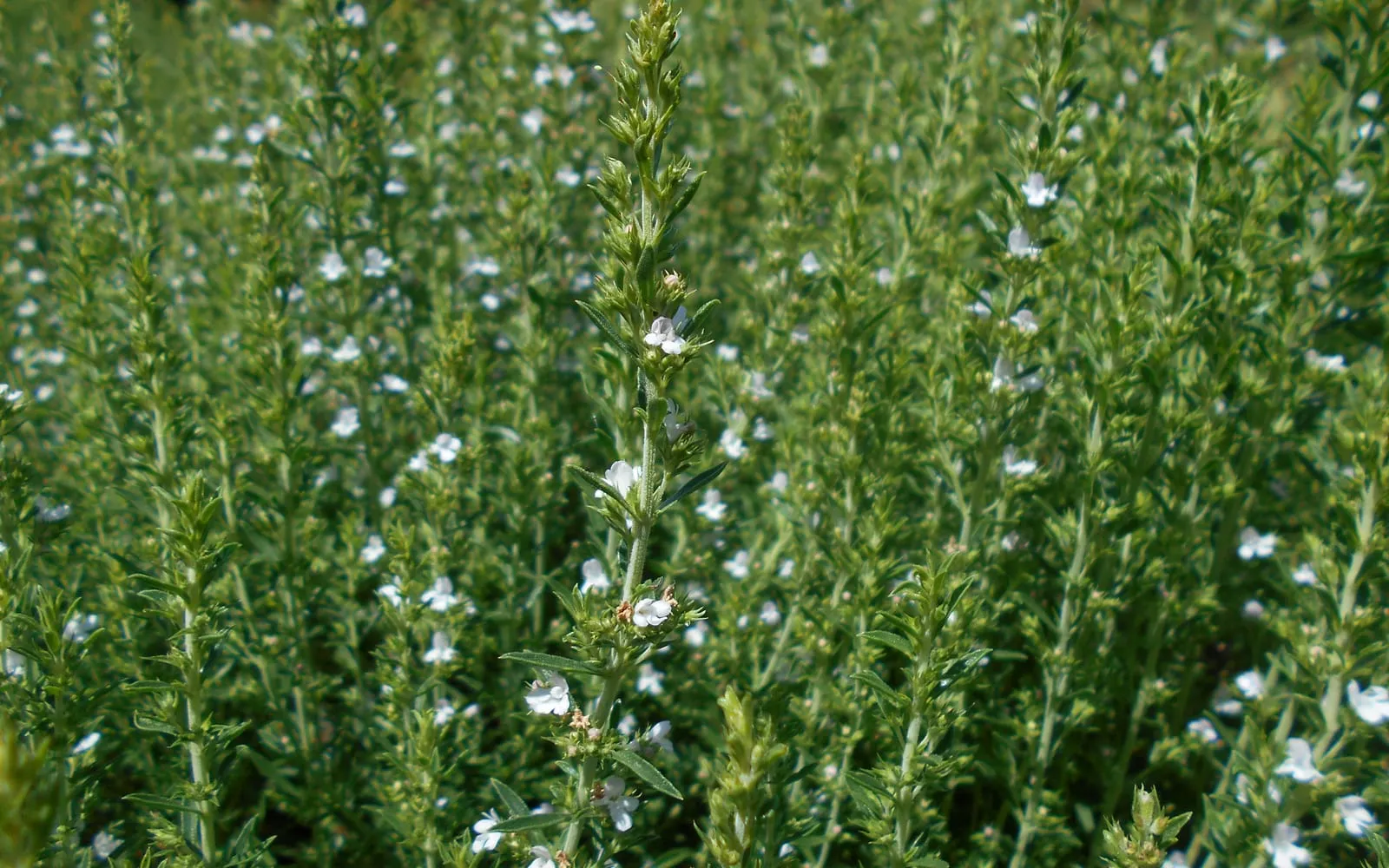
A low dense sub-shrub, 20 to 40 cm high and often wider, woody at the base with a mass of fine twiggy stems above.
Leaves are small, narrow, stiff, pointed and leathery, dark glossy green, and they stay on the plant all winter. They are noticeably firmer than summer savory’s soft leaf.
Flowers open from July to October, small and white, sometimes flushed pink, carried in loose spikes along the upper stems. Bees work them hard, and the long flowering season is part of the plant’s value.
Stems are square, going brown and woody from the second year.
The scent is powerful. A brushed plant on a hot day scents the whole bed, and crushed leaves smell of thyme with a hard peppery edge.
The plant makes a tidy evergreen dome that holds its shape, which suits the front of a gravel bed or a dry wall.
Where it is from
Winter savory is native to southern Europe and north Africa, from Spain through southern France, Italy and the Balkans, on dry limestone rock and stony hillsides.
It has been in cultivation since antiquity. The Romans grew both savories, made a vinegar sauce with them and used savory before pepper was a common commodity.
It arrived in Britain early enough that Tudor gardening books list it among the standard kitchen herbs, and Gerard describes it as growing in gardens in the 1590s.
Continental Europe kept using it while Britain largely forgot it. It remains standard in Provencal cooking, in the herb mixes of southern France, and in Balkan and Bulgarian food.
The oil is extracted commercially for flavouring and for its carvacrol content, which is why the species turns up in industrial contexts well outside the kitchen.
How it grows
Buy a plant or take cuttings. Seed is slow and variable, though it does work if you are patient: surface sow in spring at 18 deg C and expect three weeks to germinate.
Take semi-ripe cuttings in July. They root readily in gritty compost and give you replacements for a plant going woody.
Plant in spring rather than autumn, so the roots establish before its first winter. Autumn planting into cold wet ground is a common way to lose one.
Choose the driest, sunniest, sharpest-drained spot you have. A raised bed, a gravel garden, a south-facing bank or the top of a dry wall all suit it better than a herb border.
Space at 30 cm. It spreads wider than it grows tall.
Cut back by a third in spring, once new growth shows, and trim again lightly after the main flush of flower. Cutting into old bare wood usually kills the stem, so keep the pruning within green growth.
Harvest through the year, taking small amounts in winter and cutting properly from June to September.
Replace the plant every five or six years, or sooner if it goes bare in the middle.
Through the seasons
Winter is when the plant earns its place. It holds its leaves and you can pick it in January. Keep the crown clear of fallen leaves and any mulch, because anything lying wet against the base is what kills it.
Spring brings new growth from April. Cut back by a third now, taking out dead wood at the same time.
Early summer is when the plant fills out. Take cuttings in July.
Midsummer to autumn is a long flowering season, from July into October, and the plant is covered in bees throughout.
Autumn needs nothing beyond keeping leaf litter off the crown. Do not cut it back now, since the old growth shelters the base through winter.
Care difficulty
Easy in the right place and impossible in the wrong one, and the right place is defined entirely by drainage.
Winter wet kills it. The plant survives -15 deg C on dry stony ground and dies at -2 deg C sitting in wet clay. Grit, gravel, a raised bed or a pot is the answer, and improving a heavy border rarely works well enough.
Pruning is the one technique to learn. Prune in spring into green growth and never into bare old wood, because these Mediterranean sub-shrubs do not reliably break from it. That rule covers lavender, rosemary and sage as well.
Neglect suits it. No feeding, no watering once established, no staking and no winter protection.
Age is the eventual problem. After five or six years the base is bare and the growth is thin. Take cuttings before that happens rather than after.
Watering
Water weekly through the first summer after planting, then stop.
An established plant needs nothing in an ordinary year. It is drought tolerant to a degree that surprises people used to soft herbs.
Water in a genuine long drought if the plant is on a wall top or in a shallow raised bed, where the root run is small.
Water a container weekly in July and August, letting it dry out between waterings. Terracotta is far better than plastic for it.
Never let it stand in water and never mulch it with anything moisture-holding. Gravel is the right surface mulch.
Keep it dry from September onwards. A plant going into winter with wet roots is the plant that dies in February.
Warning signs, diseases and pests
Root and crown rot is the main killer. The plant blackens at the base, fails to shoot in spring, or dies suddenly in a wet winter. There is no cure. Plant the replacement somewhere sharper.
Powdery mildew whitens the leaves of a crowded plant in still humid weather. Thin the stems and improve airflow.
Aphids appear on the soft spring growth. Rub them off.
Bare woody stems with a tuft of green at the tip mean the plant is old or was never trimmed. Cut into green growth in spring; if there is none low on the stem, replace the plant.
A stem cut into old wood that then dies has not been diseased. That is the plant refusing to break from bare wood, which is normal for the family.
Sparse yellow growth on rich damp ground means the soil is too good for it.
A plant lost in February that looked fine in December was rotting all along.
Growing environment
Full sun and sharp drainage. Every other consideration is secondary.
Poor stony soil, low in nutrients, ideally with grit or gravel worked through it. Rich ground gives you soft growth that rots.
Alkaline, around pH 7 to 8. It is a limestone plant and chalk suits it perfectly.
Raised beds, gravel gardens, dry stone walls and the gaps between paving are all good positions, and all of them beat a conventional herb border on clay.
A terracotta pot of gritty compost works well and can be tipped on its side or moved under an overhang for winter.
It companions naturally with lavender, thyme, rosemary and pot marjoram, which all want the same treatment and the same neglect.
Feeding
None. Winter savory grown lean lives longer, tastes stronger and holds a better shape than winter savory that has been fed.
Do not mulch with compost or manure. Beyond the nutrition, the material holds moisture against the crown, and crown rot is what kills these plants.
Use gravel or grit as a surface mulch instead. It keeps the base dry, reflects heat and suppresses weeds.
A container plant needs a weak balanced feed once in late spring, and nothing else.
Repot into fresh gritty compost every second or third spring rather than feeding an exhausted pot.
Troubleshooting
It died in the winter. Wet rather than cold, in almost every case. Replant in gravel, in a raised bed or in a pot.
I cut it back hard and the stems died. Cutting into old bare wood kills these plants. Prune only into green growth, and take cuttings each summer so you always have a young replacement.
The middle has gone bare. Age, or years without trimming. Trim by a third each spring from the start, and replace a plant that has already gone hollow.
Summer or winter savory for the kitchen? Summer savory has the finer flavour and the tender leaf. Winter savory is stronger and coarser, and it is the one you can pick in January.
It has not flowered. Too much shade or too much feeding. It flowers freely in poor soil and full sun.
The leaves look grey and dusty. Powdery mildew from crowded still conditions. Thin it out.
Can I grow it from seed? Yes, though slowly and with variable results. Cuttings in July are quicker and give you the plant you already have.