
Outdoor plant
Hawthorn
Crataegus monogyna
Also known as Quickthorn, May tree, Whitethorn
How to grow hawthorn, Crataegus monogyna. Planting a bare-root hedge, the trimming that thickens it, laying an old one, May blossom and the haws that follow.
At a glance
- Difficulty
- Easy
- Water
- Rarely once established
- Light
- Full sun to partial shade
- Temperature
- Extremely hardy, and it stands wind, salt and exposure
- Hardiness
- USDA 4-8, RHS H6, hardy to -30 C
- Type
- Deciduous shrub or small tree, living several hundred years
- Height
- 1-2 m as a hedge, and 8-15 m as a tree
- Native to
- Europe, North Africa and western Asia, including native Britain
- Best month
- October in the Northern Hemisphere, April in the Southern Hemisphere
Almost nothing stops it, and it takes wind, salt, drought, chalk and clay. That toughness is the reason it is a declared noxious weed in New Zealand, Victoria and Tasmania, and invasive through the American Pacific north-west and southern Chile, where birds carry the seed into pasture and native scrub. Fireblight kills whole branches wherever summers are warm and humid.
Hardiness zones describe winter cold alone. Summer heat, humidity, rainfall and the length of the growing season decide as much, so treat the range as the outer limit rather than as a recommendation.
Every month named in this guide is for the temperate Northern Hemisphere. If you garden in the Southern Hemisphere, shift each one by six months, so October becomes April. Closer to the equator the wet and dry seasons matter more than the calendar, and the shift stops being a useful guide.
Skin irritant
- Safe to eat
- The flesh of the ripe haws, and the young spring leaves
- Do not eat
- The seeds inside the haws
- Harm from
- Eating it and handling it
- Affects
- People, cats, dogs and horses
Hawthorn is a hedgerow food plant with two ordinary cautions. The flesh of the ripe haws is edible and is used for jellies, ketchups and country wines, and the young leaves in spring were eaten by children as bread and cheese. The seed inside each haw is a different matter. Like the pips of apples and the stones of plums, it contains cyanogenic glycosides, so the seeds should be strained out rather than crushed and eaten. Cook the fruit whole and sieve it, which is what every recipe does anyway. Swallowing a seed whole is harmless because it passes through intact. The second caution is physical and more likely to matter. Hawthorn thorns are hard, sharp and up to 2.5 cm long, they break off under the skin readily, and a fragment left in a joint can cause plant thorn synovitis, an inflammation that sometimes needs surgical removal. Wear thick gloves and eye protection when cutting a hedge, and take a deep thorn puncture near a joint seriously. Hawthorn is not listed by the ASPCA as toxic to cats or dogs, and horses grazing a hedge take no harm from the leaves, although large quantities of fruit will upset any animal's stomach.
Sources: RHS potentially harmful garden plants, ASPCA toxic and non-toxic plants
About
Hawthorn is the hedge plant of Britain. Something like 200,000 miles of it were planted during the parliamentary enclosures of the eighteenth and nineteenth centuries, and the old name quickthorn comes from quick meaning living, a hedge that grows rather than one that is built.
Nothing else does the job as well. It grows a foot or more a year on any soil, stands wind and salt and clay, makes a barrier no animal will push through, and supports more wildlife than almost any other native shrub.
For a garden it offers three seasons. Dense green from April, heavy white blossom in May with a strange heavy scent, and clusters of red haws through autumn that the birds work through until Christmas.
Appearance and character
A deciduous shrub or small tree, dense and thorny, kept at 1 to 2 m as a hedge and reaching 8 to 15 m as an old tree.
Thorns are the defining feature, sharp, woody and 1 to 2.5 cm long, carried along the stems and branches.
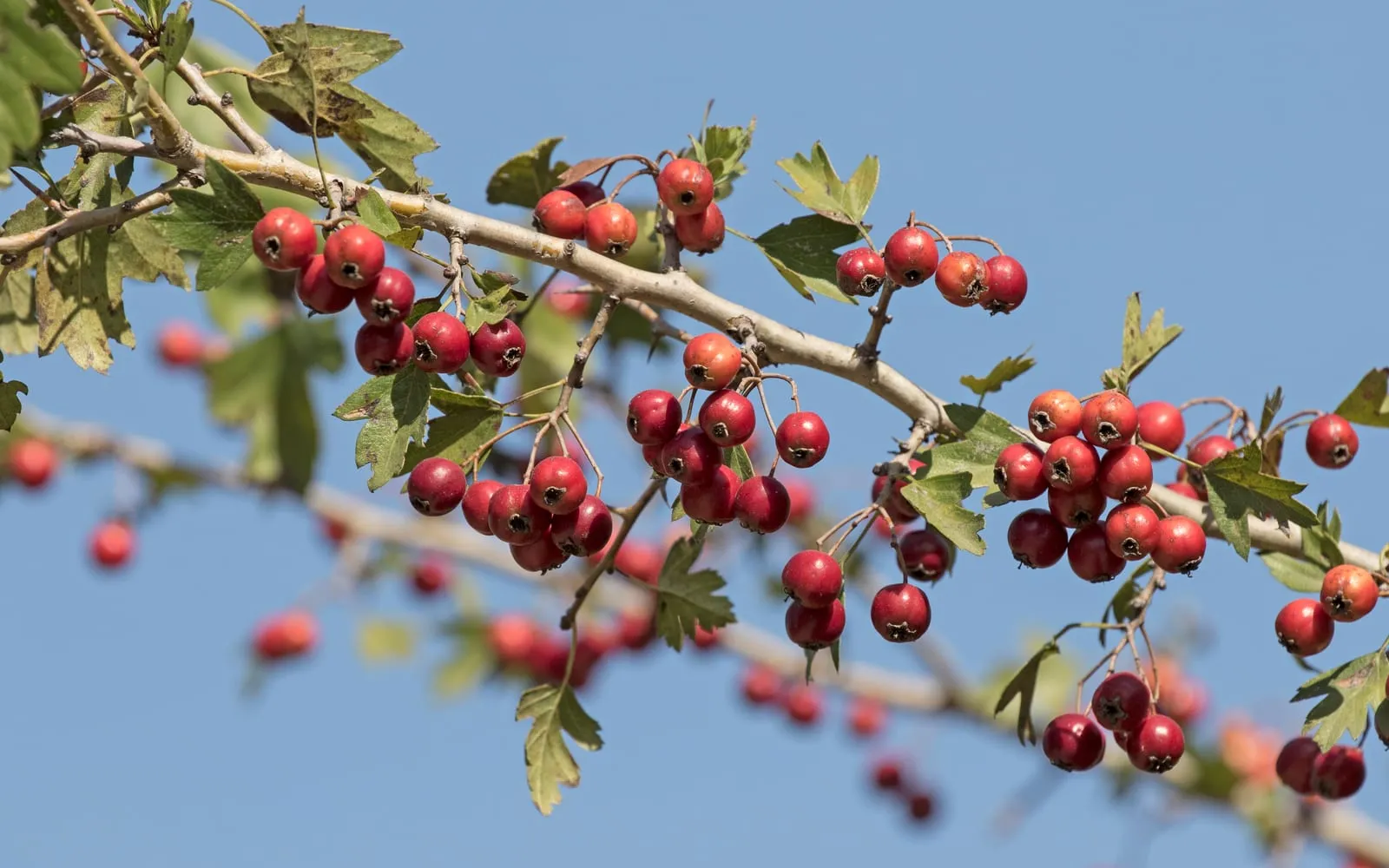
Leaves are small and deeply cut into three to seven lobes, glossy dark green, turning yellow and bronze in autumn.
Flowers open in May in dense flat clusters of small white blooms with pink-tipped stamens. The scent is heavy and slightly rank, since the plant is fly-pollinated and the flowers contain trimethylamine, the same compound found in decaying tissue. That smell is the origin of the superstition against bringing May blossom indoors.
Haws ripen from September, deep red, oval, about 1 cm long, each holding a single stone. The single stone is what distinguishes Crataegus monogyna from midland hawthorn, Crataegus laevigata, which holds two.
Bark is grey-brown, cracking into small squares on old trunks, and ancient hawthorns become gnarled and hollow.
Where it is from
Europe, North Africa and western Asia, and native throughout Britain, where it grows in hedgerows, scrub, woodland edges and on open hillsides.
Hawthorn is a pioneer. It colonises open grassland once grazing stops and is usually the first woody plant to appear, which is why it stands so much exposure.
Its cultural weight in Britain is considerable. The Glastonbury Thorn, a form that flowers at Christmas, was said to have grown from Joseph of Arimathea’s staff, and solitary hawthorns on hillsides were left uncut as fairy trees in Ireland well into modern times.
Old hedgerow hawthorns are used to date hedges, since the number of woody species in a thirty-yard stretch gives a rough century count under Hooper’s rule.
Individual trees live for several hundred years, and the oldest in Britain are thought to be over seven centuries old.
How it grows
Plant bare-root whips between November and March, which is far cheaper and establishes better than container-grown stock. Order in October for winter delivery.
For a hedge, plant a double staggered row 30 cm apart in rows 30 cm apart, giving about five plants per metre.
Cut every whip back hard to 15 to 20 cm after planting. This feels brutal and it is the single thing that produces a hedge thick at the base rather than a row of bare-legged sticks.
Trim the sides each year and let the height build gradually. Cutting the sides to a slight taper, wider at the bottom than the top, lets light reach the base and keeps it furnished.
Trim in late winter where you can, since a hedge cut in February keeps its haws through the winter for birds. Avoid cutting between March and August, when birds are nesting, which is a legal consideration as well as a courtesy.
For a specimen tree, grow it on a single stem, remove the lower branches over a few years, and let the head develop.
Lay an old thin hedge rather than replacing it. Partly cutting through each stem near the base and bending it over at an angle produces a dense living barrier that regrows from the base.
Pick haws in September and October, and leave plenty for the birds.
Through the seasons
Winter is planting, cutting and laying. Plant bare-root whips, trim established hedges, and lay old ones between November and March.
Spring brings the leaves in April and the blossom in May. Leave the hedge alone entirely, since birds are nesting in it.
Summer is growth. A hedge puts on 30 to 60 cm, and light trimming after August is acceptable once the nesting season has finished.
Autumn ripens the haws to red and turns the leaves bronze. Order bare-root stock now for winter planting.
Care difficulty
Easy. Hawthorn survives conditions that kill most garden plants, including heavy clay, chalk, drought, waterlogging, salt wind and hard frost.
The work is in the cutting rather than the growing. A hedge needs an annual trim, and the hard cut-back at planting decides whether it thickens properly.
Thorns make every job slower and more uncomfortable. Gloves and eye protection are worth taking seriously.
Fireblight is the only disease that threatens the plant, and it is uncommon in most gardens.
Beyond that it needs no feeding, no watering and no winter protection.
Watering
Water bare-root plants through their first summer after planting, which is when losses happen.
Established hawthorn needs no watering in a temperate climate.
Mulch a newly planted hedge to suppress grass and weeds, which compete far more seriously than drought does.
Do not water an established hedge to encourage growth. Trimming does that job better.
Warning signs, diseases and pests
Fireblight is the serious disease. It is caused by the bacterium Erwinia amylovora, and it kills shoots from the tip backwards, leaving blackened leaves that hang on as though scorched, often with a shepherd’s crook bend at the tip. Cut affected branches out at least 60 cm into healthy wood, disinfect the tools between cuts, and burn the prunings. It spreads in warm wet weather and can travel to apples and pears, so it matters more near an orchard.
Powdery mildew coats trimmed hedges in white in dry summers. It follows the soft regrowth after cutting and does little lasting harm.
Hawthorn leaf spot produces brown or purple blotches and early leaf fall in wet seasons, and needs no treatment.
Caterpillars strip hawthorn in some years, and the tree supports well over a hundred insect species. Defoliation looks alarming and the plant refoliates.
Bare gappy growth at the base of a hedge means it was never cut back hard at planting, or that it has been trimmed with vertical sides. Cut a taper, and consider laying the hedge to renew it.
Thorn punctures near a joint that stay painful and swollen need medical attention rather than patience, since a fragment left inside causes a persistent inflammation.
Honey fungus attacks hawthorn and is fatal.
Apple maggot fly is native to North America, and wild hawthorn is its original host, predating its documented shift onto orchard apple by roughly a century. A haw carrying brown internal trails and a faint surface dimple carries the same fly a nearby apple tree deals with, and it has never established outside North America.
Growing environment
Full sun to partial shade. A hedge thins in heavy shade and grows in it anyway.
Any soil. Hawthorn grows on heavy clay, thin chalk, sand, acid ground and waterlogged corners without complaint.
Exposure is no obstacle. It stands coastal salt wind, upland cold and open sites that defeat most hedging plants.
Allow 60 cm of width for a trimmed hedge and considerably more for an untrimmed one.
Keep it away from a boundary where the thorns will reach a path or a neighbour’s washing line.
It is one of the best wildlife plants available. The flowers feed insects, the haws feed thrushes and winter migrants, and the dense thorny growth is prime nesting cover.
Consider the ornamental forms for a small garden. ‘Paul’s Scarlet’ has double red flowers, and Crataegus persimilis ‘Prunifolia’ has good autumn colour and larger fruit.
Feeding
Hawthorn needs no feeding on ordinary soil.
Mulch a newly planted hedge with compost or bark in its first two springs, which does more good by suppressing grass than by feeding.
Avoid nitrogen fertiliser, which produces soft growth that mildews after trimming.
A weak hedge is usually competing with grass at its base or sitting in compacted ground rather than lacking nutrients.
Troubleshooting
My new hedge is bare at the bottom. The whips were probably not cut back hard at planting. Cut them to 15 to 20 cm in the first winter, and trim the sides to a taper so light reaches the base.
When can I cut it? Late winter is best, since the haws stay on for the birds. Avoid cutting between March and August when birds are nesting.
Blackened shoots that look scorched and hang on the tree. Fireblight. Cut back at least 60 cm into healthy wood, disinfect the tools between cuts, and burn the prunings.
Can I eat the haws? The flesh, yes, cooked into jelly or ketchup. Sieve out the seeds rather than crushing them, since they contain cyanogenic compounds like apple pips.
How many plants per metre for a hedge? Five, in a double staggered row 30 cm apart each way.
The hedge is old, thin and gappy. Lay it. Cut partway through each stem near the base, bend it over at an angle, and it regrows dense from the bottom.
Something has eaten all the leaves. Caterpillars, in a bad year. Hawthorn supports a great many insects and refoliates without lasting harm.
A thorn went in and the joint is still swollen. See a doctor. A thorn fragment left in a joint causes plant thorn synovitis and sometimes needs removing surgically.