
Outdoor plant
Christmas Rose
Helleborus niger
Also known as Hellebore, Black hellebore, Snow rose
How to grow the Christmas rose, Helleborus niger. Planting, soil, when to cut the old leaves, the diseases to watch for, and why it rarely flowers at Christmas.
At a glance
- Difficulty
- Moderate
- Water
- Rain is enough once it is established
- Light
- Partial shade, ideally under deciduous trees
- Temperature
- Fully hardy, down to about -20 deg C
- Hardiness
- USDA 4-9, RHS H7, hardy to -20 C
- Type
- Evergreen perennial
- Height
- 25-30 cm
- Native to
- The eastern Alps, The northern Apennines, The western Balkans
- Best month
- January and December in the Northern Hemisphere, July and June in the Southern Hemisphere
Cold is no obstacle and the flowers themselves take hard frost, drooping and standing up again as it lifts. Cut the old leaves off in midwinter as the buds appear, which removes the hellebore leaf spot carried on them and lets you see the flowers. It wants a cold winter to flower properly and does poorly in zone 9 and warmer.
Hardiness zones describe winter cold alone. Summer heat, humidity, rainfall and the length of the growing season decide as much, so treat the range as the outer limit rather than as a recommendation.
Every month named in this guide is for the temperate Northern Hemisphere. If you garden in the Southern Hemisphere, shift each one by six months, so January becomes July. Closer to the equator the wet and dry seasons matter more than the calendar, and the shift stops being a useful guide.
Toxic if eaten
- Do not eat
- Every part, and the roots most of all
- Harm from
- Eating it and handling it
- Affects
- People, cats, dogs and horses
Every part is poisonous and the roots are the worst of it. The sap carries protoanemonin, which blisters skin on contact, and the plant also contains bufadienolides, a class of compound that affects the heart in quantity. Serious poisoning is rare, because the sap is acrid enough that almost nobody swallows a second mouthful, but the RHS lists hellebore as harmful if eaten and a skin irritant, and the ASPCA reports drooling, abdominal pain, diarrhoea and colic in cats, dogs and horses. Wear gloves when you divide it or cut the old leaves away, and wash your hands afterwards. If a child or an animal has chewed any part of it, rinse the mouth and ring a doctor or vet rather than waiting to see what happens.
Sources: ASPCA, RHS potentially harmful garden plants
About
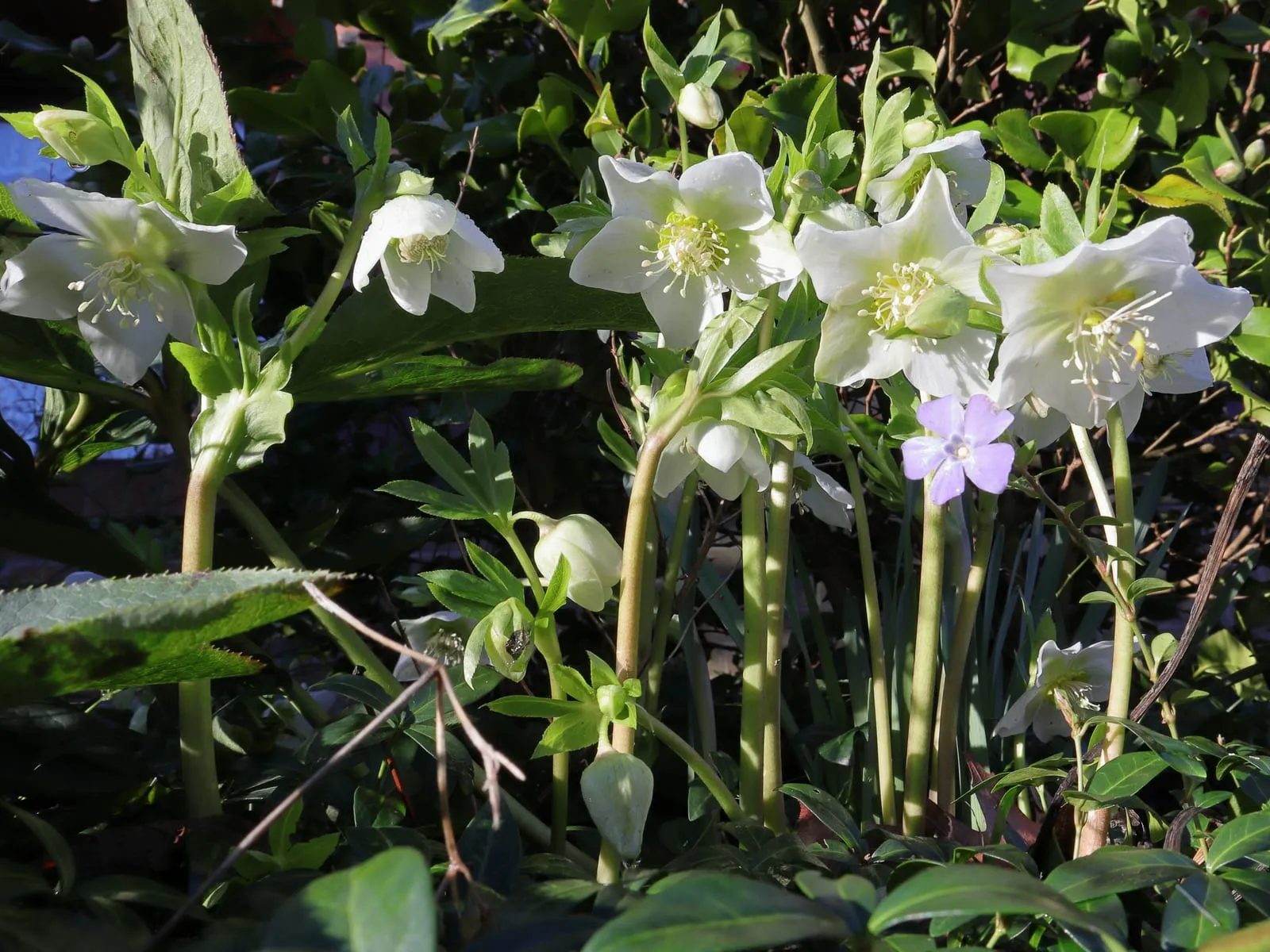
The Christmas rose flowers when nothing else will. Large white saucers open at ankle height in the dead of winter, on a plant that keeps its leathery leaves all year and asks very little once it has settled in.
Two of its names mislead. “Black hellebore” describes the rhizome, which is dark brown to black underground, and the name has been attached to this species since long before anyone worried about accuracy. Christmas is the bigger stretch. A plant in a garden border usually opens in January or February. Growers force the ones you see for sale in December, and named selections such as ‘Praecox’ are early, but a wild-type niger that flowers on Christmas Day has had a mild autumn and a bit of luck.
Most people searching for hellebores own a different plant. The purple, plum, speckled and slate-coloured ones that fill garden centres in February are Helleborus x hybridus, the Lenten rose. It is a related plant with a different constitution, and the section on cutting old leaves below is one of the places where the two want opposite treatment.
Appearance and character
The flower is the reason to grow it, and it is not built the way it looks. What you take for five white petals are sepals, the outer parts that on most plants form the green bud casing. The true petals sit in the centre, shrunk down to a ring of small green tubes that hold nectar.
That single piece of anatomy explains most of the plant’s behaviour. Sepals are tough and they photosynthesise, so they stay on the plant for two or three months rather than dropping after a week, and they turn green as the seed pods swell behind them. A gardener who deadheads at the first hint of green is removing the plant’s own seed-feeding machinery.
Flowers open outward or slightly nodding, 6-9 cm across, white and ageing through pink to green. The leaves are dark, leathery and divided into seven to nine leaflets on a stiff stalk, and the whole plant sits at 25-30 cm. There is no scent worth reporting.
Where it is from
The eastern Alps, the northern Apennines and the western Balkans, in open woodland and on limestone slopes at altitude.
Two things follow from that. It expects a proper cold winter and it will not be bothered by yours. It also grew up on limestone, which is why it does better on neutral to alkaline soil than on acid ground, and why gardeners on chalk find it easier than gardeners on peat.
How it grows
An evergreen perennial that grows from a thick rhizome and spreads slowly into a clump. Its year runs opposite to most of the garden. It flowers through winter and sets seed in spring, then takes its rest in high summer while everything around it is at full stretch.
It is slow. Give it two or three years to settle before judging it, and expect a plant that then carries on for twenty years or more in the same spot. Those fleshy roots hate being moved, so plant it where you intend to keep it and resist lifting and dividing it out of curiosity.
Seed drops around the parent and germinates in its own time, taking a cold spell to break dormancy. Seedlings take three or four years to flower.
Through the seasons
Winter is the show. Flowers open from December to February depending on the season, and mud splashed up by heavy rain marks the white sepals badly. A pane of glass on bricks over the clump, or a cloche, keeps them clean.
Spring is when the sepals turn green and the seed pods fill. Leave them unless you want to stop the plant self-seeding.
Summer is the quiet season and the one where it can be lost. The clump looks unremarkable and gets forgotten, so a young plant dries out under a tree where nothing reaches it.
Autumn is when you mulch. Leaf mould or garden compost spread around the crown, kept off the crown itself, replaces what the woodland floor would have given it.
Care difficulty
Moderate, and the difficulty is all in the establishment. Getting a hellebore through its first two years takes attention that an established one never needs again. The usual failures are planting it too deep, planting it in a dry spot under a greedy tree, and giving up on it during the year when it’s not happy and does nothing.
Plant with the crown level with the soil surface. A crown buried a couple of centimetres too low is the most common reason a healthy-looking plant refuses to flower.
Watering
Rain does the work once the plant has been in the ground two years. Before that, water it weekly through dry spells in its first two summers, which is exactly when a winter-flowering plant is easiest to ignore.
Watch for dry winters too. A hellebore flowering in a rain shadow, under the eaves of a house or beneath an evergreen, can go short of water in January while everything around it looks wet. Push a finger into the soil if it has not rained for a fortnight.
Heavy clay that sits wet all winter rots the roots. Fork in grit before planting rather than trying to fix it later.
Warning signs, diseases and pests
Hellebore leaf spot is the one you will meet. Dark brown to black blotches spread on the leaves and run into the flower stems, caused by the fungus Microsphaeropsis hellebori. It overwinters on old foliage, which gives you a straightforward control: cut the old leaves off and burn or bin them, do not compost them.
Hellebore black death is much worse and much rarer. Black streaks and rings follow the leaf veins, growth is stunted and distorted, and the plant never recovers. It is a virus spread by aphids, there is no treatment, and the only useful response is to dig up the whole plant, roots included, and destroy it. Keeping aphids down in spring is the only prevention available, so squash the colonies that appear on flower stems rather than leaving them.
Vine weevil grubs eat the roots of container-grown plants and the first sign is a plant that wilts and then lifts out of the pot with no roots left. Water on nematodes in spring or early autumn if you grow hellebores in pots.
Slugs and snails take the emerging flower buds in mild winters.
Growing environment
Partial shade suits it, and the ideal position is under deciduous trees or shrubs where it gets winter light while the branches are bare and shade once they leaf up. The north side of a wall works. Deep shade under conifers does not.
It is fully hardy and unbothered by frost down to about -20 deg C. Flowers that flop in a hard freeze usually stand back up when it thaws.
Soil matters more than anything else here. It wants ground that holds moisture through summer but drains in winter, ideally neutral to alkaline. On acid soil a handful of garden lime at planting helps. On heavy clay, add grit. On thin sand, add compost and expect to water more.
Feeding
Feed once, in late winter, with a balanced granular fertiliser scattered around the clump as the flower buds come up. Bone meal in autumn suits it as well, and supports the winter flowering that a plant fed only in spring has to fund from reserves.
Mulch with leaf mould or garden compost every autumn. That does more for a hellebore than fertiliser, because it rebuilds the leaf litter the plant evolved in and holds the summer moisture it needs.
Keep both the mulch and the feed off the crown itself, and do not fork them in. Disturbing those roots costs you more than the feed gives back.
Troubleshooting
No flowers. Usually one of three things. The plant is too young or recently moved and needs another year. The crown is buried too deep. Or it is in shade too heavy for it to build reserves over summer.
Black blotches on the leaves. Hellebore leaf spot. Cut off every affected leaf and destroy it, then remove the rest of the old foliage in late autumn.
Black streaks along the veins, distorted growth. Hellebore black death. There is no cure. Dig up and destroy the plant, and do not replant a hellebore in the same spot.
Flowers turning green. Normal, and a sign the plant is setting seed. Cut the stems off at the base if you want to stop it seeding around.
Flowers marked and muddy. Rain splash. A cloche or a pane of glass over the clump through the flowering weeks keeps them clean.
Should I cut the old leaves off? For the Lenten rose, Helleborus x hybridus, yes, all of them, in December or early January before the flower stems come up. For the Christmas rose, no. Its leaves sit lower and the flowers come up among them, so take off only what is damaged or diseased and leave the rest to feed the plant.
Wilting suddenly in a pot. Vine weevil grubs. Tip it out and check the roots.