
Outdoor plant
Hornbeam
Carpinus betulus
Also known as European hornbeam, Common hornbeam, Yoke elm
How to grow hornbeam, Carpinus betulus. The hedge that holds its leaves all winter and takes wet clay where beech fails, when to cut it, and how to tell the two apart.
At a glance
- Difficulty
- Easy
- Water
- Rarely once established
- Light
- Full sun to full shade, and it tolerates more shade than beech
- Temperature
- Fully hardy, to about -30 deg C
- Hardiness
- USDA 4-8, RHS H6, hardy to -30 C
- Type
- Deciduous tree, long lived and tolerant of hard cutting
- Height
- 20-30 m as a tree, and any height as a hedge
- Native to
- Europe and western Asia, and native to south-east England
- Best month
- August in the Northern Hemisphere, February in the Southern Hemisphere
It takes heavy wet clay that beech will not, which is the practical reason to choose between the two, and both hold dead leaves on a clipped hedge through winter. Heat and drought are tolerated better than by beech. American hornbeam, Carpinus caroliniana, is the native equivalent through the eastern United States and is hardier again.
Hardiness zones describe winter cold alone. Summer heat, humidity, rainfall and the length of the growing season decide as much, so treat the range as the outer limit rather than as a recommendation.
Every month named in this guide is for the temperate Northern Hemisphere. If you garden in the Southern Hemisphere, shift each one by six months, so August becomes February. Closer to the equator the wet and dry seasons matter more than the calendar, and the shift stops being a useful guide.
Not known to be toxic
Hornbeam is not listed by the RHS as a potentially harmful garden plant and is not recorded by the ASPCA as toxic to cats, dogs or horses. No part of it is a recognised hazard to people or animals, and it is a sound choice for a garden or a boundary used by children and pets. Historically the foliage was cut as fodder for cattle, which is one reason so many old hornbeams in Epping Forest and Hatfield Forest are pollards, and the seeds are eaten by hawfinches and other finches without harm. The nuts are technically edible and are small, hard and not worth the effort. Where a plant is unlisted by both sources rather than positively assessed, the correct reading is that no hazard has been recorded rather than that one has been ruled out, so there is no reason to encourage anybody to eat it. The practical caution attached to hornbeam is nothing to do with toxicity. The wood is the hardest and densest of any European tree, which is why it was used for cogs, butchers' blocks and mill gears, and it is correspondingly hard on saw blades and secateurs.
Sources: RHS potentially harmful garden plants, ASPCA toxic and non-toxic plants
About
Hornbeam is what to plant where you wanted beech and the ground is too wet.
The two make almost identical hedges. Both are deciduous, both hold onto their dead brown leaves through winter so the hedge stays opaque, both clip to a crisp face, and side by side most people cannot tell them apart at ten paces.
The difference is underground. Beech needs free drainage and sulks on heavy wet clay. Hornbeam is entirely happy there, and it also takes more shade and more cold.
That makes it the more useful of the two wherever the ground is heavy, and it is consistently the better answer for a boundary hedge on clay.
As a tree it is under-planted and worth more attention. It has a beautifully fluted grey trunk that looks like muscle, it stays a manageable size, and it is one of the best trees in Europe for hawfinches.
The wood is the hardest of any European tree, which is where the name comes from. Horn for hardness, beam being the old word for tree.
Appearance and character
A deciduous tree reaching 20 to 30 m, with a dense rounded crown, and endlessly manipulable as a hedge or a pleached screen.
The trunk is the most beautiful thing about it. Grey, smooth, and vertically fluted into sinuous ridges that look like twisted muscle or a bundle of cables.
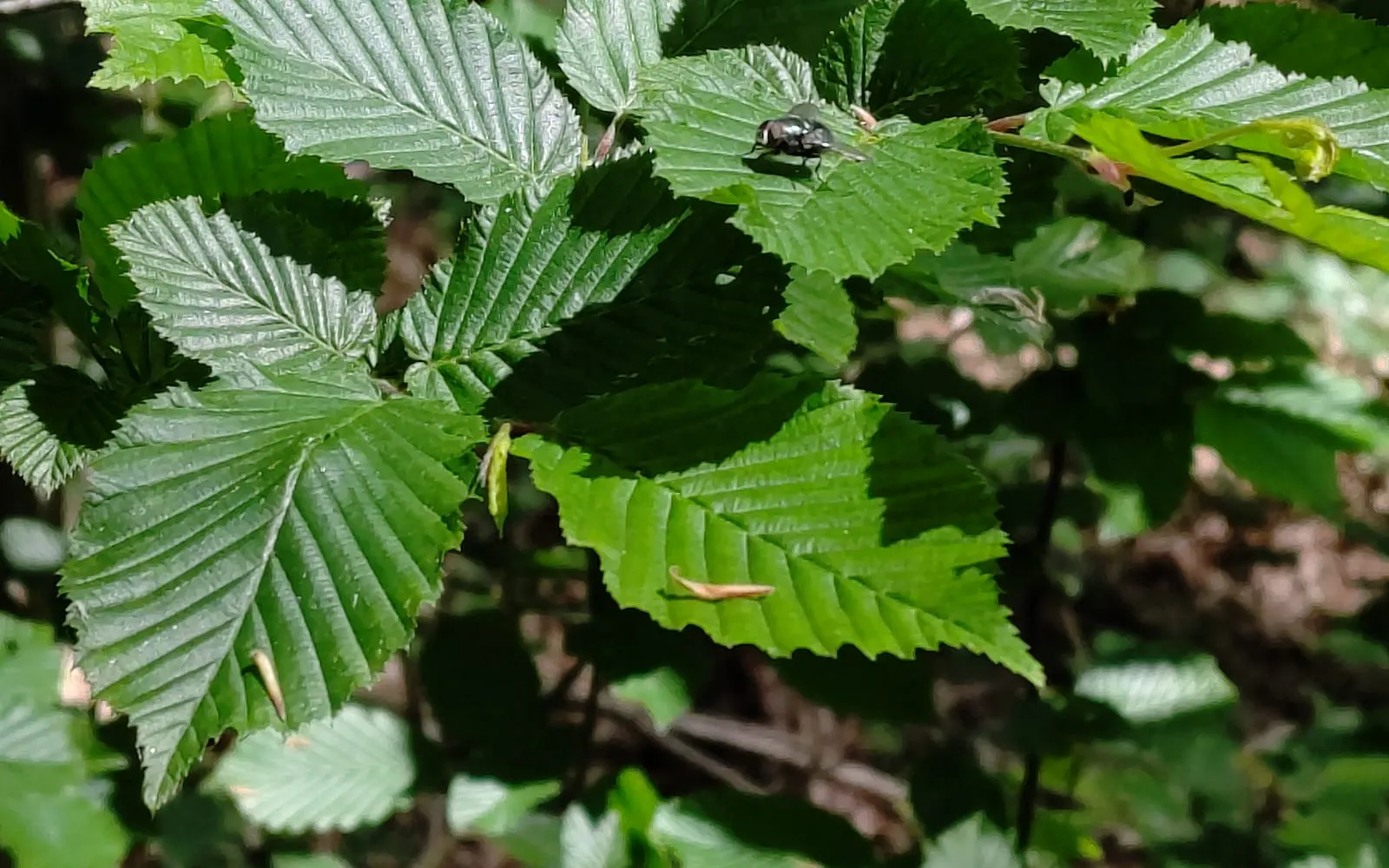
Leaves are oval with a pointed tip, 4 to 10 cm long, and the identification is in the edge and the veins. The margin is sharply doubly toothed, meaning large teeth with smaller teeth on them, and the parallel veins are strongly impressed so the leaf looks pleated or corrugated.
Beech, by contrast, has a wavy untoothed margin, a silky fringe of hairs when young, and a smoother, glossier surface.
Catkins appear in April with the leaves, greenish and hanging.
Fruits are distinctive. Each small nut sits at the base of a three-lobed papery green bract, and these hang in clusters through late summer, turning pale brown and spinning as they fall.
Autumn colour is a good clear yellow, turning to russet brown, and a clipped hedge holds those brown leaves until the new growth pushes them off in spring.
Where it is from
Europe and western Asia, and native to Britain in the south and east of England, particularly Essex, Hertfordshire, Kent and Sussex.
Epping Forest and Hatfield Forest hold internationally important stands of ancient hornbeam pollards, cut on rotation for centuries to produce firewood and charcoal.
It grows on any soil and is at its most useful on heavy wet clay, in shade, and in cold exposed positions.
The timber is exceptionally hard, dense and difficult to work, and it was used for gear teeth in windmills, butchers’ chopping blocks, ox yokes, piano actions and mallet heads. It burns hotter than almost any other firewood.
Its value to birds is specific. Hawfinches, which are scarce and declining in Britain, feed heavily on hornbeam seed, and the old pollard stands are among their strongholds.
How it grows
Plant bare-root whips between November and March for a hedge, which is far cheaper than container-grown stock.
For a hedge, plant a single row of 60 to 90 cm whips at 30 to 45 cm spacing, or a double staggered row for a thicker result.
Cut the whips back by about a third after planting, and trim the sides lightly in the first two years to build density low down.
Trim an established hedge once a year in late July or August. This is the timing that matters, because a hedge cut in late summer holds its brown leaves through winter, while one cut in spring or early summer produces soft regrowth that drops.
Cut the sides to a slight taper, wider at the base than the top, so light reaches the bottom and the hedge stays furnished.
Renovate an overgrown hedge by cutting one face hard back to the main stems in late winter, waiting a full season, then doing the other face. Hornbeam breaks readily from old wood.
For a tree, plant in autumn or winter, stake for two years, and remove competing leaders to keep a single stem.
Pleaching suits it exceptionally well, and hornbeam is the standard species for a raised hedge on clear stems.
Pollarding also works and produces a long-lived tree.
Through the seasons
Winter keeps the brown leaves on a clipped hedge, which is the whole reason to plant it. This is bare-root planting season and the time for hard renovation.
Spring breaks bud in April with fresh green leaves and hanging catkins, pushing last year’s brown leaves off.
Summer is growth, and the annual trim falls at the end of it in late July or August.
Autumn turns the foliage clear yellow then russet, and the winged seed clusters ripen and fall.
Care difficulty
Easy. Hornbeam is one of the most forgiving hedging and screening plants available.
It grows on any soil, takes sun or deep shade, tolerates cold and wind, and responds to hard cutting by regrowing.
The only thing to get right is the timing of the annual trim, and the penalty for getting it wrong is a hedge that goes bare in winter rather than a dead plant.
It is slower than beech in the first few years, so allow for that when comparing prices and expectations.
Watering
Water through the first summer after planting, particularly a bare-root hedge.
Established hornbeam needs no watering in a temperate climate.
It handles wet ground far better than beech and also tolerates dry summers once rooted.
Mulch a new hedge to suppress grass, which competes far more seriously than drought does.
Warning signs, diseases and pests
Hornbeam is remarkably trouble-free.
A hedge that drops its leaves in winter has almost always been cut at the wrong time. Move the annual trim to late July or August.
Bare gappy growth at the base means the whips were not cut back after planting, or the hedge has been trimmed with vertical sides. Cut a taper so light reaches the bottom.
Aphids and leaf miners produce sticky leaves and pale blotches respectively, and neither matters.
Coral spot appears as pink-orange pustules on dead and dying wood, usually following damage or stress. Cut affected wood out into clean growth.
Honey fungus attacks hornbeam and is fatal, showing as white fungal sheets under the bark at the base and sudden collapse.
Slow growth in the first two years is normal and not a fault. Hornbeam takes longer than beech to get going and then catches up.
Growing environment
Full sun to full shade. It is more shade-tolerant than beech and will make a respectable hedge on a north-facing boundary.
Any soil, and it is the right choice on heavy wet clay where beech fails. It also grows well on chalk.
Fully hardy to about -30 deg C, and tolerant of cold and exposure, including inland frost pockets.
For a hedge, allow 60 to 90 cm of width at maturity, and remember it can be kept to any height from 1 m to 5 m.
For a tree, allow 10 to 15 m of space.
It is one of the best plants for a formal clipped screen, a pleached avenue, a boundary hedge, or a windbreak on clay.
Its wildlife value is solid. The seed feeds hawfinches, greenfinches and tits, the dense growth gives nesting cover, and it supports a range of moth caterpillars.
Pair the guide with the beech guide here if you are choosing between the two, since the decision comes down to drainage.
Feeding
None needed on ordinary soil.
Mulch a newly planted hedge with compost for its first two springs, which helps by suppressing grass more than by feeding.
Avoid high-nitrogen feeds, which produce soft growth that is less likely to hold its winter leaves.
A weak hedge is nearly always competing with grass at its base or sitting in compacted ground rather than short of nutrients.
Troubleshooting
Is this hornbeam or beech? Look at the leaf edge. Hornbeam has sharp double teeth and deeply impressed pleated veins. Beech has a wavy untoothed margin, a smoother surface and a silky fringe when young. Hornbeam fruit hangs in clusters of papery three-lobed bracts, beech has spiky husks holding triangular nuts.
Which should I plant? Hornbeam on heavy wet clay, in shade, or in a cold exposed spot. Beech on free-draining soil where you prefer the slightly warmer brown of its winter leaves.
My hedge dropped all its leaves in winter. Cut at the wrong time. Trim once a year in late July or August and it will hold the brown leaves through to spring.
When do I cut it? Once a year, late July or August. Avoid cutting between March and August where birds are nesting in it, which in practice means late August.
Can I cut an overgrown hedge hard back? Yes. Take one face right back to the main stems in late winter, wait a full season, then do the other. Hornbeam breaks freely from old wood.
It is growing more slowly than my neighbour’s beech. Normal for the first two or three years. It catches up.
The bottom of the hedge is bare. Either it was not cut back after planting or the sides are being clipped vertically. Cut a taper so light reaches the base.
Is it safe for children and pets? Yes. It is not listed as harmful by the RHS and not recorded as toxic by the ASPCA.