
Disease
Fairy rings
Marasmius oreades and others
Also called Fairy ring, Fairy ring champignon, Lawn rings, Toadstool rings
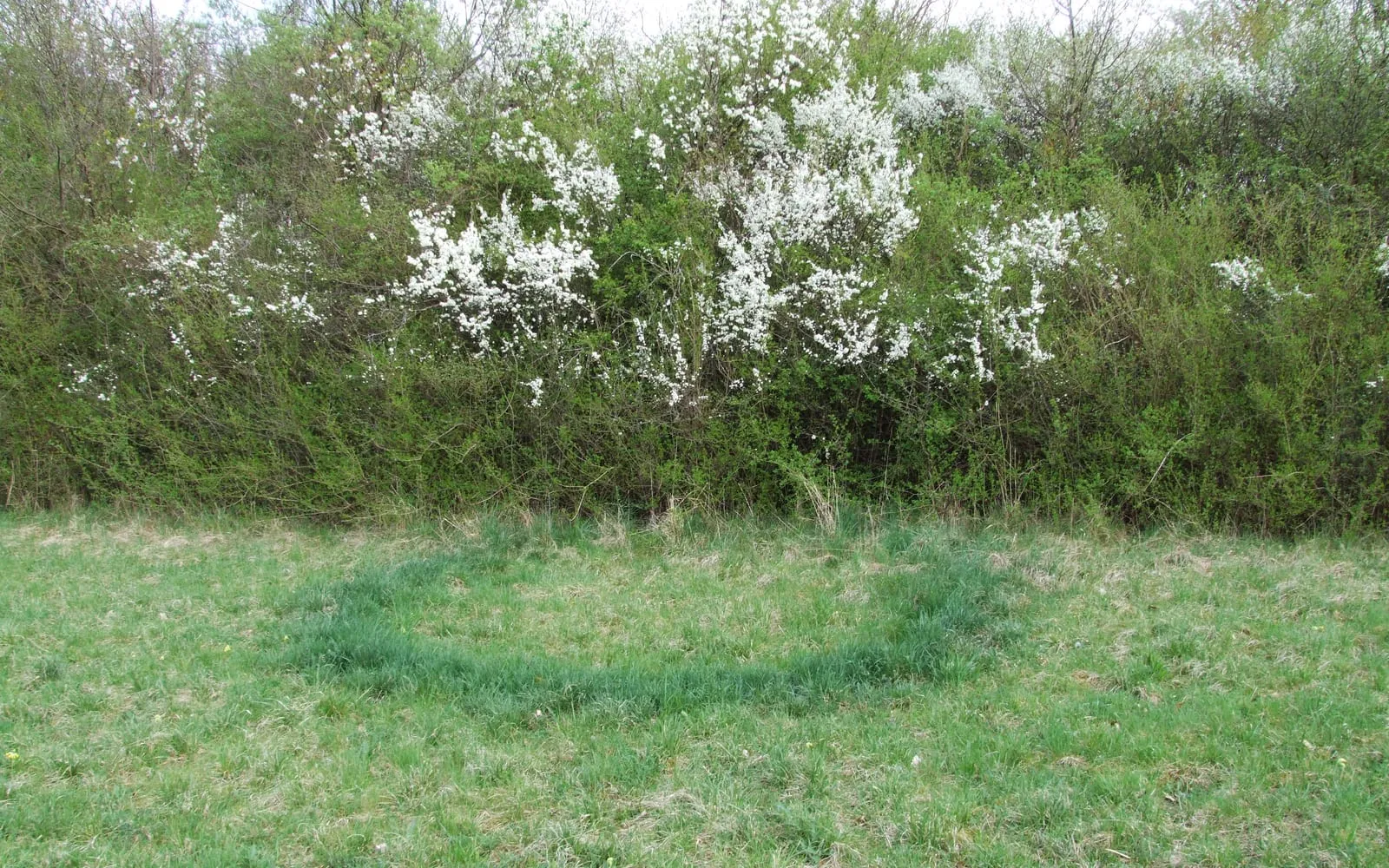
A ring of lush dark grass, a bare arc inside it, or a circle of toadstools in autumn. A fungus is working outward through the soil at about 30 cm a year, and the dead grass has died of drought rather than infection.
At a glance
- Type
- Disease
- Cause
- Fungus
- Severity
- Weakens the plant
- Affects
- Garden plants
- Active
- June to November
- Established in
- Worldwide
What you are seeing
- A ring or arc of grass noticeably darker green and growing faster than the rest
- A band of dead or bare grass just inside the dark ring
- Soil under the dead band that water runs straight off rather than soaking into
- White fungal threads and a mushroom smell in the top few centimetres when you dig into the band
- A circle of toadstools appearing in late summer and autumn, usually after rain
- The same ring a little wider every year, and never in the same place twice
- Rings crossing paths and borders and carrying on into the next lawn
Before you treat anything
Never eat a toadstool from a ring on the strength of the ring. The fairy ring champignon is edible and grows in the same turf as the ivory funnel, Clitocybe rivulosa, which also forms rings, is loaded with muscarine and has killed people. In warmer regions the green-spored parasol, Chlorophyllum molybdites, rings lawns and is the commonest cause of mushroom poisoning in the United States. Teach children not to pick them, sweep them off where dogs have the run of the lawn, and leave identification to someone who does it properly.
What you are looking at
A circle in the lawn, and which circle you have decides whether anything needs doing.
The commonest is a ring of grass a good shade darker than everything around it, growing faster and needing mowing sooner. It has no dead grass in it and it does the lawn no harm.
The one that brings people here is the same dark ring with a band of dead or bare turf just inside it, a few centimetres to a foot wide. Water poured onto that band beads up and runs off. Dig into it and the top few centimetres are threaded with white fungal strands and smell strongly of mushrooms.
The third is a ring of toadstools in September, standing in grass that is otherwise perfect, and gone within a fortnight.
All three are the same thing at different stages and in different species, and the ring gets wider every year.
A colony walking outwards
The fungus starts from a spore or a scrap of buried wood at one point and grows outwards through the soil in every direction at the same rate, which is what makes a circle. It feeds on dead organic matter as it goes, exhausts the ground behind it, and dies out in the middle. What you see is the advancing edge.
That edge moves about 30 cm a year. A ring two metres across has been going since the lawn was young, and rings in old pasture run to tens of metres and have been dated at several centuries. They cross a path, come up the other side, and carry on into the neighbour’s garden.
The dark green comes from what the fungus leaves behind it. Breaking down old roots and thatch releases nitrogen into the soil, and the grass immediately takes it up. So the ring is a fertiliser trail, and the reason it stands out is that the rest of the lawn is short of nitrogen by comparison.
Why the dead band is a drought
The bare arc looks like a disease killing grass and it is not. The fungal threads pack the soil so densely, and coat the particles with such a water-repellent layer, that water stops going in. Rain lands on it and runs sideways. The grass roots sit in soil that stays dry through a wet week, and the plants die of thirst.
That explains the treatment, and it explains why fungicide is beside the point even for anyone who could get hold of one. Break the water barrier up with a fork, water heavily and repeatedly, and keep the grass fed, and the turf comes back. Do nothing and the band stays bare until the front has passed over it.
The other consequence is that dry summers make an existing ring far more obvious. In a wet year the same colony may show as nothing more than a green line.
The toadstools are the part to be careful about
A ring of mushrooms on a lawn is not a licence to eat them. The fairy ring champignon, Marasmius oreades, is a good edible species and it shares its habitat with the ivory funnel, Clitocybe rivulosa, which also grows in rings in short turf, contains a great deal of muscarine and has killed people. The two grow in the same lawns in the same weeks.
In warmer parts of the world the risk is different and larger. The green-spored parasol, Chlorophyllum molybdites, forms rings on watered lawns and sends more people to hospital than any other mushroom in the United States, because it is big, handsome and looks like several edible species.
Sweep them off, and if anyone in the house is inclined to pick and eat, get the identification from someone who does it for a living.
What to do about it
Look at which kind you have before doing anything.
Feed the whole lawn evenly, which makes a green ring vanish into a green lawn.
Spike the dead band deeply with a fork and water it hard, repeatedly, through every dry spell.
Add a wetting agent where the soil still sheds water after spiking.
Mow high and keep the turf growing so it closes over behind the front.
Scarify out the thatch and top dress with sandy loam rather than compost.
Brush the toadstools off as they appear and collect the clippings.
Leave excavation alone unless the ring is small and new, and take the soil off site if you do it.
Expect the ring to keep moving outwards whatever you do.
What it gets mistaken for
Red thread bleaches irregular patches and puts pink threads through the grass, with no ring and no toadstools.
Dog urine burns a small dead circle with a green halo right around it, and it stays the size it started.
Leatherjackets and chafer grubs yellow irregular patches and leave the turf loose enough to roll back, with birds and badgers tearing at it.
Drought picks out the high ground, the thin soil and the shallowest rooting, and it goes with the weather rather than with a shape.
Honey fungus fruits in tufts at the base of a dead tree or shrub rather than in a ring in open grass.
What to do, in order
Nothing available to a gardener will cure this once a plant has it. The steps below are about limiting the spread and deciding what to plant in its place.
Start here
Prevention, and the changes that stop the problem returning. Most of these pages should end at this tier.
- Decide whether it needs anything at all
- Most rings are a ring of greener, faster grass and a flush of toadstools in autumn, and both are harmless. The fungus is breaking down old organic matter in the soil and releasing nitrogen as it goes, which is what the dark green is. On a garden lawn that is a curiosity rather than a problem, and the least work is often the right answer.
- Feed the whole lawn to hide the ring
- A dark green circle is only visible because the grass around it is hungrier. Feeding the lawn evenly through the season brings the rest up to the same colour and the ring disappears from view without anything being done to the fungus. This is the practical answer to the harmless kind.
- Keep the turf growing strongly over the affected band
- Grass that is well fed, mown high and never allowed to dry out survives the fungal front far better than thin, hungry, closely mown turf. The ring will pass through and the lawn will close over behind it.
- Do not add more organic matter
- The fungus lives on dead organic matter in the soil, so a thick layer of thatch, a heavy dressing of compost or the remains of an old tree stump under the lawn all feed it. Scarify to keep the thatch down, and top dress with sandy loam rather than with compost where a ring is active.
- Accept that it will keep going
- A colony spreads outwards at roughly 30 cm a year and dies out behind itself, so it is a ring rather than a disc. Large ones in old turf have been going for centuries, and they cross paths, borders and boundaries without stopping. There is nothing you can do about the far side of the fence.
Then reach for a barrier
Netting, hand removal and water. Nothing here harms anything except the target.
- Spike the dead band and water it hard
- The grass in the bare arc has died of drought rather than infection. The mycelium coats the soil particles and makes them water-repellent, so rain and irrigation run off instead of soaking in. Drive a fork in every few centimetres across the band to 15 cm or more, then water heavily, and repeat through dry spells. This is the treatment that works.
- Use a wetting agent on the repellent soil
- Where spiking and watering are not enough, a soil wetting agent applied to the band lets water through the water-repellent layer. Groundskeepers use them for this exact problem, and they are sold for garden lawns alongside the lawn feeds.
- Knock the toadstools off before they shed
- Brush or mow them off as they appear and collect the clippings rather than leaving them. This does nothing to the colony you have and it keeps the spores from starting new ones, and it takes them away from children and dogs.
- Excavate only if you have to, and know what it involves
- The one certain cure is to strip the turf and dig out the soil to at least 30 cm deep and 30 cm beyond the ring on both sides, take it right away rather than barrowing it across the garden, then refill with clean soil and returf. On anything but a small young ring this is more work than the problem is worth, and a single spadeful of infected soil dropped elsewhere starts it again.
Plants affected
Guides that name it among the problems to watch for. The list is the plants it is characteristic of rather than everything it will feed on.