
Outdoor plant
Horse Chestnut
Aesculus hippocastanum
Also known as Conker tree, Common horse chestnut
How to grow horse chestnut, Aesculus hippocastanum. Conkers, why the leaves go brown every August, bleeding canker, and why a conker is not a sweet chestnut.
At a glance
- Difficulty
- Easy
- Water
- Rarely once established
- Light
- Full sun to partial shade
- Temperature
- Fully hardy, to about -30 deg C
- Hardiness
- USDA 4-7, RHS H6, hardy to -30 C
- Type
- Deciduous tree, long lived and very large
- Height
- 25-40 m
- Native to
- The Balkan mountains of Greece, Albania and North Macedonia
- Best month
- October in the Northern Hemisphere, April in the Southern Hemisphere
Cold is no obstacle and drought is. It needs deep moist soil and drops its leaves early in a dry summer wherever rainfall is low. Horse chestnut leaf miner, a moth from the Balkans, now browns the foliage of most trees across Europe by August without killing them. Bleeding canker is the disease that does kill, and it is present across Europe and reported in North America.
Hardiness zones describe winter cold alone. Summer heat, humidity, rainfall and the length of the growing season decide as much, so treat the range as the outer limit rather than as a recommendation.
Every month named in this guide is for the temperate Northern Hemisphere. If you garden in the Southern Hemisphere, shift each one by six months, so October becomes April. Closer to the equator the wet and dry seasons matter more than the calendar, and the shift stops being a useful guide.
Toxic if eaten
- Do not eat
- The conkers, leaves, bark and flowers
- Harm from
- Eating it
- Affects
- People, cats, dogs and horses
Conkers are poisonous and this catches people out because they look like an edible nut and share a name with one. Every part of the tree contains aesculin and related saponins, and the conker holds the most. Eating one causes vomiting, stomach pain and diarrhoea, with throat irritation and drowsiness in larger amounts. Serious poisoning in people is uncommon, mostly because the taste is bitter and unpleasant enough to stop anybody eating much, and cases generally involve small children. The greater practical concern is dogs, which do eat them. The ASPCA lists Aesculus as toxic to dogs, cats and horses, and a dog that swallows conkers faces two problems at once, the saponins and the physical risk of an intestinal blockage from a whole conker. Ring a vet if a dog has eaten one, particularly a small dog. The belief that conkers repel spiders has no good evidence behind it. Do not confuse this tree with sweet chestnut, Castanea sativa, whose nuts are food and which has entirely different long toothed leaves and a spiny bur with several flat nuts inside.
Sources: ASPCA toxic and non-toxic plants, RHS potentially harmful garden plants
About
The horse chestnut is the conker tree, and for a great many people it is the first tree they can name.
It is not native. It arrived from the Balkans around 1600 and was planted in parks, avenues and village greens because it grows fast, makes a magnificent domed shape and carries candles of white flowers in May.
Two things about it are widely misunderstood and both are worth settling early.
Conkers are not edible. Sweet chestnuts are a different tree entirely, with long narrow toothed leaves and spiny burs holding several flat nuts. A conker sits alone or in pairs in a thick green case with short blunt spikes, and eating one will make you ill.
The browning leaves everybody notices in August are usually not the tree dying. Horse chestnut leaf miner arrived in Britain in 2002 and now affects most trees every year, turning the foliage brown and papery by late summer. It looks alarming and it does not kill the tree.
The disease that does kill is bleeding canker, and that is a separate problem showing on the trunk rather than the leaves.
Appearance and character
A large deciduous tree reaching 25 to 40 m, with a broad domed crown and heavy lower branches that sweep down and then turn up at the tips.
Leaves are the identification. They are palmate, meaning five to seven leaflets radiate from a single point like fingers from a palm, and the whole leaf can be 30 cm across. Each leaflet is broadest towards the tip and toothed.
Buds in winter are large, fat, dark red-brown and extremely sticky, which is another easy identification when the tree is bare.
Flowers open in May in upright conical spikes 20 to 30 cm tall, white with a yellow blotch at the base of each petal that turns pink or red once the flower has been pollinated. Bees read that colour change and stop visiting.
Fruits are thick green cases about 6 cm across, covered in short blunt spikes, each splitting to release one or two glossy red-brown conkers.
Bark is grey-brown, smooth on young trees and flaking into irregular plates on old ones.
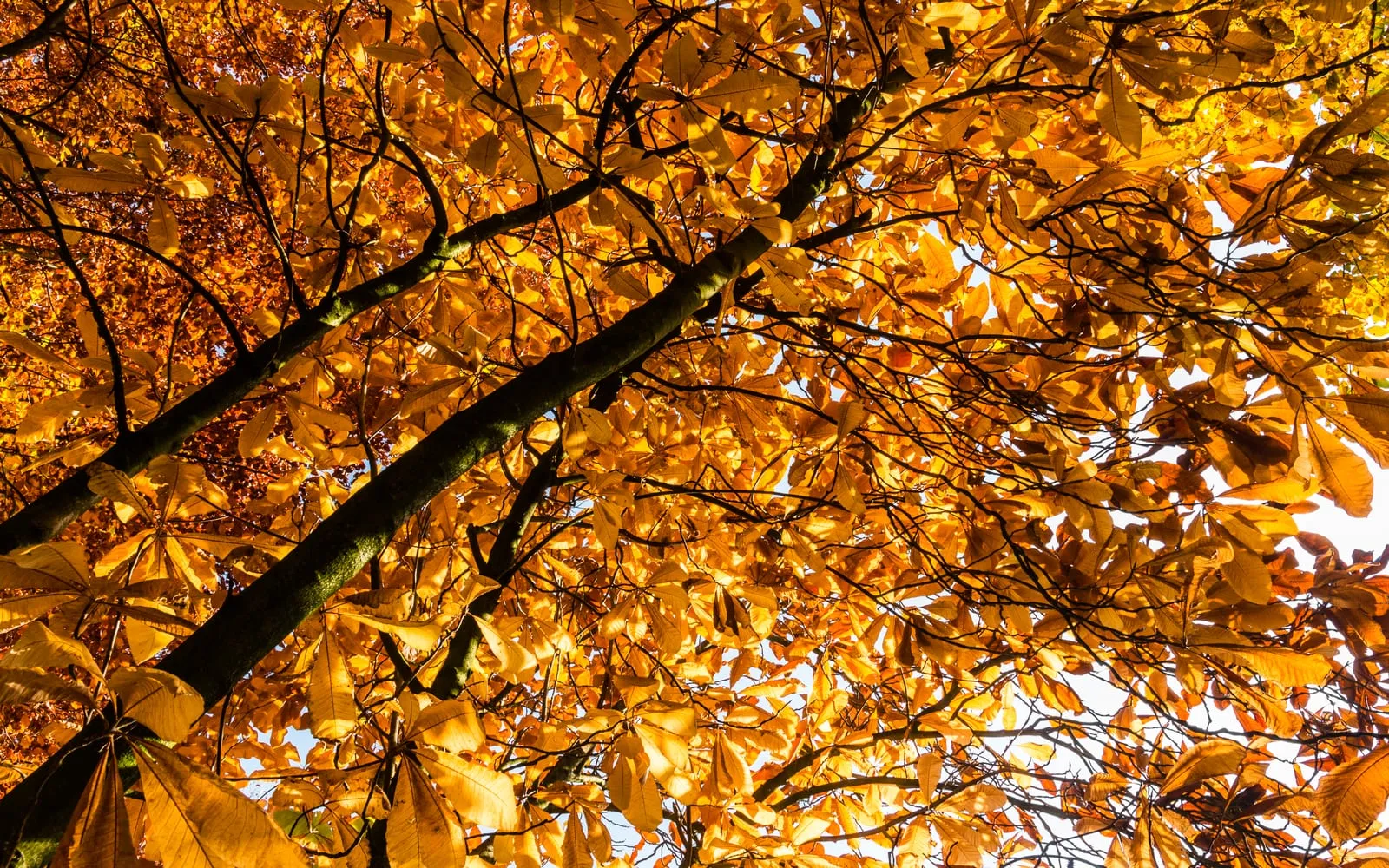
Autumn colour is a strong gold and orange when leaf miner has not got there first.
Where it is from
The mountains of the Balkan peninsula, in Greece, Albania and North Macedonia, where it grows in mixed woodland in a small and fragmented native range.
It is classed as vulnerable in the wild despite being planted in enormous numbers across Europe.
It reached Britain around 1600 and was planted widely from the eighteenth century in parkland, on village greens, along avenues and in churchyards.
The name is unresolved. The most repeated explanation is that the nuts were fed to horses in Turkey to treat coughs, and another points to the horseshoe-shaped scar left on a twig when a leaf falls, complete with what look like nail marks.
Conkers, the game, is nineteenth-century and English, and the World Conker Championships have been held in Northamptonshire since 1965.
How it grows
Plant a young tree between November and March, bare-root or container-grown.
Choose the position with the eventual size in mind, which is the mistake most often made with this tree. A horse chestnut is 25 m or more with a spread to match, and it is far too big for an ordinary garden.
Give it deep moist soil in sun or partial shade. It tolerates clay and chalk and dislikes waterlogging and thin dry sand.
Stake a young tree for the first two years and water it through its first two summers.
Prune as little as possible, and only in late summer or autumn. Horse chestnut bleeds sap heavily from cuts made in spring.
Remove dead, damaged or crossing branches, and keep the crown lifted over paths.
Collect conkers in September and October, which is the whole point of the tree for most people.
To grow one from a conker, collect fresh in autumn, plant it 5 cm deep in a pot of compost, leave it outside all winter to get the cold it needs, and expect germination in spring.
Consider Aesculus x carnea, the red horse chestnut, for a smaller garden. It reaches about 20 m, carries pink flowers, and is noticeably less affected by leaf miner.
Through the seasons
Winter shows the fat sticky red-brown buds, which are the easiest winter identification of any tree. Check the trunk for bleeding canker now.
Spring breaks bud early, often in March, and the white flower candles open in May.
Summer is when leaf miner takes hold, browning the foliage from July. Conkers swell in their green cases.
Autumn drops the conkers from September through October, and the leaves colour gold where the miner has not already browned them.
Care difficulty
Easy to grow and hard to place.
The tree asks for nothing once established. It is fully hardy, tolerant of most soils, and needs no feeding or watering.
The difficulties are all about scale and about two specific problems. It outgrows almost every domestic garden, it drops heavy conkers and shed branches, and it now carries leaf miner as a matter of course.
Bleeding canker is the one thing to take seriously, and there is no treatment for it.
Watering
Water through the first two summers after planting.
An established horse chestnut needs no watering in a temperate climate.
It prefers deep moist soil and suffers in prolonged drought on thin ground, showing early leaf fall.
Do not let a newly planted tree dry out in its first year, which is when most losses happen.
Warning signs, diseases and pests
Horse chestnut leaf miner is the thing everybody sees. Small blotches appear on the leaves from June, turning brown and spreading until the whole canopy looks scorched by August, and the leaves fall early. The moth arrived in London in 2002 and has spread across the country. It weakens a tree slightly over many years and does not kill it, and there is no practical treatment for a large tree. Raking up and destroying fallen leaves in autumn reduces the following year’s population, which helps on a single garden tree.
Bleeding canker is the serious disease. Dark, sticky, rust-coloured or black ooze runs down the trunk and main branches from cracks in the bark, and the crown thins above the affected area. It is caused by the bacterium Pseudomonas syringae pv. aesculi. There is no cure. Some trees recover on their own, some decline over years, and severely affected trees become brittle and dangerous. Have a large affected tree assessed by an arboriculturist rather than felling it immediately.
Guignardia leaf blotch produces brown patches with a bright yellow margin, and is distinguished from leaf miner by that yellow edge. It is harmless.
Falling branches are a real hazard on old trees, particularly those weakened by canker. Do not park under one and get old trees inspected.
Honey fungus attacks horse chestnut and is fatal.
Growing environment
Full sun to partial shade, in deep, moist, well-drained soil.
It tolerates clay and chalk, and it will not thrive on thin dry sand or in waterlogged ground.
Space is the first requirement. Allow at least 15 to 20 m from a building, and understand that the mature spread will be similar to the height.
Parks, large gardens, village greens, churchyards and avenues are where it belongs.
Do not plant it beside a drive, a path or a parking area unless you are content with conkers, sticky flower debris and heavy leaf fall every year.
Grass will not grow well beneath it, since the canopy is dense and the surface roots are greedy.
Its wildlife value is moderate rather than high, since it is not native and supports fewer insects than oak or willow. The early flowers are useful to bees.
Feeding
None needed. A horse chestnut in ordinary soil finds everything it requires.
Mulch a newly planted tree with compost for its first two or three springs, keeping the mulch clear of the trunk.
Avoid fertilising an established tree, which does nothing useful and can encourage soft growth.
A tree in poor condition is far more likely to have canker or root damage than a nutrient shortage.
Troubleshooting
The leaves go brown every August. Horse chestnut leaf miner, which now affects most trees across Europe every year. It looks bad and does not kill the tree. Rake up and destroy the fallen leaves to reduce next year’s numbers.
There is dark sticky ooze running down the trunk. Bleeding canker. There is no cure. Have the tree assessed by an arboriculturist, since affected trees can become brittle and dangerous, and some do recover.
Can you eat conkers? No. They are poisonous and taste bitter. Sweet chestnuts are a different tree with long narrow toothed leaves and spiny burs containing several flat nuts.
My dog ate a conker. Ring a vet. There are two risks, the saponins and a physical blockage from a whole conker, and the second is the more likely problem in a small dog.
Do conkers keep spiders away? There is no good evidence that they do.
How do I grow one from a conker? Plant it 5 cm deep in a pot of compost in autumn, leave the pot outdoors all winter so it gets the cold it needs, and expect a shoot in spring.
When can I prune it? Late summer or autumn. Cuts made in spring bleed sap heavily.
It is too big for my garden. It was always going to be. Consider the red horse chestnut, Aesculus x carnea, which reaches about 20 m and suffers far less from leaf miner.