
Outdoor plant
Sycamore
Acer pseudoplatanus
Also known as Sycamore maple, Great maple, Plane (in Scotland)
How to identify sycamore, Acer pseudoplatanus. Telling it from field maple and Norway maple, the seedlings that kill horses through atypical myopathy, and managing it in a garden.
At a glance
- Difficulty
- Easy
- Water
- Rarely once established
- Light
- Full sun to partial shade, and seedlings tolerate deep shade
- Temperature
- Extremely hardy, and it stands wind and salt better than most trees
- Hardiness
- USDA 4-7, RHS H7, hardy to -35 C
- Type
- Deciduous tree, long lived and fast growing
- Height
- 25-35 m
- Native to
- Central and southern Europe and western Asia, naturalised in Britain
- Best month
- May in the Northern Hemisphere, November in the Southern Hemisphere
Salt wind, exposure and pollution are all taken, which is why it shelters upland farms and coastal towns where little else will stand. It seeds prolifically and the seedlings appear everywhere, and it is a declared weed in New Zealand and parts of Australia. In North America sycamore means Platanus occidentalis, an unrelated tree with mottled bark, so search under Acer pseudoplatanus. Sycamore maple is the North American name for this one.
Hardiness zones describe winter cold alone. Summer heat, humidity, rainfall and the length of the growing season decide as much, so treat the range as the outer limit rather than as a recommendation.
Every month named in this guide is for the temperate Northern Hemisphere. If you garden in the Southern Hemisphere, shift each one by six months, so May becomes November. Closer to the equator the wet and dry seasons matter more than the calendar, and the shift stops being a useful guide.
Poisonous to horses if eaten
- Do not eat
- The seeds, seedlings and to a lesser extent the leaves
- Harm from
- Eating it
- Affects
- Horses
Sycamore is harmless to people and it kills horses. The seeds and seedlings contain hypoglycin A, which causes atypical myopathy, a disease that destroys the muscles used for breathing, posture and the heart. It has a high fatality rate, commonly reported at around seventy per cent, and horses that survive need weeks of intensive care. The risk is seasonal and comes in two peaks. Autumn, when the winged seeds fall onto pasture in large numbers, and spring, when the seedlings germinate in the grass. Poached, overgrazed pasture with little else to eat is the classic setting, because a hungry horse will eat what it would otherwise avoid. Signs include muscle stiffness and trembling, sweating, reluctance to move, a horse standing with its head low, and dark red-brown urine, which is the muscle protein being excreted. Call a vet as an emergency, since early intensive fluid therapy is what saves horses. Prevention is the real answer. Fence horses away from sycamores, collect seeds in autumn, avoid overgrazing, and provide supplementary forage so the field is not bare. The tree is not listed as toxic to cats or dogs, and it presents no hazard to people.
Sources: RHS potentially harmful garden plants, ASPCA toxic and non-toxic plants
About
Sycamore divides opinion more than any other tree in Britain.
It is not native, arriving at some point between the Middle Ages and the sixteenth century, and it seeds itself with such enthusiasm that conservationists spend a great deal of time pulling it out of ancient woodland.
It is also the toughest broadleaf tree in Britain. Sycamore stands salt wind, urban pollution, industrial soil and exposure that kills everything else, which is why it shelters farms across upland Britain and lines streets in coastal towns.
For a horse owner it is something else again. Sycamore seeds and seedlings cause atypical myopathy, which kills roughly seven in ten of the horses that get it. That is the single most important thing on this page, and it is why the guide leads on identification.
If you have horses, learning to recognise this tree at a hundred metres matters more than anything else you will read about it.
Appearance and character
A large deciduous tree reaching 25 to 35 m, with a heavy domed crown casting dense shade.
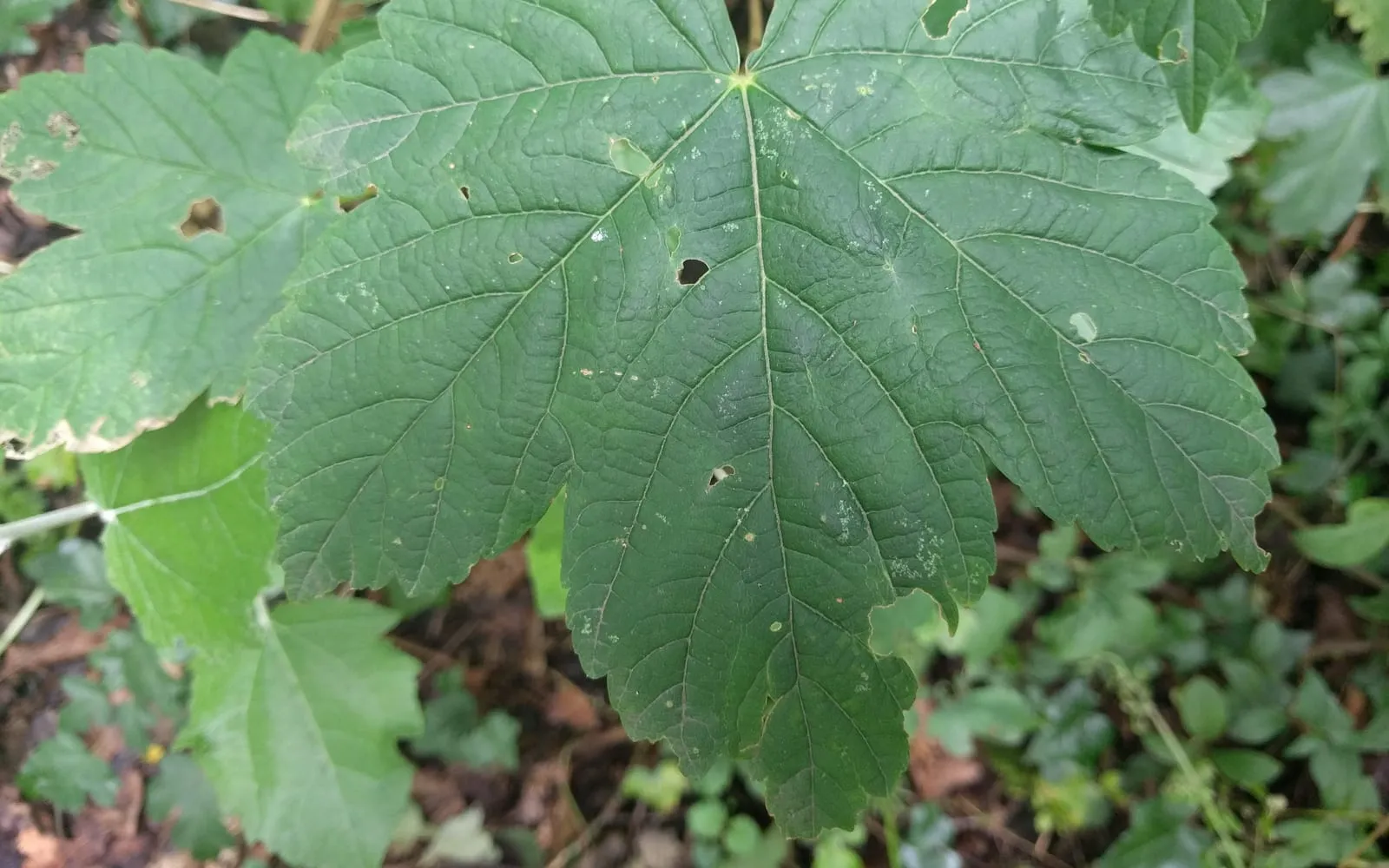
Leaves are the identification. They are large, 10 to 20 cm across, with five lobes radiating from the leaf stalk, coarsely and irregularly toothed along the edges, dark green above and paler beneath. They are held in opposite pairs.
The leaf stalk is often flushed red, and the whole leaf feels thick and slightly leathery.
Flowers open in April and May in hanging greenish-yellow spikes 10 to 20 cm long, after the leaves. Bees work them heavily.
Seeds are the familiar paired winged keys, joined at an angle of roughly 90 degrees, green ripening to brown, spinning as they fall.
Bark is smooth and grey on young trees, flaking into irregular pinkish-brown plates on old ones.
Buds in winter are large, green, and held in opposite pairs, which is a useful winter check.
Where it is from
Central and southern Europe and western Asia, in mountain woodland.
It is not native to Britain and the date of introduction is disputed, with evidence suggesting anywhere from Roman times to the Tudor period. It is now thoroughly naturalised everywhere.
It grows on any soil, including heavy clay, chalk, sand and contaminated industrial ground, and it tolerates conditions that defeat oak, beech and ash.
Its salt tolerance is exceptional, which is why sycamore shelter belts surround farms in Cumbria, Scotland and coastal Wales.
The name confuses matters. This tree is not the North American sycamore, which is a plane, and in Scotland it is often called plane, which makes the confusion worse. The species name pseudoplatanus means false plane.
Its ecological reputation has softened somewhat. It supports fewer insect species than oak but very large aphid populations, which in turn feed birds and bats, and it is now recognised as valuable for lichens.
How it grows
Sycamore rarely needs planting, and it will arrive on its own.
If you do plant one, do so between November and March in any position. It is indifferent to soil and exposure and needs no aftercare beyond staking and watering for a year.
Consider whether you want it first. This is a large, dense, greedy tree that seeds prolifically, and there are few gardens where it is the best choice.
The purple-backed form, Acer pseudoplatanus f. purpureum, and the variegated ‘Brilliantissimum’, which stays small at around 6 m with shrimp-pink spring growth, are both better garden plants than the species.
Prune in late summer or autumn. Sycamore bleeds heavily from cuts made in late winter and spring.
Control seedlings, which is the real work. They germinate in their hundreds in borders, gravel, gutters and lawns. Pull them while the taproot is small, since a seedling left for a season becomes a real job.
Coppicing works well and sycamore regrows vigorously from a cut stump. Ring-barking or stump treatment is needed to kill one permanently.
For horse pasture, remove seeds in autumn, fence the drip line plus a generous margin, and check for seedlings in spring.
Through the seasons
Winter shows the opposite green buds and the flaking plated bark. This is planting season.
Spring breaks bud in April, flowers in April and May, and germinates last autumn’s seed as seedlings in the grass. This is the spring risk period for horses.
Summer brings tar spot on the leaves from July and heavy aphid populations dripping honeydew.
Autumn drops the keys in very large numbers from September, which is the main risk period for horses, and the leaves turn a modest yellow-brown.
Care difficulty
Easy to the point of being hard to stop.
The tree needs nothing. It grows on any soil, in any exposure, at speed, and it is effectively immune to neglect.
The difficulties are all about control. Seedlings appear everywhere, the canopy is dense enough to kill what grows beneath it, and the aphid honeydew makes it a poor choice near a drive or a patio.
For horse owners the difficulty is different and serious, and it is about exclusion and vigilance rather than cultivation.
Watering
Water through the first summer after planting.
An established sycamore needs no watering in a temperate climate under any conditions.
It tolerates drought, waterlogging and compaction better than almost any other large broadleaf.
Warning signs, diseases and pests
Tar spot is the thing everybody notices. Large black blotches with yellow haloes appear on the leaves from midsummer, caused by the fungus Rhytisma acerinum. It is harmless, it does not affect the tree’s health, and it is more common in clean air, so its presence is a sign of low pollution rather than a problem.
Sooty bark disease is the serious one. Caused by Cryptostroma corticale, it follows hot dry summers, killing branches and eventually whole trees. The bark blisters and peels to reveal a black sooty spore mass underneath. The spores can cause a lung condition in people working with affected timber, so wear a mask when handling it and get a badly affected tree assessed professionally.
Aphids colonise sycamore in enormous numbers and rain honeydew onto everything below, which then grows black sooty mould. This is why cars parked under a sycamore end up sticky.
Squirrel damage strips bark from young trees and can kill them.
Seedlings everywhere are the normal state of affairs rather than a fault.
Asian longhorned beetle, a large black-and-white beetle with antennae longer than its own body, prefers maples and is not established anywhere outside Asia today. Every outbreak found in North America and Europe since 1996 has triggered eradication rather than being left to spread. Round pencil-width exit holes in the trunk are the sign to report immediately.
For horses, the signs of atypical myopathy are muscle stiffness and trembling, sweating, reluctance to move, standing with the head low, and dark red-brown urine. Call a vet immediately as an emergency. The fatality rate is high and early intensive fluid therapy is what changes it.
Growing environment
Full sun to partial shade, and seedlings germinate happily in deep shade, which is how it invades woodland.
Any soil at all, including heavy clay, chalk, sand, and contaminated or compacted ground.
Exposure is where it excels. Coastal salt wind, upland cold, urban pollution and industrial sites are all tolerated.
Allow a great deal of room. This is a 25 to 35 m tree with a heavy crown and a wide root system, and it should be well away from buildings.
Do not plant it near a drive, a patio or a parking area because of the honeydew.
Do not plant it anywhere near horse pasture, and audit existing trees on a horse property.
Grass and border plants struggle beneath it. The shade is dense and the surface roots are competitive.
In a garden, the small cultivar ‘Brilliantissimum’ gives the foliage interest without the size or the seed.
Feeding
None needed, ever. Sycamore finds what it requires on the poorest ground.
Feeding it produces faster growth, which is rarely what anybody wants.
Mulch a newly planted tree for its first spring and then leave it.
Troubleshooting
Is this sycamore or field maple? Sycamore leaves are 10 to 20 cm across with coarsely toothed lobes, and the keys join at about 90 degrees. Field maple is a much smaller tree with small blunt-lobed leaves 4 to 8 cm across and keys held in a straight line, almost 180 degrees.
Is it Norway maple? Norway maple leaves are thinner with sharply pointed teeth ending in fine bristle tips, its keys spread widely at about 180 degrees, and the leaf stalk exudes milky sap when snapped. Sycamore sap is clear.
My horse is stiff, sweating and passing dark urine. Call a vet immediately as an emergency and mention sycamore. This is the presentation of atypical myopathy and it is time-critical.
How do I protect horses? Fence them away from sycamores and a generous margin beyond the canopy, collect seeds in autumn, check for seedlings in spring, and never overgraze, since a bare field is what makes a horse eat them.
Black spots all over the leaves. Tar spot. It is harmless and it indicates clean air.
The bark is peeling off and there is black soot underneath. Sooty bark disease. Get the tree assessed, and wear a mask if handling the timber, since the spores affect the lungs.
Seedlings everywhere. Normal. Pull them while the taproot is small.
Everything under it is sticky and black. Aphid honeydew and the sooty mould that grows on it. Nothing cures it except not parking there.