
Edible
Sweet chestnut
Castanea sativa
Also known as Spanish chestnut, Marron
How to grow sweet chestnut, Castanea sativa. Telling it from horse chestnut, why the nuts are often small, and the blight and canker to watch for.
At a glance
- Difficulty
- Moderate
- Water
- In dry spells for the first few years
- Light
- Full sun, and it needs warmth to ripen a worthwhile nut
- Temperature
- Fully hardy, and a cool summer will not ripen a worthwhile nut
- Hardiness
- USDA 5-8, RHS H6, hardy to -25 C
- Type
- Deciduous tree, extremely long lived and fast growing when young
- Height
- 20-35 m
- Native to
- Southern Europe and Asia Minor, and introduced to Britain by the Romans
- Best month
- November in the Northern Hemisphere, May in the Southern Hemisphere
The tree grows happily well north of where it fruits, and summer heat is what fills the nuts. Cool maritime summers give small kernels or empty husks from a healthy tree. Chestnut blight is the other constraint. The fungus destroyed the American chestnut and is present across Europe, so planting stock and movement are regulated in many countries.
Hardiness zones describe winter cold alone. Summer heat, humidity, rainfall and the length of the growing season decide as much, so treat the range as the outer limit rather than as a recommendation.
Every month named in this guide is for the temperate Northern Hemisphere. If you garden in the Southern Hemisphere, shift each one by six months, so November becomes May. Closer to the equator the wet and dry seasons matter more than the calendar, and the shift stops being a useful guide.
Not known to be toxic
Sweet chestnut nuts are a food and carry no toxicity concern beyond the ordinary caution around tree nut allergy, which is one of the more serious food allergies. The nuts must be cooked. Raw sweet chestnuts contain enough tannin to cause stomach upset and they taste unpleasant, and roasting or boiling deals with both. Score the shell before roasting, since a whole nut heated in its shell bursts. The confusion that matters is with horse chestnut, Aesculus hippocastanum, which is an unrelated tree whose conkers contain aesculin and cause vomiting, abdominal pain and drowsiness if eaten. Children have been poisoned by eating conkers in the belief that they were chestnuts. The two are easy to distinguish and the difference is set out below. The ASPCA lists Aesculus as toxic and does not list Castanea. The spiny burr around a sweet chestnut carries fine sharp spines that penetrate skin readily, so wear gloves or use your boot to open them.
Sources: RHS potentially harmful garden plants, ASPCA toxic and non-toxic plants
About
Sweet chestnut and horse chestnut are unrelated trees, and telling them apart matters because one produces food and the other produces something that makes children sick.
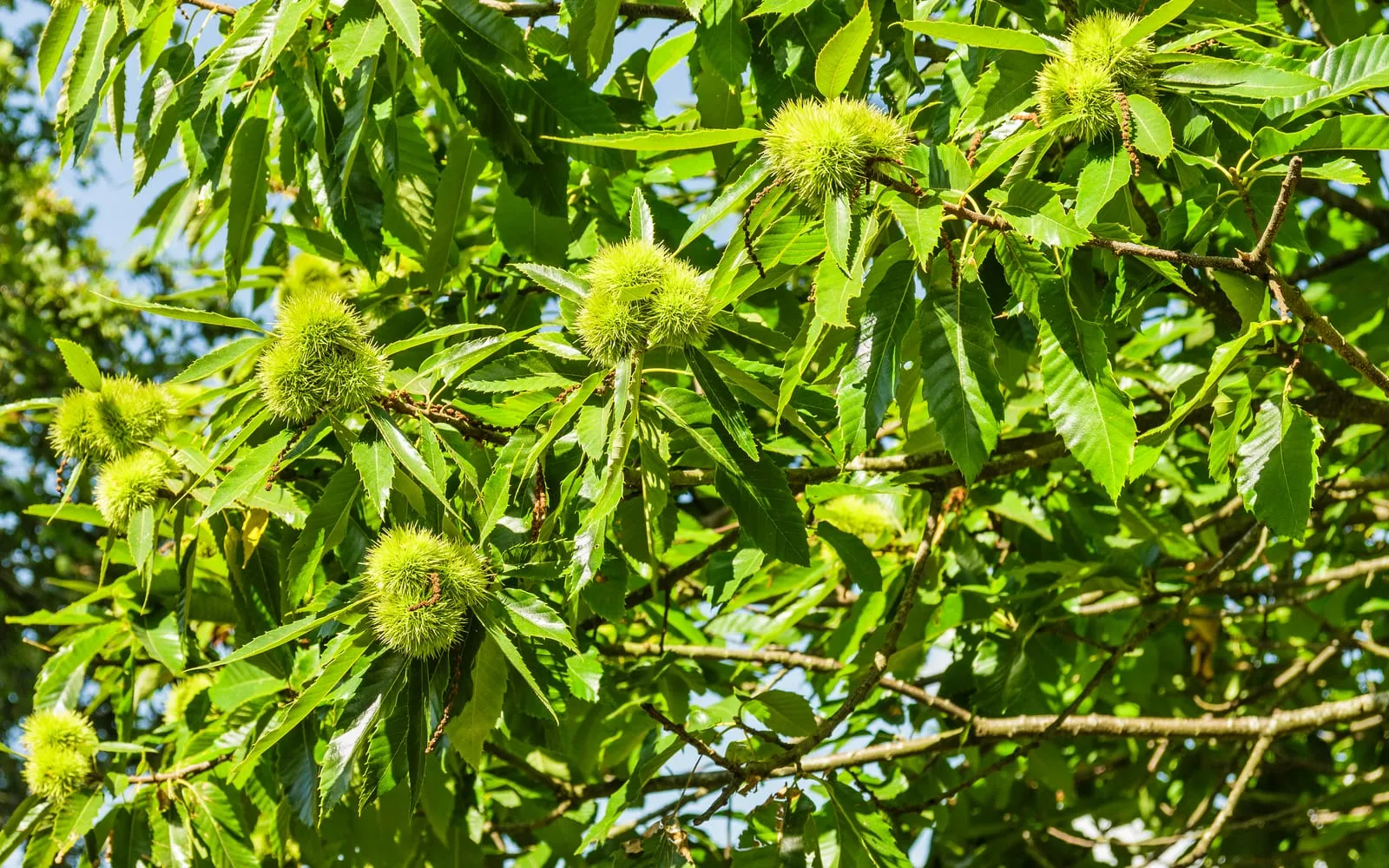
Sweet chestnut has long single leaves with saw teeth along the edge, and its nuts sit two or three together inside a burr covered in dense fine spines like a hedgehog. Horse chestnut has a hand-shaped leaf divided into five or seven leaflets radiating from one point, and its conker sits singly inside a thick green case with a few short blunt spikes.
Sweet chestnut was brought to Britain by the Romans and has been here ever since, and the oldest specimens are among the most impressive trees in the country. The bark spirals around the trunk as the tree ages, which is unmistakable on an old one, and coppice stools in Kent and Sussex have been cut on rotation for centuries.
Whether it is worth planting for the nuts in a cool climate is a fair question. Such summers are often too cool to ripen a nut of any size, and the crop comes out small next to the imported Spanish and Italian ones. A hot summer produces something worth roasting and a cool one does not.
Two serious diseases have arrived. Sweet chestnut blight, which devastated the American chestnut, was first found in Britain in 2011 and is notifiable.
Appearance and character
A deciduous tree reaching 20 to 35 m, with a broad domed crown on a massive trunk.
Bark is the identification on a mature tree. Grey-brown with deep fissures that spiral around the trunk, often dramatically so on an old specimen.
Leaves are long, narrow and oblong, 15 to 25 cm, glossy dark green, with prominent parallel veins each ending in a sharp forward-pointing tooth along the margin.
Catkins appear in July, long, upright to spreading, creamy-yellow and strongly and unusually scented, with the female flowers at the base of the male catkins.
Burrs ripen in October, 5 to 8 cm across, densely covered in long fine sharp spines, and they split into four to release the nuts.
Nuts are two or three per burr, glossy rich brown, flattened on one side with a pale patch at the base and a tuft at the tip.
Autumn colour is a good clear yellow and the leaves fall late.
The tree coppices readily and lives for centuries, and some British coppice stools are estimated at over a thousand years.
‘Marron de Lyon’ and ‘Marigoule’ are selected fruiting cultivars, grafted, producing larger single nuts per burr.
Where it is from
Southern Europe, north Africa and Asia Minor, growing in mountain woodland on acid soils.
The Romans introduced it to Britain, and it has been here for around two thousand years, which makes it an archaeophyte rather than a native.
Chestnut was a staple food across southern Europe, particularly in mountain regions of Italy, France, Spain and Portugal, where chestnut flour was a bread crop where cereals would not grow.
British sweet chestnut has been grown for coppice rather than for nuts. Kent and Sussex chestnut coppice, cut on a twelve to sixteen year rotation, supplied hop poles, fencing and cleft pale fencing, and the trade continues.
The timber is durable and splits cleanly, which is what makes chestnut paling.
Sweet chestnut blight, caused by Cryphonectria parasitica, arrived in North America around 1904 and killed an estimated three to four billion American chestnuts within fifty years, effectively removing a dominant forest tree. It reached Europe in the 1930s and Britain in 2011, where it is a notifiable disease.
Ink disease, caused by Phytophthora species, kills chestnut on wet ground and has been present in Europe longer.
The oriental chestnut gall wasp arrived in Britain in 2015 and is also notifiable.
How it grows
Buy a grafted fruiting cultivar if nuts are the object. ‘Marron de Lyon’ and ‘Marigoule’ produce larger nuts and crop younger than a seedling, which may take twenty years or more.
Plant in autumn or early spring in full sun, in the warmest position you have.
Choose deep, light, free-draining, acid to neutral soil. Sweet chestnut dislikes chalk and shallow alkaline soil, where it becomes chlorotic and short-lived.
Avoid wet ground, where ink disease kills it.
Allow the space. This is a 25 m tree with a crown as wide, and it belongs in a park, a paddock or a woodland rather than a garden.
Stake for two years and water through the first three summers.
Mulch generously while establishing.
Prune very little, in late summer or early autumn, removing only dead, damaged or crossing wood.
Coppice it if you want poles rather than nuts, cutting to the base on a twelve to sixteen year rotation. It regrows vigorously.
Plant two trees for a worthwhile nut crop. Sweet chestnut is largely self-incompatible, and a lone tree produces a poor set of small or empty nuts.
Gather nuts in October as the burrs split and fall, wearing gloves or using a boot to open the spiny burrs.
Discard any nut that feels light, since it is empty, and float them in water to sort them.
Store fresh chestnuts in the fridge or a cool place and use them within a couple of weeks, since they mould readily. Drying or freezing keeps them longer.
Score each nut through the shell before roasting, or it bursts.
Report any suspected chestnut blight or oriental chestnut gall wasp through the Forestry Commission’s TreeAlert system, since both are notifiable.
Through the seasons
Winter the tree is bare, and this is planting and coppicing season.
Spring breaks into leaf in May, later than most trees.
Summer flowers in July with strongly scented catkins, which is late for a temperate tree.
Autumn ripens and drops the burrs through October, and this is the harvest.
Care difficulty
Moderate. An established tree needs nothing at all, and the difficulty is deciding whether to plant one and getting a crop worth having.
The size rules it out for most gardens.
The nut crop is unreliable in a cool temperate climate, dependent on summer warmth, and improved considerably by planting a grafted cultivar and by having two trees for pollination.
The two notifiable diseases are outside the gardener’s control, and reporting a suspected case matters.
Chalky or wet soil are the two site conditions that kill it.
Watering
Water through the first three summers after planting.
An established sweet chestnut needs no watering in a temperate climate and is reasonably drought tolerant on deep soil.
Mulch generously in the establishment years, which does more than watering.
Avoid wet ground entirely. Ink disease is a Phytophthora root rot that kills chestnut on waterlogged sites, and drainage matters more than moisture.
Warning signs, diseases and pests
Sunken orange-brown patches on the bark, often with small orange pustules, above which the branch dies with withered leaves hanging on, is sweet chestnut blight. It is notifiable across much of Europe and North America. Do not prune it or move material. Report it to the national plant health authority, which in Britain is TreeAlert.
Green or brown swollen galls on the buds, leaf stalks and shoots, with distorted growth, is the oriental chestnut gall wasp. It is also notifiable. Report it.
Dark inky stains bleeding from the base of the trunk, with dieback in the crown and death over a few years, is ink disease, a Phytophthora root rot on wet ground. There is no treatment. Improve drainage and do not replant chestnut in the same place.
Small or empty nuts is either a cool summer, a lone tree with poor pollination, or a seedling rather than a selected cultivar. Plant two grafted trees and accept that cool summers limit the crop.
Yellowing between the veins on chalky soil is chlorosis. Sweet chestnut wants acid to neutral ground and there is no lasting fix on chalk.
Nuts mouldering within days of gathering is normal. Fresh chestnuts have a high moisture content and short shelf life. Refrigerate, dry or freeze them.
Honey fungus attacks sweet chestnut and is fatal.
Growing environment
Full sun in the warmest position available, since summer warmth determines the nut crop.
Deep, light, free-draining, acid to neutral soil. Avoid chalk, shallow alkaline soil and anywhere that waterlogs.
Fully hardy, and the limitation is summer warmth rather than winter cold.
Allow 15 to 20 m of space and keep it well away from buildings and drains.
It suits a park, a paddock, a large estate garden, a woodland or a field boundary. It does not suit an ordinary garden.
Plant two grafted cultivars for a nut crop, since a single tree sets poorly.
Its wildlife value is fair rather than high. It is a Roman introduction rather than a native and supports fewer invertebrates than oak, and the late scented catkins are worked heavily by bees in July when much else has finished.
Consider coppicing if you have space and want poles, since chestnut coppice is one of the most productive traditional woodland crops in Britain.
Feeding
None needed on reasonable soil.
Mulch generously for the first few springs, keeping it clear of the trunk.
Avoid lime, since sweet chestnut wants acid to neutral ground.
Avoid high-nitrogen feeds, which produce soft growth.
Yellowing on chalk is a pH problem rather than a nutrient one. Plant something else there.
Troubleshooting
How do I tell sweet chestnut from horse chestnut? Sweet chestnut has a long single leaf with saw teeth along the edge, and its nuts come two or three in a burr covered in dense fine spines. Horse chestnut has a hand-shaped leaf divided into five or seven leaflets from one point, and its conker sits singly in a thick case with a few short blunt spikes. Conkers are poisonous.
Why are my chestnuts so small? A cool summer will not ripen a large nut. A grafted fruiting cultivar and a hot summer both help, and a seedling tree in a cool year produces very little.
Do I need two trees? For a nut crop, yes. Sweet chestnut is largely self-incompatible and a lone tree sets poorly.
Can I eat them raw? No. Raw chestnuts contain enough tannin to cause stomach upset and they taste unpleasant. Roast or boil them.
Why do they explode when I roast them? The moisture inside turns to steam. Score each nut through the shell with a knife before roasting.
How long do they keep? Only a couple of weeks fresh, in the fridge or somewhere cool, since they have a high moisture content and mould readily. Dry or freeze them for longer storage.
Where is chestnut blight now? Across most of Europe and North America. It reached Britain in 2011 and is notifiable there. Look for sunken orange-brown bark patches with orange pustules and dying branches above them, and report suspected cases to the national plant health authority without pruning or moving material.
Can I grow one in my garden? Only a large one. This is a 25 m tree with a crown as wide, and it belongs in a park or a paddock.
Will it grow on chalk? No. It wants acid to neutral ground and becomes chlorotic and short-lived on chalk.