
Outdoor plant
Common lime
Tilia europaea
Also known as Linden, European linden, Common linden
How to grow common lime, Tilia europaea. Why it drips sticky honeydew onto everything below, how to pleach it, and the July blossom that scents a whole street.
At a glance
- Difficulty
- Easy
- Water
- Rarely once established
- Light
- Full sun to partial shade
- Temperature
- Fully hardy, to about -35 deg C
- Hardiness
- USDA 3-8, RHS H6, hardy to -35 C
- Type
- Deciduous tree, very long lived and vigorous
- Height
- 25-40 m
- Native to
- A natural hybrid of small-leaved and large-leaved lime, native to Europe including Britain
- Best month
- July in the Northern Hemisphere, January in the Southern Hemisphere
Cold, wind, pollution and hard pruning are all taken without complaint, and the tree is planted through the coldest parts of the northern temperate zone. Aphids on the leaves drip honeydew onto everything below from June, which is the reason to think twice about a parking space. In North America this genus is called basswood or linden, and lime means a citrus fruit, so search under Tilia to avoid the confusion.
Hardiness zones describe winter cold alone. Summer heat, humidity, rainfall and the length of the growing season decide as much, so treat the range as the outer limit rather than as a recommendation.
Every month named in this guide is for the temperate Northern Hemisphere. If you garden in the Southern Hemisphere, shift each one by six months, so July becomes January. Closer to the equator the wet and dry seasons matter more than the calendar, and the shift stops being a useful guide.
Not known to be toxic
Common lime is not listed by the RHS as a potentially harmful garden plant and is not recorded by the ASPCA as toxic to cats, dogs or horses. The flowers have been used as a herbal tea across Europe for centuries, sold as tilleul or linden blossom, and the young leaves are edible in salad. No part of the tree is a recognised poisoning hazard to people or animals. One related question comes up often enough to answer here. Dead and dying bumblebees are sometimes found in numbers under limes in July, most reliably under silver lime, and the old explanation was that the nectar contains mannose which bees cannot digest. Later work did not support that, and the current reading is that these are old bees at the end of their lives starving at a tree whose nectar has run out, drawn there because the lime is the last mass source of forage in the neighbourhood. Planting more forage that flowers after the lime is the useful response.
Sources: RHS potentially harmful garden plants, ASPCA toxic and non-toxic plants
About
Common lime is the tree that ruins your car in July.
It is planted along more European avenues and streets than almost anything else, because it is cheap, fast, tolerant of pollution and pruning, and it makes a magnificent tall dome within a lifetime. Every summer the aphids feeding in the canopy rain honeydew onto the pavement, the parked cars and anything growing beneath, and a black sooty mould grows on the stickiness.
The same tree in flower is one of the best things in midsummer. The blossom is small and greenish-cream and the scent carries a long way down a street, and the sound of a lime in full flower is a constant hum from the bees working it.
It has nothing to do with the citrus fruit. The name comes through Middle English lind, which also gives linden, and the Old English form is preserved in place names such as Lyndhurst.
This is a hybrid, arising naturally where small-leaved and large-leaved lime overlap, and it is the one planted most often in Europe. The two parents make better garden trees and are covered at the end. In North America the genus is called linden or basswood, since lime there means a citrus fruit.
Appearance and character
A large deciduous tree reaching 25 to 40 m, with a tall domed crown on a straight trunk.
The trunk is the giveaway on a mature common lime. It develops heavy burrs and knobs low down, and dense thickets of twiggy sucker growth sprout from them, so an old avenue lime looks as though it is wearing a skirt.
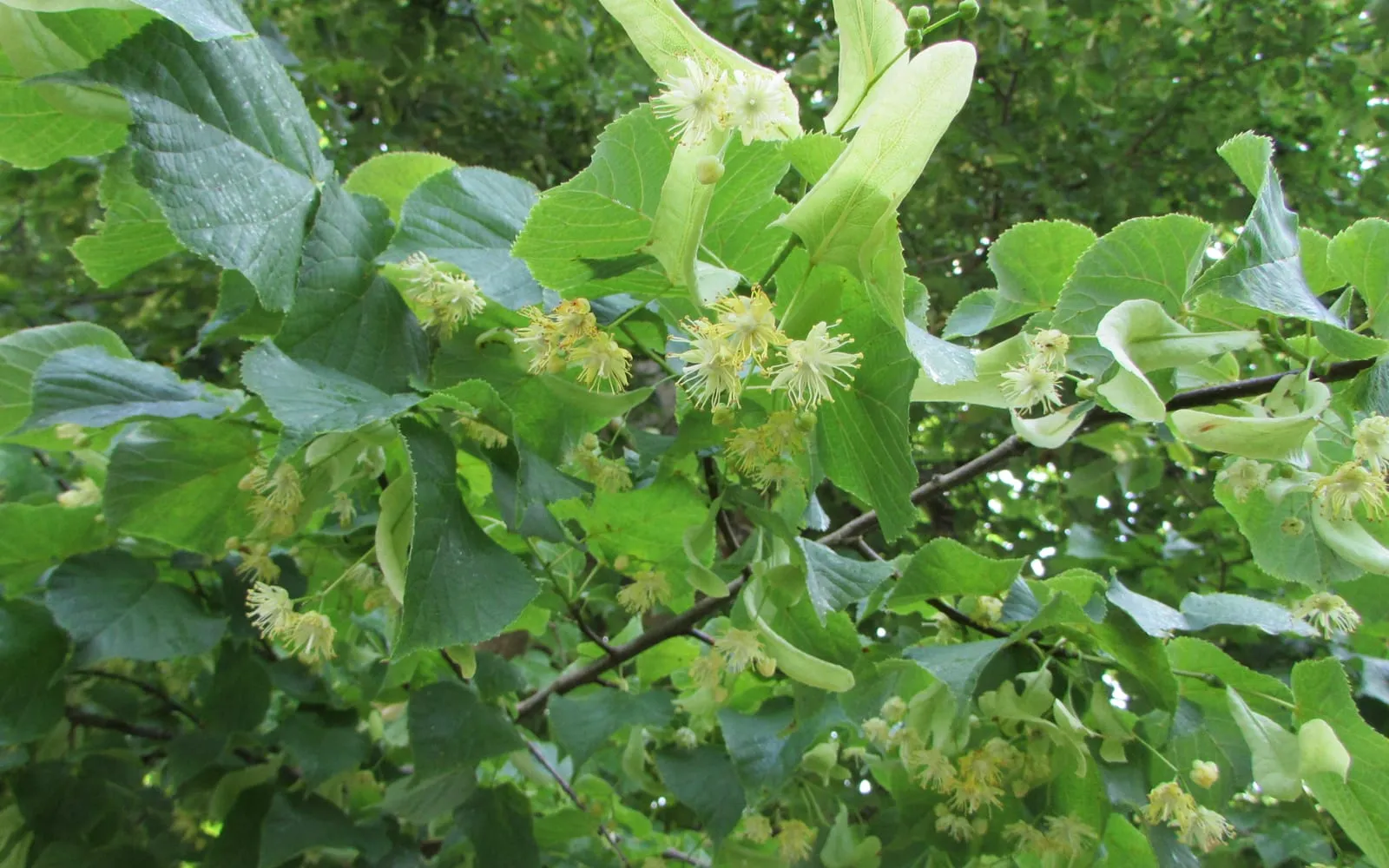
Leaves are heart-shaped with an off-centre base, 6 to 10 cm long, finely toothed, matt mid-green above and paler beneath with tufts of whitish hairs in the vein angles.
Flowers open in July, small and yellowish-cream in hanging clusters of five to ten, each cluster attached to a narrow pale bract like a strap. That bract is the family signature and stays on the tree with the fruit.
Fruits are hard round nutlets about 8 mm across, faintly ribbed, hanging beneath the bract which spins them away from the tree.
Twigs are reddish and zigzag slightly, with alternate buds that have two visible scales.
Autumn colour is a clear butter yellow, and the leaves fall early and rot fast.
Where it is from
Native across Europe including Britain, arising wherever small-leaved lime and large-leaved lime grow together and cross.
Wild trees are scarce and almost every large lime you see was planted. The avenue lime came into fashion in the seventeenth century, following Dutch and French garden design, and the great formal avenues at Hampton Court and Clumber Park set the pattern.
Small-leaved lime, Tilia cordata, is the wild species across northern Europe and was one of the commonest trees in lowland England after the last glaciation. Its decline is a long-running puzzle, and cool summers limiting seed set is part of the answer.
Lime bast, the fibrous inner bark, was the standard cordage of prehistoric Europe and was still being made into rope and matting into the nineteenth century.
The timber is pale, even-textured and free of grain figure, which makes it the best carving wood in Europe. Grinling Gibbons worked almost entirely in lime.
Limes coppice and pollard indefinitely, and some coppice stools in British woodland are among the oldest living things in the country.
How it grows
Plant between November and March, bare-root for small stock or container-grown for larger.
It grows on nearly any soil, including chalk, clay and made ground, and it tolerates compaction and pollution better than most trees. This is why it ended up in so many towns.
Give it full sun for the best flowering, and accept light shade if you must.
Stake for two years and water through the first two summers.
Think hard about the size. A common lime left alone reaches 30 m or more and is the wrong tree for a garden, a front lawn or anywhere near a house.
Pleaching is the answer if you want lime at a domestic scale. Plant at 2 to 3 m spacing, clear the trunks to about 1.8 m, and train the branches onto horizontal wires to build a hedge on legs. Cut it twice a year in summer and again in winter.
Pollarding also works and was traditional. Cut the head back to the same points every few years and the tree lives far longer than a maiden.
Remove basal suckers every winter with a pruning saw cut flush to the trunk. Pulling them off is more effective than cutting where you can get a grip, since it takes the dormant buds with them.
Prune in late winter or midsummer, avoiding the early spring period when lime bleeds sap heavily.
Choose Tilia cordata or the cultivar ‘Greenspire’ for a smaller and much cleaner tree, since neither suckers at the base the way the common lime does.
Through the seasons
Winter is planting season, and the time to cut basal suckers and to do structural pruning once the hardest frosts pass.
Spring breaks bud in April into fresh yellow-green leaves, and the aphid populations start building.
Summer brings the flowers in July, the scent, the bees, and the honeydew that follows.
Autumn turns the leaves clear yellow in October and drops them, and the winged bracts spin off through the winter.
Care difficulty
Easy to grow and awkward to live with.
Lime survives almost anything. Chalk, clay, drought, waterlogging, hard frost, urban pollution, root compaction and repeated heavy pruning all leave it going.
The difficulties are all about scale and mess. It gets very large, it drips honeydew for two months of the year, and common lime in particular produces suckers around its base that need cutting every winter.
None of that is a disease and none of it can be treated. Choosing the right species and the right position is the whole of the answer.
Watering
Water through the first two summers after planting, especially on chalk.
An established lime needs no watering in a temperate climate, though it does drop leaves early in a hard drought.
Pleached limes are worth watering in dry spells, since their restricted crowns and frequent cutting keep them working harder than a free-standing tree.
Mulch a young tree with compost to hold moisture and keep grass off the root plate.
Warning signs, diseases and pests
Sticky leaves, sticky pavement and a sticky car in July are aphid honeydew. This is normal for lime and it is not a disease. There is no practical treatment on a mature tree, and the aphids feed blue tits, ladybirds, hoverfly larvae and wasps.
Black film on leaves and on anything below is sooty mould growing on the honeydew. It does no direct harm to the tree. Wash it off paving and cars with warm soapy water before it hardens.
Bright red pointed spikes standing up from the upper leaf surface are lime nail gall, caused by the mite Eriophyes tiliae. They look alarming and do no harm at all.
Yellow stippling and fine webbing in a hot dry summer is red spider mite. It is cosmetic on a mature tree.
Suckers around the base of the trunk are the normal behaviour of common lime rather than a symptom. Cut them every winter.
Heavy bleeding from a cut made in early spring is sap pressure. Prune in midsummer or late winter instead.
Honey fungus attacks lime and is fatal, showing as white sheets under the bark at the base.
Massaria disease and various decay fungi affect old limes and are a matter for an arboriculturist rather than a homeowner where the tree overhangs anything.
Growing environment
Full sun to partial shade. Flowering is far better in sun.
Any reasonable soil. It grows well on chalk, on heavy clay, on made ground and in compacted urban conditions.
Fully hardy to about -35 deg C, and it stands wind and pollution well.
Allow a great deal of room for a free-standing tree, at least 15 m from a building. A pleached lime needs 2 to 3 m of run per plant and 1 m of depth.
It suits an avenue, a park, a large garden boundary, a pleached screen or a pollard. It does not suit a small garden as a specimen.
Its value to insects is high in July and the flowering season is short. Plant late summer forage nearby so the bees working it have somewhere to go afterwards.
Do not plant one over a drive, a patio or a parking space unless you have made peace with the honeydew.
Feeding
None needed on ordinary soil.
Mulch a young tree with compost for its first three springs, keeping the mulch off the bark.
Avoid high-nitrogen feeds, which produce the soft sappy growth that aphids multiply on fastest.
A pleached lime benefits from a spring mulch each year, since the annual cutting keeps it in permanent regrowth.
Troubleshooting
Why is everything under my lime sticky? Aphids feeding in the canopy excrete honeydew. It runs from June to August and there is no treatment on a mature tree. Move the car and do not put a bench under it.
Can I wash the black film off? Yes. Sooty mould grows on the honeydew and comes off paving, glass and paintwork with warm soapy water. Do it before it bakes on.
Red spikes are growing out of the leaves. Lime nail gall, caused by a mite. It is harmless and needs no action.
My lime has a thicket of twigs around the bottom of the trunk. Basal suckers, which is characteristic of common lime. Cut or pull them every winter, or plant Tilia cordata next time.
Which lime should I plant? Small-leaved lime, Tilia cordata, or the cultivar ‘Greenspire’ for street use. Both are smaller, cleaner and do not sucker like the common lime.
Can I make tea from the flowers? Yes. Lime blossom tea is a long-standing European herbal drink. Pick the flowers with their bracts on a dry day in July and dry them in the shade.
When can I prune it? Midsummer or late winter. Cutting in early spring makes it bleed sap heavily.
It is far too big. Can I cut it down to size? Yes, lime tolerates hard cutting better than almost any broadleaf and can be pollarded. Get an arboriculturist to do it on a mature tree, and understand that pollarding is a commitment to recutting every few years.
Are the dead bees under it my fault? No. Bumblebees do die under limes in July, and the best current explanation is old bees starving at a tree that has run out of nectar rather than poisoning. Plant forage that flowers after the lime.