
Edible
Cluster Bean
Cyamopsis tetragonoloba
Also known as Guar, Gawar, Guvar, Cluster bean
How to grow guar, Cyamopsis tetragonoloba. A Rajasthani vegetable whose seed thickens ice cream, and the crop whose price quadrupled because of American shale gas.
At a glance
- Difficulty
- Moderate
- Water
- Very little. It is among the most drought tolerant legumes grown
- Light
- Full sun
- Temperature
- 25-35 deg C, and it will not grow below 15
- Hardiness
- USDA 9-11, RHS H2, hardy to 10 C
- Type
- Tender annual legume
- Height
- 60-200 cm
- Native to
- India, Rajasthan and the Thar desert margin
A drought-hardy legume from the dry north-west of the Indian subcontinent, and it needs a long hot season and free-draining soil. Waterlogging kills it. Guar gum from the endosperm is the reason it is a global commodity, thickening food and, since around 2012, drilling fluid for hydraulic fracturing, which caused a price spike that reshaped growing in Rajasthan.
Hardiness zones describe winter cold alone. Summer heat, humidity, rainfall and the length of the growing season decide as much, so treat the range as the outer limit rather than as a recommendation.
Edible, with limits
- Safe to eat
- The young pods cooked, and the seed processed into gum
- Do not eat
- Raw mature seed
- Harm from
- Eating it
- Affects
- People
Guar is safe as a cooked vegetable and is eaten daily across Rajasthan and Gujarat. The mature seed carries the lectins and protease inhibitors common to pulses and is not eaten whole in any tradition; it is milled to extract guar gum from the endosperm, and the remainder goes to animal feed after heat treatment. Guar gum itself is a widely used food additive, E412, and is regarded as safe at the levels used in food. Swallowing large quantities of dry guar gum is a different matter, since it swells rapidly in water, and diet products based on it were withdrawn in several countries after cases of oesophageal obstruction. Guar is not one of the 14 named allergens in Britain, though occupational sensitisation to guar gum dust is documented in workers handling it.
Sources: Food Standards Agency on the 14 named allergens, Food Standards Agency on food allergy and intolerance
About
Guar leads two lives that rarely meet. In Rajasthan and Gujarat it is gawar phali, a green vegetable picked young and cooked with spices, a staple of dry land farming that produces where almost nothing else will. Everywhere else it is a raw material.
The seed’s endosperm holds galactomannan, a polysaccharide that thickens water at very low concentrations. Milled and separated, it becomes guar gum, and guar gum is in ice cream, sauces, gluten-free bread, toothpaste, cosmetics and paper. India supplies most of the world’s crop.
In 2012 the price quadrupled in a matter of months, and the cause was American shale gas. Hydraulic fracturing uses guar gum to thicken the fluid that carries sand into a fractured rock, the drilling boom created demand that Rajasthan could not immediately meet, and farmers on the desert margin found themselves at the centre of a global commodity story.
Appearance and character
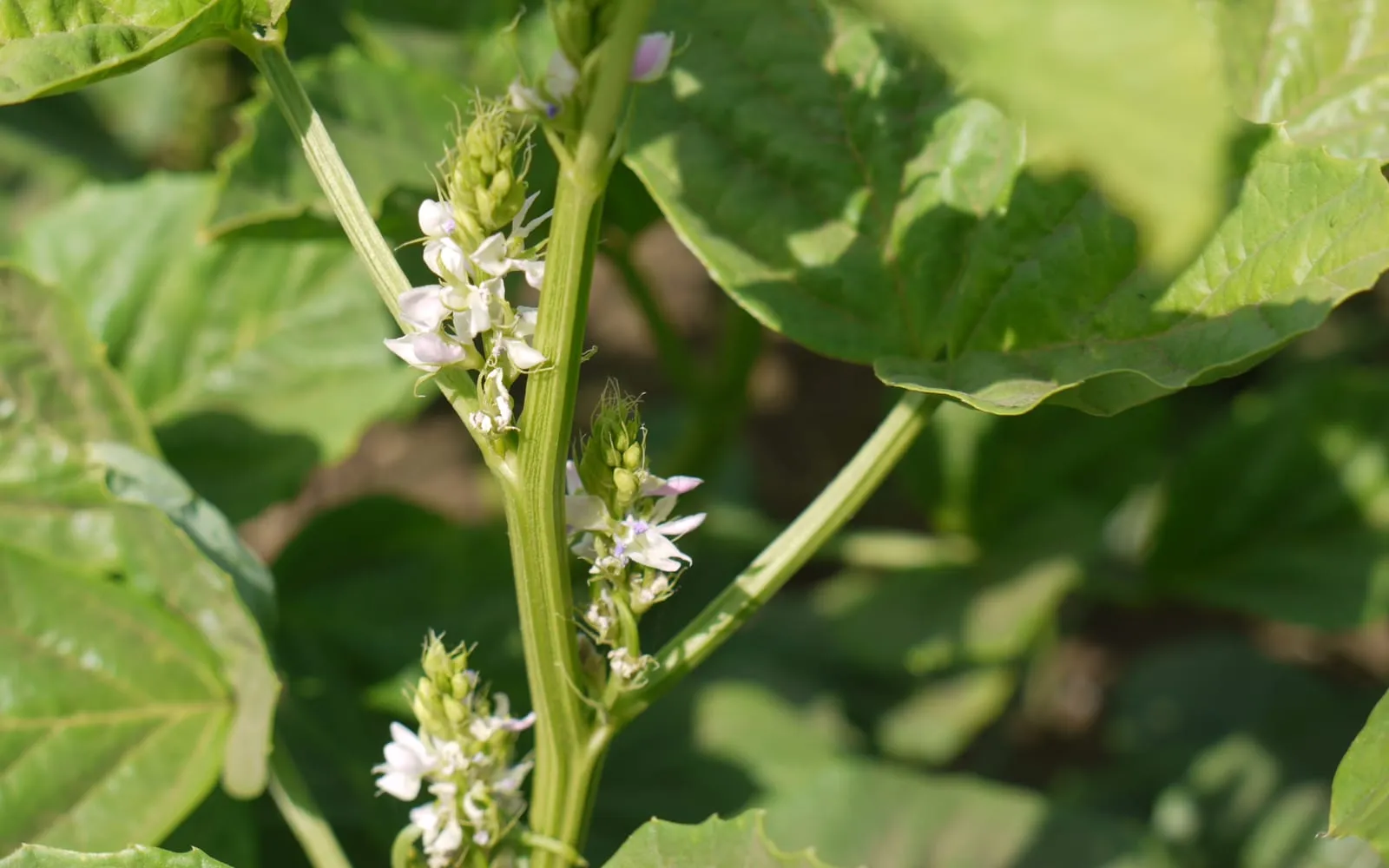
The plant is upright and sparsely branched, standing knee to head high, with leaves of three toothed leaflets carried on long stalks. The stems are ridged and the whole plant has a rather stiff, upright, angular look.
The flowers are small, 5 to 8 mm, pale pink to purple, carried in dense spikes at the leaf joints. They self-pollinate, and the spike sets a whole cluster of pods at once, which is where the name cluster bean comes from.
The pods stand in tight bunches pressed against the stem, 4 to 10 cm long, slender, flattened and slightly beaked, ripening from green to pale brown. Each holds five to twelve small squarish seeds, pale grey or pinkish, which are hard and glassy when dry.
Where it is from
Guar was domesticated in India, most probably from the African species Cyamopsis senegalensis brought across in antiquity, though no wild population of the crop itself has been found and the origin remains debated.
Its agricultural home is the arid north west of the subcontinent, in Rajasthan, Haryana and the Pakistani Punjab, where it has been grown for centuries as a vegetable, a fodder and a green manure on land at the edge of the Thar desert.
Industrial use is recent. Guar gum extraction developed from the 1940s, and India now supplies around 80 per cent of world production. The United States, Australia and Brazil grow small areas.
How it grows
Guar germinates in hot soil and grows slowly at first, putting energy into a deep taproot. That root is the basis of the plant’s drought tolerance, reaching well below the surface layers that dry out first.
Nodules form and fix nitrogen. The species associates readily with local rhizobia and establishes on ground that has not carried a legume.
Flowering starts about eight weeks after sowing and the plant sets pods in clusters at each node, working up the stem. In its home range it is sown with the monsoon and harvested on residual moisture, which is what makes it valuable to farmers with no irrigation.
Frost ends it, and where the season is short of about four hot months green pods rather than mature seed are the realistic outcome.
Through the seasons
Sow indoors in April in deep pots, or outdoors from late May once the soil is above 18 deg C. Guar dislikes root disturbance, so use deep modules rather than trays.
Plant out at the end of May, 20 cm apart in rows 45 cm apart. Growth is slow in June and rapid in a warm July.
Pick young pods from August, when they are 5 to 7 cm long and snap cleanly. Keep picking, since the plant sets more where pods are removed. Mature seed needs a long hot season, so in a cool climate treat this as a green vegetable crop.
Care difficulty
The plant is undemanding and the climate is the obstacle. Guar wants 25 to 35 deg C and does nothing below 15, which puts it in a polytunnel or against a hot wall anywhere summers are cool.
Given that heat it needs nothing. It fixes its own nitrogen, tolerates drought and alkalinity, and has few diseases outside its home range.
Pick the pods young. A guar pod left more than a few days past the right stage goes fibrous and stringy, and the window is shorter than with a French bean.
Watering
Water at sowing and through establishment while the taproot goes down. After that the plant needs very little and does better on the dry side.
In a container the calculation changes, since the taproot cannot escape, and a large pot in a polytunnel needs watering two or three times a week in hot weather.
Waterlogging causes root rot, and the plant is intolerant of wet feet at every stage. Free drainage is the one thing it insists on.
Warning signs, diseases and pests
Bacterial blight is the major disease of guar in India, producing water-soaked spots that turn brown and merge on leaves, stems and pods. It is seed-borne, and an affected crop should not be saved from.
Powdery mildew appears late in the season as a white dusty coating, particularly under glass where air movement is poor.
Root rot follows waterlogging and shows as yellowing plants that lift easily with brown roots.
Aphids gather on the growing tips, red spider mite arrives under dry glass, and slugs take the seedlings. Frost ends the plant in a night, which sets the harvest deadline.
Growing environment
Full sun and sustained heat. Guar is a desert-margin crop and it performs at temperatures that damage most legumes.
Soil should be sandy and free-draining, and it can be poor and alkaline. The plant grows from pH 7 to 8.5 without difficulty, which is unusual, and it tolerates a degree of salinity.
Where summers are cool a polytunnel or a raised bed at the foot of a south-facing wall gives the best chance. Frost kills it outright, so the season runs from the end of May to the end of September at best.
Feeding
Feed nothing. Guar fixes its own nitrogen and is grown deliberately on soil with very little in it.
In a container, a high-potash feed every fortnight once flowering starts is reasonable, since a pot cannot supply what open ground would.
Cut the plant at the base at the end of the season and leave the roots. Guar is used as a green manure in India for that reason, and the same benefit applies in a temperate bed.
Troubleshooting
What is guar gum? A polysaccharide extracted from the endosperm of the seed, sold as food additive E412. It thickens water at very low concentrations, which is why it is in ice cream, sauces, gluten-free bread, cosmetics and toothpaste.
Why did the price spike in 2012? Hydraulic fracturing. American shale gas drilling uses guar gum to thicken the fluid that carries sand into fractured rock, and the boom created demand faster than Rajasthan could supply it.
Can I eat the pods? Yes, cooked, and they are a standard Indian vegetable. Pick them young at 5 to 7 cm, when they snap cleanly, and cook them rather than eating them raw.
Can I eat the dry seed? Not whole. It carries the usual pulse lectins and is processed rather than cooked, with the endosperm milled into gum and the rest heat treated for animal feed.
Will it crop where I am? It wants 25 to 35 deg C through a long season, which the dry subtropics supply and a cool summer does not. In a cool climate grow it in a polytunnel or against a hot wall for green pods rather than mature seed.
Why are my pods stringy? Picked too late. Guar goes fibrous quickly, and the window between tender and tough is a matter of days rather than the week a French bean allows.
Is it related to the beans I know? Distantly. It is a legume in its own genus, Cyamopsis, and its habit of setting whole clusters of pods at each node is distinctive enough that nothing else in a garden looks like it.
Cluster Bean problem guides
Not sure what is wrong? See the common vegetable pests guide.