
Outdoor plant
Cocksfoot
Dactylis glomerata
Also known as Orchard grass
How to grow cocksfoot as a pasture or wildlife grass. Its coarse tussocky habit, hay fever significance, and role as a butterfly larval food plant.
At a glance
- Difficulty
- Moderate
- Water
- Naturally rain-fed in most established plantings
- Light
- Full sun to light shade
- Hardiness
- USDA 3-9, RHS H7, hardy to -35 C
- Type
- Hardy perennial grass
- Height
- 30-140 cm
- Native to
- Europe, Temperate Asia, North Africa
Extremely hardy and adaptable across a huge range of temperate climates, which is a large part of why it has been sown as an agricultural forage grass on every temperate continent. It tolerates both cold winters and warm, moderately dry summers, and struggles more with heavy grazing pressure or repeated close mowing than with any climatic extreme.
Hardiness zones describe winter cold alone. Summer heat, humidity, rainfall and the length of the growing season decide as much, so treat the range as the outer limit rather than as a recommendation.
Edible, with limits
- Safe to eat
- None for people; grown entirely as forage for livestock rather than as a food crop
- Harm from
- Eating it
- Affects
- People
Cocksfoot itself has no toxicity listing from the RHS or the ASPCA and is a standard, safe grazing grass for livestock and a valuable food plant for several butterfly and moth caterpillars. Its real significance for people is as a major cause of hay fever: its pollen is one of the most allergenic of the common grass pollens, and it is a standard species included in pollen count monitoring and allergy testing panels.
Source: RHS
About
Cocksfoot is one of the most widely sown agricultural forage grasses in the temperate world, valued by farmers for its toughness, its tolerance of a wide range of soils and its reliable regrowth after grazing or cutting, though it appears in this collection mainly for gardeners managing a wildlife meadow, hay-style planting or rough grass area rather than for anyone growing it deliberately as a lawn. Its coarse, tussocky growth habit and comparatively tall, dense flower heads mark it out clearly from the finer grasses more commonly chosen for an ornamental setting.
It has real significance beyond agriculture as one of the most important grass species for hay fever sufferers, since its pollen, released in large quantities through late spring and early summer, is among the more potent common triggers included in standard grass pollen allergy testing.
Appearance and character
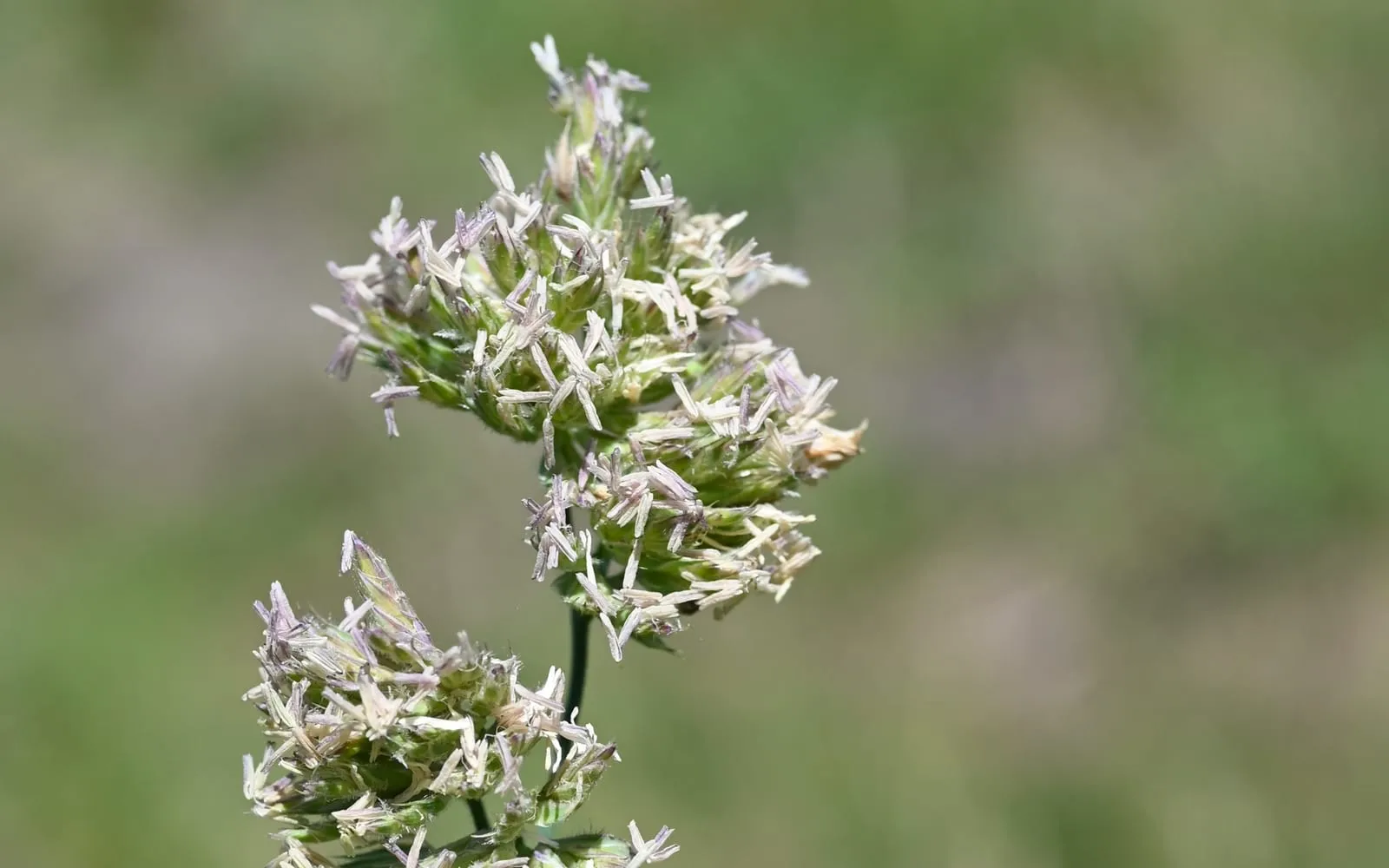
Broad, flat, blue-green leaves arise from a coarse, tussocky base, noticeably rougher in texture than many finer ornamental or lawn grasses. Flower heads are dense, one-sided clusters of tightly packed spikelets, held on stiff upright stems well above the leaves, giving the plant a distinctive, somewhat ungainly silhouette compared with the more delicate flower heads of many other grasses.
The plant forms substantial, well-defined tussocks over time rather than a smooth, even sward, a structural feature that makes it valuable habitat for ground-nesting insects and small mammals in a wildlife- focused planting, even where its coarse texture makes it unsuitable for a fine, manicured lawn.
Where it is from
Grassland, meadows, hedgerows and disturbed ground across Europe, temperate Asia and North Africa, and introduced widely elsewhere as an agricultural forage crop, now naturalised across large parts of North America, Australia and beyond.
Its enormous native and introduced range reflects an especially adaptable species, tolerant of a wide range of soils, rainfall patterns and management regimes, which is the combination of traits that made it such a successful choice for agricultural sowing across such varied climates.
How it grows
A hardy perennial forming an increasingly substantial tussock over successive years, regrowing vigorously from the base after grazing, mowing or cutting, a trait bred and selected for extensively in agricultural strains. Left uncut, a mature plant produces tall flower stems well above the leaf tussock, particularly in late spring and early summer.
In a wildlife meadow or rough grass setting, its tolerance of infrequent cutting, once or twice a year rather than regular mowing, suits a naturalistic management regime, and it holds its own well against many other competing meadow species thanks to its vigorous regrowth.
Through the seasons
Spring growth resumes strongly, with flower stems developing rapidly through late spring.
Summer flowering and pollen release peak in late spring to early summer, an important consideration for hay fever sufferers nearby, after which the plant continues growing through summer.
Autumn growth slows as temperatures drop, though the tussock remains green later into the year than many other grasses.
Winter the tussock persists, semi-evergreen in a mild winter, fully hardy to significant cold regardless.
Care difficulty
Moderate in a garden setting, mainly because it is coarse and vigorous enough to need active management, whether mowing, cutting for hay-style maintenance, or accepting its tussocky, informal character, rather than being left entirely to its own devices in a small or tidy garden.
Watering
This species relies on natural rainfall in an established meadow or rough grass setting and rarely needs supplemental watering once established, reflecting its long history as a resilient agricultural forage grass across a wide range of rainfall conditions. Water during establishment or an unusually severe drought only.
Warning signs, diseases and pests
Few pests trouble this tough, widely adapted species in an ordinary garden setting; frit fly and other cereal-adjacent pests are more relevant to large-scale agricultural cultivation than to a garden meadow or rough grass area.
The main practical concern with this species is its pollen rather than any pest or disease, and gardeners or neighbours with grass pollen allergies may want to avoid planting it in quantity close to windows or frequently used outdoor seating areas, cutting it before flowering if included in a managed meadow where pollen exposure is a concern.
Growing environment
Full sun to light shade both suit it, and it tolerates an unusually wide range of soil types, from poor and dry through to reasonably heavy clay. This adaptability is part of why it succeeds as an agricultural forage grass across such varied conditions, and the same toughness makes it a reliable, low-maintenance choice for a wildlife meadow or rough grass area.
Feeding
A balanced granular feed once or twice a year suits a managed hay meadow or pasture setting, though an informal wildlife area generally performs well without supplemental feeding, since richer soil tends to favour this already vigorous species over finer, more delicate meadow companions.
Troubleshooting
The plant is outcompeting finer, more delicate meadow species. This reflects its naturally vigorous, competitive growth habit. Reducing soil fertility and cutting more frequently through the growing season can help rebalance a mixed meadow planting in its favour less strongly.
Pollen from a nearby planting is causing hay fever symptoms. Cut the grass before it flowers in late spring if pollen exposure is a concern, or avoid planting large stands of it close to windows or frequently used outdoor areas.
The tussock has become large and coarse, dominating a small area. This is normal vigorous growth for the species. Cut back hard if a more restrained appearance is wanted, since it regrows readily from the base.
You are managing a wildlife meadow and want to know when to cut. Cutting once or twice a year, after the main flowering and seeding period in most cases, suits this species well and supports the wider range of wildlife, including butterfly and moth caterpillars, that use it as a food plant.
You want to identify whether cocksfoot is present in an existing rough grass area. Look for the coarse, blue-green, distinctly tussocky growth habit and, once flowering, the dense, one-sided clusters of spikelets held on stiff stems well above the leaves, a combination that sets it apart from most finer meadow and lawn grasses growing nearby.