
Disorder
Fertiliser scorch
Also called Fertiliser burn, Feed burn, Salt burn, Nitrogen burn, Over-feeding
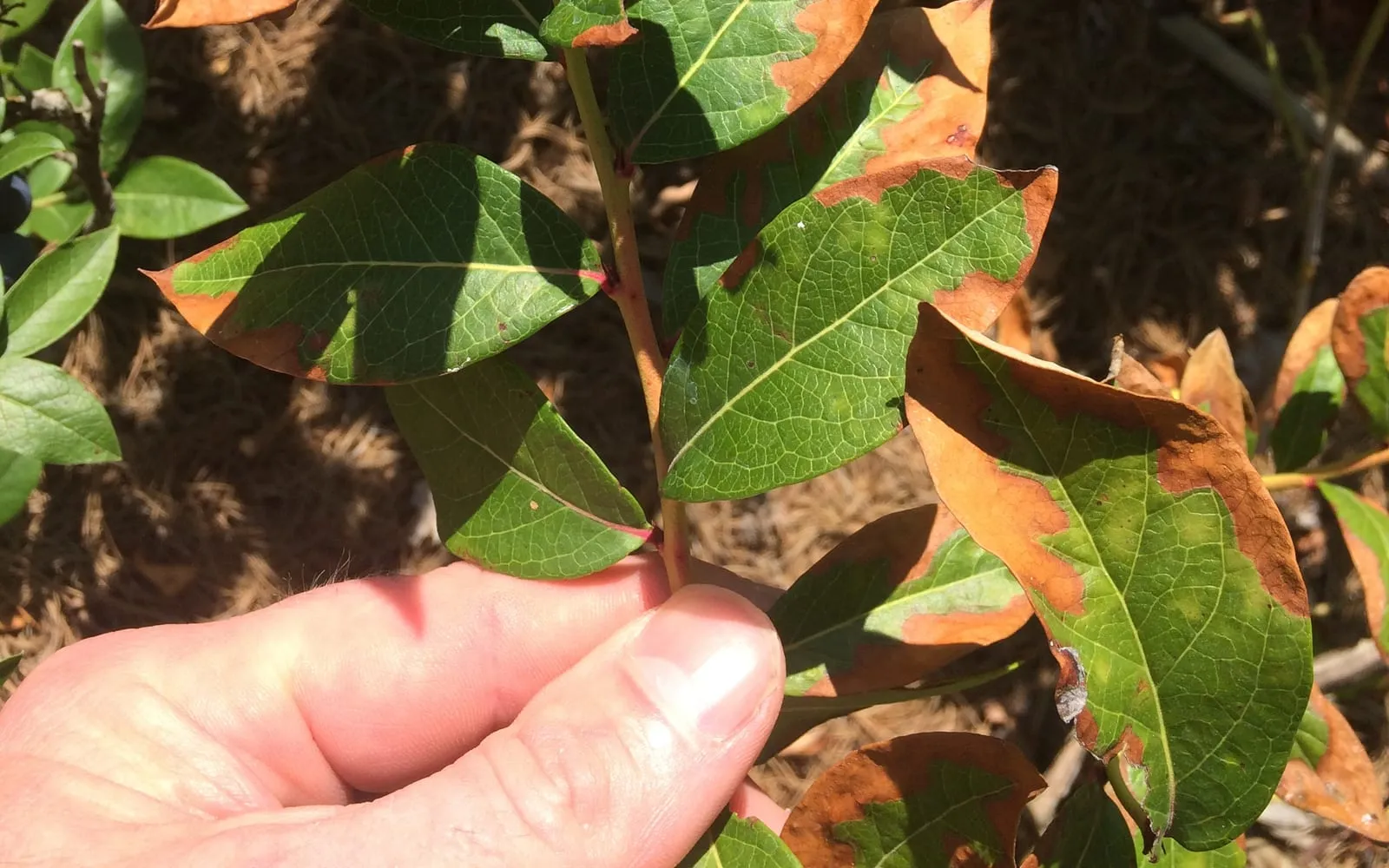
Brown crisp margins on the oldest leaves, a white crust on the compost and a plant wilting in soil that is plainly wet. Too much fertiliser stops roots taking up water, and the plant shows drought symptoms while standing in it.
At a glance
- Type
- Disorder
- Cause
- Feeding or nutrients
- Severity
- Weakens the plant
- Affects
- Houseplants, Garden plants, Herbs and edibles
- Active
- All year
What you are seeing
- Brown, dry, crisp margins and tips on the oldest and lowest leaves first
- A plant wilting in compost that is obviously wet
- A white, yellow or brown crust on the compost surface, the pot rim and around the drainage holes
- Growth stopping altogether while the plant stays green
- Lower leaves yellowing and dropping while the top of the plant looks well
- Yellow or brown stripes across a lawn matching the passes of a spreader
- Scorched patches on a lawn where granules were spilled or overlapped
- Roots brown and dead at the tips when the plant is knocked out of its pot
- Seedlings collapsing days after being potted into fresh manure or rich compost
Before you treat anything
Granular lawn feeds, particularly those containing ferric or ferrous sulphate, are harmful to dogs and cats if eaten off the grass and will stain paving, clothing and skin. Keep animals off a treated lawn until it has been watered in and dried. Store fertiliser in a locked shed rather than an open greenhouse.
What you are looking at
The oldest leaves on the plant, the ones lowest down and furthest from the growing tip, have gone brown and papery around the edges. The brown is dry rather than soft, it has a sharp boundary against the green, and it runs the whole way round the margin rather than sitting in patches.
Push a finger into the compost and it is wet. The plant is wilting anyway.
Look at the surface and there is likely to be a crust, white or yellowish or faintly brown, dusting the compost and rimming the pot. The same deposit gathers around the drainage holes and on the outside of a terracotta pot.
On a lawn the picture is different and easier to read. Yellow or brown stripes lie across the grass in the pattern of a spreader, wider at the turns, with darker green grass in between.
Salt, and why the plant wilts in wet compost
Fertiliser is salt. Every soluble feed is a mixture of mineral salts, and once dissolved they raise the concentration of the water in the compost.
Roots take up water by osmosis, which works only while the water outside the root is less concentrated than the sap inside it. Push enough salt into the compost and that gradient flattens out, and beyond a certain point it reverses and the compost starts drawing water out of the root.
So a badly over-fed plant behaves exactly like a plant in a drought, because from the root’s point of view that is what it is in. The leaves lose water faster than the roots can replace it, and the tissue at the margins, furthest from the veins and last in the queue, dries out and dies. That is the brown edge.
Two other things happen alongside. Ammonium and urea in a strong feed are directly toxic to root tips, killing them outright and shrinking the root system that was struggling already. And the salts left behind as water evaporates from the surface build the crust, which is the visible marker of how much has accumulated.
The four ways people do it
Feeding dry compost accounts for more damage than over-dosing does. A pot that has dried out has no water in it to dilute the feed, so the full concentration arrives at roots that are already short. Watering first and feeding half an hour later removes the problem entirely.
Feeding out of season accounts for most of the rest. A houseplant in a dim room in December is taking up next to nothing, and everything poured in stays there. Four months of winter feeding at the summer rate builds a concentration no plant will tolerate.
Mixing it stronger than the packet says is the one people admit to. The rate on the bottle is not cautious and there is no benefit above it.
And feeding a plant that is already in trouble is the one that feels most like help. A plant with cold-damaged, rotting or freshly disturbed roots cannot use what it has, and adding more makes water harder to reach at the moment it is needed most.
Lawns, manure and the greenhouse border
A lawn scorches in stripes because a spreader delivers granules in a band, and where two passes overlap the grass gets a double dose. Feeding before a dry spell rather than before rain makes it far worse, since nothing washes the granules off the leaf and down into the soil.
Fresh manure burns for a different reason. As it breaks down it releases ammonia, and ammonia damages roots and young stems in contact with it. Stacking manure for a year and spreading it on the surface rather than in the planting hole solves both problems.
Glasshouse borders and growing bags accumulate salts season after season, because they are watered from above, never leached by winter rain, and fed hard all summer. A border that has grown tomatoes for five years without being flushed or replaced will scorch a crop that would be fine anywhere else.
What to do about it
Water the plant, wait, then feed. Never the other way round.
Mix at half the stated strength and feed twice as often.
Stop feeding when the plant stops growing, and leave it alone through the winter.
Leave a struggling plant unfed until it is producing new leaves again.
Check whether the compost already carries a feed charge before adding more.
Flush an affected pot with three or four times its volume of water, twice, a week apart.
Scrape the crusted compost off the surface and replace it.
Repot into fresh compost where the root tips have gone brown.
Soak a scorched lawn or border repeatedly to wash the salt below the roots.
Stack manure for a year, spread it on the surface, and keep poultry pellets away from stems.
What it gets mistaken for
Drought produces identical crisp margins in dry compost. Feel the compost before deciding, because watering a salt-scorched plant helps and feeding a dry one does not.
Hard water leaves a chalky deposit and browns the tips slowly over many months rather than in a week.
Tipburn takes the young leaves in the middle of a lettuce or cabbage and leaves the outer leaves untouched, which is the opposite pattern.
Sun scorch bleaches whichever leaves face the window and spares the shaded side of the same plant.
Root rot softens the roots and sours the compost, while salt damage leaves the roots dry and the compost odourless.
Weedkiller drift distorts and straps the newest growth at the top of the plant without killing the leaf edges below it.
What to do, in order
Start here
Prevention, and the changes that stop the problem returning. Most of these pages should end at this tier.
- Water first, then feed
- Liquid feed poured onto dry compost is the commonest way to burn a houseplant. There is nothing in the pot to dilute it, the roots are already stressed, and the concentration around them briefly goes very high. Water the plant, wait half an hour, then feed. The same rule applies to a lawn, which should be fed on moist ground rather than in the middle of a dry spell.
- Halve the strength and feed more often
- Every packet gives a rate that suits a plant in full growth in good light. A houseplant on a windowsill in a British October is not that plant. Mixing at half the stated rate and feeding twice as often gives the same total with none of the peaks, and it is the single change that prevents most cases.
- Stop feeding when growth stops
- A plant that is not growing takes up almost nothing, so anything you add stays in the compost and concentrates. Feed from the point new leaves start appearing in spring until growth slows in autumn, and leave a dormant plant alone. Feeding through the winter is how a healthy plant arrives at March with a crust on the compost.
- Do not feed a plant that is struggling
- A sick plant looks hungry and almost never is. Where the roots have been damaged by cold, drought, rot or repotting, they cannot take up what is already there, and adding more makes the water harder to reach. Fix the cause, wait for new growth, then start feeding again.
- Check whether the compost is already fertilised
- Bagged potting compost carries enough feed for around six weeks, and some carry a slow-release charge good for several months. Feeding a freshly potted plant on top of that doubles the dose. Read the bag and start feeding when it says the charge runs out.
- Keep fresh manure and poultry pellets away from roots
- Fresh manure releases ammonia as it breaks down, and poultry manure is strong enough to scorch on its own. Stack manure for a year before it goes near a plant, spread it as a surface mulch rather than digging it into a planting hole, and keep both off young stems.
- Feed a lawn to the rate on the bag, and overlap carefully
- Lawn feeds are concentrated and unforgiving. Set the spreader to the stated rate, walk at a steady pace, and take care at the turns and at the edges where passes overlap. The stripe pattern that appears a fortnight later is a permanent record of how the spreader was walked.
- Grow tomatoes in a larger volume of compost
- Growing bags concentrate feed and dry out fast, which is the combination that produces scorch. Standing bottomless pots in the bag, or using a proper container, gives the roots more compost to buffer the feed and halves the number of things that can go wrong.
Then reach for a barrier
Netting, hand removal and water. Nothing here harms anything except the target.
- Flush the pot through
- Stand the plant in a sink and pour water slowly through the compost until three or four times the volume of the pot has drained out of the bottom. That carries the accumulated salts away with it. Repeat after a week, let the plant drain properly each time, and do not leave it standing in the water that came out.
- Scrape the crust off the surface
- Take off the top two or three centimetres of crusted compost and replace it with fresh. This removes a good share of the salt and lets the flush work faster.
- Repot into fresh compost where the damage is severe
- Where the roots are brown at the tips and flushing has not helped, knock the plant out, tease away as much of the old compost as comes off easily, trim the dead root tips and pot into fresh medium of the same size. Keep it out of direct sun for a fortnight and do not feed until it is growing again.
- Water a scorched lawn or bed heavily
- Where granular feed has burnt a patch of grass or a border, soak the area repeatedly over several days to wash the salt down below the roots. Grass usually recovers from the crown, and bare patches can be oversown once the ground has been flushed.
- Sweep up spills straight away
- A handful of granular feed dropped on a lawn or path will kill a patch of grass and stain paving. Brush it up rather than watering it in, and keep the bag off a damp shed floor where it will cake.
Plants affected
Guides that name it among the problems to watch for. The list is the plants it is characteristic of rather than everything it will feed on.