
Outdoor plant
Leyland Cypress
Cupressus x leylandii
Also known as Leylandii, x Cupressocyparis leylandii
How to grow Leyland cypress, Cupressus x leylandii. A sterile hybrid from a single 1888 accident, its speed of growth, and keeping a hedge from outgrowing a boundary.
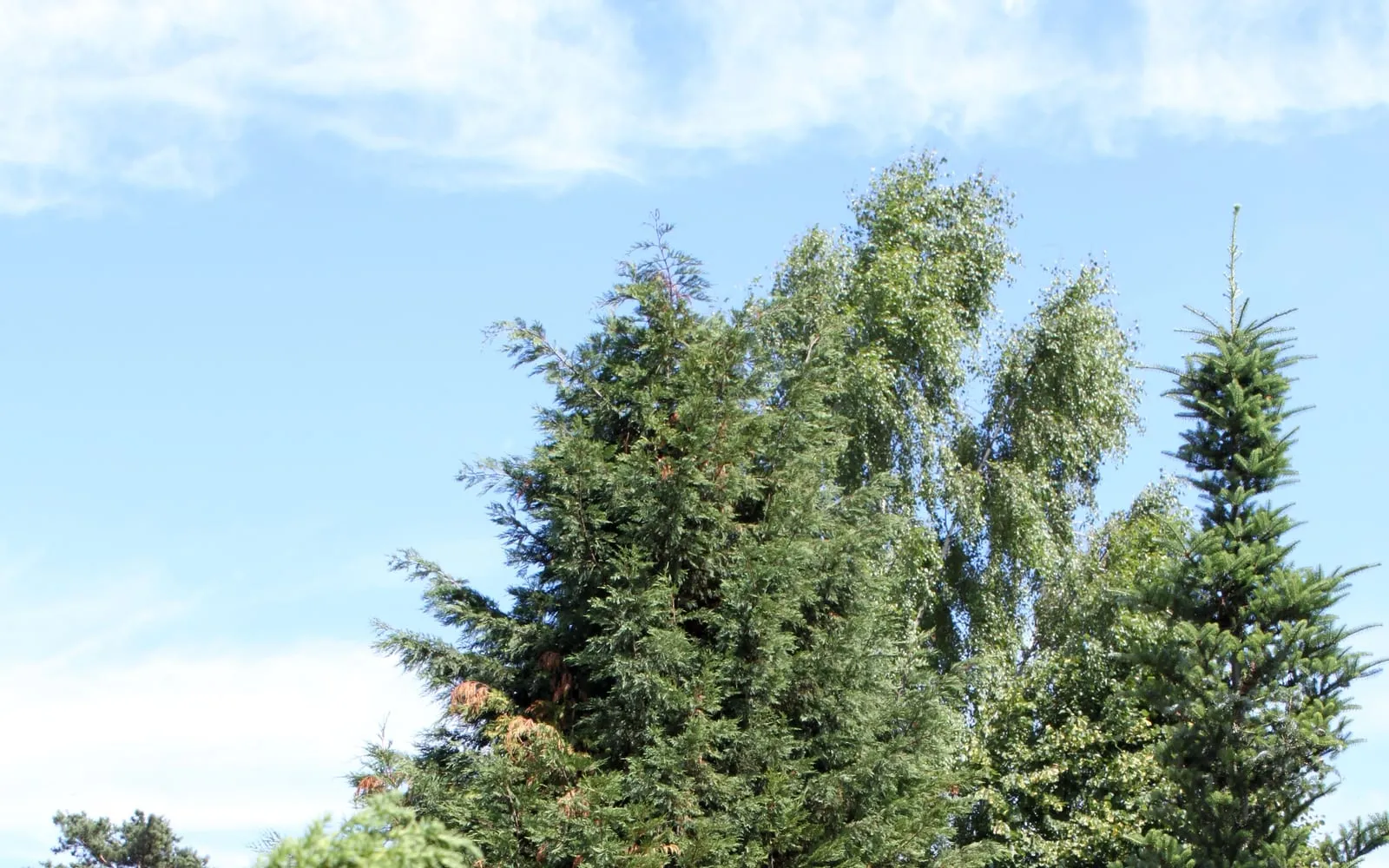
At a glance
- Difficulty
- Easy
- Water
- Regular watering while establishing; drought-tolerant once mature
- Light
- Full sun to part shade; tolerates a wide range of conditions
- Temperature
- Very cold-hardy once established; also tolerates considerable summer heat
- Hardiness
- USDA 6-10, RHS H6, hardy to -20 C
- Type
- Hardy evergreen conifer
- Height
- 35 m or more if left unpruned for its full lifespan, reached in as little as 30-40 years given a growth rate of up to 1 m a year. Almost none are grown to that size deliberately; it is planted as a hedge and kept clipped at 2-4 m, and disputes over the species start when that maintenance stops
- Native to
- Arose in cultivation at Leighton Hall, Wales, in 1888, from a cross between two North American parent species, Monterey cypress and Nootka cypress
Unusually adaptable across both winter cold and summer heat compared with either of its two parent species, which is a large part of why the hybrid became so widely planted. It tolerates coastal exposure, wind and a broad range of soils well, and the same adaptability that makes it forgiving of a poor site is exactly what lets an unmanaged hedge keep growing steadily in conditions that would slow or stop most other conifers.
Hardiness zones describe winter cold alone. Summer heat, humidity, rainfall and the length of the growing season decide as much, so treat the range as the outer limit rather than as a recommendation.
Harmful if eaten
- Do not eat
- Foliage and sap
- Harm from
- Eating it and handling it
- Affects
- People, cats and dogs
Leyland cypress foliage carries the same family of aromatic essential oils as its two cypress parents and the other Cupressaceae covered elsewhere in this collection, and it is not regarded as a seriously toxic plant by the RHS or the ASPCA. Chewing foliage can cause mouth and stomach irritation and mild vomiting in a cat or dog, and handling large quantities during hedge trimming has occasionally been reported to irritate sensitive skin. A separate and better documented issue is airborne pollen: as a widely planted hedging conifer that releases pollen in late winter and early spring, it is a recognised contributor to hay fever symptoms during a season when few other plants are flowering, which affects far more people in practice than its mild foliage toxicity does.
Sources: RHS potentially harmful garden plants, ASPCA toxic and non-toxic plants
About
Leyland cypress exists because two unrelated cypress species, growing side by side on a Welsh estate in 1888, crossed by pure accident. Monterey cypress and Nootka cypress, native to opposite ends of the North American Pacific coast and never known to hybridise in the wild, produced six seedlings that grew faster and larger than either parent, combining qualities neither species had shown alone. Every Leyland cypress grown anywhere since is a cutting or graft descended from that single accidental event, since the hybrid is essentially sterile and cannot be reliably grown from seed.
That speed of growth made it the default fast hedge for screening and privacy across a large part of the temperate world within a century of its discovery, and the same speed is exactly why it became notorious for outgrowing boundaries and provoking disputes between neighbours once routine trimming stops.
Appearance and character
Foliage is dense, feathery and scale-like, intermediate in texture between its two parent species, typically a mid to dark green though several cultivars, notably ‘Castlewellan Gold’, carry golden or bronze-tinted foliage instead.
The natural habit, if never trimmed, is a large, dense, broadly conical to columnar tree holding its foliage to ground level far better than many conifers of similar eventual size, which is precisely the trait that makes it so effective as a hedge and so difficult to remove once established at scale.
Bark is reddish-brown, thin and fibrous, becoming more fissured with age, visible mainly on the rare specimen allowed to grow into a full tree rather than kept as a clipped hedge.
Because the hybrid is sterile, it produces few or no viable cones, and any that do form are usually small, malformed and rarely carry fertile seed, a practical detail that explains why the species spreads only through deliberate propagation rather than self-seeding into the wider landscape the way some other conifers can.
Where it is from
x Cupressocyparis leylandii has no native range at all in the ordinary sense, since it originated in cultivation rather than in the wild. The cross occurred in 1888 at Leighton Hall, near Welshpool in Wales, where Monterey cypress, Cupressus macrocarpa, native to a small stretch of the central California coast, was growing near Nootka cypress, native to the Pacific coast of North America from Alaska to Oregon. The two species do not naturally overlap in range or flowering time in the wild, and the cross is generally accepted to have happened only because both were planted together, out of their native ranges, on the same estate.
C. J. Leyland, after whom the tree is named, propagated and distributed the original seedlings, and the hybrid’s parentage was confirmed and formally described by botanists at Kew shortly afterwards. Later, deliberate repeats of the same cross at other locations produced a small number of additional, genetically distinct clones, but the great majority of Leyland cypress in cultivation worldwide traces to that first 1888 event.
Its hybrid vigour, the tendency for a cross between two distinct species to outperform either parent, is well documented in plant breeding generally and is thought to be a major reason the hybrid grows so much faster than either Monterey or Nootka cypress does alone.
How it grows
Plant in autumn or spring into almost any well-drained soil; this hybrid tolerates a wider range of conditions, including coastal exposure and poorer ground, than either of its two parent species manage individually.
Decide on a final trimmed height and width before planting a hedge, and commit to trimming at least once, ideally twice, every growing season from early on. This is the most important practical advice for the species: a hedge trimmed regularly from a young age stays manageable indefinitely, while one left even a few years without trimming quickly reaches a size that is difficult, expensive and sometimes legally contentious to reduce.
Space plants according to the intended hedge width, typically 60 to 90 cm apart for a standard screening hedge, and water regularly through the first two summers while the root system establishes.
Cut into the current season’s soft green growth only when trimming, since like most conifers in this list it does not reliably resprout from bare, leafless wood cut back into the interior of an overgrown plant, which is part of why an old, neglected hedge is so hard to bring back under control without leaving permanent bare patches.
Through the seasons
Spring brings the fastest flush of soft new growth of the year and is usually the first of two trimming sessions for a maintained hedge, along with pollen release that contributes to hay fever in many climates.
Summer is the peak growing season, and a second trim in mid to late summer keeps a fast-growing hedge in shape through the rest of the year; skipping this second cut is how many hedges quietly gain a metre or more of height in a single season.
Autumn is a reasonable secondary planting window, and it is a good time to assess whether a hedge has been allowed to grow beyond its intended size before winter, since reducing an overgrown hedge is easier while it is not carrying the additional weight of wet snow.
Winter dormancy slows growth considerably, and established plants tolerate real cold well; this is also a sensible season to plan and carry out any significant reduction of an overgrown hedge, working carefully and never cutting back into completely bare wood.
Care difficulty
Easy in terms of what the plant itself demands, and this is exactly the source of the difficulty it is famous for. Leyland cypress tolerates a wide range of soils and conditions, establishes quickly, and needs relatively little beyond routine trimming to stay healthy. The genuine challenge is discipline rather than horticulture: a hedge left untrimmed for even a handful of seasons grows fast enough to become a serious boundary and light problem, and by the time that is noticed, the plant is often already too large to cut back hard without leaving permanent bare patches.
Watering
Water regularly through the first two growing seasons while a new hedge establishes its root system, since this supports the dense, even growth a good screening hedge depends on.
Established plants are reasonably drought-tolerant and rarely need supplemental watering on most soils outside a prolonged dry spell, reflecting the combined toughness of its two parent species.
Avoid permanently waterlogged ground; while more tolerant of a wide range of soils than many conifers, this hybrid still develops root-rot in ground that never drains properly.
Warning signs, diseases and pests
Seiridium canker and the related Coryneum canker are the most serious diseases affecting this species, causing sunken, resin-oozing lesions on branches and stems that can girdle and kill affected wood, sometimes spreading through a whole hedge section by section. Prune out and destroy infected material promptly using clean, disinfected tools between cuts, since both diseases spread readily on contaminated pruning equipment and there is no cure once a stem is fully girdled.
Bagworms build spindle-shaped bags of silk and foliage and feed inside them, capable of causing patchy defoliation in a hedge if not removed by hand or treated while numbers are still low.
Spider mites cause fine speckling and, in a bad infestation, faint webbing, more common in hot, dry conditions, particularly along a hedge next to a paved driveway or south-facing wall.
Root-rot in waterlogged soil is less common in this hybrid than in many conifers given its general toughness, but it still occurs on poorly drained ground, showing as browning from the base of affected sections upward.
Uneven browning along one section of an otherwise healthy hedge is worth investigating for canker before assuming drought or a general pest, since canker spreads section by section in a way drought stress usually does not.
Growing environment
Full sun to part shade both suit it, and it tolerates more shade than many conifers without excessive thinning, though the densest growth comes in full sun.
Almost any well-drained soil is tolerated, including poor or exposed coastal ground, reflecting the combined adaptability of its Californian and Pacific Northwest parent species.
Wind and coastal exposure are both well tolerated, making it a useful windbreak, provided the trade-off, its considerable eventual size and speed, is planned for rather than discovered later.
Space and a firm maintenance plan matter more for this species’ growing environment than almost any specific soil or light requirement, since the practical outcome for most plantings depends far more on trimming discipline than on where exactly it is sited.
Feeding
A balanced, slow-release fertiliser applied once in spring supports a young or recently trimmed hedge through active growth.
Established hedges on reasonable soil need relatively little supplemental feeding, and additional nitrogen feeding is generally best avoided given how fast this species already grows without encouragement.
A hedge showing patchy, uneven growth despite adequate feeding is more likely affected by canker disease or shade competition from a nearby tree than by a genuine nutrient shortfall.
Troubleshooting
How did this hybrid come about? From a single accidental cross in 1888 at Leighton Hall in Wales, between Monterey cypress and Nootka cypress, two North American species that do not naturally overlap in range and had never been known to hybridise before. The resulting hybrid is essentially sterile and grows only from cuttings taken from that original stock and its later propagations.
My hedge has grown far larger than I expected. This is the species’ defining trait: a growth rate of up to a metre a year means even a few seasons without trimming produces dramatic size gains. Regular trimming, at least once and ideally twice a year from early on, is the only reliable way to keep it at a manageable size.
Can I cut an overgrown hedge back hard to reduce its size? With caution. This species does not reliably regrow from completely bare wood, so cutting back into leafless interior growth often leaves permanent bare patches. Reducing height and width gradually over a couple of seasons, staying within the green growth where possible, gives a better result than one drastic cut.
There are sunken, resin-oozing patches on a section of the hedge. This is likely canker, either Seiridium or Coryneum, both capable of spreading section by section through a hedge. Prune out and destroy affected wood promptly with clean tools, and disinfect tools between cuts to avoid spreading it further.
Does this tree produce seed I need to worry about self-seeding? No. The hybrid is essentially sterile and any cones it does produce rarely carry viable seed, so unlike some conifers it does not spread into surrounding land on its own.
Is it really as bad for hay fever as people say? It contributes meaningfully. As a widely planted conifer that releases pollen in late winter and early spring, when few other plants are flowering, it is a recognised source of seasonal allergy symptoms for some people during a period otherwise low in airborne pollen.
Should I choose this species for a new hedge given its reputation? Only with a genuine commitment to trimming it at least once, ideally twice, every year from planting onward. The plant itself is easy to grow and highly adaptable; nearly all of its reputation for causing problems comes from being left unmanaged rather than from anything inherently difficult about growing it.