
Outdoor plant
Cow Parsley
Anthriscus sylvestris
Also known as Queen Anne's lace, Wild chervil, Keck
How to identify cow parsley, Anthriscus sylvestris. The plain green downy stem that separates it from hemlock, when it flowers, growing it in a wild garden and keeping it in check.
At a glance
- Difficulty
- Easy
- Water
- None needed in open ground
- Light
- Partial shade to full sun, and it thrives on shaded verges
- Temperature
- Fully hardy, and in leaf through mild winters
- Hardiness
- USDA 4-8, RHS H7, hardy to -30 C
- Type
- Biennial or short-lived perennial, dying after it seeds
- Height
- 60-150 cm in flower
- Native to
- Europe, western Asia and North Africa, and native to Britain
- Best month
- May in the Northern Hemisphere, November in the Southern Hemisphere
Nitrogen decides where it dominates, and run-off from fertilised fields is why it has taken over verges that once carried a wider flora. It is naturalised across North America and New Zealand and is a listed noxious weed in Washington State and parts of Canada. The important point is not horticultural. It is one of several white-flowered umbellifers that includes hemlock and hemlock water-dropwort, both of which kill, so never eat any of them on a guess.
Hardiness zones describe winter cold alone. Summer heat, humidity, rainfall and the length of the growing season decide as much, so treat the range as the outer limit rather than as a recommendation.
Every month named in this guide is for the temperate Northern Hemisphere. If you garden in the Southern Hemisphere, shift each one by six months, so May becomes November. Closer to the equator the wet and dry seasons matter more than the calendar, and the shift stops being a useful guide.
Skin irritant
- Do not eat
- The sap, which can sensitise skin in sunlight
- Harm from
- Handling it
- Affects
- People
Cow parsley itself is not a poisonous plant. It is not listed by the ASPCA as toxic to cats or dogs, and it has been eaten historically as a pot herb, although that practice is not one to revive for the reason below. The sap contains furanocoumarins, in far smaller quantities than giant hogweed, and contact followed by strong sunlight can produce a phototoxic rash and blistering in susceptible people. Wear gloves and long sleeves if you are clearing a large quantity on a sunny day. The real hazard attached to this plant is misidentification rather than the plant itself. Cow parsley is the template that hemlock, hemlock water-dropwort, fool's parsley and giant hogweed are all mistaken for, and three of those are capable of killing. Anyone thinking of eating a white-flowered umbellifer needs to be certain rather than fairly sure, and the safe rule is not to eat any of them. The identification checks are set out below and are cross-referenced from the hemlock and hemlock water-dropwort guides.
Sources: RHS potentially harmful garden plants, ASPCA toxic and non-toxic plants
About
Cow parsley is the froth of white along every British hedgerow in May. For about six weeks it turns lanes into tunnels of lace, and then it browns off and is forgotten until the following spring.
It is worth a guide for two reasons that pull in opposite directions.
The first is that it is the reference plant for a whole group. Hemlock, hemlock water-dropwort, fool’s parsley and giant hogweed all get called cow parsley by people who have not looked closely, and three of those can kill. Knowing what cow parsley looks like is what makes the others recognisable.
The second is that gardeners increasingly want it. It suits the loose naturalistic planting that has taken over from bedding, and the dark-leaved form ‘Ravenswing’ is sold in nurseries. Growing it deliberately means understanding how freely it seeds.
Appearance and character
A biennial or short-lived perennial, making a rosette of ferny leaves and then throwing up branched flowering stems 60 to 150 cm tall.
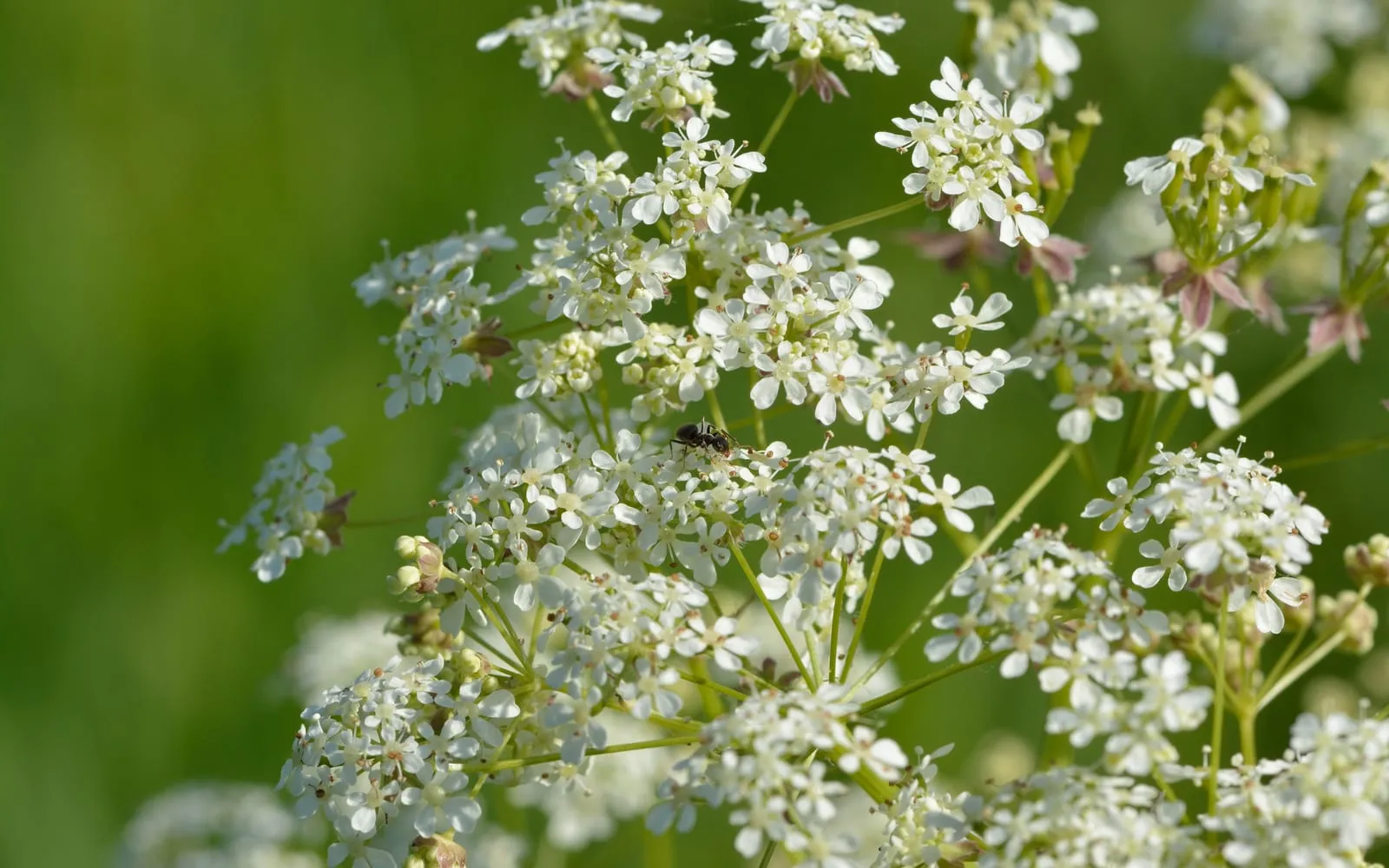
The stem identifies it by what it lacks. It is green, sometimes faintly flushed purple at the very base, hollow, ridged or furrowed, and covered in fine soft downy hairs on the lower part. There are no purple blotches.
Hemlock, by contrast, has a smooth hairless stem with distinct purple to red-brown smudges. That single comparison resolves most confusion.
Leaves are two or three times divided into fine pointed segments, soft, fresh green, and often described as fern-like or carrot-like.
The smell is mild. Crushed foliage smells faintly green and aromatic, a little like parsley or carrot. It does not smell rank or mousy.
Flowers open from April, peak in May and are largely over by mid-June, carried in flat-topped umbels 2 to 6 cm across of small white five-petalled florets. The outer petals of the outer florets are slightly larger, giving the umbel a lacy edge.
Fruits are smooth, narrow, ridged and about 6 to 10 mm long, ripening dark brown.
Timing is a useful check in itself. Cow parsley is the early one. A white umbellifer in full flower in July on a verge is more likely to be hogweed or hemlock.
Where it is from
Europe, western Asia and North Africa, and native throughout Britain.
It grows on roadside verges, hedge banks, woodland edges, riverbanks, churchyards and rough grass, preferring fertile, moist, partly shaded ground.
It has become markedly more dominant on British verges over the last half century. Nitrogen from vehicle exhaust and agricultural runoff favours vigorous coarse plants over fine ones, and cow parsley is a beneficiary. A verge that is now solid cow parsley may once have held cowslips and orchids.
The name Queen Anne’s lace is used for this plant in Britain and for wild carrot in North America, which causes a good deal of confusion in books and online.
How it grows
In a garden setting, plant it in partial shade in ordinary soil and then manage the seeding.
Sow fresh seed in autumn, since it needs a period of cold to germinate. Plants raised from a spring sowing of old seed usually disappoint.
It self-seeds prolifically. A single plant produces a great many seeds and a tolerated colony becomes a takeover within three years.
The control is to cut the stems down as the flowers fade and before the seed ripens, usually in early to mid June. This is the whole of the management.
Deadheading also prolongs the plant’s life, since it is monocarpic in habit and dies after setting seed.
Dig out unwanted plants with the taproot intact. A snapped root regrows.
The dark-leaved ‘Ravenswing’ is grown for its near-black foliage and pink-tinged flowers. It comes reasonably true from seed if you rogue out the green seedlings, and it needs the same deadheading discipline.
Through the seasons
Winter keeps the ferny rosettes green through all but the hardest weather. This is a good time to identify and remove plants.
Spring brings rapid growth from March and flowering from late April.
Summer peaks in May, finishes by mid-June, then sets seed. Cutting down at the end of flowering is the job that matters.
Autumn germinates a new generation of seedlings and the old stems collapse.
Care difficulty
Easy in every sense, which in a border is the problem rather than the virtue.
It needs no watering, no feeding and no winter protection, and it grows on almost any soil.
The work is in stopping it. A plant left to seed produces a colony, and cow parsley outcompetes finer plants quickly on rich ground.
Identification is the other place to take care, and it is straightforward once the stem check is learned.
Watering
None needed. Cow parsley is entirely self-sufficient in a temperate climate.
It prefers moisture-retentive soil and will look tired in a hot dry summer, which does it no lasting harm since it is going over by then anyway.
Warning signs, diseases and pests
The plant itself has few problems worth naming. Downy mildew occasionally greys the foliage and leaf miners make pale tracks in the leaves, and neither matters.
The warning signs to take seriously are about what you are looking at.
Purple or reddish-brown blotches on a smooth hairless stem means hemlock. It is lethal, it flowers later, and it smells rank and mousy when crushed.
A stout grooved stem in or beside water with celery-like leaflets, and a cluster of parsnip-shaped root tubers means hemlock water-dropwort. It is the most poisonous plant in Britain.
A stem thicker than a broom handle with coarse bristly hairs and huge jagged leaves, standing 2 to 5 m tall means giant hogweed. Its sap causes severe burns in sunlight and it must not be touched or strimmed.
A stout ridged bristly stem 1 to 2 m tall with broad coarsely lobed leaves, flowering June to September means common hogweed, which is harmless to touch for most people.
A smaller plant with a fetid smell and long bracts hanging beneath each flower cluster may be fool’s parsley, which is poisonous.
If you are not certain, do not eat it and do not let livestock or children near it.
Growing environment
Partial shade to full sun. It is at its best in the dappled shade of a hedge bank and tolerates open verges.
Any reasonable soil, best on moist fertile ground. It responds strongly to enrichment, which is why it dominates roadsides.
In a garden it suits a wild corner, an orchard, the base of a hedge, or a naturalistic border where a froth of white in May is wanted before the summer planting takes over.
Keep it away from small refined plants, which it will overwhelm.
It is excellent for insects. The open umbels are accessible to short-tongued hoverflies, beetles and solitary bees at a point in the year when little else is out.
Where the aim is a species-rich verge rather than a cow parsley monoculture, the useful measures are cutting and removing the arisings to reduce fertility, and avoiding fertiliser drift.
Feeding
None. Feeding cow parsley makes it larger and more dominant, which is rarely the aim.
The reverse is the useful management. Reducing soil fertility by cutting and removing the cut material each year gradually shifts a verge or meadow away from cow parsley towards finer species.
Troubleshooting
Is this cow parsley or hemlock? Look at the stem. Cow parsley is plain green, downy and ridged with no blotches. Hemlock is smooth, hairless and blotched purple or red-brown. Then crush a leaf. Cow parsley smells faintly of parsley, hemlock smells rank and mousy. Then check the date. Cow parsley peaks in May, hemlock flowers in June and July.
Can I eat it? No, as a rule. It has been used as a pot herb historically, and the plants it resembles include three that can kill. The safe practice is to eat no wild white umbellifer.
It has taken over my border. Cut every stem down as the flowers fade in early June, before the seed ripens, and dig out unwanted plants with the whole taproot.
Will it come back after I cut it? The plant dies after setting seed, so cutting before seed both prevents the next generation and often prolongs the parent plant.
My skin blistered after clearing it. The sap contains furanocoumarins and can cause a phototoxic reaction in sunlight, far more mildly than giant hogweed. Keep the area out of the sun, and get advice if blistering is severe.
How do I grow the black-leaved one? ‘Ravenswing’ needs the same conditions. Sow fresh seed in autumn, and pull out any green-leaved seedlings so the dark form stays dominant.
Why is my verge all cow parsley and nothing else? Enrichment from traffic and runoff favours it. Cutting and removing the arisings each year lowers fertility and gradually lets finer species back in.