
Outdoor plant
Hemlock
Conium maculatum
Also known as Poison hemlock, Poison parsley, Spotted hemlock
How to identify hemlock, Conium maculatum. The purple-blotched stem, the mousy smell, how it differs from cow parsley and hogweed, and what to do if anyone has eaten it.
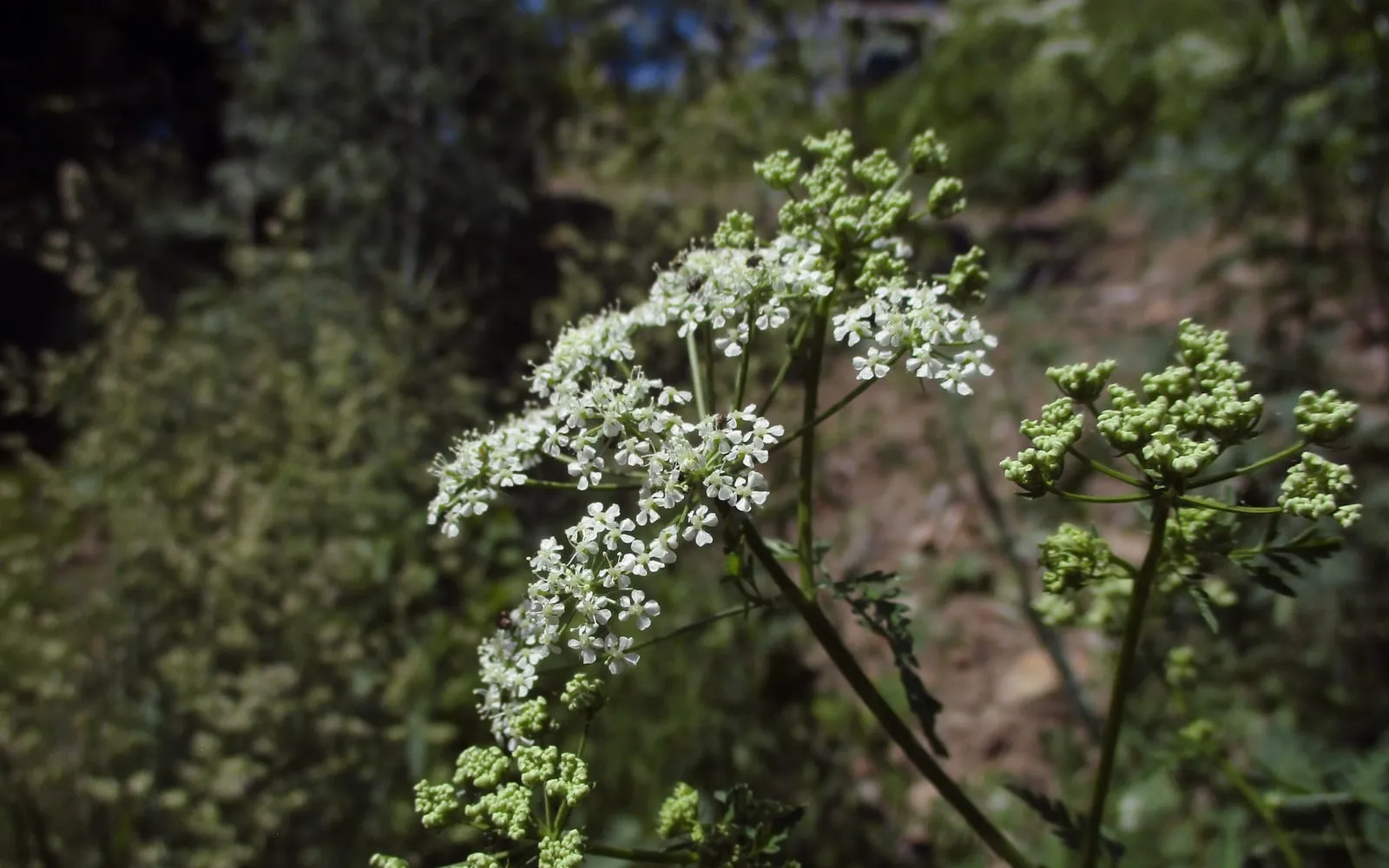
At a glance
- Difficulty
- Easy
- Water
- Not applicable, since this is a plant to remove rather than grow
- Light
- Full sun to partial shade
- Temperature
- Fully hardy, and one of the first plants up in spring
- Hardiness
- USDA 4-9, RHS H7, hardy to -30 C
- Type
- Biennial, making a leaf rosette in year one and flowering in year two
- Height
- 1.5-2.5 m in flower
- Native to
- Europe, North Africa and western Asia, and native to Britain
- Best month
- June in the Northern Hemisphere, December in the Southern Hemisphere
It grows on every continent except Antarctica and nothing in the climate limits it. Learn it rather than grow it. Every part contains coniine, the whole plant is lethal in small quantity to people and livestock, and it is a listed noxious weed across most of the western United States, in New Zealand and in several Australian states. The purple-blotched stem and the mousy smell of crushed leaves are the checks that separate it from the harmless white umbellifers it grows beside.
Hardiness zones describe winter cold alone. Summer heat, humidity, rainfall and the length of the growing season decide as much, so treat the range as the outer limit rather than as a recommendation.
Every month named in this guide is for the temperate Northern Hemisphere. If you garden in the Southern Hemisphere, shift each one by six months, so June becomes December. Closer to the equator the wet and dry seasons matter more than the calendar, and the shift stops being a useful guide.
Poisonous if eaten
- Do not eat
- Every part, and the root and unripe seed most of all
- Harm from
- Eating it and handling it
- Affects
- People, cats, dogs and horses
Hemlock is one of the most poisonous plants in Europe and North America alike, and it kills people. Every part contains piperidine alkaloids, chiefly coniine and gamma-coniceine, and the root and green seed carry the highest concentrations. The alkaloids block neuromuscular transmission, so poisoning produces burning in the mouth, salivation, vomiting, muscle weakness that begins in the legs and moves upwards, and eventually paralysis of the breathing muscles. The mind usually stays clear throughout, which is what makes the historical accounts of the death of Socrates recognisable. Onset is typically within thirty minutes to three hours. A few leaves can poison an adult, and the root has been eaten in mistake for parsnip or wild carrot with fatal results. Treat any suspected ingestion as a medical emergency, get help immediately, and take a photograph or a bagged sample of the plant with you. There is no antidote and treatment is supportive, so speed matters. Livestock are poisoned by hemlock cut into hay and silage, where it stays toxic after drying. Handling the plant is much less dangerous than eating it, though the sap irritates skin and the alkaloids are absorbed to a limited degree, so wear gloves and long sleeves and do not strim it, which aerosolises the sap. Never burn it.
Sources: RHS potentially harmful garden plants, ASPCA toxic and non-toxic plants
About
This is a guide to recognising hemlock and getting rid of it, rather than to growing it. Nobody should plant this.
Hemlock is native across Europe and has naturalised on every continent except Antarctica. It grows on riverbanks, in ditches, along motorway verges, on waste ground and increasingly on the edges of gardens, and most people walk past it every year without knowing.
The danger is that it looks like several harmless plants. Cow parsley, wild carrot, sweet cicely, chervil and ground elder are all white-flowered umbellifers of the same rough shape, and hemlock is the one that kills. Foragers have died from this confusion, and children have been poisoned by making pea-shooters from the hollow stems.
Three features separate it, and you want all three rather than any one. Purple or reddish-brown blotches on a smooth hairless stem, a rank mousy smell when the leaves are crushed, and greater height and later flowering than cow parsley.
Appearance and character
A biennial, forming a low rosette of ferny leaves in its first year and a tall branched flowering plant in its second, reaching 1.5 to 2.5 m.
The stem is the identification. It is round, hollow, ridged, completely hairless, and marked with purple to reddish-brown blotches and streaks, heaviest towards the base. The blotches are irregular smudges rather than neat spots. On a young plant they can be faint, so check low down.
Leaves are large, triangular in outline, and divided three or four times into fine toothed segments, giving a lacy, carrot-top or fern-like appearance. They are a glossy bright to dark green.
The smell is distinctive and unpleasant. Crushed foliage smells rank and musty, and the usual description is mouse urine. Cow parsley smells faintly of parsley or of nothing much.
Flowers open from June to July in flat-topped umbels 3 to 6 cm across, white and made up of many tiny five-petalled florets. Hemlock flowers later than cow parsley, which is largely finished by early June.
Fruits are small, green, ridged and paired, ripening brown.
Where it is from
Europe, North Africa and western Asia, and native throughout Britain.
Its favoured ground is damp, fertile and disturbed. Riverbanks, ditches, the edges of arable fields, roadside verges, railway land, farmyards and neglected corners.
It has spread noticeably along road networks in recent decades, helped by verge cutting regimes and nutrient-rich runoff.
Hemlock is the plant of the Athenian state poison, and the account of Socrates dying with a clear mind as paralysis climbed from his feet matches the pharmacology closely enough that the identification is generally accepted.
The species name maculatum means spotted, which is the plant telling you what to look for.
How it grows
The only reason to know how it grows is to remove it before it seeds.
It germinates in autumn and spring, makes a rosette, overwinters as green foliage and runs up to flower the following summer. It is often one of the first green plants visible in a hedge bottom in February.
A single plant produces many thousands of seeds, and the seed stays viable in soil for several years, so removal takes more than one season.
Remove small plants by pulling or digging the whole root out, wearing gloves, long sleeves and eye protection. The root is a pale taproot and will regrow if snapped off.
Cut larger stands before the flowers set seed, which is the single most useful intervention. Repeat cutting through the season weakens the plant.
Bag the material and dispose of it through the council green waste route or as directed locally. Do not compost it, do not feed it to animals, and never burn it, since the smoke carries the alkaloids.
Do not strim or mow it. That aerosolises sap and throws fragments about, and strimmer operators have been made unwell this way.
Follow up the same ground for three or four years, since the seed bank outlasts the first clearance.
Through the seasons
Winter is when the rosettes are visible and easiest to dig, with little else growing around them. This is the best time to work.
Spring brings rapid growth. Ferny green foliage runs up from March and the stems extend through May.
Summer is flowering, from June to July, and the point at which cutting must happen if seed is to be prevented.
Autumn drops the seed and the plant dies, leaving dry hollow stems that stay standing through winter. New rosettes germinate around it.
Care difficulty
Easy to identify once you know the three features, and easy to remove if you catch it early.
The difficulty is entirely in the consequence of getting it wrong. This is a plant where a misidentification kills, so the standard is certainty rather than confidence.
If you are foraging and not certain, do not eat it. That rule sounds obvious and it is the one that fails, because hemlock most resembles the plants people most want to pick.
Persistence is the other difficulty. The seed bank means a cleared area needs watching for several years.
Watering
Not applicable. This is not a plant to cultivate.
Its presence tells you something about the ground. Hemlock indicates damp, fertile, disturbed soil, often with high nitrogen, so it appears where ground has been cleared, tipped on or manured.
Improving drainage and establishing dense competitive grass cover both reduce its foothold over time.
Warning signs, diseases and pests
The warning signs that matter here are signs of poisoning rather than of ill health in the plant.
In people, symptoms begin within about thirty minutes to three hours. Burning in the mouth and throat, excessive salivation, nausea and vomiting, then progressive muscle weakness starting in the legs, dilated pupils, a slowing then racing pulse, and in severe cases paralysis of the muscles used for breathing. The mind commonly stays clear.
If anyone has eaten any part of this plant, treat it as a medical emergency. Do not wait for symptoms and do not try to make them sick. Take a photograph of the plant, or a bagged piece of it, to hospital. There is no antidote, treatment is supportive and it works, so getting there early is what decides the outcome.
In dogs and cats, expect drooling, vomiting, muscle tremors, weakness and difficulty breathing. Ring a vet at once.
In horses and cattle, hemlock is a serious hazard in hay and silage, where drying does not destroy the alkaloids. Check pasture and field margins before cutting.
Skin contact causes irritation in some people. Wash the area, and get advice if a large amount of sap has been on skin for a long period.
Growing environment
Hemlock is telling you about your ground rather than asking for anything.
It favours damp fertile soil on riverbanks, ditch edges, field margins, roadside verges and disturbed waste ground.
It tolerates sun and partial shade and is fully hardy.
Check for it wherever ground has recently been disturbed, where soil has been imported, and along watercourses. New building plots and reseeded verges are common places for it to appear.
Where children or livestock have access, treat removal as a priority rather than a tidying job.
Feeding
Not applicable. Rich nitrogen-heavy ground is exactly what favours it, so muck heaps, manure runoff and tipped topsoil all encourage it.
Reducing fertility and establishing thick perennial grass cover are the long-term controls on a site that keeps producing it.
Troubleshooting
How do I tell hemlock from cow parsley? Three checks together. Hemlock has purple or red-brown blotches on a smooth hairless stem, cow parsley has a plain green stem that is ridged and downy with no blotches. Hemlock smells rank and mousy when crushed, cow parsley does not. Hemlock is taller and flowers in June and July, cow parsley peaks in April and May.
How do I tell it from hogweed? Common hogweed has a thick ridged stem covered in coarse bristly hairs and broad coarsely lobed leaves. Hemlock is hairless with finely divided lacy leaves. Giant hogweed is far bigger and burns skin in sunlight.
How do I tell it from hemlock water-dropwort? Water-dropwort grows in and beside water, has celery-like leaves and a cluster of pale parsnip-shaped root tubers. Hemlock has a single pale taproot and lacy leaves. Both are lethal, so neither is a plant to test by tasting.
Someone has eaten it. Get medical help now. Do not wait for symptoms and do not induce vomiting. Take the plant or a photograph with you.
My dog chewed a stem. Ring a vet immediately. Take a sample or photograph.
Can I strim it? No. Strimming aerosolises the sap and throws fragments about. Pull or dig small plants, cut larger stands with hand tools, and wear gloves, long sleeves and eye protection.
Can I burn it? No. The smoke carries the alkaloids. Bag it and use the council green waste route.
It keeps coming back. The seed stays viable in soil for several years. Expect to work the same ground for three or four seasons and stop it flowering each year.