
Edible
Camu Camu
Myrciaria dubia
Also known as Camu-camu, Caçari, Araça d'agua
How to grow camu camu, Myrciaria dubia. The Amazon shrub that spends half the year underwater, one of the richest sources of vitamin C on earth, and a fruit too sour to eat.
At a glance
- Difficulty
- Moderate
- Water
- Two or three times a week, and it minds wet feet less than anything here
- Light
- Full sun
- Temperature
- Minimum 12 deg C. Damaged below 10 deg C
- Humidity
- High
- Hardiness
- USDA 10-12, RHS H1b, hardy to 12 C
- Type
- Tender evergreen shrub or small tree
- Height
- 3-8 m in the open, 1.5 m in a pot
- Native to
- the Amazon basin, Peru, Brazil
- Best month
- June and July in the Northern Hemisphere, December and January in the Southern Hemisphere
Amazon river margins, where it stands in floodwater for four or five months a year. Few fruit trees tolerate that, and it is one of the few crops suited to seasonally flooded ground. No frost.
Hardiness zones describe winter cold alone. Summer heat, humidity, rainfall and the length of the growing season decide as much, so treat the range as the outer limit rather than as a recommendation.
Every month named in this guide is for the temperate Northern Hemisphere. If you garden in the Southern Hemisphere, shift each one by six months, so June becomes December. Closer to the equator the wet and dry seasons matter more than the calendar, and the shift stops being a useful guide.
Not known to be toxic
- Safe to eat
- The whole fruit, though it is far too sour to eat in quantity raw
Camu camu is not toxic and nothing in the plant is listed as harmful to people or to cats and dogs. The fruit's chemistry matters for a different reason. It contains one of the highest concentrations of vitamin C recorded in any fruit, in the region of 2 to 3 g per 100 g of pulp, which is roughly fifty times an orange. That acidity makes it unpalatable raw and hard on tooth enamel, and the fruit is diluted into drinks or dried into a powder rather than eaten. Very large doses of vitamin C cause stomach upset and diarrhoea, and anyone with a history of oxalate kidney stones should be careful with concentrated supplements. As a juice or a spoonful of powder it is food.
Sources: ASPCA toxic and non-toxic plants, RHS potentially harmful garden plants
About
Camu camu grows in water. The shrub lines the seasonally flooded margins of Amazon rivers, and for four to five months of the year it stands with its lower stems submerged, flowering and fruiting as the water falls.
The fruit is a small purple-red berry, and its chemistry is what made it famous. Camu camu holds among the highest concentrations of vitamin C measured in any fruit, in the order of fifty times an orange, which is why almost all of it is dried into powder for the supplement trade.
Nobody eats it raw. The acidity is severe enough to be unpleasant, and Peruvian and Brazilian use is entirely as a juice, an ice cream or a powder.
Appearance and character
A multi-stemmed evergreen shrub or small tree, 3 to 8 m in the open, branching from the base into a bushy outline.
Bark is smooth, pale brown to grey, and flakes in thin patches like other myrtles.
Leaves are opposite, lance-shaped to elliptic, 3 to 10 cm, glossy dark green, thin, and pointed at the tip. New growth flushes red.
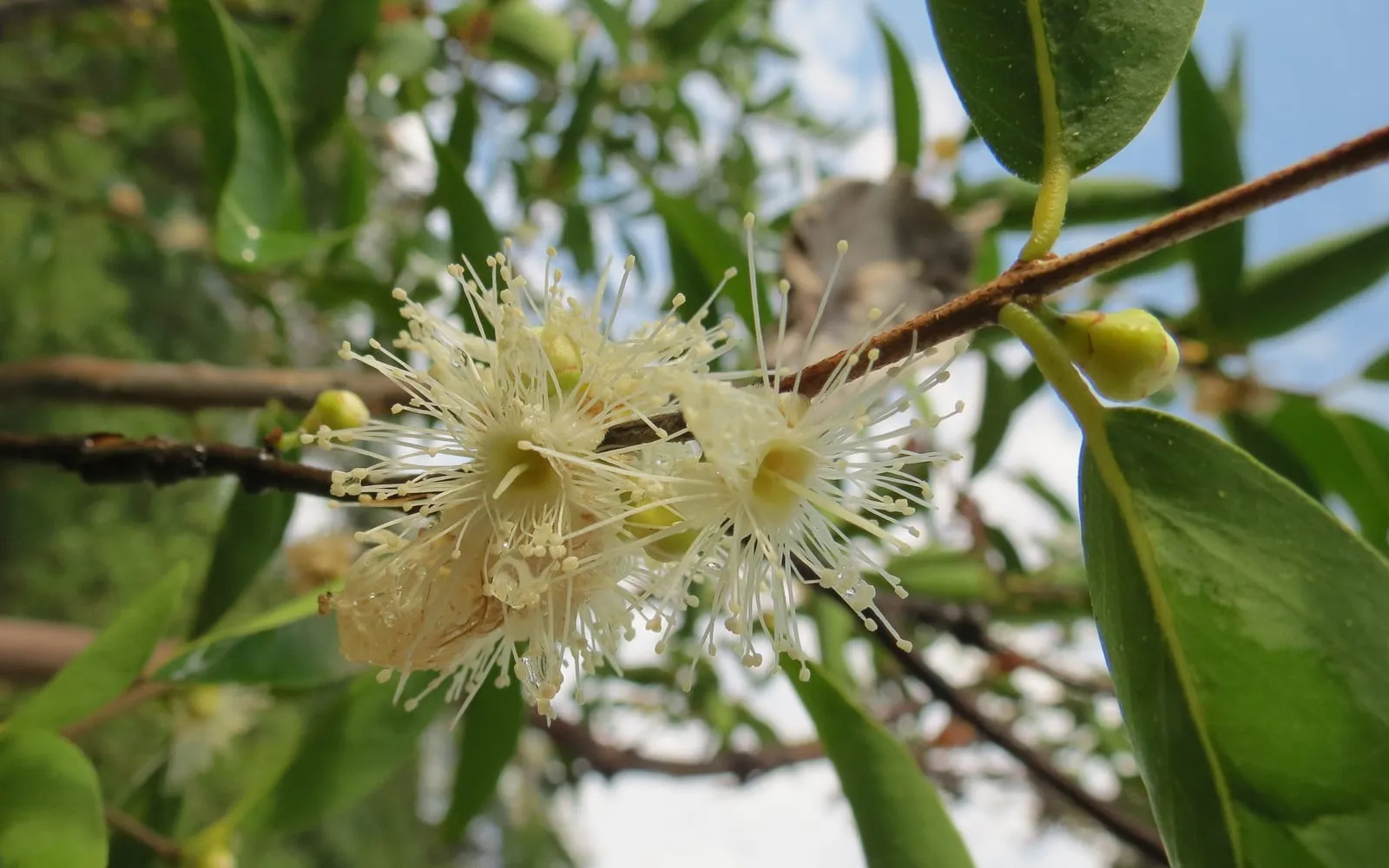
Flowers are small, white, with a boss of long white stamens, borne in clusters along the stems, and heavily worked by bees.
Fruit is round, 2 to 3 cm, ripening from green through red to a deep purple-red, with a thin glossy skin.
Flesh is pale yellow-pink, juicy and intensely acid, with one to four flattened seeds.
The plant tolerates its roots being submerged for months, which almost nothing else in cultivation does, and that is the character that defines it.
Where it is from
Camu camu is native to the Amazon basin, in Peru, Brazil, Colombia and Venezuela, growing along the margins of rivers and oxbow lakes in seasonally flooded forest.
Local people harvested it from wild stands for generations, picking from canoes during the flood.
Its vitamin C content was measured in the mid twentieth century and turned a local fruit into an export commodity. Peru promoted planting and processing from the 1990s, and the dried powder now reaches health food shops across Europe and North America.
Peru remains the largest producer, with Brazil next, and much of the crop is still harvested from wild or semi-wild stands rather than orchards.
Temperate markets see camu camu as a powder in health food shops and never as fresh fruit, which does not travel.
How it grows
Take the seed straight out of a ripe fruit and sow it the same week. It stays viable for a matter of days once cleaned of pulp, and warmth of 24 to 30 deg C brings it up over the following month or two.
Grow in rich moisture-retentive acid compost.
Give full sun and a minimum of 12 deg C.
Water heavily. Camu camu is the one plant in this collection that tolerates standing water, and a pot stood in a saucer of water suits it in warm weather.
Keep humidity high.
Use rainwater and an acid mix, since the species yellows on hard water.
Feed monthly from April to September with an ericaceous feed.
Prune lightly to keep the bush compact.
Expect fruit in three to five years from seed, which is fast for a fruit tree, and a warm greenhouse may give two crops a year.
Through the seasons
Winter is a warm rest above 12 deg C, watered steadily and unfed.
Spring brings a growth flush and flowering. Repot and start feeding.
Early summer is fruit set, and fruit develops fast.
Midsummer is harvest.
Late summer brings a second flowering in a warm house.
Autumn is when to stop feeding while keeping the compost damp.
Care difficulty
Moderate, and easier than most of these plants.
Watering is where it differs from everything else here. Camu camu tolerates waterlogging, so the usual anxiety about drainage does not apply and a pot can stand in water through the summer.
Minimum 12 deg C is the floor.
Acid compost and rainwater are needed, or the leaves yellow.
Fruit comes in three to five years from seed.
Size suits a pot, since the plant is naturally a bush.
The disappointment is culinary. The fruit is far too sour to eat, so the crop is a juice or a powder rather than something to pick and eat.
Watering
Water two or three times a week in growth, keeping the compost thoroughly damp.
Stand the pot in a saucer of water through warm weather, which suits this species and would kill most others here.
Reduce in winter, keeping the compost damp without standing water in the cold.
Keep humidity high.
Use rainwater, since hard water brings iron shortage.
Never let it dry out, which checks it badly.
Water more during fruit swell.
Warning signs, diseases and pests
Yellowing between green veins is iron shortage on hard water or compost that is not acid enough.
Leaf drop follows drought, which this species minds far more than wet.
Brown leaf edges mean dry air.
Leaf drop after a cold spell is chill damage below 10 deg C.
Brown limpets on the stems are scale.
White fluff in the leaf axils is mealybug.
Fine webbing on the leaves is spider mite.
Fruit too sour to eat is the species rather than a fault.
Standing water in cold weather still rots the roots, despite the tolerance in warmth.
Growing environment
A heated greenhouse or conservatory. There is no outdoor option outside the tropics.
Minimum 12 deg C, with 25 to 32 deg C for growth and fruit.
Full sun.
High humidity.
Rich moisture-retentive acid compost.
pH from 4.5 to 6.0.
Rainwater rather than tap water.
A pot that can stand in a saucer of water through summer.
Feeding
Feed monthly from April to September with an ericaceous liquid feed containing iron.
Add sequestered iron at the first yellowing between the veins.
Stop feeding at the end of September.
Give nothing through winter.
Top-dress or repot each spring.
Add magnesium if older leaves yellow between the veins.
Keep feeding steady across a season with two crops.
Troubleshooting
Can I eat it raw? You can and you will not enjoy it. Camu camu is among the most acid fruits in cultivation and is diluted into juice or dried into powder instead.
How much vitamin C does it have? Roughly 2 to 3 g per 100 g of pulp, which is in the order of fifty times an orange and among the highest recorded in any fruit.
Can I stand the pot in water? In warm weather, yes. This is a plant of seasonally flooded Amazon forest and it spends months with its roots submerged. In cold weather drain it, since cold standing water still rots roots.
The leaves are yellow between the veins. Iron shortage from hard water. Use rainwater and ericaceous compost.
How soon will it fruit? Three to five years from seed, and a warm greenhouse may give two crops a year.
Is the powder in health food shops the same thing? Yes, dried and milled fruit. Peru processes most of it, much of it harvested from wild stands.
The plant dropped its leaves after I forgot to water it. Camu camu has no drought tolerance. Wet is fine and dry is not.
Is there a risk in taking a lot of the powder? Large doses of vitamin C cause stomach upset, and anyone with a history of oxalate kidney stones should be careful with concentrated supplements.
Camu Camu problem guides
Not sure what is wrong? See the common vegetable pests guide.