
Edible
Milk Thistle
Silybum marianum
Also known as St Mary's thistle, Blessed milk thistle, Marian thistle
How to grow milk thistle, Silybum marianum. The white-marbled leaves, the seed used for silymarin, and why it poisons cattle on rich ground.
At a glance
- Difficulty
- Easy
- Water
- Rarely once established
- Light
- Full sun
- Temperature
- Fully hardy. The rosette overwinters outdoors
- Hardiness
- USDA 4-9, RHS H6, hardy to -20 C
- Type
- Hardy annual or biennial
- Height
- 60-150 cm, occasionally 2 m
- Native to
- the Mediterranean
- Best month
- June and July in the Northern Hemisphere, December and January in the Southern Hemisphere
Poor dry ground suits it and it seeds prolifically, which is why it is a declared noxious weed across southern Australia, New Zealand and California, where it takes over pasture and poisons stock through nitrate accumulation. Cut the heads before they open if you grow it.
Hardiness zones describe winter cold alone. Summer heat, humidity, rainfall and the length of the growing season decide as much, so treat the range as the outer limit rather than as a recommendation.
Every month named in this guide is for the temperate Northern Hemisphere. If you garden in the Southern Hemisphere, shift each one by six months, so June becomes December. Closer to the equator the wet and dry seasons matter more than the calendar, and the shift stops being a useful guide.
Toxic if eaten
- Safe to eat
- Young leaves with the spines cut off, stems and flower bases
- Do not eat
- The foliage grown on rich ground, which accumulates nitrate
- Harm from
- Eating it and handling it
- Affects
- People and horses
Milk thistle has two separate hazards and they are easy to confuse. The first is mechanical: the spines are stiff and sharp and a large plant needs gauntlets to handle. The second is chemical and it matters to livestock rather than to gardeners. Milk thistle accumulates nitrate from rich ground, and cattle and sheep grazing a heavy stand have been poisoned and killed by it, with the nitrate converted to nitrite in the rumen. Horses are also at risk. That is a farm problem rather than a garden one, and it is the reason the plant is a declared weed in parts of Australia and the United States. For people the leaves and stems are eaten after the spines are trimmed, and the seed is the source of silymarin, sold widely as a herbal liver preparation. The European Medicines Agency has assessed milk thistle fruit as a traditional herbal medicine. Do not plant it in a paddock.
Sources: RHS potentially harmful garden plants, European Medicines Agency, Silybum marianum
About
Milk thistle is the thistle with white marbling on its leaves, as though milk had been spilled across them, and the medieval story that gave it that name says the milk was the Virgin’s. It is a striking plant in a border, forming a rosette nearly a metre across before it runs up to flower.
Its modern reputation rests on the seed. Milk thistle seed contains silymarin, a group of compounds sold widely as a liver preparation, and the seed is grown commercially for extraction in eastern Europe and China.
In a garden it is easy, self-sufficient and generous with its seed. The two things to plan for are the spines, which need gauntlets, and the seedlings, which arrive in quantity and are unpleasant to weed out once they are past infancy.
Appearance and character
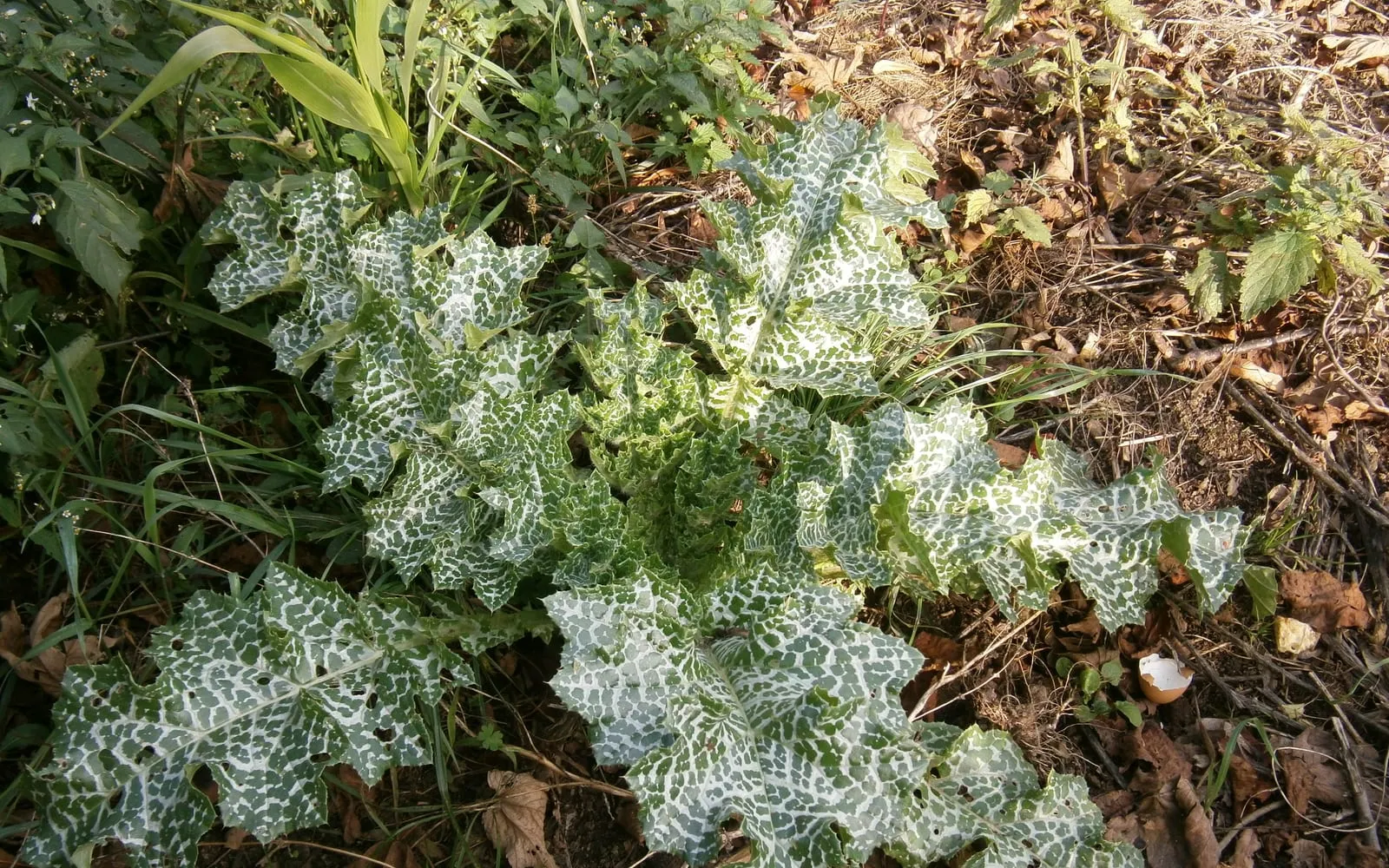
In its first phase, a flat rosette up to 1 m across of large, glossy, deeply lobed leaves, spined along every edge and marbled with irregular white veining over the green.
The marbling is the identification character and no other thistle has it.
The flowering stem is stout, ridged and branching, rising to 1.5 m and sometimes 2 m.
Flowers are large purple thistle heads, 4 to 6 cm across, each cupped in a ring of stiff bracts that curve outwards and end in long yellow spines.
Seed is black and shining with a ring of white hairs, ripening in late summer.
The whole plant is armed. The spines are stiff, sharp and numerous, and they make clearing a stand at the end of the season a job for thick gloves and long sleeves.
Where it is from
Milk thistle is native to the Mediterranean, north Africa and western Asia, growing on dry disturbed ground, roadsides and overgrazed pasture.
In Britain it is an introduction rather than a native, established on waste ground mostly in the south, and it was grown in gardens long before it escaped.
The white marbling produced the legend and the names. Medieval tradition held that milk from the Virgin Mary fell on the leaves, giving the plant its marks, its English name and its specific epithet marianum.
Its medicinal use for liver complaints is old and continuous. Dioscorides recorded it, medieval herbals repeat it, and nineteenth century eclectic medicine in America used it heavily.
Modern extraction began in the 1960s, when silymarin was isolated and characterised, and the seed has been grown as a pharmaceutical crop ever since, principally in Hungary, Romania, Austria and China.
Elsewhere it became a serious agricultural weed. Australia, New Zealand and much of the western United States list it as noxious, chiefly because of the nitrate poisoning risk to stock.
How it grows
Sow direct where it is to grow, in spring or early autumn. The taproot resents disturbance.
Sow at 1 cm and thin to 60 cm. It is a large plant and crowding it produces mildew.
An autumn sowing makes a stronger rosette and a taller earlier flower stem.
Choose an open sunny position on ordinary free-draining ground. Rich soil grows a bigger plant with more nitrate in it.
Water until established, then leave it.
Wear gauntlets whenever you handle it.
Cut the seed heads off before they open if you want to limit self-seeding, which is otherwise generous.
Harvest seed in late summer by cutting whole heads as they start to open and drying them in paper bags. The white pappus separates easily once dry.
Pull the plants after seeding. They are annual or biennial and die once they have flowered.
Through the seasons
Winter is a flat rosette sitting through the cold, entirely hardy, and quite handsome in a bare border.
Spring brings the flower stem in an autumn-sown plant, and the first sowing for a new one.
Early summer is when the stem extends and buds form. The plant is at its most striking now.
Midsummer is flowering, from June to August, and the heads are worked by bumblebees.
Late summer ripens the seed. Collect it, or cut the heads off before the goldfinches and the wind distribute it for you.
Autumn ends the plants. Cut them down in gauntlets and clear the debris, which stays spiny long after it dries.
Care difficulty
Easy. Milk thistle grows itself and the work is all at the two ends.
Handling is the practical difficulty. The spines are sharp enough to go through ordinary gardening gloves, so gauntlets and long sleeves are the right kit for sowing, weeding around it and clearing it away.
Self-seeding is heavy. One plant produces a large quantity of viable seed and the seedlings are spiny from an early stage, so weeding them is unpleasant. Cut the heads off before they open.
Rich soil is worth avoiding for two reasons. It makes a lax oversized plant, and it raises the nitrate content of the foliage, which is what makes the plant dangerous to grazing animals.
Beyond that it needs no feeding, no watering, no staking and no protection.
Do not grow it anywhere livestock can reach it.
Watering
Water the seedlings until they are established, then stop.
An established plant needs no watering in a temperate climate. The taproot goes deep and the plant comes from dry Mediterranean ground.
Water in a genuine drought if the rosette is wilting by mid-morning.
Water at the base rather than over the rosette, which holds water in its centre and rots.
A container is a poor choice for a plant this size. If you use one, make it deep and wide and water weekly.
Warning signs, diseases and pests
Aphids build dense colonies on the flower buds in early summer and bring in ladybirds. They rarely need action.
Slugs graze the young rosette and can destroy a seedling.
Powdery mildew whitens the rosette leaves in late summer, usually as the plant is finishing.
A rosette rotting in the centre over winter means water sat in it. Site it somewhere free-draining.
Plants that stay small and never flower were sown too late or crowded.
Seedlings across the bed mean the heads opened. Cut them earlier.
Spines in your hands are the plant behaving as designed. Wear gauntlets.
Growing environment
Full sun. Milk thistle in shade makes a thin rosette and a poor flower stem.
Free-draining soil of ordinary fertility. It grows on disturbed dry ground in the wild and does not want a rich bed.
pH from 6 to 8. It is unfussy.
Give it a metre of space. A mature rosette is very wide and it will smother anything planted close.
Keep it away from paths, seats and play areas because of the spines, and away from any ground grazed by livestock because of the nitrate.
For pollinators the flowers are good, drawing bumblebees through July, and goldfinches take the seed if you leave the heads standing.
Feeding
None, and there is a specific reason beyond the usual one. Rich ground raises the nitrate concentration in the foliage, which is the mechanism behind the livestock poisonings this plant is known for.
Do not add manure or high-nitrogen fertiliser.
Poor ground gives a more compact plant with better leaf markings.
A container plant takes a weak balanced feed once in spring.
Ground that grew milk thistle needs nothing before the next crop.
Troubleshooting
What are the white markings? Natural variegation along the veins, and the feature that names the plant. It is not a disease or a virus.
It seeded everywhere. Cut the heads off before they open. The seedlings are spiny early, so deal with them small.
Can I eat it? The young leaves with the spines trimmed off, the peeled stems and the flower bases are all eaten, in the same way as cardoon. Avoid plants grown on heavily manured ground because of the nitrate.
Is it safe near animals? Not in a paddock. Milk thistle accumulates nitrate and has killed cattle and sheep grazing heavy stands. In an ordinary garden with a dog, the spines are the only realistic issue.
How do I harvest the seed? Cut whole heads as they start to open, dry them in paper bags, then rub out the seed and separate it from the white pappus.
Is it the same as blessed thistle? No. Blessed thistle, Cnicus benedictus, is a smaller yellow-flowered annual. The names overlap because milk thistle is sometimes called blessed milk thistle.
The rosette rotted over winter. Water sat in the crown. Plant on free-draining ground next time.