
Edible
Pistachio
Pistacia vera
Also known as Pistachio nut, Pesteh, Green almond, Fistik
How to grow pistachio, Pistacia vera. Why you need two trees, the split shell that means the nut is ready, and the summer heat a cool climate cannot supply.
At a glance
- Difficulty
- Difficult
- Water
- Deeply and infrequently, and it tolerates drought
- Light
- Full sun, and a great deal of it
- Temperature
- Long hot dry summers above 30 deg C, and cold winters for chilling
- Humidity
- Low. Summer humidity brings disease
- Hardiness
- USDA 7-10, RHS H4, hardy to -15 C
- Type
- Hardy deciduous tree, though it needs a climate few regions can offer
- Height
- 6-10 m
- Native to
- Central Asia, Iran, Turkmenistan, Afghanistan
- Best month
- March and October in the Northern Hemisphere, September and April in the Southern Hemisphere
It wants two things that rarely occur together, a winter cold enough to supply about 1000 chill hours and a summer long, hot and above all dry enough to ripen the nuts. Humidity brings Botryosphaeria blight and splits the crop, so it fails in maritime climates that suit almost everything else. Trees are male or female, and it takes seven to ten years to bear.
Hardiness zones describe winter cold alone. Summer heat, humidity, rainfall and the length of the growing season decide as much, so treat the range as the outer limit rather than as a recommendation.
Every month named in this guide is for the temperate Northern Hemisphere. If you garden in the Southern Hemisphere, shift each one by six months, so March becomes September. Closer to the equator the wet and dry seasons matter more than the calendar, and the shift stops being a useful guide.
Skin irritant
- Safe to eat
- The kernel
- Do not eat
- The sap and the hull, which are irritant, and mouldy nuts, which carry aflatoxin
- Harm from
- Eating it and handling it
- Affects
- People, cats and dogs
Pistachio kernels are food. Two cautions attach to the plant and one to the stored nut. Pistacia is in the Anacardiaceae with cashew, mango and poison ivy, and the sap and the fleshy hull around the shell contain urushiol-type compounds that raise a contact rash on sensitive people, so pruning is a job for gloves. Pistachio is also a standard tree nut allergen. The stored nut carries a separate risk. Pistachios are among the crops most prone to contamination with aflatoxin, a carcinogenic mould toxin produced by Aspergillus, which is why imported consignments are tested and why discoloured, shrivelled or musty-smelling nuts should be thrown away rather than eaten. Never eat a nut that smells mouldy. The ASPCA advises against feeding nuts to cats and dogs generally, and mouldy nuts of any kind are a serious hazard to dogs.
Sources: NHS guidance on food allergy, ASPCA people foods to avoid feeding your pets, RHS potentially harmful garden plants
About
Pistachio wants a climate of extremes. Long summers above 30 deg C with almost no rain, and winters cold enough to give the tree 600 to 1,500 hours below 7 deg C. Iran, Turkey, Syria and California’s Central Valley all provide that. A maritime climate provides neither half.
Trees are male or female and never both, so a crop needs at least one male within pollen range of every eight or so females. Wind carries the pollen, and a gardener with one tree will never see a nut.
The split shell is the plant advertising that it is ready. As the kernel swells, it forces the shell open along a natural seam, and Iranian growers call the result a laughing pistachio while American ones say it is smiling. A nut that never splits is usually one where the kernel never formed.
Alternate bearing is the trade’s other problem. A pistachio that crops heavily one year sets few flower buds for the next, so orchards swing between glut and famine on a two-year cycle.
Appearance and character
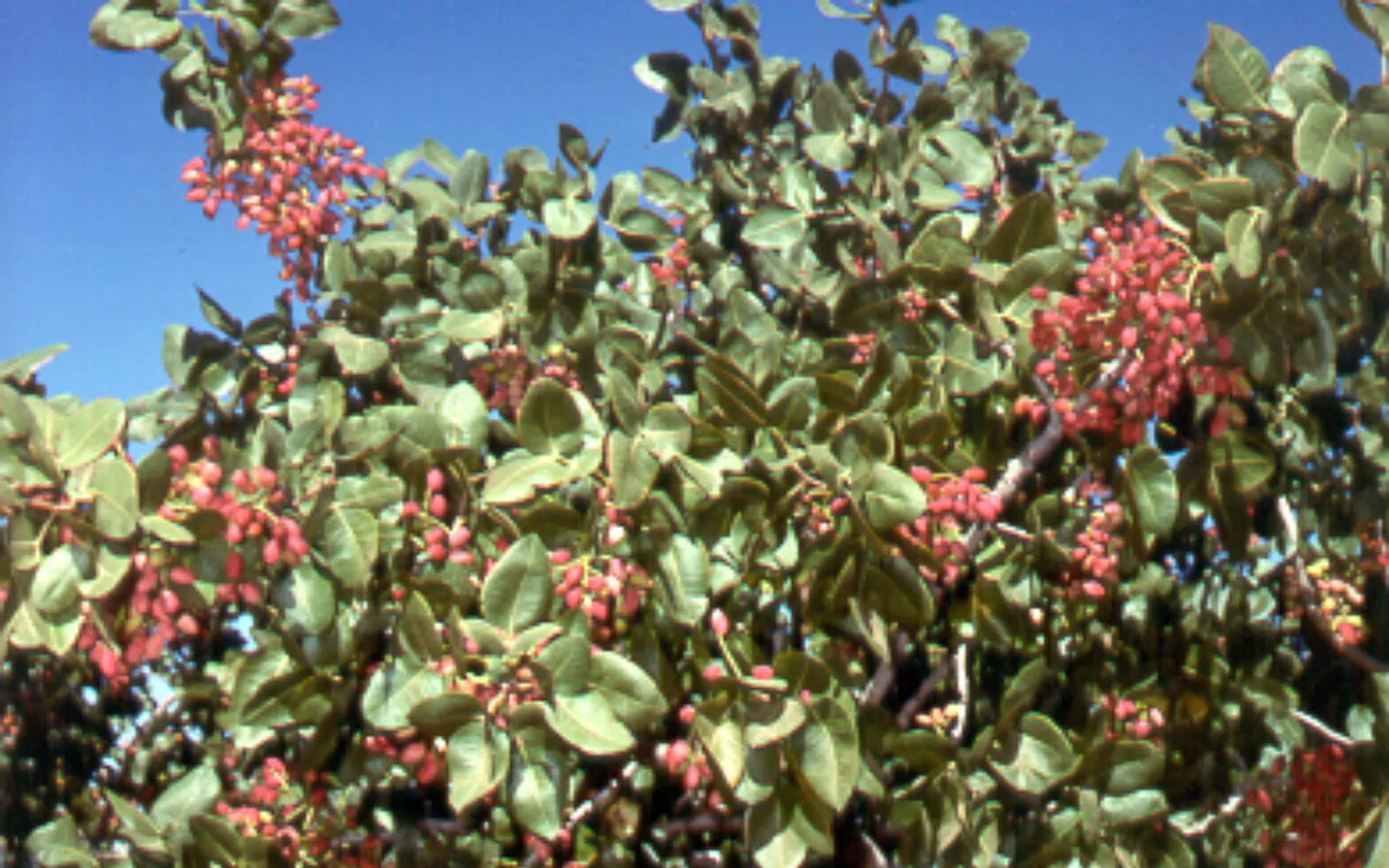
A small spreading deciduous tree, 6 to 10 m, slow growing, with a short thick trunk and a broad open crown.
Bark is grey and becomes deeply fissured with age.
Leaves are pinnate, 10 to 20 cm long, with three to five broad leathery leaflets, grey-green and thick, turning a good yellow before falling.
Male and female flowers grow on separate trees. Both are small, petal-less, brownish green and wind-pollinated, in loose panicles appearing before or with the leaves.
Female trees carry the fruit in dense drooping clusters, each nut wrapped in a fleshy hull that turns rosy or yellowish and loosens at maturity.
Inside the hull is the familiar cream-coloured shell, splitting along its seam, with a green or purplish kernel inside.
The green colour of the kernel comes from chlorophyll, and the deepest green kernels, prized for baklava and ice cream, come from particular Iranian and Sicilian cultivars.
Roots go deep, which is what lets the tree survive drought and salt where little else will.
Where it is from
Pistacia vera comes from Central Asia, with wild stands in Iran, Turkmenistan, Uzbekistan, Afghanistan and northern Pakistan, growing on dry rocky hillsides where summers are fierce and winters are hard.
Domestication happened in that region several thousand years ago, and pistachios appear in Bronze Age contexts across the Near East.
The tree moved west through Persia into the Roman world in the first century, and Sicily and Greece have grown it since.
Iran and Turkey have long been the leading producers, and Iranian pistachios from Kerman and Turkish ones from Gaziantep are the standard for the confectionery trade.
California became a producer only in the twentieth century, after seed collections in the 1920s, and now rivals Iran on volume from the Central Valley.
No maritime country has grown it commercially and none will, for reasons of climate rather than of will.
How it grows
Buy a grafted tree of a named cultivar, and buy a male as well. Seedlings take a decade or more, half will be male, and none will come true.
Plant in the sunniest, hottest, best-drained position available, ideally against a south wall or in a large container that can be moved under cover.
Use free-draining alkaline compost with plenty of grit. The tree tolerates lime, salt and drought and will not tolerate wet feet.
Keep it dry in winter. Winter rain on a dormant pistachio is what kills it, and a container under an unheated cover is the practical answer.
Give a cold winter rest. The tree needs several hundred hours below 7 deg C to break dormancy properly, which a cool winter does supply.
Provide the summer heat it needs, which a cool climate does not. A glasshouse in summer and a dry cold shelter in winter is the only route to a crop.
Water deeply and infrequently in summer, and not at all in winter.
Feed lightly once or twice a year. Rich feeding produces soft growth and disease.
Prune in late winter to keep an open crown that light and air can reach.
Expect a first crop in five to seven years on a grafted tree, and expect alternate bearing thereafter.
Through the seasons
Winter is dormancy, and the tree wants cold and dry. Wet is the danger rather than frost.
Late winter is the pruning window, before the buds move.
March and April bring flowering, before or with the new leaves, and this is when a male tree earns its space.
May and June are shoot growth and early nut development.
July and August are when the kernel fills, and the months that need real heat.
September brings the hull colouring and loosening, and the shell splitting.
October is harvest, and the leaves colour and fall soon after.
Care difficulty
Difficult outside its climate band, and the difficulty is the climate rather than the plant.
Summer heat is the missing ingredient. The tree needs long spells above 30 deg C to fill a kernel, and a cool summer will not do it.
Winter wet is the killer. The tree is hardy to cold and rots in damp soil.
Two trees are needed, one male and one female, and a gardener buying one will never see a nut.
Alternate bearing means even a successful tree crops properly every other year.
As an ornamental it is handsome, with good autumn colour and grey-green pinnate leaves.
Watering
Water deeply and infrequently through summer, every two or three weeks.
Let the soil dry substantially between waterings.
Water not at all through winter dormancy, and shelter a container from winter rain.
Increase watering while the kernel is filling in July and August.
Avoid overhead watering, which encourages disease on the flower clusters.
Never allow waterlogging at any time of year.
Warning signs, diseases and pests
Wilting branches with brown staining in the wood are verticillium wilt, which is the main disease of the crop worldwide and which has no cure.
Wilting in wet winter soil is root rot, and it is what kills most attempts in a damp climate.
Shells that form with no kernel inside are blanks, caused by poor pollination or insufficient heat.
Nuts that never split had no kernel to force them open.
A heavy crop followed by almost none the next year is alternate bearing rather than a fault.
Curled new shoots with sticky residue are aphids.
Brown limpets along the stems are scale.
A rash after pruning is the sap, and gloves prevent it.
Growing environment
A large container that can spend summer under glass and winter dry and cold outside, or a very hot dry sheltered site in the far south.
Full sun and as much summer heat as possible.
Free-draining alkaline soil with plenty of grit.
Cold dry winters, which a maritime climate half provides.
Shelter from winter rain above all else.
A male tree within pollen range of the female.
Room for a spreading crown 6 m across on a mature tree.
Feeding
Feed a balanced fertiliser once in spring.
Feed again lightly in early summer on a cropping tree, and not otherwise.
Avoid heavy nitrogen, which makes soft growth prone to disease.
Skip acidifying feeds, since the tree prefers alkaline conditions.
Mulch with grit rather than compost.
Feed nothing after midsummer.
Troubleshooting
Why do I need two trees? Pistachios are male or female, never both. Pollen travels on the wind, so a female tree needs a male within range or it will set nothing.
What does the split shell mean? The kernel has swelled enough to force the shell open along its seam, which is the sign it is ripe. Iranian growers call it a laughing pistachio.
My shells are empty. Blanks, from poor pollination or too little summer heat. Both are common outside its proper climate.
Can I grow one outdoors here? As an ornamental in a hot dry southern garden, possibly. For nuts, no. It needs long summers above 30 deg C.
Is it hardy? To cold, yes, and it needs a cold winter to break dormancy. What kills it in a damp climate is winter wet at the root rather than frost.
Why does it crop heavily one year and not the next? Alternate bearing. A heavy crop suppresses the following year’s flower buds, and the whole industry plans around a two-year cycle.
What is aflatoxin? A carcinogenic mould toxin that pistachios are prone to in storage. Imported consignments are tested for it. Throw away any nut that is discoloured, shrivelled or smells musty.
Is pistachio related to cashew? Yes, both are Anacardiaceae, along with mango and poison ivy. The sap and the hull can raise a contact rash, so prune with gloves.
Why are some kernels greener than others? Cultivar and maturity. The green is chlorophyll, and the deepest green kernels come from particular Iranian and Sicilian cultivars grown for confectionery.
Pistachio problem guides
Not sure what is wrong? See the common vegetable pests guide.