
Edible
Rambutan
Nephelium lappaceum
Also known as Hairy lychee, Ngoh, Chom chom
How to grow rambutan, Nephelium lappaceum. The hairy fruit that is not a lychee, how to open one without a knife, and why almost every tree in an orchard is female.
At a glance
- Difficulty
- Difficult
- Water
- Two or three times a week year round
- Light
- Full sun with light shade when young
- Temperature
- Minimum 15 deg C, and it dislikes anything below 10 deg C
- Humidity
- High. This is a true equatorial species
- Hardiness
- USDA 11-12, RHS H1b, hardy to 12 C
- Type
- Tender evergreen tree
- Height
- 12-20 m in the open, 2 m in a pot
- Native to
- the Malay archipelago
- Best month
- July and August in the Northern Hemisphere, January and February in the Southern Hemisphere
Wet equatorial south-east Asia. It needs rain through the year and no cool season, and most named cultivars are female clones that need a male or a hormone spray to set.
Hardiness zones describe winter cold alone. Summer heat, humidity, rainfall and the length of the growing season decide as much, so treat the range as the outer limit rather than as a recommendation.
Every month named in this guide is for the temperate Northern Hemisphere. If you garden in the Southern Hemisphere, shift each one by six months, so July becomes January. Closer to the equator the wet and dry seasons matter more than the calendar, and the shift stops being a useful guide.
Edible, with limits
- Safe to eat
- The ripe white aril
- Do not eat
- The seed, which contains saponins and is not eaten raw
- Harm from
- Eating it
- Affects
- People
The flesh of a ripe rambutan is food and no reputable source treats it as harmful. The seed is a different matter. Raw rambutan seed contains saponins and an unpalatable oil, and it is bitter and narcotic in effect if eaten in quantity; it is roasted and eaten in parts of South East Asia and pressed for oil, both of which change its chemistry. Do not eat it raw, and do not let a dog have one, since it is both toxic in the same way and the right size to obstruct a gut. The thin skin peels away cleanly and the spines are soft and harmless despite their appearance.
Sources: RHS potentially harmful garden plants, ASPCA toxic and non-toxic plants
About
Rambutan is the fruit that looks like a small red sea urchin. The name comes from the Malay word for hair, and the soft spines covering the skin are the whole reason anyone remembers it.
Opening one needs no knife. Press a thumbnail into the skin at the seam and twist, and the two halves come apart to leave a white translucent ball in one hand and the spiny shell in the other.
It shares a family with lychee and longan, and it separates from them on climate. Where lychee wants a cool dry winter, rambutan wants none at all. It is an equatorial species that grows within about fifteen degrees of the equator and sulks anywhere with a season.
Appearance and character
An evergreen tree to 20 m, with a dense spreading crown and a rather upright frame when young.
Leaves are pinnate with two to four pairs of leaflets, each oval and 5 to 20 cm, dull dark green above and yellowish beneath, with the veins prominent.
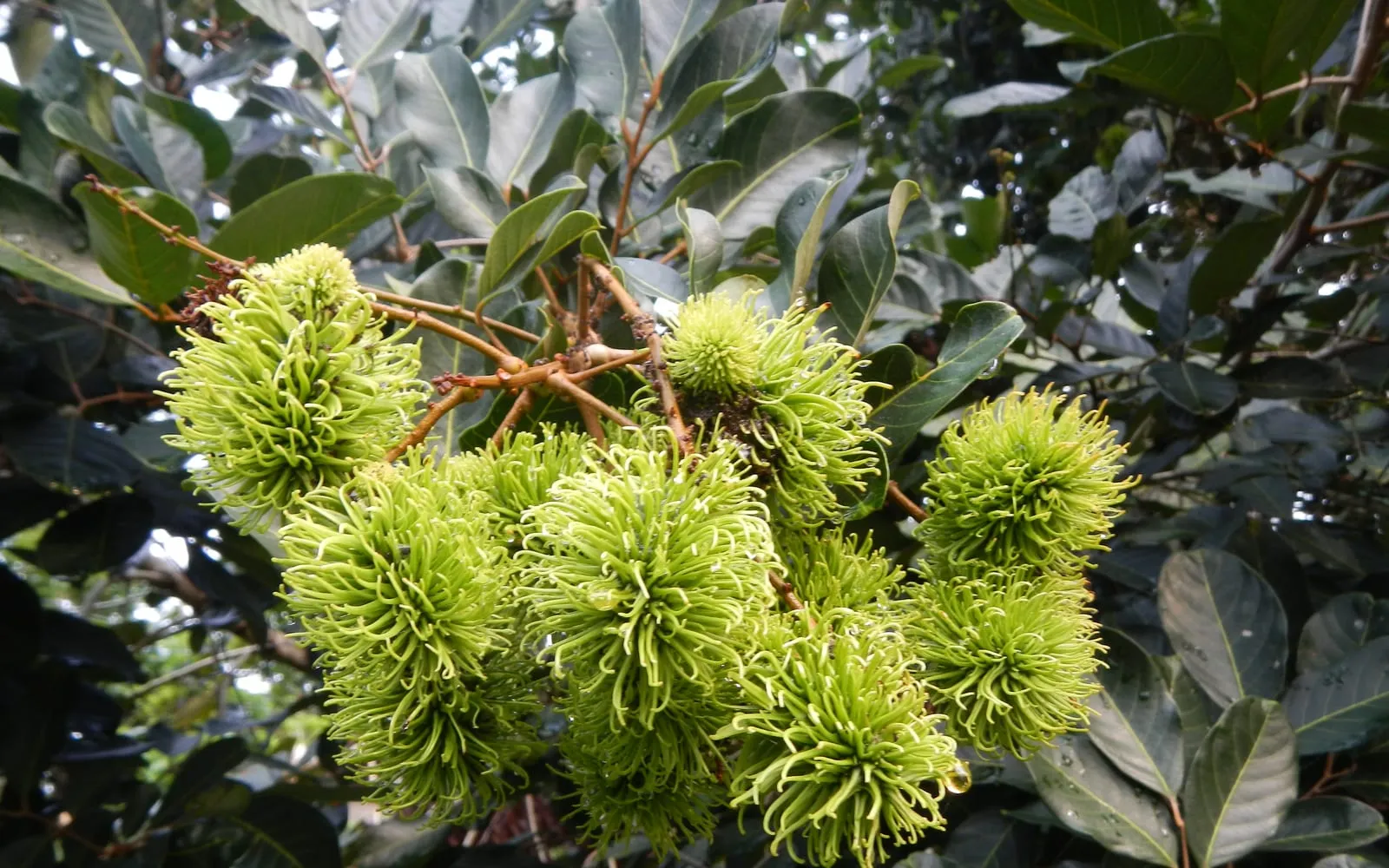
Flowers are tiny, greenish white and borne in large branched terminal sprays. Most cultivated trees carry functionally female flowers, and a small percentage of hermaphrodite flowers producing pollen is what sets the crop.
Fruit is oval, 3 to 6 cm, borne in loose clusters, and covered in soft fleshy spines 1 to 2 cm long. Colour ripens from green through yellow to bright red or deep orange depending on cultivar.
The spines are soft and bend under a finger. They look formidable and are not.
Inside is a white or pale pink translucent aril, sweet and slightly acid, firmer than a lychee and less floral.
The seed is oval, brown and flattened, and in some cultivars the aril clings to it so tightly that eating cleanly is difficult. Freestone cultivars are the prized ones.
Where it is from
Rambutan is native to the Malay archipelago, across Malaysia, Sumatra and Borneo, where it grows wild in lowland rainforest.
Cultivation is ancient across the region and the fruit is central to the market season in Malaysia, Indonesia and Thailand, where it arrives alongside durian and mangosteen in the same few weeks.
Arab traders are credited with carrying it to Zanzibar and East Africa, and the Dutch moved it to Suriname in the eighteenth century, which is how it reached the Americas.
Thailand is now the largest producer, with Indonesia, Malaysia, Vietnam and the Philippines following.
Temperate markets see it fresh in South East Asian groceries in late summer, and tinned year round, usually stuffed with pineapple.
How it grows
Buy a grafted plant if fruit is the aim. Seedling rambutans are roughly half male and set nothing.
Sow seed fresh if you want the plant. Rambutan seed loses viability in a few days, so sow it the day the fruit is eaten, at 25 to 30 deg C.
Use an ericaceous or acid compost with plenty of organic matter and sharp drainage.
Grow at a minimum of 15 deg C, with 25 to 30 deg C for real growth, and never let it get near freezing.
Keep humidity high. Rambutan suffers in dry air more than lychee does.
Give light shade when the plant is young and full sun as it matures.
Water two or three times a week year round. There is no dry rest.
Feed fortnightly from April to September with an ericaceous feed containing iron.
Expect a grafted plant to fruit in four to six years under glass with real heat, and a seedling perhaps never.
Through the seasons
Winter is the difficult season. Hold above 15 deg C with high humidity and reduced watering, and feed nothing.
Spring brings the new growth flush. Repot if needed and start feeding.
Early summer is strong growth and, on a mature plant, flowering.
Midsummer is fruit swell, which takes about fifteen weeks from flowering.
Late summer is harvest.
Early autumn is a second growth flush in a warm greenhouse.
Autumn is when to stop feeding and reduce watering as light falls, while keeping the plant warm.
Care difficulty
Difficult because rambutan needs equatorial conditions with no season at all.
Constant warmth is the first demand. Minimum 15 deg C, ideally 25 to 30 deg C, year round, with no cool rest.
High humidity is the second, and it has to be maintained through a cool winter when the heating is drying the air.
Acid compost and rainwater are the third. Iron shortage appears fast on hard water.
Sex is the fourth. Most seedlings are functionally male and set no fruit, and commercial orchards are planted with female clones plus a few pollen trees.
Fruit under glass is a serious undertaking and needs a well-heated humid house.
As a foliage plant in a warm humid conservatory it grows steadily and looks handsome, which is the realistic outcome for most.
Watering
Water two or three times a week throughout the year, keeping the compost evenly damp.
Do not impose a dry rest. Rambutan has no dormancy and drying it off checks it badly.
Drain fully every time.
Keep humidity high with misting, damp gravel trays and grouping.
Use rainwater. Hard water brings on iron shortage quickly in this species.
Reduce watering somewhat in winter without letting the compost dry.
Never let a pot stand in cold water.
Warning signs, diseases and pests
Yellowing between green veins is iron shortage from hard water or compost that is not acid enough.
Brown leaf edges and tips mean dry air, which is the standard cool winter problem for this species.
Leaf drop after a cold spell is chill damage below 10 deg C.
Fine stippling and webbing under the leaves is spider mite, which arrives when the humidity falls.
Brown limpets along the stems are scale.
White fluff in the leaf axils is mealybug.
Wilting in damp compost is root rot.
A tree that flowers and sets nothing is functionally male, which is the usual outcome for a seedling.
Fruit with the flesh stuck hard to the seed is a clingstone cultivar and is a matter of variety rather than culture.
Growing environment
A well-heated humid greenhouse or conservatory. There is no outdoor option outside the tropics and no cool-house option either.
Minimum 15 deg C, and 25 to 30 deg C for growth.
High humidity year round, which is the hardest part to maintain in a cool winter.
Full sun when mature, light shade when young.
Ericaceous compost rich in organic matter with sharp drainage.
pH from 4.5 to 6.5.
Rainwater rather than tap water.
Grouping with other tropical plants, which raises local humidity.
Feeding
Feed fortnightly from April to September with an ericaceous liquid feed containing iron.
Add sequestered iron at the first yellowing between the veins.
Stop feeding at the end of September.
Feed nothing through winter, though the plant stays in leaf.
Top-dress with composted bark or leaf mould each spring.
Repot every second or third spring into fresh acid compost.
Avoid lime in any form.
Troubleshooting
How do I open one? Press a thumbnail into the skin around the middle and twist the two halves apart. The spines are soft and harmless and no knife is needed.
Is it a hairy lychee? Same family, different genus and a different climate. Rambutan is equatorial and wants constant warmth, where lychee needs a cool dry winter to flower.
Can I eat the seed? Not raw. It contains saponins and is bitter and unpleasant. It is roasted in parts of South East Asia, which changes it, and it should never be given to a dog.
The flesh will not come off the seed. You have a clingstone cultivar. The freestone types, where the aril lifts cleanly, are the ones commercial growers prefer.
My seedling has flowered and set nothing. It is functionally male, which most seedlings are. Orchards plant female clones with a few pollen trees among them.
The leaf edges are brown all winter. Dry air. Rambutan needs high humidity year round and a heated greenhouse in January is a desert.
The leaves are yellow between the veins. Iron shortage. Use rainwater, ericaceous compost and sequestered iron.
Will it fruit outside the tropics? In a well-heated humid greenhouse, a grafted plant can fruit in four to six years. In anything cooler it will not.
Rambutan problem guides
Not sure what is wrong? See the common vegetable pests guide.