
Edible
Mooli
Raphanus sativus var. longipinnatus
Also known as Daikon, White radish, Winter radish
How to grow mooli, Raphanus sativus var. longipinnatus. The August sowing that stops it bolting, getting a straight metre-long root, and using it as a soil-breaking green manure.
At a glance
- Difficulty
- Easy
- Water
- Weekly, and steadily rather than heavily
- Light
- Full sun
- Temperature
- 10-20 deg C. Bolts in long days and sustained heat
- Hardiness
- USDA 2-11, RHS H4, hardy to -5 C
- Type
- Annual or biennial grown as an annual
- Height
- 40-120 cm when flowering
- Native to
- Of cultivated origin, developed in eastern Asia
- Best month
- August in the Northern Hemisphere, February in the Southern Hemisphere
Lengthening days make it bolt before the root has bulked, which is why the crop is sown from midsummer onwards almost everywhere and why spring sowings run to seed. Roots need deep loose soil to reach any size. Warm regions sow through the cool season instead.
Hardiness zones describe winter cold alone. Summer heat, humidity, rainfall and the length of the growing season decide as much, so treat the range as the outer limit rather than as a recommendation.
Every month named in this guide is for the temperate Northern Hemisphere. If you garden in the Southern Hemisphere, shift each one by six months, so August becomes February. Closer to the equator the wet and dry seasons matter more than the calendar, and the shift stops being a useful guide.
Not known to be toxic
- Safe to eat
- The root, the leaves, the seed pods and the sprouted seed
Mooli is a food crop and carries no toxicity concern for people. The RHS does not list it as a potentially harmful garden plant and the ASPCA does not list Raphanus sativus as toxic to cats and dogs, though a dog eating a quantity of raw radish is likely to get an upset stomach from the mustard oils. Those mustard oils are glucosinolates and their breakdown products, the compounds that give every radish its heat, and mooli contains considerably less of them than a summer radish, which is why it tastes mild. They are harmless in any quantity a person eats and irritant only in concentrated form. The leaves are edible and are cooked as a green across Asia, and their roughness comes from stiff hairs rather than anything harmful. The young seed pods are eaten raw and are excellent. Fodder radish grown as a green manure and grazed by livestock carries the same brassica forage considerations as any other, which do not arise with a garden crop.
Sources: RHS potentially harmful garden plants, ASPCA toxic and non-toxic plants
About
Mooli is a radish that has been selected for size and mildness instead of heat and speed. The root runs 30 to 45 cm long in a garden variety and well over a metre in the Japanese types grown for competition, and the flavour is closer to a crisp turnip than to the summer radish it is descended from.
The whole crop turns on the sowing date. Sown in spring, mooli reads the lengthening days as a signal to flower and bolts without making a root. Sown in August, the same seed makes the roots the plant is grown for.
It has a second life as a green manure. The root drives down through compacted subsoil, dies over winter and leaves a channel behind it, and this is the cheapest way an allotment holder can break a pan without a spade.
Appearance and character
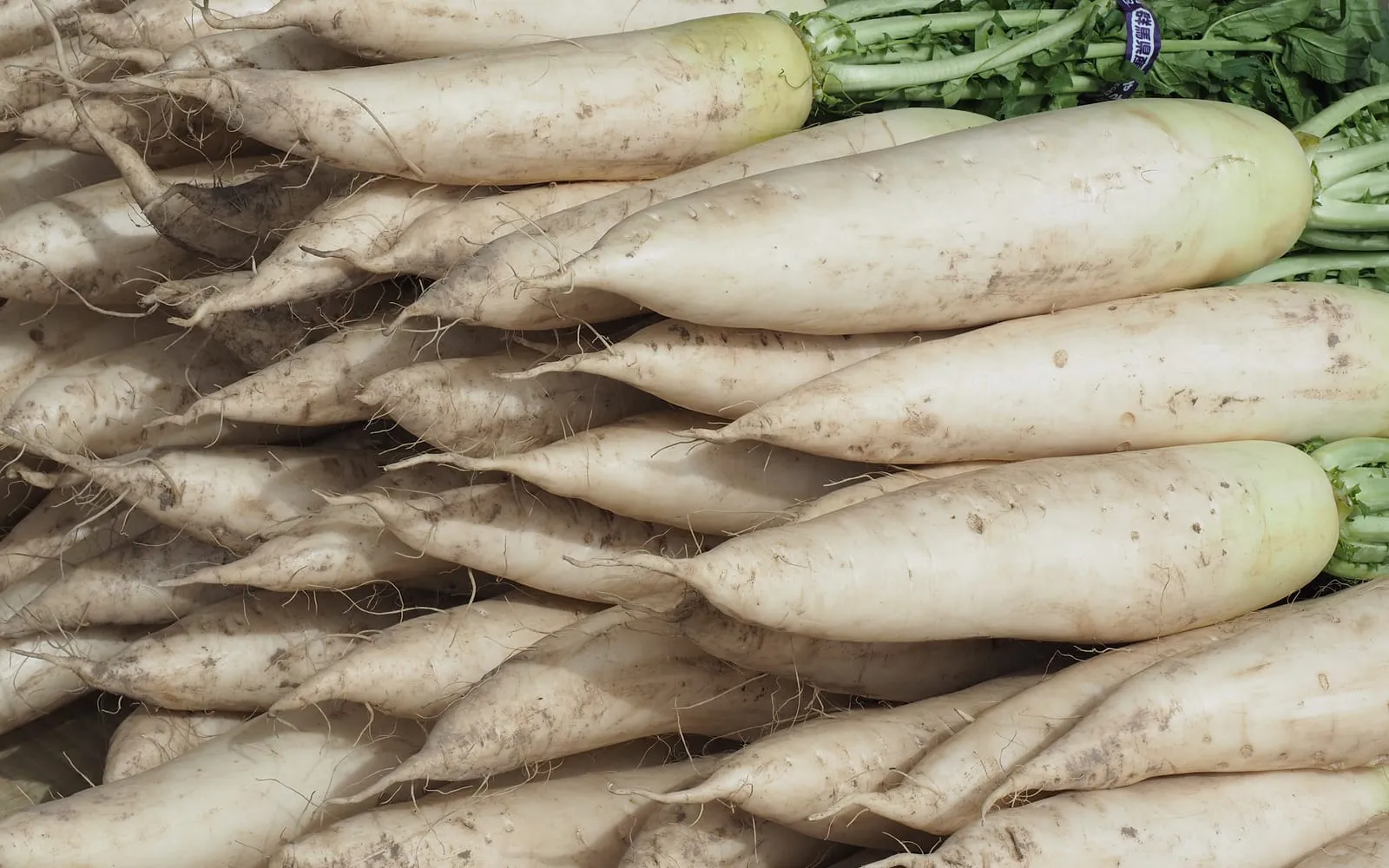
A long, smooth, cylindrical white root, tapering gently, sitting with its shoulders and often the top third clear of the ground.
Skin is white in most varieties, and green-shouldered, red-fleshed and purple forms are all grown. The green shoulders of a variety like ‘Minowase’ are sunlight rather than a fault.
Flesh is white, dense, crisp and juicy, mild with a faint pepperiness concentrated near the skin and the tip.
Leaves form a rough, bristly rosette of deeply lobed leaves, 40 cm or more across, coarse to the touch in the same way turnip leaves are.
A bolting plant sends up a branched stem to well over a metre with white to pale pink four-petalled flowers, followed by fat pointed pods. The pods are edible and good, and the root is woody by then.
Where it is from
Mooli is Raphanus sativus, the same species as the summer radish, selected in eastern Asia for a large mild root. Where the species itself was first domesticated is unsettled, with the Mediterranean and central Asia both proposed.
Japan grows more of it than any other vegetable. Daikon means great root, and the sakuradjima variety from Kagoshima produces spherical roots that have exceeded 30 kg.
China, Korea and the Indian subcontinent all grow their own forms, and the Hindi muli is where the English name comes from.
Britain has grown fodder radish as a green manure for far longer than it has eaten mooli, and the two are close relatives grown for opposite purposes.
How it grows
Sow direct. The taproot is the crop and any disturbance forks it.
Sow at 2 cm deep in rows 30 cm apart and thin to 15 cm apart. Thin early, at the two-leaf stage, because a crowded row gives thin roots.
Germination takes four to seven days.
Roots are ready from eight to ten weeks, which for an August sowing means October and November.
Lift before hard frost on heavy soil, and leave them in the ground under straw on free-draining ground, pulling as needed until February.
For green manure, broadcast at 3 g per square metre in August, let it grow until the frosts kill it, and leave the residue on the surface. The roots rot in place and leave the channels behind.
Sow from mid-July to early September for the eating crop.
Through the seasons
Spring is the wrong time outdoors. Lengthening days push the plant into flower before it makes a root. A March sowing under cover, pulled small, is the only spring use worth making.
Summer before mid-July gives the same result. Grow summer radish instead.
Late summer is the season, from mid-July to early September. Prepare a deep stone-free bed, sow thinly, and thin early.
Autumn grows the root, and steady watering through September is what makes it straight and crisp.
Late autumn and winter are the harvest. Lift as needed. Mooli stores for two months in damp sand in a cool shed, and the leaves keep for days rather than weeks.
Care difficulty
Easy, with the same three faults that spoil any long root crop.
Sowing date is the first and the one people get wrong. Mid-July to early September. Anything earlier bolts.
Stones and fresh manure fork the root. Mooli needs the same deep, stone-free preparation a parsnip does, and it is worth digging a bed properly for it.
Thinning late gives thin roots. Thin at the two-leaf stage and again a fortnight later.
Flea beetle attacks the seedlings and is much reduced by a late sowing. Slugs take seedlings in a damp August.
Lifting is the last hurdle. A 40 cm root snaps if pulled straight up. Loosen the soil alongside with a fork first.
Watering
Water steadily rather than heavily. Even moisture gives a smooth straight root and interrupted moisture gives a split or forked one.
Around 12 litres per square metre a week in dry weather, given as a single soak that reaches root depth.
Keep the seedbed damp through germination and for the fortnight after, which also keeps flea beetle down.
Mulch between the rows once the plants are thinned.
Splitting follows heavy rain onto dry ground, and even watering is the only prevention.
Container growing needs a pot at least 45 cm deep, which is more than most people have. Grow a round variety such as ‘Mantanghong’ instead.
Warning signs, diseases and pests
Flea beetle shot-holes the seedlings and slows them badly. Cover with fine insect mesh from the day of sowing and keep the surface damp. An August sowing misses most of the pressure.
Bolting sends up a flower stem instead of making a root, and it is entirely a sowing-date problem.
Cabbage root fly larvae tunnel through the root leaving brown channels. Fit a 15 cm collar at thinning, or cover the row with fine mesh from sowing.
Slugs graze seedlings off at ground level in a damp August. Water in the morning and patrol on damp evenings.
Forked or stunted roots mean stones, compaction or fresh manure rather than a pest.
Splitting follows irregular watering.
Clubroot distorts the root into a swollen mass. Lime to pH 7 and rotate on four years.
Woody, hot flesh means the root was left in the ground too long, or the plant has started to bolt.
Growing environment
Full sun.
Deep, light, stone-free soil is the requirement, exactly as for parsnips. Dig to a spade and a half, remove stones, and break up any pan.
Lime to pH 6.5 or 7.
Never sow into freshly manured ground. Fresh organic matter forks the root. Follow a crop that was manured the previous season.
Rake the surface to a fine tilth before sowing.
Raised beds suit this crop where the natural soil is heavy or stony, and 45 cm of sieved soil and sand grows a good root anywhere.
Rotate on four years with the other brassicas, counting radish, turnip, swede, kohlrabi, cabbage, kale and the oriental greens as one crop.
Feeding
Mooli needs very little. On ground in reasonable heart it needs nothing.
Avoid nitrogen, which gives a large leafy top over a small forked root.
A light dressing of sulphate of potash at 15 g per square metre before sowing helps on poor or sandy ground.
Never apply fresh manure. Add well-rotted compost a full season ahead where the bed needs organic matter.
A green manure crop needs no feeding, since the point is cheap bulk and deep rooting.
Troubleshooting
It flowered instead of making a root. Bolting, from sowing before midsummer. Sow between mid-July and early September.
Forked and stunted roots. Stones, compaction or fresh manure. Dig a deep stone-free bed and follow a crop that was manured last year.
Thin roots on a full row. Thinned too late. Thin at the two-leaf stage to 15 cm.
The root snapped when I pulled it. Loosen the soil alongside with a fork before lifting.
Shot holes across the seedling leaves. Flea beetle. Fine mesh from sowing and a late sowing date.
Woody, hot flesh. Left in the ground too long, or the plant has begun to bolt. Lift at eight to ten weeks.
Splitting. Heavy rain after a dry spell. Water evenly.
Can I eat the leaves and pods? Yes to both. The leaves are cooked as a green across Asia and the young seed pods are eaten raw and are one of the best things the plant produces.
Is mooli the same as daikon? Yes. Mooli is the Hindi-derived name and daikon the Japanese one, and both mean this plant.
Mooli problem guides
Not sure what is wrong? See the common vegetable pests guide.