
Edible
Loquat
Eriobotrya japonica
Also known as Japanese medlar, Japanese plum, Nispero, Pipa
How to grow loquat, Eriobotrya japonica. An evergreen that flowers in winter and fruits in spring, which is exactly the wrong way round for a cool temperate garden.
At a glance
- Difficulty
- Moderate
- Water
- Weekly through summer for the first years
- Light
- Full sun, on a sheltered south wall
- Temperature
- Tree hardy to -12 deg C, flowers killed at -3 deg C
- Hardiness
- USDA 8-10, RHS H3, hardy to -10 C
- Type
- Evergreen tree, long-lived
- Height
- 5-8 m, less against a wall
- Native to
- China, Japan
- Best month
- May and June in the Northern Hemisphere, November and December in the Southern Hemisphere
Subtropical southern China, and the tree is far hardier than the crop. Wood survives about -10 deg C, and the flowers open in autumn and winter and are killed near -3, so a tree in USDA 8 lives for decades as handsome evergreen foliage and fruits only after a mild winter.
Hardiness zones describe winter cold alone. Summer heat, humidity, rainfall and the length of the growing season decide as much, so treat the range as the outer limit rather than as a recommendation.
Every month named in this guide is for the temperate Northern Hemisphere. If you garden in the Southern Hemisphere, shift each one by six months, so May becomes November. Closer to the equator the wet and dry seasons matter more than the calendar, and the shift stops being a useful guide.
Edible, with limits
- Safe to eat
- The ripe flesh
- Do not eat
- The seeds and the leaves
- Harm from
- Eating it
- Affects
- People, cats and dogs
The flesh is food and is grown commercially across southern Europe and Asia. The seeds are the part to respect. Loquat seeds are large and contain cyanogenic glycosides at levels comparable to apricot kernels, releasing hydrogen cyanide when crushed and chewed. Swallowing a seed whole passes through harmlessly, and the risk arises from deliberately crushing or grinding them, which some folk remedies recommend and which should be avoided. The leaves carry the same compounds at lower levels. The ASPCA lists loquat as toxic to cats, dogs and horses on the strength of the seeds and leaves rather than the flesh.
Sources: RHS potentially harmful garden plants, ASPCA toxic and non-toxic plants
About
Loquat runs on a calendar that suits the subtropics and works against it here. It flowers from October through to January and ripens fruit in spring, so the crop develops through exactly the months a cool winter can destroy it.
The tree is hardy to about -12 deg C. The flowers and small fruit are killed at around -3 deg C, which is why loquats grow happily across southern England as foliage plants and fruit only in exceptional years or under glass.
Grown for leaves alone it is worth having. The foliage is enormous, deeply veined, glossy above and rust-felted beneath, and it gives a subtropical look that few hardy plants match.
Where fruit does form it is excellent. Sweet, slightly tart, apricot-coloured, with a texture between a plum and a pear.
Appearance and character
An evergreen tree with a dense rounded crown, growing on a single trunk or several stems.
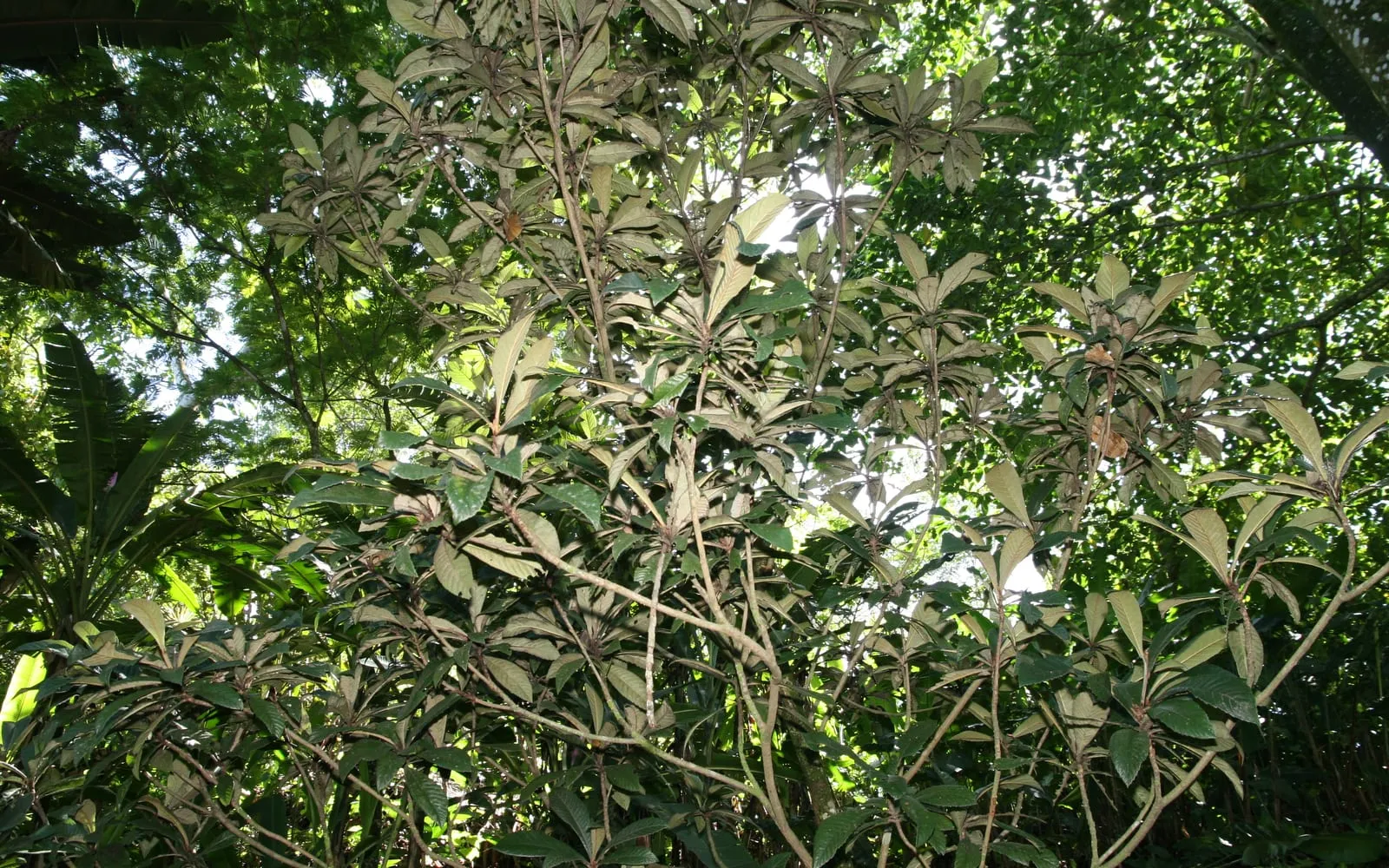
Leaves are the plant’s signature: 15 to 30 cm long, thick and leathery, deeply corrugated along the veins, dark glossy green above and covered in dense rusty felt beneath, with toothed margins.
Young shoots and flower stalks carry the same rusty wool.
Flowers open from October to January in upright clusters at the shoot tips, small, creamy white and strongly scented of almond, which carries a long way on a mild winter day.
Fruit is oval to round, 3 to 5 cm, with downy yellow to orange skin and firm juicy flesh, containing one to four large glossy brown seeds.
Where it is from
Eriobotrya japonica is native to central and southern China, despite a name that points at Japan.
It reached Japan over a thousand years ago and was cultivated so thoroughly there that European botanists assumed it was Japanese in origin.
It arrived in Europe in the late eighteenth century, first as an ornamental for botanic gardens.
Spain is now the largest producer outside Asia, with the crop centred in Alicante, and Japan, China, Turkey and India all grow it commercially.
Its natural climate is warm temperate with mild winters, which is exactly the mismatch that limits it in a cool climate.
How it grows
Buy a container-grown plant, and buy a grafted named variety if you want fruit. Seed-raised trees grow readily from a supermarket fruit stone but take eight to ten years to flower and give unpredictable results.
Plant against a sheltered south or west wall, in well-drained fertile soil at pH 6 to 7.
Shelter from wind matters as much as sun, since the large leaves tear and brown badly in exposure.
Protect the flowers if you want fruit. Fleece over the tree on frosty nights from November to February is the only practical approach outdoors.
Under glass in a cool conservatory it fruits far more reliably, and a large container makes that possible.
Prune lightly after fruiting or in spring, removing crossing wood and thinning the crown.
Through the seasons
Autumn brings the flowers, opening from October and continuing through the winter in mild spells, scenting the air around the tree.
Winter is the critical period. Frost below about -3 deg C kills open flowers and any small developing fruit.
Where flowers survive, fruit swells through late winter and early spring.
Thin the clusters in March to three or four fruit each, which improves size considerably.
Ripening comes in May and June, and the fruit is ready when fully coloured and slightly soft. It does not ripen further once picked.
Summer is the tree’s growing season, putting on new shoots and leaves ready for the next flowering cycle.
Care difficulty
Moderate as a foliage plant and difficult as a fruit crop.
The tree grows easily through USDA 8, needs little pruning and has few pests beyond fireblight.
The fruiting problem is structural rather than fixable. A plant that flowers in December in a country that frosts in January will rarely carry a crop.
Under glass or in a conservatory the difficulty disappears, and a large container plant will fruit most years.
Fireblight is the disease to watch, since loquat is among the more susceptible members of the rose family.
Watering
Water weekly through summer for the first three or four years, 20 litres at a time.
An established tree needs water only in drought, though a wall-trained specimen sits in rain shadow and needs more.
Water steadily while fruit is developing in spring, since irregular moisture causes splitting.
Mulch in spring with compost over the root area, kept clear of the trunk.
A container plant needs watering through the year, reduced but not stopped in winter, since the tree is evergreen and never fully dormant.
Warning signs, diseases and pests
Flowers browning and dropping in winter. Frost. Fleece the tree on cold nights if you want any fruit at all.
Shoot tips blackened and hooked, leaves dead and clinging. Fireblight, to which loquat is very prone. Cut 60 cm into clean wood, burn the prunings and disinfect the saw between cuts.
Large leaves torn, browned and tattered. Wind. Move the plant or improve shelter.
Brown limpet bumps along stems and leaf ribs, sooty mould beneath. Scale insects. Scrub off or treat with horticultural soap.
Dark spots spreading on leaves in a wet season. Leaf spot. Remove the worst leaves and improve airflow.
Fruit disappearing in May. Birds, which find it before you do. Net if a crop has set.
Growing environment
Full sun against a sheltered south or west wall in USDA 8.
Shelter from wind is as important as warmth, given the size of the leaves.
Well-drained fertile soil at pH 6 to 7, and the plant dislikes waterlogging.
A frost-free winter is what fruiting requires, which points to a conservatory, a cool greenhouse or a very mild coastal garden.
Allow 3 to 4 m against a wall, or a container of at least 60 cm for a plant kept under cover.
Feeding
Feed once in spring with a balanced general fertiliser, and again in early summer on poor soil.
Avoid heavy nitrogen, which produces soft growth that fireblight enters easily.
Mulch with compost each spring.
A container plant needs a balanced liquid feed monthly from April to August, and a light feed in winter given that it is evergreen.
Sulphate of potash in late winter improves fruiting where the tree is growing strongly.
Troubleshooting
Tree thriving, never any fruit. Winter frost killing the flowers, which is the normal outcome in a cool summer. Fleece the tree, or grow it under glass.
Seed-grown tree not flowering after five years. Expected. Seedlings take eight to ten years, and grafted trees three to four.
Fruit small and seedy. Not thinned. Reduce clusters to three or four fruit in March.
Leaves yellowing between the veins. Iron shortage on limy soil. Apply chelated iron.
Leaf edges brown and crisp. Wind scorch or drought. Improve shelter and water more.
Fruit split before ripening. Irregular watering in spring. Water steadily and mulch.
Loquat problem guides
Not sure what is wrong? See the common vegetable pests guide.