
Edible
Gold kiwi
Actinidia chinensis
Also known as Golden kiwi, Yellow kiwi, Smooth-skinned kiwi, Chinese gooseberry
How to grow gold kiwi, Actinidia chinensis. Smooth-skinned and yellow-fleshed, earlier than the furry kind, and a degree or two more tender.
At a glance
- Difficulty
- Difficult
- Water
- Twice weekly through summer
- Light
- Full sun on a sheltered south wall
- Temperature
- Dormant wood hardy to -12 deg C, new growth killed at -1 deg C
- Hardiness
- USDA 8-9, RHS H4, hardy to -12 C
- Type
- Deciduous woody climber, long-lived
- Height
- 6-8 m, kept to 4 m on wires
- Native to
- China
- Best month
- September and October in the Northern Hemisphere, March and April in the Southern Hemisphere
The least hardy of the three and the one that needs the longest warm season. Bacterial canker is the bigger obstacle. Pseudomonas syringae pv. actinidiae reached Italy in 2008 and New Zealand in 2010 and destroyed the gold plantings almost entirely, so buy only certified stock and expect movement restrictions in growing regions.
Hardiness zones describe winter cold alone. Summer heat, humidity, rainfall and the length of the growing season decide as much, so treat the range as the outer limit rather than as a recommendation.
Every month named in this guide is for the temperate Northern Hemisphere. If you garden in the Southern Hemisphere, shift each one by six months, so September becomes March. Closer to the equator the wet and dry seasons matter more than the calendar, and the shift stops being a useful guide.
Edible, with limits
- Safe to eat
- The fruit, and the skin is edible on this species
- Harm from
- Eating it
- Affects
- People
The fruit is food, sold in every supermarket. The two cautions are both about people rather than about poison. Kiwi is one of the more common fruit allergies, and reactions range from a tingling mouth to something more serious, with a recognised cross-reaction in people allergic to latex, banana or avocado. Separately, the fruit contains needle-like calcium oxalate crystals and the enzyme actinidain, which together produce the mild mouth irritation many people notice after eating several, and which is why kiwi will not set a gelatine dessert. Neither the RHS nor the ASPCA lists Actinidia as harmful to people or pets. Cats are strongly attracted to the stems and roots in the way they respond to catmint, and a young plant needs protecting from being shredded rather than from being poisoned.
Sources: RHS potentially harmful garden plants, ASPCA toxic and non-toxic plants
About
Gold kiwi is the smooth one. No bristles, a bronze skin thin enough to eat, and yellow flesh that is sweeter and less acidic than the green sort, with a tropical note closer to mango.
It ripens three to four weeks earlier than Actinidia deliciosa, which is a real advantage where the season runs out in October.
The trade is hardiness. This species is a degree or two more tender in the wood and breaks dormancy earlier still, which extends the window in which a spring frost can take the crop.
For a temperate garden it is a plant for a warm southern wall and a mild area. Where it succeeds it is the better fruit of the two.
Appearance and character
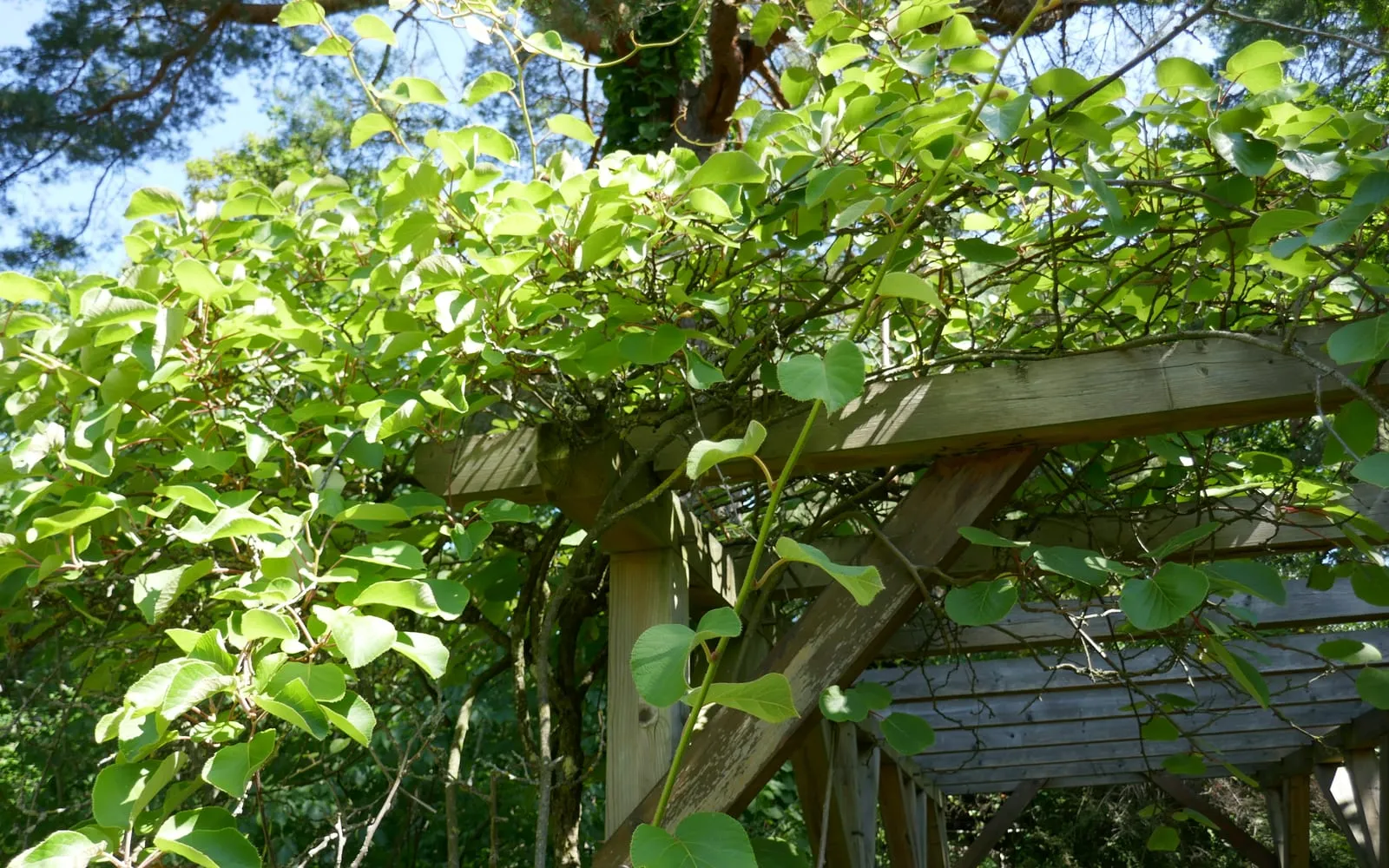
A vigorous twining climber, marginally less rampant than the green kiwi but still a large plant.
Young shoots carry soft whitish hairs rather than the stiff reddish bristles of A. deliciosa, which is the reliable way to tell the two species apart.
Leaves are large and heart-shaped, 10 to 18 cm, dark glossy green above and paler beneath.
Flowers open in May, creamy white ageing to yellow, 3 to 4 cm across, with the same separate male and female arrangement as the green kiwi.
Fruit is oval to slightly barrel-shaped, 5 to 7 cm, with a smooth bronze skin carrying a fine down that rubs off, and golden-yellow flesh with a pointed core.
Where it is from
Actinidia chinensis is native to central and eastern China, growing in warm temperate forest at lower altitudes than A. deliciosa.
The two were treated as one species until the 1980s, when botanists separated them, which is why older books describe a single Chinese gooseberry with variable fruit.
New Zealand breeders released ‘Hort16A’ as Zespri Gold in the late 1990s, and it transformed the export market.
A bacterial canker outbreak devastated those plantings in 2010, and the industry replanted with the more resistant ‘Gold3’, sold as SunGold.
Wild plants grow in a warmer and more humid part of China than the green kiwi, which is exactly why they are the least hardy of the three.
How it grows
Buy named plants of both sexes, or a self-fertile selection if space is limited. Nurseries sell female gold varieties with a matching early-flowering male, since the timing differs from the green kiwi’s pollinators.
Choose the warmest wall available, facing south, with shelter from wind on both sides.
Build substantial support before planting. Wires at 50 cm intervals, anchored into masonry, or a heavy timber pergola.
Plant in spring into deep soil worked with compost, at pH 6 to 6.5.
Cage young plants against cats, which are as attracted to this species as to any other Actinidia.
Train one main stem to the top wire, two permanent arms along it, and fruit on side shoots from those arms.
Through the seasons
Bud break is early, often in late March, which is earlier than the green kiwi and raises the frost risk.
Fleece the vine on cold nights from bud break until the middle of May. This is the most important job of the year.
Flowering is in May, a little ahead of A. deliciosa, so the male must be matched to this timing.
Summer growth is fast. Shorten side shoots to five or six leaves beyond the last fruit in July.
Harvest from late September into October. The fruit is picked firm and ripened indoors, and the earlier season is this plant’s chief advantage here.
Prune in January, removing old fruited wood and tying in replacement shoots.
Care difficulty
Difficult, marginally more so than the green kiwi.
Everything that makes A. deliciosa demanding applies here, with less hardiness and an earlier bud break on top.
The site is what decides success. A sheltered south wall in a mild southern county gives a reasonable chance, and an exposed or northern garden gives very little.
The vine needs heavy watering, strong support and pruning in both summer and winter.
The earlier harvest is the compensation, since fruit ripens in a cool autumn rather than running into November.
Watering
Water twice weekly through summer, 25 litres at a time for an established vine.
Wall-trained plants sit in rain shadow and need watering regardless of the weather.
The large leaves transpire heavily and the plant wilts quickly when short of water.
Mulch thickly with compost each spring across the whole root area.
Drainage must remain good, since waterlogged roots rot as readily as in any kiwi.
Warning signs, diseases and pests
Soft new shoots blackened in late March or April. Frost. This species breaks dormancy early and needs fleecing sooner than the green kiwi.
Bark stripped and stems chewed at the base. Cats. Cage young plants.
Leaves torn and browning at the margins. Wind. Improve shelter, since the large leaves are easily damaged.
Growth stalling, leaves yellowing, roots dark and soft. Root rot. Improve drainage or move the plant.
Sticky stems with brown limpet-like bumps. Scale insects. Scrub off what you can reach.
Crisp brown leaf edges in a hot spell. Leaf scorch from drought or heat reflected off a wall. Water heavily and mulch.
Growing environment
Full sun on a sheltered south-facing wall, in the mildest part of the garden.
Deep, fertile, moisture-retentive soil with good drainage, at pH 6 to 6.5.
Shelter is as important as warmth. Wind damages the leaves and disrupts pollination.
The plant needs a frost-free spring more than a hot summer, given how early it starts into growth.
Allow 4 m of wall per vine, plus room for a male, on supports strong enough for a heavy mature plant.
Feeding
Apply a balanced general fertiliser in early spring.
Follow with a high-potash liquid feed monthly from May to July.
Mulch each spring with compost or well-rotted manure over the root area.
Stop feeding at the end of July so the wood ripens before autumn.
Overfeeding with nitrogen produces soft growth that is more vulnerable to both frost and canker.
Troubleshooting
Growth killed every spring. Bud break is too early for the site. Fleece from late March, or accept that the garden is too cold for this species.
Flowers but no fruit. No male, or a male whose flowering does not overlap. Gold varieties flower earlier and need a matched pollinator.
Fruit not sizing. Underwatering, or too many fruit on the vine. Thin and water heavily.
Skin still hairy. The plant is A. deliciosa rather than A. chinensis. Check the shoot hairs, which are stiff and reddish on the green kiwi.
Vine outgrowing its wall. Normal vigour. Summer prune in July and winter prune in January.
Fruit soft and bland. Left on the vine too long. Pick firm and ripen indoors.
Gold kiwi problem guides
Not sure what is wrong? See the common vegetable pests guide.