
Edible
Hardy kiwi
Actinidia arguta
Also known as Kiwiberry, Baby kiwi, Tara vine, Siberian gooseberry, Cocktail kiwi
How to grow hardy kiwi, Actinidia arguta. Grape-sized fruit eaten skin and all, hardy to -25 deg C, and far easier in a cool climate than the furry kind.
At a glance
- Difficulty
- Moderate
- Water
- Weekly through summer, twice weekly in hot weather
- Light
- Full sun to light shade
- Temperature
- Dormant wood hardy to -25 deg C, new growth killed at -1 deg C
- Hardiness
- USDA 4-8, RHS H7, hardy to -30 C
- Type
- Deciduous woody climber, long-lived
- Height
- 10 m or more if unrestricted, kept to 4-5 m on wires
- Native to
- China, Korea, Japan, Siberia
- Best month
- September and October in the Northern Hemisphere, March and April in the Southern Hemisphere
It ripens in about 150 frost-free days and takes -30 deg C when dormant, which puts kiwi fruit within reach of far colder gardens. The new growth is still killed at -1, so a late frost costs a season. It is listed as invasive in parts of the northeastern United States, where it climbs into and smothers woodland trees.
Hardiness zones describe winter cold alone. Summer heat, humidity, rainfall and the length of the growing season decide as much, so treat the range as the outer limit rather than as a recommendation.
Every month named in this guide is for the temperate Northern Hemisphere. If you garden in the Southern Hemisphere, shift each one by six months, so September becomes March. Closer to the equator the wet and dry seasons matter more than the calendar, and the shift stops being a useful guide.
Edible, with limits
- Safe to eat
- The whole fruit, skin included
- Harm from
- Eating it
- Affects
- People
The fruit is food, sold in every supermarket. The two cautions are both about people rather than about poison. Kiwi is one of the more common fruit allergies, and reactions range from a tingling mouth to something more serious, with a recognised cross-reaction in people allergic to latex, banana or avocado. Separately, the fruit contains needle-like calcium oxalate crystals and the enzyme actinidain, which together produce the mild mouth irritation many people notice after eating several, and which is why kiwi will not set a gelatine dessert. Neither the RHS nor the ASPCA lists Actinidia as harmful to people or pets. Cats are strongly attracted to the stems and roots in the way they respond to catmint, and a young plant needs protecting from being shredded rather than from being poisoned.
Sources: RHS potentially harmful garden plants, ASPCA toxic and non-toxic plants
About
This is the kiwi worth growing where summers are short. The fruit is the size of a large grape with smooth green skin you eat along with the flesh, and it is sweeter than a supermarket kiwi because it ripens fully on the vine.
Hardiness is the reason. Dormant wood survives -25 deg C, which puts the whole country within range where the furry kiwi is limited to warm southern walls.
The catch is vigour. Actinidia arguta is one of the most rampant climbers in cultivation and will run 10 m into a tree if allowed. It needs a serious structure and firm pruning.
‘Issai’ is self-fertile and the usual choice for a single plant, though it crops lighter than a proper male and female pairing of ‘Ken’s Red’ or ‘Weiki’.
Appearance and character
A very vigorous deciduous twining climber, making 3 to 4 m of growth in a season on an established plant.
Stems are smooth and reddish-brown, without the bristles of the larger kiwis, and become thick and woody with age.
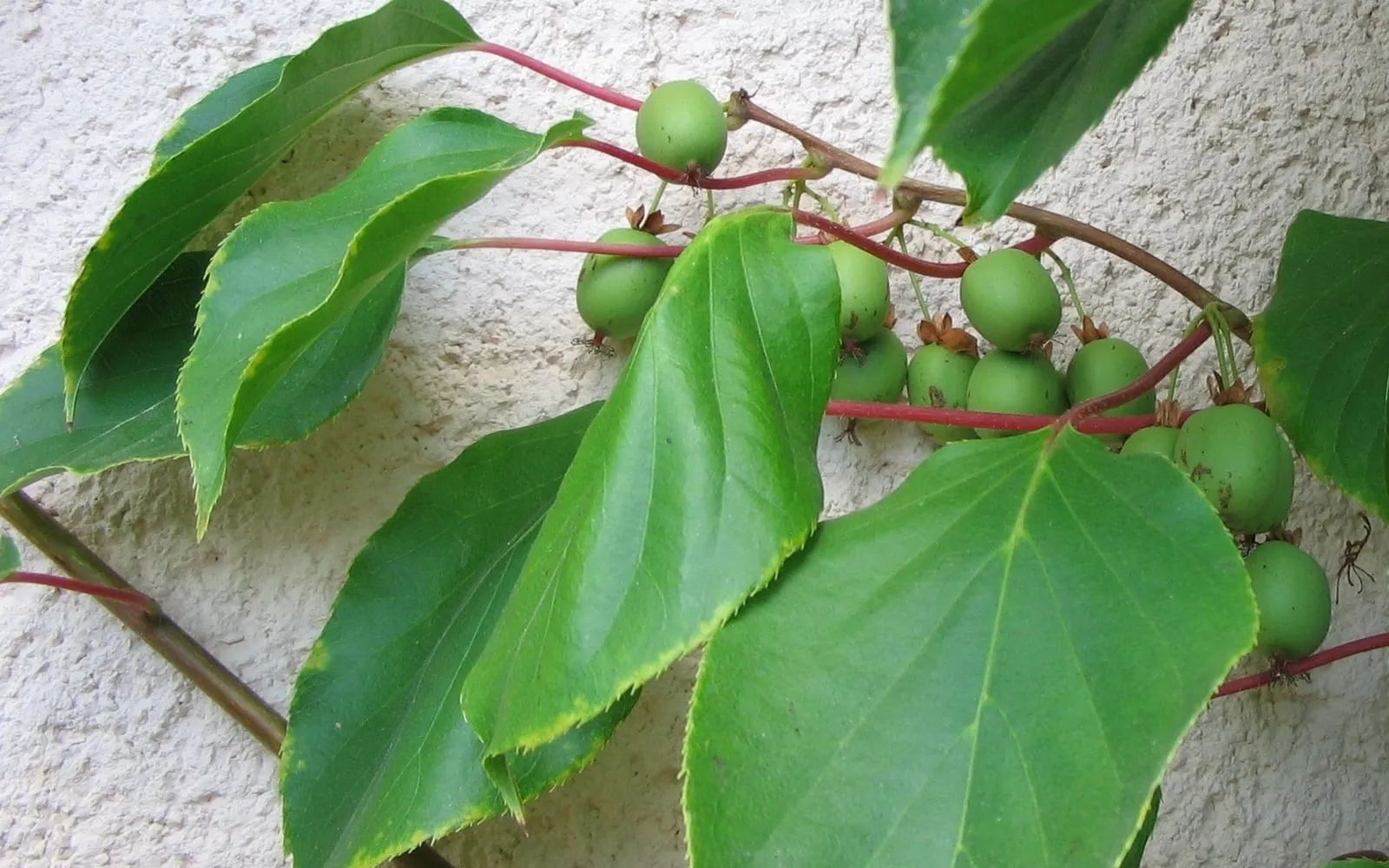
Leaves are 6 to 12 cm, oval with a pointed tip and finely toothed edges, glossy dark green, often with red leaf stalks.
Flowers open in June, white, 1.5 to 2 cm across, slightly scented, hanging in small clusters. Male and female are separate plants except in self-fertile selections.
Fruit is smooth-skinned and green, 2 to 3 cm long, oval, hanging in bunches, with the flesh and black seeds of a kiwi in miniature.
Where it is from
Actinidia arguta is native to north-east Asia, from Korea and Japan through north-east China into the Russian Far East and Siberia.
It grows in cool temperate forest, climbing into trees to reach light, in a climate of cold winters and warm summers.
That northern range is where the hardiness comes from, and it is the reason this species succeeds in gardens that cannot support the Chinese kiwis.
Russian growers selected varieties for fruit through the twentieth century, and ‘Ken’s Red’, a New Zealand selection with red-flushed fruit, extended the range of what is available.
Commercial kiwiberry production has grown in Oregon, Chile and Portugal since the 1990s, sold as a snack fruit that needs no peeling.
How it grows
Buy named plants. For the heaviest crop plant a female such as ‘Weiki’ or ‘Ken’s Red’ with a male, one male serving up to eight females. For a single plant choose ‘Issai’.
Build the support before planting. A pergola, a substantial arch, or heavy wires on a wall. A mature vine weighs a great deal.
Plant in spring or autumn in sun or light shade, in deep soil improved with compost, at pH 5.5 to 6.5.
Cage young plants against cats, which shred Actinidia stems.
Train a single stem to the top of the support, then two permanent arms, with fruiting side shoots from those arms.
Prune twice a year. Shorten side shoots to five or six leaves beyond the fruit in July, and remove old fruited wood in January.
Through the seasons
Bud break is in April, and the soft new growth is as frost-tender as any kiwi despite the wood’s hardiness. Fleece where a late frost threatens.
Flowering is in June, later than the larger kiwis, which reduces the frost risk to the crop.
Growth through summer is rapid and needs controlling, or the vine will bury its support and shade out its own fruiting wood.
Fruit ripens from September into October. Unlike the furry kiwis it can ripen on the vine, and the flavour is much better for it.
Pick when the fruit gives slightly to a gentle squeeze. Firm fruit picked early will ripen indoors in a few days.
Winter pruning in January is the main structural work of the year.
Care difficulty
Moderate, which makes it far more approachable than the other two kiwis.
Hardiness removes the site restriction that limits A. deliciosa to warm southern walls.
Vigour is the real work. Two pruning sessions a year are needed to keep the plant productive and within bounds.
Spring frost on new growth remains a risk, though June flowering means the crop itself is rarely lost.
Support is the other consideration. A vine this heavy needs a structure built for it, and retro-fitting one later is a difficult job.
Watering
Water weekly through summer, 20 to 25 litres for an established vine, and twice weekly in hot weather.
The plant is thirsty, though less demanding than A. deliciosa.
Water steadily through August and September while the fruit is sizing.
Mulch generously each spring with compost or bark over the root area, kept clear of the stem.
Drainage must be good. Deep moisture-retentive soil that does not waterlog is the target.
Warning signs, diseases and pests
New shoots blackened in April. Late frost. The wood is hardy but the young growth is not. Fleece on cold nights.
Stems chewed and shredded near ground level. Cats. Cage young plants until the bark hardens.
Soft growth torn and browned. Wind. The new shoots are brittle and snap at the base.
Vine yellowing with dark soft roots. Root rot from waterlogging. Improve drainage.
Wasps on ripe fruit in September. They arrive once the fruit softens. Pick promptly rather than leaving fruit hanging.
Brown crisp leaf margins in July. Leaf scorch from drought. Water more heavily and mulch.
Growing environment
Full sun gives the heaviest and sweetest crop, though the plant tolerates light shade better than the larger kiwis.
Deep fertile moisture-retentive soil with good drainage, at pH 5.5 to 6.5.
Hardiness to -25 deg C puts it within reach of gardens down to USDA zone 4, including northern and upland ones.
Shelter from strong wind helps, mainly to protect soft spring growth.
The structure matters most. A pergola, a strong arch or a wall with heavy wires, allowing 4 to 5 m per vine, and room for a male unless you grow ‘Issai’.
Feeding
Apply a balanced general fertiliser in early spring.
Follow with a high-potash liquid feed monthly from May to July to support fruiting.
Mulch each spring with compost or well-rotted manure.
Stop feeding by the end of July so growth hardens before winter.
Avoid pushing nitrogen on a plant this vigorous, since the result is more growth to prune and less fruit.
Troubleshooting
No fruit on a mature vine. The plant is male, or no male is nearby. Check the flowers, since males carry obvious yellow stamens and no central styles.
‘Issai’ cropping lightly. Normal. It is self-fertile but yields better with a male nearby.
Vine swamping everything. Its nature. Prune in July and again in January, and expect to keep doing so.
Fruit small. Too many on the vine, or drought. Thin and water.
Fruit dropping before ripening. Water stress during a dry August.
No flowers after three years. Young plants take three to five years to flower, and hard pruning delays it further.
Hardy kiwi problem guides
Not sure what is wrong? See the common vegetable pests guide.