
Edible
Persimmon
Diospyros kaki
Also known as Kaki, Japanese persimmon, Sharon fruit, Chinese persimmon
How to grow persimmon, Diospyros kaki. Astringent and non-astringent types, why one must be jelly-soft before you eat it, and orange fruit hanging on bare branches.
At a glance
- Difficulty
- Moderate
- Water
- Weekly through summer for the first years, then in drought
- Light
- Full sun, on a sheltered south wall in most temperate regions
- Temperature
- Hardy to about -15 deg C when dormant
- Hardiness
- USDA 7-10, RHS H4, hardy to -15 C
- Type
- Deciduous tree, long-lived
- Height
- 4-8 m in a cool climate, more in warmer ones
- Native to
- China, Japan, Korea
- Best month
- October, November and December in the Northern Hemisphere, April, May and June in the Southern Hemisphere
Northern China, and hardier than its reputation, surviving about -15 deg C. Fruiting needs a long warm autumn to ripen, and the astringent cultivars need frost or full softening before they are edible while the non-astringent ones do not. Fruit is set without pollination on many cultivars.
Hardiness zones describe winter cold alone. Summer heat, humidity, rainfall and the length of the growing season decide as much, so treat the range as the outer limit rather than as a recommendation.
Every month named in this guide is for the temperate Northern Hemisphere. If you garden in the Southern Hemisphere, shift each one by six months, so October becomes April. Closer to the equator the wet and dry seasons matter more than the calendar, and the shift stops being a useful guide.
Edible, with limits
- Safe to eat
- The ripe fruit
- Do not eat
- Unripe fruit, in quantity
- Harm from
- Eating it
- Affects
- People
The ripe fruit is food. Neither the RHS nor the ASPCA lists Diospyros kaki as harmful, and no toxicity to cats or dogs is recorded. The caution concerns unripe fruit, which is loaded with soluble tannins. Eaten in quantity on an empty stomach those tannins can bind with stomach acid and food into a hard mass called a diospyrobezoar, which occasionally needs medical removal. Cases are rare and associated with eating several unripe astringent persimmons at once. Waiting until the fruit is properly ripe removes the risk along with the astringency, which is the same thing the flavour requires.
Sources: RHS potentially harmful garden plants, ASPCA toxic and non-toxic plants
About
Two kinds of persimmon exist and confusing them ruins the fruit. Astringent varieties such as ‘Hachiya’ are inedible until the flesh turns to jelly, at which point they are superb. Non-astringent varieties such as ‘Fuyu’ are eaten firm like an apple.
Anyone who has bitten a firm ‘Hachiya’ remembers it. The tannins strip the moisture from the whole mouth and the sensation lasts for several minutes.
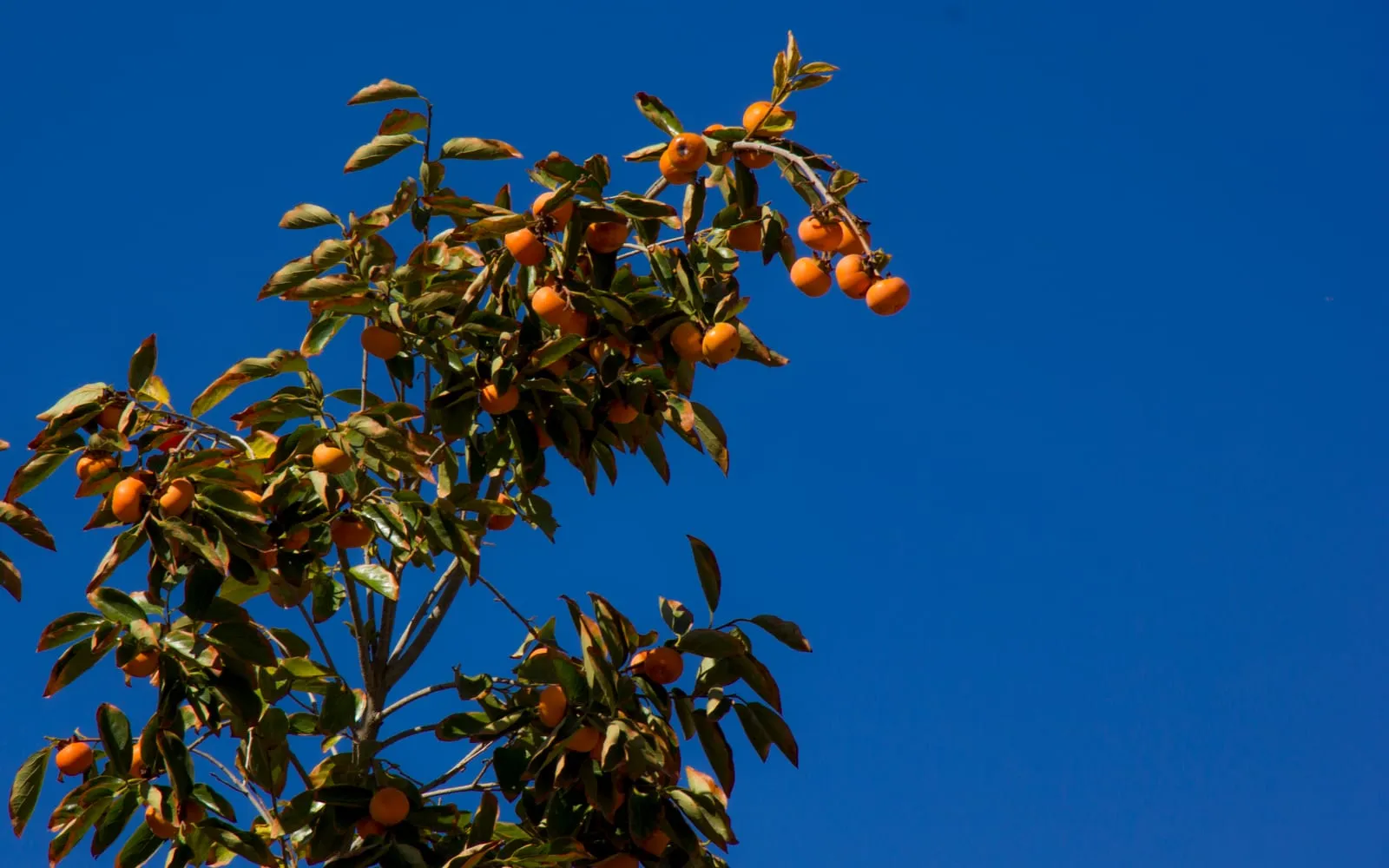
As a garden tree it is handsome. Glossy leaves turn orange and scarlet in autumn, then drop and leave the fruit hanging on bare branches like lanterns, often into December.
USDA 8 is the edge of what it will do. A sheltered south wall in the south of England ripens fruit in a good year, and ‘Rojo Brillante’ and ‘Fuyu’ are the varieties most likely to succeed.
Appearance and character
A rounded deciduous tree with a spreading habit and outer branches that droop under the weight of fruit.
Bark is dark grey-brown, breaking into small squarish blocks on an old trunk.
Leaves are large, 8 to 18 cm, oval, thick and glossy dark green, turning through yellow and orange to deep red in autumn. The autumn colour alone justifies the tree.
Flowers open in May and June, small, bell-shaped and creamy yellow, often inconspicuous. Many varieties carry female flowers only and set fruit without pollination.
Fruit is round to slightly flattened or acorn-shaped depending on variety, 5 to 9 cm across, glossy orange to deep red, with a persistent four-lobed green calyx at the top.
Where it is from
Diospyros kaki originates in China, where it has been cultivated for well over two thousand years, and it spread early to Korea and Japan.
Japan treats it as a national fruit and grows hundreds of varieties, and the distinction between astringent and non-astringent types was formalised there.
It reached Europe in the eighteenth century and became a commercial crop in Spain and Italy, where ‘Rojo Brillante’ from Valencia now dominates European supply.
Sharon fruit is a trade name for a non-astringent type grown in the Sharon plain in Israel, treated after picking to remove tannins.
The genus name means fruit of the gods, which suggests the regard the ripe fruit has always attracted.
How it grows
Buy a grafted tree of a named variety. Seedlings take many years and give unpredictable fruit.
Choose ‘Fuyu’ or ‘Jiro’ for non-astringent fruit eaten firm, or ‘Rojo Brillante’ for a heavy cropper that ripens relatively early.
Plant in spring against a sheltered south or west wall, into deep well-drained soil at pH 6 to 7.
Fan-training against a wall is the best method in a cool climate, giving the fruit reflected heat through a long autumn.
Stake young trees and shelter them from wind, which damages the large leaves.
Prune lightly in late winter. Persimmon fruits on the current season’s growth from last year’s wood, so avoid removing all the young shoots.
Through the seasons
The tree leafs out late, often not until May, which protects it from spring frost.
Flowering follows in May and June, and many varieties set fruit without any pollination at all.
Early summer brings fruit drop, which is normal and can be heavy. The tree sheds what it cannot carry.
Through late summer the fruit swells slowly and colours from green to orange from September.
Leaves fall in late autumn, leaving the fruit on bare branches, and this is the tree’s best moment.
Pick in November and December by cutting the stalk with the calyx attached. Ripen astringent varieties indoors until the flesh is jelly-soft.
Care difficulty
Moderate. The tree is hardy enough for USDA 8 and needs no spraying, and the difficulty is in ripening and in fruit drop.
Fruit drop is the recurring frustration. Young trees in particular shed most of their crop, and it takes several years before a tree holds fruit reliably.
Ripening needs a long warm autumn, which is why a wall matters so much.
Pruning is light and infrequent, and the tree has few pests in cool climates.
Patience is the main requirement. A grafted tree takes three to five years to fruit and longer to crop well.
Watering
Water weekly through summer for the first three or four years, 20 to 25 litres at a time.
An established tree in open ground needs water only in drought, though a wall-trained tree sits in rain shadow and needs it every summer.
Steady moisture reduces fruit drop, which is often triggered by a swing between dry and wet.
Mulch in spring with compost over the root area, kept clear of the trunk.
Drainage matters. The tree will not tolerate roots standing wet through winter.
Warning signs, diseases and pests
Small green fruit dropping through June and July. Normal on a young tree, particularly after a dry spell. Water steadily and expect the habit to reduce with age.
Fruit still hard and orange in December with frost forecast. Pick it and ripen indoors. Frost will damage fruit left hanging.
White waxy clusters or brown bumps on stems. Mealybug or scale on a warm wall. Scrub off or treat with horticultural soap.
Large leaves browning at the edges in July. Leaf scorch from drought or reflected wall heat. Water heavily and mulch.
Tree declining with dark soft roots. Root rot from waterlogging. Improve drainage.
Fruit pecked and hollowed. Birds and wasps once it softens. Bag individual fruits or pick slightly early and ripen indoors.
Growing environment
Full sun on a sheltered south or west wall in most temperate regions. Only the mildest southern gardens can grow it well in the open.
Deep fertile well-drained soil at pH 6 to 7.
Shelter from wind protects the large leaves and helps the fruit hang on.
A long warm autumn is what ripens the crop, so a position that stays warm into October matters more than midsummer heat.
Allow 3 to 4 m of wall for a fan. A large container works for a few years and restricts the tree usefully, at the cost of constant watering.
Feeding
Feed once in early spring with a balanced general fertiliser.
Avoid high nitrogen, which increases fruit drop and produces soft growth.
Mulch with compost each spring, which does more than fertiliser on reasonable soil.
Sulphate of potash in late winter helps fruiting and wood ripening on a tree making plenty of growth.
A container tree needs a balanced liquid feed monthly from May to August.
Troubleshooting
Fruit unbearably astringent. An astringent variety eaten too early. Ripen it until the flesh is jelly-soft, or grow a non-astringent variety instead.
All the fruit dropping in summer. Common on young trees and after water stress. Water steadily and give the tree time.
Fruit not colouring by November. A cool autumn or too little sun. A warmer wall is the only real fix.
No fruit at all. The tree is too young, or growth is too vigorous from feeding. Most varieties set without pollination, so a partner is rarely the issue.
Leaves scorching in summer. Drought or wall heat. Water far more heavily.
Frost damage to hanging fruit. Pick before the first hard frost and ripen indoors.
Persimmon problem guides
Not sure what is wrong? See the common vegetable pests guide.