
Edible
Wild Leek
Allium tricoccum
Also known as Ramps, Ramson (North America), Wild leek
How to grow ramps, Allium tricoccum. The North American wild leek, why it takes seven years from seed, and harvesting one leaf instead of the bulb.
At a glance
- Difficulty
- Difficult
- Water
- Rarely once established, in a dry spring only
- Light
- Dappled shade under deciduous trees
- Temperature
- Fully hardy. It needs a cold winter to break dormancy
- Hardiness
- USDA 3-7, RHS H7, hardy to -35 C
- Type
- Hardy perennial from a bulb, with a short spring leaf season
- Height
- 20-30 cm in leaf, 40 cm in flower
- Native to
- Eastern North America
- Best month
- April in the Northern Hemisphere, October in the Southern Hemisphere
A spring ephemeral of deciduous forest, so it wants a cold winter, damp leaf litter and a canopy that closes over it by June. Warm regions with no real winter are the wrong place entirely. It takes five to seven years from seed to a harvestable bulb, which is why wild harvesting has emptied whole woods and why Quebec protects it by law.
Hardiness zones describe winter cold alone. Summer heat, humidity, rainfall and the length of the growing season decide as much, so treat the range as the outer limit rather than as a recommendation.
Every month named in this guide is for the temperate Northern Hemisphere. If you garden in the Southern Hemisphere, shift each one by six months, so April becomes October. Closer to the equator the wet and dry seasons matter more than the calendar, and the shift stops being a useful guide.
Toxic to pets if eaten
- Safe to eat
- The leaves and bulbs, for people
- Harm from
- Eating it
- Affects
- Cats, dogs and horses
Ramps are a food crop and entirely safe for people. They are not safe for pets. Every Allium contains organosulphur compounds that damage red blood cells in cats, dogs, horses and cattle, causing Heinz body haemolytic anaemia, and the ASPCA lists the genus as toxic to all three. Cooking does not destroy them. The identification hazard matters more here than the toxicity, because ramps are a foraged plant and their broad flat leaves resemble those of lily of the valley and, in Europe, lords-and-ladies and autumn crocus, all of which are seriously poisonous. Deaths have occurred in Europe from people picking Colchicum autumnale in mistake for wild garlic, and the same confusion is possible with ramps. The reliable test is smell. Crush a leaf, and if it does not smell strongly of onion or garlic, do not eat it. Ramps are also a conservation concern. Wild populations in eastern North America have been depleted by commercial harvesting, Quebec protects the species by law, and several US states restrict collection.
Sources: ASPCA (Onion, Allium species), RHS potentially harmful garden plants
About
Ramps are the North American answer to wild garlic, and they are a far slower plant than that comparison suggests. Seed takes two winters to germinate, a seedling takes another three to five years to reach a pickable size, and a patch takes the better part of a decade to establish.
That slowness is why they have become a conservation problem. Commercial foraging for restaurants strips a wood in one season and the patch takes decades to recover, which is why Quebec protects the species and several American states restrict collection.
For a gardener with a shady damp corner and patience, they are a rewarding thing to grow. The flavour is stronger and more garlicky than European wild garlic, and the plant is a genuine woodland ephemeral, up and gone between April and June before the tree canopy closes.
Appearance and character
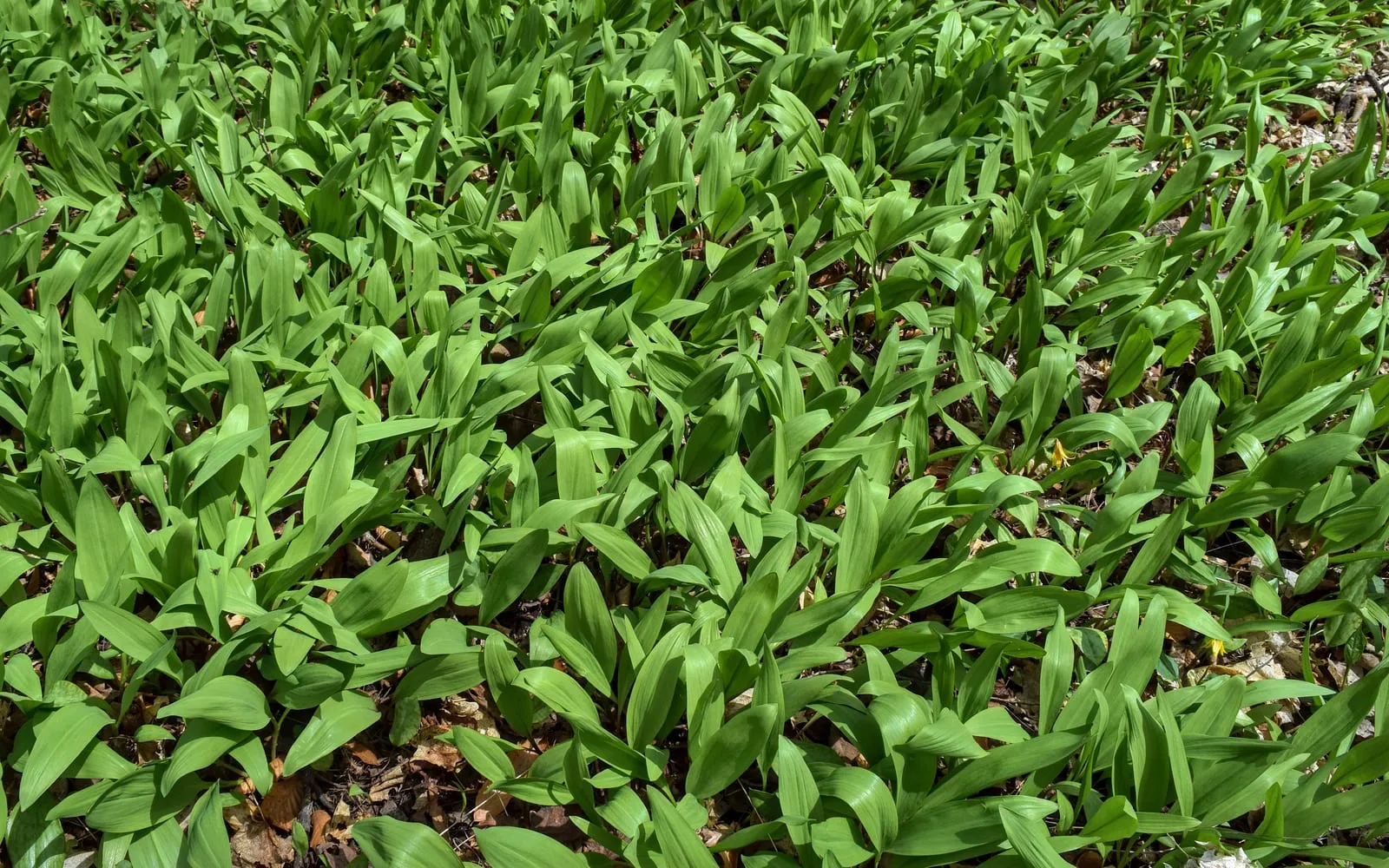
Two or three broad, flat, smooth leaves rising directly from a slender white bulb, each 15 to 25 cm long and 5 to 8 cm wide, in a soft pale green.
The leaf stalks are usually flushed deep red or burgundy at the base, which is the most useful distinguishing feature in the field.
The whole plant smells strongly of garlic and onion when any part is crushed, which is the safety test as much as the identification.
Leaves die back completely in late May or June, before the flowers appear.
Flowers follow in July on a leafless stem to 40 cm, in a rounded umbel of small white star-shaped flowers, followed by shiny black seeds in three-lobed capsules.
Flavour is pungent, garlicky and onion-sweet, stronger than European wild garlic and considerably stronger than chives.
Where it is from
Allium tricoccum is native to eastern North America, from Quebec and Ontario south to Georgia, growing in rich deciduous woodland on moist slopes.
Indigenous peoples across that range harvested and used it, and the Menominee name for the plant gave Chicago its name, through shikaakwa, the place of the wild onion.
Appalachian communities built spring festivals around the ramp harvest, and ramp suppers in West Virginia and Tennessee are still annual events.
Restaurant demand from the 1990s onwards changed the picture. Wild harvesting intensified, populations declined measurably, and cultivation began to be taken seriously as a result.
The European equivalent is Allium ursinum, wild garlic or ramsons, which is a different species with narrower leaves, a longer season and a much faster growth rate.
How it grows
Plant bulbs rather than sowing seed where you can. Bulbs planted in autumn at 8 cm deep and 10 cm apart give a crop within two or three years.
Seed is the slow route. Sow fresh seed in autumn in a shady bed, and expect it to need two winters to germinate, since the seed has a double dormancy that needs warm then cold stratification. Allow five to seven years to a pickable plant.
Choose the site carefully. Ramps want the conditions of a deciduous wood floor. Give them dappled shade, deep leafy soil, and ground that is moist in spring and dries out under a closed canopy in summer.
Mulch with leaf mould every autumn. This is the plant’s natural fertility supply and it matters more than any feed.
Harvest one leaf per plant rather than lifting the bulb. Taking a single leaf allows the plant to continue and is the practice that makes a patch sustainable. Lifting bulbs is what has depleted the wild populations.
Leave a patch alone entirely for the first three years after planting.
Through the seasons
Early spring brings the leaves up in April, before the tree canopy closes. This is the whole harvest season and it lasts six to eight weeks.
Late spring is picking, taking one leaf per plant from established clumps only. Leaves begin to yellow and die back in late May.
Summer is dormancy for the leaves and flowering time. The plant sends up a bare flower stem in July, which is often the only sign it is there.
Autumn is planting and mulching. Plant bulbs, sow fresh seed, and spread leaf mould over the whole patch.
Winter is the cold period the plant needs. Ramps require a proper winter to break dormancy, which makes them a poor choice for a mild frost-free garden.
Care difficulty
Difficult, and the difficulty is time rather than skill.
Establishment is the whole thing. Nothing about the plant is fussy once it is growing, and getting to that point takes years. Buy bulbs rather than seed if you have any choice.
Site selection decides success. Deep, moist, humus-rich soil in dappled deciduous shade, which usually means under a hedge, a group of trees or on the north side of a shrub border.
Restraint in harvesting is the discipline that keeps a patch alive. One leaf per plant, from established clumps, and nothing at all for the first three years.
Slugs take the emerging leaves in spring.
Waterlogging over winter rots the bulbs on heavy ground.
Watering
Water in a dry spring while the leaves are up, which is the only period the plant is actively growing.
An established patch under trees rarely needs watering, since it does its growing in the wettest part of the year.
Do not water in summer. The plant is dormant and wet dormant bulbs rot.
Mulch with leaf mould in autumn, which holds spring moisture and feeds the patch at the same time.
Avoid heavy clay that stays wet all winter.
Container growing is possible in a deep pot of leafy compost in shade, and it does not suit a plant that wants to spread slowly over years.
Warning signs, diseases and pests
Slugs graze the emerging leaves in April and can strip a young patch. Patrol on damp evenings while the leaves are up.
Allium white rot yellows and wilts the plants with white fluffy growth at the base. Since this is a long-lived perennial that cannot be rotated, plant into ground with no allium history.
Rabbits and deer graze the spring foliage. Fence or net a young patch.
Root and bulb rot follow winter waterlogging on heavy ground.
Slow establishment is normal rather than a fault. A patch that seems to do nothing for three years is behaving correctly.
A patch that thins and disappears has almost always been over-harvested. Take one leaf per plant and never lift bulbs from a patch you want to keep.
Growing environment
Dappled shade under deciduous trees or shrubs. Full sun scorches the leaves and deep evergreen shade starves them.
Deep, moist, humus-rich woodland soil with plenty of leaf mould worked in.
Slightly acid soil, pH 5.5 to 6.5.
Spring moisture and summer dryness, which is exactly what a deciduous canopy provides.
A cold winter, since the plant needs sustained cold to break dormancy.
A permanent position, undisturbed, outside any rotation and away from cultivation.
Ground with no history of allium white rot.
Feeding
Mulch with leaf mould every autumn. This is the correct feed for a woodland plant and it is what the natural habitat supplies.
Well-rotted compost is an acceptable alternative, applied in autumn.
Avoid all artificial fertiliser and especially nitrogen, which gives soft growth that slugs strip.
Never use fresh manure.
An established patch needs nothing beyond the annual leaf mould.
Troubleshooting
The seed did not germinate. Normal. Ramp seed has a double dormancy and needs a warm period followed by a cold one, which usually means two winters in the ground. Sow fresh seed in autumn and wait.
The plants disappeared in June. Normal. Ramps are a spring ephemeral. The leaves die back before the flower stem appears in July.
The patch has thinned out over a few years. Over-harvesting. Take one leaf per plant from established clumps and never lift the bulbs from a patch you want to keep.
Slugs stripped the young leaves. Patrol on damp evenings through April and May, which is the only period the plant is above ground.
The leaves scorched and browned. Too much sun. Ramps want dappled shade under a deciduous canopy.
The bulbs rotted over winter. Waterlogging on heavy ground. Ramps want moist soil in spring and free drainage in winter.
How do I tell them from something poisonous? Crush a leaf and smell it. Ramps smell strongly of garlic and onion. Lily of the valley, lords-and-ladies and autumn crocus have similar broad leaves and no allium smell, and all three are seriously poisonous. If it does not smell, do not eat it.
How long until I can pick any? Two or three years from planted bulbs, and five to seven from seed. Leave a new patch entirely alone for the first three years.
Wild Leek problem guides
Not sure what is wrong? See the common vegetable pests guide.