
Edible
Juneberry
Amelanchier lamarckii
Also known as Snowy mespilus, Serviceberry, Saskatoon, Shadbush, Amelanchier
How to grow juneberry, Amelanchier lamarckii. Blossom in April, sweet almond-flavoured fruit in June, and the netting you will need to keep any of it.
At a glance
- Difficulty
- Easy
- Water
- Weekly in the first two summers, then in drought only
- Light
- Full sun to part shade
- Temperature
- Fully hardy to -25 deg C or lower
- Hardiness
- USDA 4-8, RHS H7, hardy to -30 C
- Type
- Deciduous shrub or small tree, long-lived
- Height
- 4-8 m, and as wide with age
- Native to
- North America
- Best month
- June and July in the Northern Hemisphere, December and January in the Southern Hemisphere
Cold is no obstacle at all, and the plant is grown commercially on the Canadian prairies where winters reach -40 deg C. Warm climates are the problem. Below about 400 chill hours it flowers poorly, and in humid summers the fruit is taken by rust that alternates with juniper.
Hardiness zones describe winter cold alone. Summer heat, humidity, rainfall and the length of the growing season decide as much, so treat the range as the outer limit rather than as a recommendation.
Every month named in this guide is for the temperate Northern Hemisphere. If you garden in the Southern Hemisphere, shift each one by six months, so June becomes December. Closer to the equator the wet and dry seasons matter more than the calendar, and the shift stops being a useful guide.
Not known to be toxic
- Safe to eat
- The ripe fruit
- Do not eat
- Seeds and leaves, at trace levels
The fruit is food and is eaten in quantity across North America. Neither the RHS nor the ASPCA lists Amelanchier as harmful. Like other members of the rose family the seeds and leaves contain cyanogenic glycosides at low levels, and the seeds are small and soft enough to eat with the fruit without concern. Wilted foliage is the form that matters for grazing animals rather than for people, so keep prunings out of a paddock and out of reach of livestock. The berries carry no risk to cats or dogs.
Sources: RHS potentially harmful garden plants, ASPCA toxic and non-toxic plants
About
Juneberry earns its place in a garden four times a year, which is a rare thing in a fruiting plant. Copper-pink young leaves in April, white blossom at the same moment, sweet purple fruit in June, and orange-red autumn colour.
The fruit tastes of blueberry with a strong note of marzipan behind it, which comes from the soft seeds. Anyone who has eaten a Saskatoon berry pie in western Canada knows the flavour, and it has no close parallel among European fruit.
You will be competing with birds. Blackbirds and starlings know exactly when the fruit turns and can clear a small tree in two days. Netting is the difference between a harvest and a nice show of blossom.
The plant asks for very little. It survives cold far beyond anything most gardens will see, grows on most soils, and needs no pruning beyond tidying.
Appearance and character
A multi-stemmed shrub or small tree with a light open crown, usually wider than it is tall once mature.
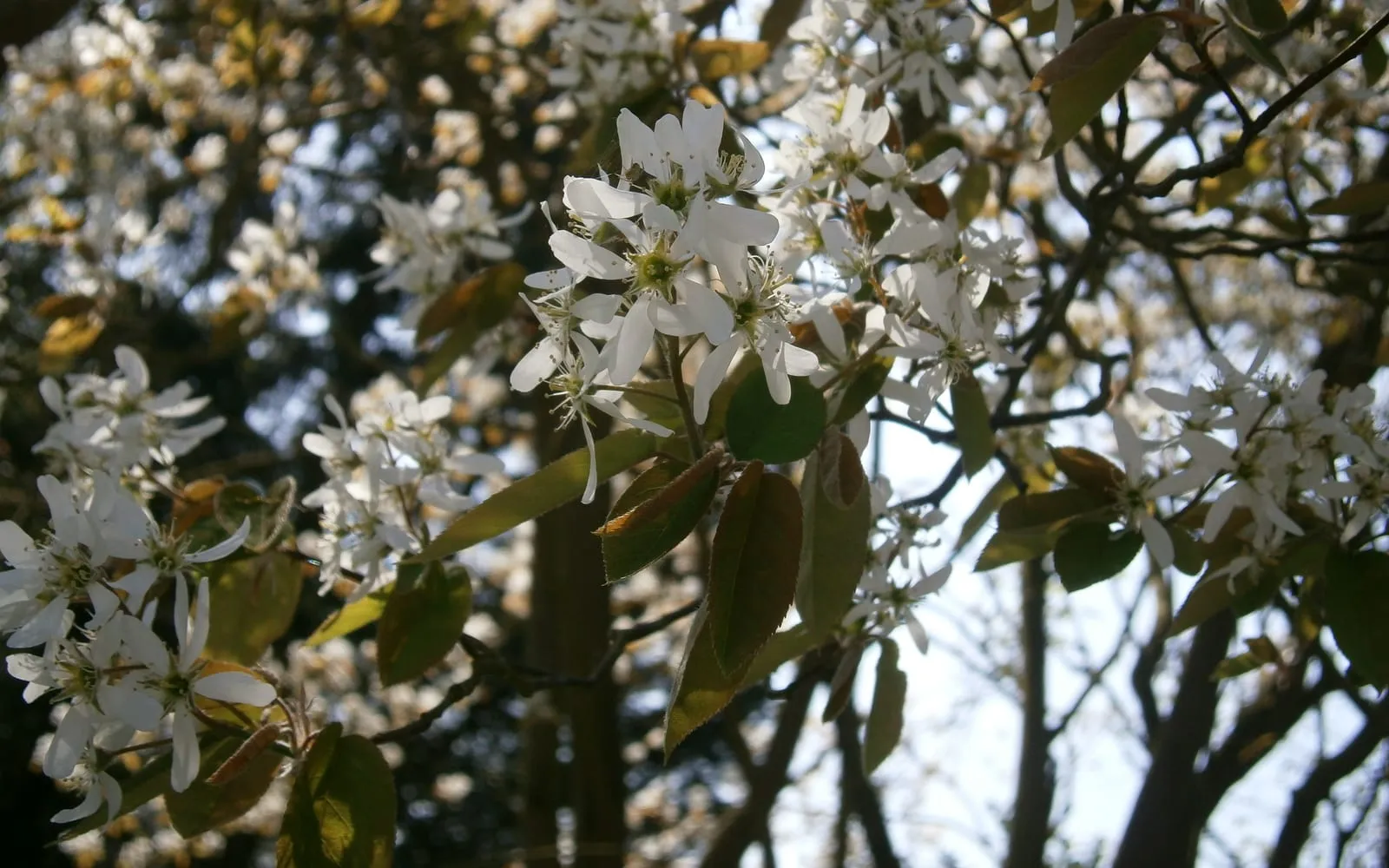
New leaves in spring emerge coppery pink and silky with fine hairs, turning smooth mid-green as they expand. They are oval, 4 to 8 cm, with fine teeth along the edge.
Flowers open in April in loose drooping clusters, each with five narrow white petals set well apart, giving the whole plant a gauzy look rather than the solid white of blossom on a cherry.
Fruit is a small round pome 8 to 12 mm across, green turning red then deep purple-black with a blue bloom. Ripening runs over three weeks rather than all at once.
Autumn colour is orange through to red, reliable in most years and better on acid soil.
Where it is from
Amelanchier lamarckii is North American in origin, from the eastern seaboard, and it has been grown in Europe since the seventeenth century.
Its exact wild origin has been argued over for a long time, and the plant may be a hybrid that arose in cultivation rather than a clean wild species.
It has naturalised widely in the Netherlands, Germany and parts of southern England, spreading by bird-sown seed into sandy heathland and open woodland.
The genus grows across northern North America, and the western species Amelanchier alnifolia is the Saskatoon, farmed commercially on the Canadian prairies for fruit.
Indigenous peoples across the northern plains dried the berries and pounded them with fat and meat into pemmican, where the fruit supplied both sugar and a preservative.
How it grows
Buy a container-grown or bare-root plant in autumn or winter. Named fruiting selections such as ‘Ballerina’ or the Saskatoon variety ‘Smoky’ crop more heavily than the ordinary garden form.
Plant into moist well-drained soil, ideally neutral to slightly acid. It grows on chalk but the autumn colour suffers and the leaves may yellow.
Space at 4 m if you are planting more than one, or 1 m apart if you want a fruiting hedge.
Water through the first two summers. Once established the plant is drought-tolerant and needs nothing.
Net from late May. Drape the net clear of the foliage on a frame, since fruit touching the mesh gets taken through it, and secure the bottom edge so birds cannot walk in underneath.
Pick over several visits from mid-June, taking only fruit that is fully purple-black and comes away with no resistance.
Through the seasons
April brings the leaves and the blossom together, which is the moment the plant is most worth having.
May sets the fruit and is when the netting goes on. Leaving it until the berries colour is leaving it too late, because birds start on them while still red.
June is harvest, running into early July on a large plant. Ripening is staggered, so expect to pick three or four times.
Through high summer the plant is quiet, and mildew may dust the leaves in a dry spell without doing harm.
Autumn brings the colour, orange to scarlet, holding for two or three weeks. This is also the season to plant.
Winter shows a fine tracery of grey stems, and it is the only time to prune. Take out old, dead or crossing stems at the base and leave the rest.
Care difficulty
Easy. The plant is hardy, tolerant of most soils, untroubled by pests and needs almost no intervention.
Disease is minor. Mildew and leaf spot appear in the wrong sort of summer and clear without treatment.
The single difficulty is birds, and that is a netting problem rather than a horticultural one.
Pruning is optional. Left alone the plant makes a good shape by itself, and the only useful cut is removing a proportion of the oldest stems on a congested specimen.
It is a sound choice for a new gardener wanting fruit without a spraying and pruning regime.
Watering
Water weekly through the first two summers, 15 to 20 litres at a time, poured slowly enough to soak in.
An established plant is notably drought-tolerant and will not need watering in an ordinary cool summer.
Fruit size responds to moisture in June, so a soaking during a dry spell just before harvest pays off in the picking.
Mulch in spring with compost, bark or leaf mould, keeping it clear of the stems.
A container plant needs regular watering all season, and juneberry is happier in the ground than in a pot given its eventual size.
Warning signs, diseases and pests
Fruit disappearing between one day and the next. Birds. Net before the berries show any colour, keep the mesh off the foliage, and pin the lower edge down.
White powdery film on leaves in late summer. Powdery mildew, which follows dry roots. Mulch and water in drought, and the plant grows out of it.
Orange or rusty raised spots on the upper leaf surface. Rust, which alternates between Amelanchier and juniper. Remove affected leaves and, where the problem recurs badly, consider which juniper nearby is hosting it.
Blackened shoot tips curled into a hook. Fireblight. Uncommon on juneberry, but cut 30 cm into clean wood and burn the prunings if you see it.
Dark leaf spots spreading in a wet summer. Leaf spot. Rake up and remove fallen leaves, and expect no lasting harm.
Whole stems dying, white fungal sheets beneath the bark at the base. Honey fungus, which is fatal. Dig out the stump and roots.
Growing environment
Full sun gives the heaviest crop and the best autumn colour. The plant grows well in part shade and fruits less.
Soil should be moist but free-draining. Neutral to acid suits it best, and on thin chalk expect yellowing leaves and disappointing autumn colour.
It tolerates wind and cold without complaint, which makes it useful in exposed gardens where other fruit fails.
Allow 4 m of spread for a mature plant. It can be kept smaller, but the airy shape is lost once you start shortening branches.
A row planted at 1 m makes a productive informal hedge that flowers, fruits and colours, though netting a hedge is more work than netting a single specimen.
Feeding
Little is needed. A mulch of garden compost each spring covers everything on reasonable soil.
On poor sandy ground a handful of general-purpose fertiliser in March supports growth in the establishment years.
Avoid high-nitrogen feeds. They push leafy growth at the expense of flower buds and soften the plant against fireblight.
On alkaline soil the useful treatment is not fertiliser at all. Chelated iron corrects the yellowing, and an ericaceous mulch slows the drift back.
A container plant needs a balanced liquid feed monthly through the growing season.
Troubleshooting
Good blossom, no fruit. Frost caught the flowers, or the plant is too young. Most set fruit from the third or fourth year.
Fruit small and dry. Drought in June. Water through the ripening period and mulch to hold moisture.
Leaves yellow with green veins. Iron shortage on limy soil. Apply chelated iron and mulch with composted bark or leaf mould.
Poor autumn colour. Alkaline soil or too much shade. Neither is correctable quickly, and the plant is otherwise unharmed.
Suckers appearing around the base. Normal for a multi-stemmed plant. Pull them out if you want a single trunk, or leave them to thicken the clump.
Plant getting too big. Take out a third of the oldest stems at ground level in winter and let younger ones replace them, which keeps the size down without spoiling the shape.