
Edible
Golden currant
Ribes aureum
Also known as Clove currant, Buffalo currant, Golden flowering currant
How to grow golden currant, Ribes aureum. Yellow spring flowers that smell of cloves, black fruit in July, and a shrub that tolerates drought better than any other currant.
At a glance
- Difficulty
- Easy
- Water
- First summer, then only in drought
- Light
- Full sun to part shade
- Temperature
- Fully hardy to -30 deg C
- Hardiness
- USDA 3-8, RHS H7, hardy to -35 C
- Type
- Deciduous shrub, long-lived, suckering
- Height
- 2-3 m
- Native to
- Western North America
- Best month
- July and August in the Northern Hemisphere, January and February in the Southern Hemisphere
The most drought-tolerant of the currants and the one that takes alkaline soil, which follows from a dry continental origin. Chill is around 800 hours. It is an alternate host for white pine blister rust, so the same planting restrictions apply in parts of the United States.
Hardiness zones describe winter cold alone. Summer heat, humidity, rainfall and the length of the growing season decide as much, so treat the range as the outer limit rather than as a recommendation.
Every month named in this guide is for the temperate Northern Hemisphere. If you garden in the Southern Hemisphere, shift each one by six months, so July becomes January. Closer to the equator the wet and dry seasons matter more than the calendar, and the shift stops being a useful guide.
Not known to be toxic
- Safe to eat
- The ripe fruit
The fruit is food and was a staple across the North American plains. Neither the RHS nor the ASPCA lists Ribes as harmful, and no toxicity to cats or dogs is recorded for the genus. Unripe fruit is sour and astringent and will upset a stomach in quantity, which passes as the berries ripen. The main point is ecological rather than medical. Ribes species are the alternate host for white pine blister rust, a disease of five-needled pines, which is why planting currants is restricted in parts of North America. Europe has no such restriction and very few susceptible pines, so it governs where you would plant one in North America rather than anywhere else.
Sources: RHS potentially harmful garden plants, ASPCA toxic and non-toxic plants
About
Walk past this shrub in April and the scent stops you. The small yellow flowers smell strongly of cloves and vanilla, carrying several metres on a warm day, which is why it is often sold as clove currant.
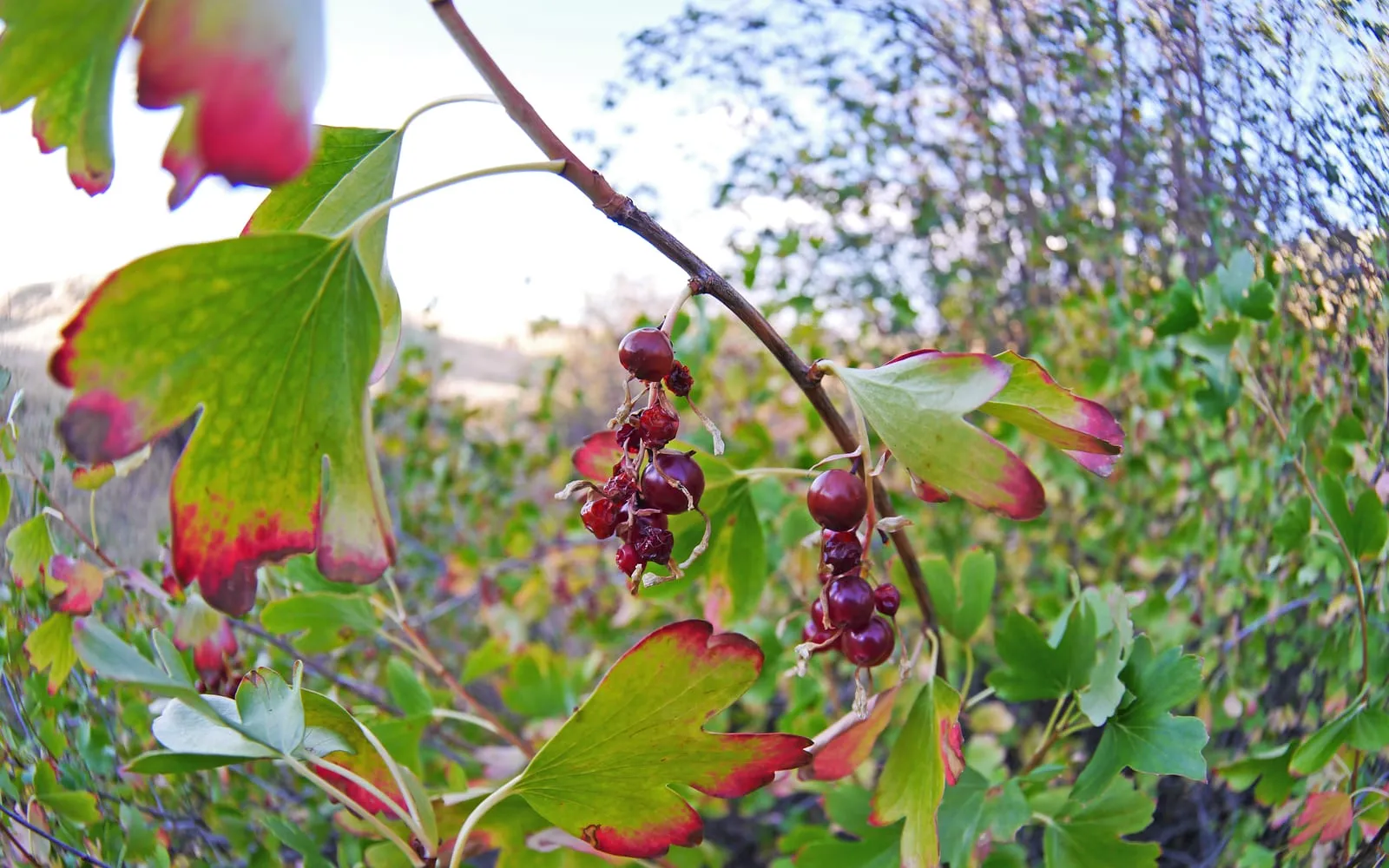
The fruit follows in July, glossy and usually black, sometimes amber or red depending on the form. It is sweeter and milder than a blackcurrant, without the muskiness, and good raw as well as cooked.
Where it beats every other currant is drought. This is a plant of the dry American West, and it crops on thin sandy ground that would leave a blackcurrant sulking.
It also takes alkaline soil, which further widens where it can be grown.
Appearance and character
An upright shrub with arching branches, spreading slowly into a clump by suckers from the base.
Stems are smooth and thornless, unlike a gooseberry, and turn grey-brown with age.
Leaves are small, 2 to 5 cm, with three rounded lobes, blue-green and smooth, and they turn a good red and gold in autumn.
Flowers open in April and May in short drooping clusters, each a long slender yellow tube 1 to 1.5 cm with five spreading lobes at the mouth. The scent is the plant’s defining feature.
Fruit is round, 6 to 10 mm, ripening through amber to black in most forms, hanging in short clusters.
Where it is from
Ribes aureum is native to western North America, from British Columbia south to California and east to the Great Plains.
It grows along streambanks, in canyons and on dry slopes, tolerating both periodic flooding and long summer drought.
Indigenous peoples across the plains dried the fruit and pounded it into pemmican, and the name buffalo currant comes from that use.
Lewis and Clark collected it on their expedition, and it reached British gardens in 1812, where it was grown for the flowers long before anyone in Europe bothered with the fruit.
The closely related Ribes odoratum from the central plains is often sold under the same names, and the two are hard to tell apart. Both are good garden plants and the confusion does no harm.
How it grows
Buy a container-grown plant. Named fruiting selections such as ‘Crandall’ carry much larger berries than the wild form.
Plant in autumn or spring in sun or light shade, in any well-drained soil. Poor sandy or chalky ground is acceptable.
Space at 1.5 to 2 m. The clump widens by suckering, slowly.
Plant two different clones if you want a heavy crop. It is partly self-fertile and sets far better with a partner.
Prune in winter, removing a proportion of the oldest stems at the base to keep young wood coming. Fruit is carried on two- and three-year-old wood.
Expect fruit from the third year.
Through the seasons
April and May bring the flowers and the scent, which is the plant’s best moment and a valuable one for early bees.
Leaves follow, blue-green and neat through summer.
Fruit sets in June and ripens through July and into August, changing from green through amber to black.
Pick when fully coloured and slightly soft. Underripe berries are sharp and astringent.
Autumn brings red and gold foliage, better than most currants manage.
Winter is the pruning season. Take out old dark stems at ground level and thin any congestion in the middle of the clump.
Care difficulty
Easy. It is hardier, more drought-tolerant and less disease-prone than blackcurrant or gooseberry.
It grows on poor, dry and alkaline soil where other currants fail.
Pests are minor. Aphids blister the leaves and sawfly can strip a plant, and neither threatens its life.
Pruning is straightforward renewal work once a year in winter.
Its main use in a garden is often ornamental, and the fruit comes as a bonus, which means a plant that is never pruned still earns its place.
Watering
Water weekly through the first summer while it establishes.
After that, water only in drought. This is among the most drought-tolerant fruiting shrubs available.
Moisture in June and July improves berry size, so a soaking during a dry spell is worthwhile once cropping.
Mulch in spring with compost, kept clear of the stems.
Waterlogging is the one condition it dislikes, despite tolerating streamside flooding in the wild, where the water moves rather than sits.
Warning signs, diseases and pests
Leaves puckered and blistered, often red-tinged. Currant blister aphid. Unsightly and rarely damaging. Squash the colonies on the leaf undersides.
White powdery coating on shoots and leaves. Powdery mildew, following still air and dry roots. Thin the stems and mulch.
Leaves stripped to the veins in early summer. Gooseberry sawfly larvae, which work from the centre of the bush outwards. Check the middle of the plant in May and pick them off.
Orange pustules on leaf undersides. Rust. Remove affected leaves. Gardens with no five-needled pines nearby rarely see it turn serious.
Fruit disappearing as it colours. Birds. Net if the crop matters.
Clump widening year on year. Suckers, which is normal. Slice through them with a spade in spring.
Growing environment
Full sun gives the heaviest crop and the strongest scent. Part shade is tolerated with a lighter crop.
Well-drained soil of almost any type, from sand to chalk, at pH 6 to 8. Alkaline ground is no obstacle.
Drought tolerance is high once established, which makes it a good choice for a dry sunny border.
Cold is irrelevant, with hardiness to -30 deg C.
Allow 1.5 to 2 m of width. It works in a mixed border, as an informal hedge, or in a dry corner where other fruit would fail.
Feeding
A balanced general fertiliser in spring is enough, and a plant on decent soil may need none.
Avoid heavy nitrogen, which produces soft growth and encourages mildew.
Mulch with compost or well-rotted manure in spring, kept off the stems.
Sulphate of potash in late winter improves fruiting on a plant making plenty of growth but little crop.
A container plant needs a balanced liquid feed monthly through summer, in a pot of at least 45 cm.
Troubleshooting
Heavy flowering, little fruit. Only one plant, or a self-sterile clone. Add a second different plant nearby.
Fruit sharp and astringent. Picked underripe. Wait until the berries are fully black and slightly soft.
Bush becoming a bare thicket with fruit only at the top. Renewal pruning overdue. Take a third of the oldest stems out at ground level each winter.
Leaves blistered and red. Blister aphid, which looks alarming and does little.
Bush stripped of leaves in June. Sawfly. Inspect the centre of the plant in May before the larvae spread outwards.
Suckers spreading into the lawn. Mow them, or cut them out with a spade in spring.
Golden currant problem guides
Not sure what is wrong? See the common vegetable pests guide.