
Edible
Saskatoon Serviceberry
Amelanchier alnifolia
Also known as Saskatoon, Western Juneberry
How to grow saskatoon serviceberry, Amelanchier alnifolia. Why birds usually beat you to the berries, the faint almond flavour that comes from the seeds, and cold hardiness that lets it fruit as far north as the Yukon.
At a glance
- Difficulty
- Easy
- Water
- Regular water while establishing; drought-tolerant once mature
- Light
- Full sun for the heaviest berry crop; tolerates part shade
- Temperature
- Extremely hardy; a severe winter causes it no harm at all
- Hardiness
- USDA 2-7, RHS H7, hardy to -40 C
- Type
- Deciduous large shrub or small multi-stemmed tree
- Height
- 2-6 m
- Native to
- western North America
A prairie and foothill shrub adapted to tolerate some of the coldest winters any fruiting plant tolerates, native as far north as the Yukon. Summer heat above about 30 deg C for extended spells checks growth and can scorch the leaves more readily than cold ever troubles it, so a short, cool growing season suits it better than a long, hot one.
Hardiness zones describe winter cold alone. Summer heat, humidity, rainfall and the length of the growing season decide as much, so treat the range as the outer limit rather than as a recommendation.
Not known to be toxic
- Safe to eat
- The ripe berries and, traditionally, the seeds ground into pemmican
Saskatoon berries are a genuine food crop, eaten fresh, dried and cooked across their native range for generations before commercial orchards existed. Neither the RHS harmful plants index nor the ASPCA toxic and non-toxic plants list carries an entry for Amelanchier. Like many fruits in the wider rose family, the small seeds contain a trace of the same cyanogenic compounds found at far higher concentration in an apple pip or a cherry stone, but the amount in a serving of berries, seeds included, is not a practical concern, and Indigenous use of the crushed seed as a flavouring in pemmican reflects generations of experience with the plant as a safe food. There is nothing about this species that calls for caution around pets or children beyond the ordinary care taken with any small hard seed as a choking hazard.
Sources: RHS potentially harmful garden plants, ASPCA toxic and non-toxic plants
About
Saskatoon serviceberry is a cold-hardy fruiting shrub from the plains and foothills of western North America, grown for clusters of sweet, purple berries that ripen through midsummer. It flowers early, a mass of white blossom on bare stems ahead of most other fruiting shrubs, and follows with fruit that tastes closer to a blueberry crossed with an almond than to any other common berry, a result of the small seeds inside. It tolerates cold that would kill most fruiting plants outright and needs very little in return.
Appearance and character
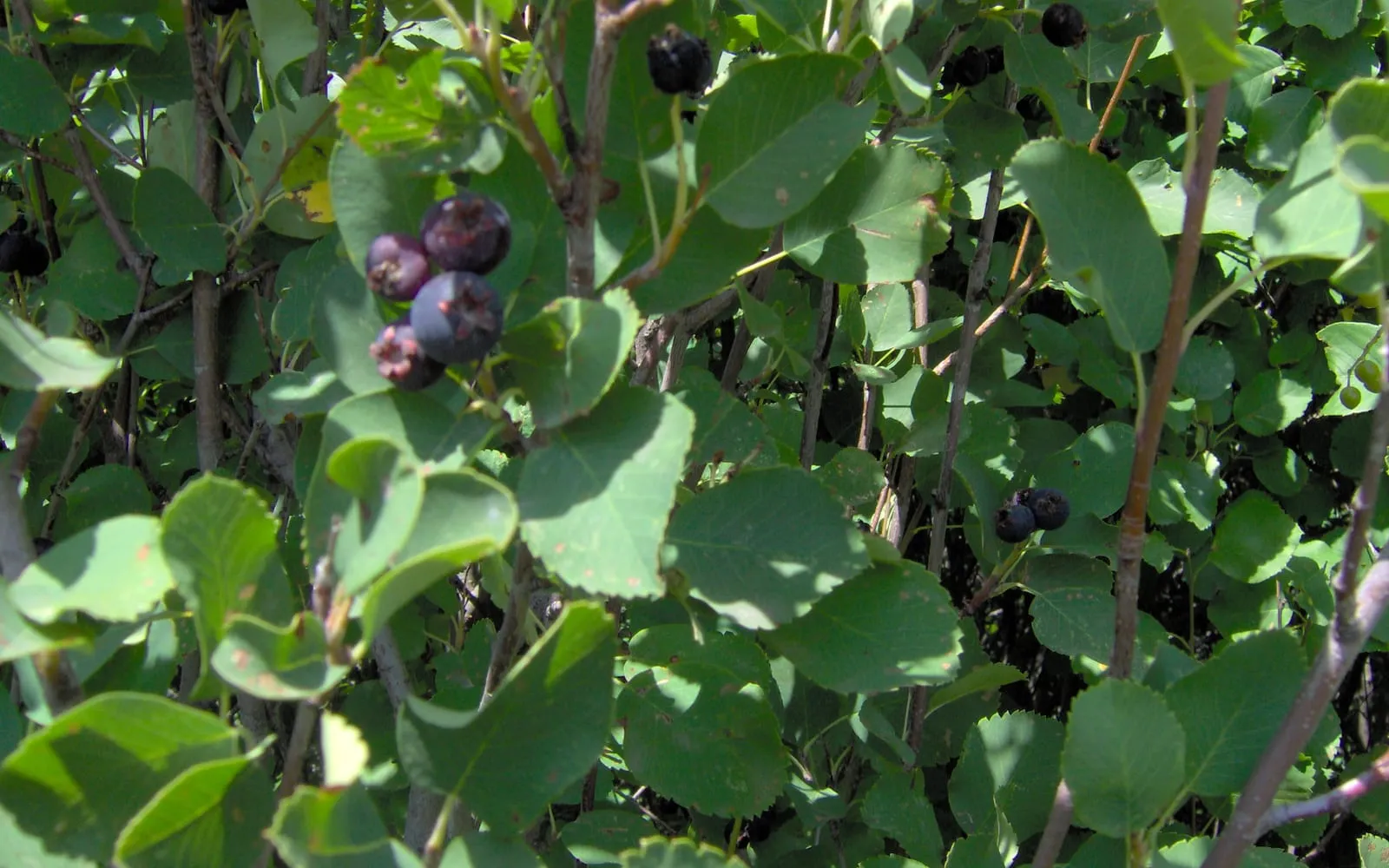
Growth is upright and multi-stemmed, suckering gently from the base to form a broad clump rather than a single trunk, though it can be trained to fewer stems where a more tree-like shape is wanted. Leaves are rounded to oval with a toothed upper margin, blue-green through summer and turning shades of orange and red in autumn. Flowers open in loose clusters of five to twenty, white with narrow, slightly twisted petals, covering the bare branches before or just as the leaves emerge. Berries follow in tight clusters, small and round, ripening from green through red to a deep blue-purple with a pale bloom, sweet and mild with a faint almond note from the seeds, and a heavy-cropping bush can produce several kilograms in a good year.
Where it is from
Amelanchier alnifolia grows wild across a wide stretch of western North America, from the northern Great Plains through the Rocky Mountain foothills and up into the boreal forest edge of Canada and Alaska. It tolerates an extreme range of winter cold, some populations surviving temperatures that few other fruiting shrubs would come through undamaged, and grows on open prairie, along stream banks and on rocky foothill slopes alike. Indigenous peoples across its range relied on the berries as a staple food, dried in quantity and pounded together with fat and meat to make pemmican, a preserved food that carried travellers through winters the fresh fruit could never have reached. Commercial cultivation began in the Canadian prairie provinces in the twentieth century, and named cultivars selected for larger fruit and heavier cropping are now grown well beyond its wild range.
How it grows
Plant in full sun for the heaviest crop, in any soil with reasonable drainage; it tolerates sandy, clay and alkaline ground better than most fruiting shrubs and needs no special soil preparation on typical garden ground. It suckers moderately from the base, less aggressively than a plum or a raspberry, and can be left to form a natural multi-stemmed clump or thinned each year to a handful of main stems for a tidier shape. Prune out the oldest, least productive stems on a mature plant in late winter to keep it renewing itself, since the youngest wood carries the heaviest crop. Little staking or support is needed even in an exposed site, since the wood is naturally sturdy.
Through the seasons
Spring brings the earliest blossom of the fruiting season, often ahead of most other shrubs, followed by leaf emergence and fruit set.
Summer is fruit ripening, usually complete by midsummer, well before many other berry crops.
Autumn brings good leaf colour and is a suitable time to plant a new shrub.
Winter is complete dormancy, and the plant needs nothing beyond letting it experience the cold it evolved for.
Care difficulty
Easy. Saskatoon serviceberry is bred from a hardy, self-sufficient plant and needs little beyond a sunny spot and reasonable drainage. It needs no winter protection anywhere within its hardiness range, tolerates poor soil, and copes with drought once established better than most fruiting shrubs. The main task most growers face is protecting the ripening berries from birds, which find them just as appealing as people do, rather than managing the plant itself.
Watering
Water regularly through the first two growing seasons while roots establish, then rely on rainfall in most climates outside a genuine drought. Extra water during flowering and while the berries are swelling improves crop size in a dry spring, though an established plant survives a dry summer with little lasting harm.
Warning signs, diseases and pests
Rust appears as bright orange pustules on the underside of leaves in wet spring weather, part of a disease cycle shared with junipers growing nearby; removing susceptible juniper species from the immediate area reduces the spore load reaching the shrub.
Fireblight, a bacterial disease shared with apple, pear and many other members of the rose family, can turn a whole flowering shoot black and bent within days in warm, wet weather. Cut affected wood out well below the visible damage, disinfecting tools between cuts, since there is no chemical cure once it takes hold.
Leaf spot speckles the foliage with brown or purplish spots through a wet summer and can bring on early leaf drop on a stressed plant; clearing fallen leaves in autumn reduces the fungus carrying over to reinfect the following spring.
Sawfly larvae strip leaves down to the bare veins in late spring or early summer on an occasional plant; hand-picking the caterpillar-like larvae off a lightly affected shrub controls the damage without further intervention.
Growing environment
Full sun brings the heaviest flowering and fruiting; it tolerates light shade but flowers and crops less generously there. Soil is rarely the limiting factor, since it copes with sand, clay, loam and alkaline ground alike, provided the roots are not sitting in standing water for long periods. Good air movement around the shrub helps keep fireblight and leaf spot in check in a humid climate, so avoid crowding it tightly against other planting.
Feeding
Little supplementary feeding is needed on ordinary garden soil beyond a spring mulch of compost around the base. A plant fed too heavily with nitrogen produces soft, leafy growth that is more susceptible to fireblight, so restraint serves it better than generosity.
Troubleshooting
Birds are stripping the berries before I can pick them. This is the single most common complaint about this plant, since the fruit ripens early and attracts birds before most other soft fruit is available. Netting the shrub as the berries begin to colour is the most reliable fix, put in place before the first fruit turns blue rather than after.
A shoot turned black and bent over almost overnight. Fireblight is the likely cause, especially after warm, wet weather during flowering. Prune out the affected wood at least 20 to 30 cm below any visible discolouration, cleaning tools between cuts to avoid spreading the bacteria to healthy wood.
The leaves have orange spots on the underside. Rust, which needs a juniper host nearby to complete its life cycle. Removing susceptible juniper species within a reasonable distance, where practical, breaks the cycle; where that is not possible, the rust is mostly cosmetic and rarely threatens the plant’s health.
How long before a new plant produces a useful crop? Often three to five years from a young nursery plant, with yields increasing steadily for several years after that as the clump of stems matures and thickens.
Can I grow it in a colder climate than most fruiting shrubs tolerate? Yes; this is one of the most cold-hardy fruiting plants available, grown successfully in parts of the Canadian prairies and Alaska where few other fruit crops survive the winter at all.