
Edible
Chinese Cinnamon
Cinnamomum cassia
Also known as Cassia, Chinese cassia, Rou gui
How to grow Chinese cinnamon, Cinnamomum cassia. The thick-barked cinnamon most of the world buys, the coumarin question, and the cassia buds used as a spice.
At a glance
- Difficulty
- Difficult
- Water
- Two or three times a week in summer, sparingly in winter
- Light
- Bright light with shade from the hottest sun
- Temperature
- Damaged below 10 deg C and killed below about 3 deg C
- Humidity
- High
- Hardiness
- USDA 10-12, RHS H1b, hardy to 10 C
- Type
- Tender evergreen tree
- Height
- Up to 15 m wild, 2 m in a pot
- Native to
- southern China
- Best month
- June and July in the Northern Hemisphere, December and January in the Southern Hemisphere
Subtropical southern China and mainland south-east Asia, and slightly hardier than true cinnamon. Bark is stripped from coppiced stems in the wet season when it lifts cleanly.
Hardiness zones describe winter cold alone. Summer heat, humidity, rainfall and the length of the growing season decide as much, so treat the range as the outer limit rather than as a recommendation.
Every month named in this guide is for the temperate Northern Hemisphere. If you garden in the Southern Hemisphere, shift each one by six months, so June becomes December. Closer to the equator the wet and dry seasons matter more than the calendar, and the shift stops being a useful guide.
Edible, with limits
- Safe to eat
- The bark and the unripe flower buds
- Do not eat
- The bark in sustained high quantity, because of coumarin
- Harm from
- Eating it
- Affects
- People
Cassia is safe as a spice and it carries one qualification that true cinnamon does not. Cassia bark contains substantial coumarin, a compound that damages the liver in sustained high doses. The European Food Safety Authority has set a tolerable daily intake of 0.1 mg per kilogram of body weight, and analyses have found that a few grams of cassia a day can exceed it for a small adult or a child. Danish authorities restricted cassia levels in traditional baked goods for this reason, which caused a public argument about cinnamon buns. None of that makes an occasional sprinkle a problem. It matters for anyone taking cinnamon daily in quantity as a supplement, and true cinnamon is the better choice there. Cassia is not on the RHS list of potentially harmful garden plants.
Sources: European Food Safety Authority on coumarin in food, RHS potentially harmful garden plants
About
Cassia is the cinnamon most people eat. Its bark is thicker, harder and stronger flavoured than true cinnamon, it curls into a single hard tube rather than a many-layered quill, and it is far cheaper to produce. In North America almost everything labelled cinnamon is cassia, and much of what is sold in Europe is too.
Two other products come off the same tree. Cassia buds are the unripe flower buds, dried and used whole as a spice that looks like a small clove, and cassia leaf oil is extracted commercially.
Coumarin is the safety issue. Cassia contains a good deal of it, true cinnamon contains very little, and coumarin damages the liver in sustained high doses. For an occasional sprinkle nothing follows from that. For anyone taking a spoonful daily it does.
Appearance and character
An evergreen tree reaching 15 m in the wild, coppiced in cultivation and kept to 1 to 2 m in a pot.
Leaves are oblong and pointed, 10 to 20 cm, thick and leathery, glossy dark green with three strong veins from the base, and slightly larger and stiffer than true cinnamon’s.
New growth flushes red before hardening.
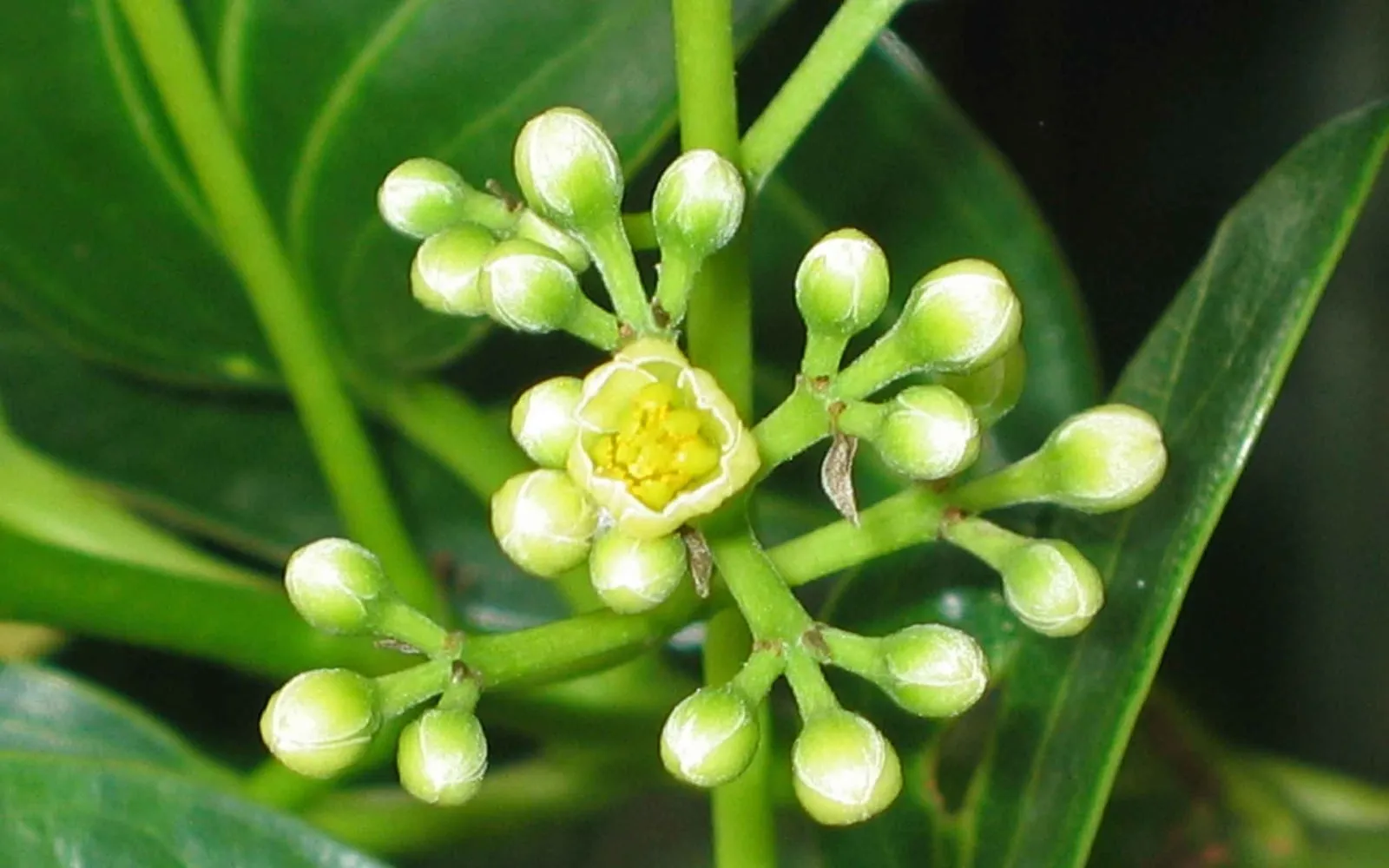
Flowers are small, white to yellow-green, in loose clusters. The unripe buds are picked and dried as cassia buds.
Bark is thick and rough on the outside, red-brown within, and it dries into a single hard curl rather than the many rolled layers of a Ceylon quill.
The scent of the bark is strong, hot and less sweet than true cinnamon, which is the practical difference in cooking.
Where it is from
Cassia is native to southern China and mainland south-east Asia, particularly Guangxi and Guangdong provinces and northern Vietnam.
Chinese use of it is very old. Rou gui appears in the earliest Chinese pharmacopoeias, and cassia is one of the components of five-spice powder.
It reached the Mediterranean along the same routes as true cinnamon and was distinguished from it in classical sources, usually as the cheaper of the two.
China, Vietnam and Indonesia are the main producers now. Indonesian cassia, from Cinnamomum burmannii, is a related species sold in the same market, and Vietnamese cassia is prized for its high oil content.
The bulk of the world cinnamon trade by volume is cassia rather than true cinnamon, which is why a jar labelled cinnamon usually contains it.
How it grows
Grow from fresh seed at 25 deg C, or from semi-ripe cuttings with bottom heat. Seed loses viability within a week or two of ripening.
Pot into free-draining slightly acid compost with grit added.
Grow it under glass at a minimum of 10 deg C, and preferably above 18 deg C. Cassia is slightly hardier than true cinnamon and still tender.
Give bright light with shade from the hottest midday sun, and keep the humidity high.
Water regularly in summer and sparingly in winter.
Feed with a balanced feed containing iron.
Prune in spring to keep it bushy. Cutting the leader promotes branching.
Harvesting bark needs a stem two or three years old and ends that stem, which is why the tree is coppiced commercially.
Through the seasons
Winter is survival under glass above 10 deg C, watered sparingly with the humidity kept up.
Spring brings new growth from April, often flushed red. Prune, repot and start feeding.
Early summer is the main growing period.
Midsummer is when the plant makes most of its wood, and when flower buds would form on a mature tree.
Late summer is the point to stop feeding.
Autumn is when to reduce watering.
Care difficulty
Difficult, for the same reasons as true cinnamon and with a slightly wider temperature margin.
Warmth is the requirement. Minimum 10 deg C and preferably above 18 deg C.
Humidity is the second, and dry heated air causes the leaf browning and spider mite that end most attempts.
Iron shortage produces yellowing between the veins on pot-grown plants, and a feed containing sequestered iron prevents it.
Growth is slow and the plant takes several years to make any size.
As a foliage plant it is handsome, and the realistic reason to grow it is the glossy three-veined leaves and the red flush on new growth rather than any prospect of a harvest.
Watering
Twice or three times a week through the summer, emptying whatever runs into the saucer.
The crop is bark, and bark is laid down by a plant growing steadily, so a stop-start season of drought and deluge gives you thin papery quills instead of the thick pieces the species is grown for.
Back off from September and let the top of the compost dry between waterings through the winter, when the plant is barely moving and cold wet roots are the main risk.
Nothing standing in a tray, in any month.
Rainwater where the tap runs hard, and water at room temperature rather than straight from a cold tap in winter.
Humidity high, from damped gravel and grouped plants rather than a daily misting that lifts it for a quarter of an hour.
Warning signs, diseases and pests
Green veins standing out against a paler blade is iron shortage, which arrives quickly on hard water. Switch to rainwater, check the compost is still on the acid side, and give sequestered iron.
Brown crisping along the leaf edges is dry air, or a night that went too cold. Below 10 deg C the foliage is damaged, and around 3 deg C the plant dies.
Brown limpets along the stems and the undersides of leaves are scale, with sticky honeydew underneath them and sooty mould growing on that.
Fine pale stippling with webbing in the leaf axils is spider mite, which turns up whenever heated air dries the house out.
White waxy fluff tucked where a leaf meets the stem is mealybug.
A blackened base on a plant in cold wet compost is root rot, and it is the commonest way these are lost over winter.
New leaves coming in bronze or dull red are doing what they should. The flush hardens to green over a fortnight.
Very little happening for a season is also normal. This is a slow plant in a pot and it does not signal anything by standing still.
Growing environment
A heated greenhouse or conservatory. No outdoor option outside the tropics.
Minimum 10 deg C and preferably above 18 deg C.
High humidity.
Bright light with shading from the hottest sun through glass.
Free-draining slightly acid compost with grit.
pH from 5.5 to 6.5.
A pot of 25 to 30 cm, potting on every second year, with spring pruning to keep it manageable.
Feeding
Feed a balanced liquid feed fortnightly from May to August, containing iron.
Sequestered iron applied separately corrects yellowing between the veins.
Stop feeding from September and give nothing through winter.
Repot into fresh compost every second spring.
An ericaceous feed suits it.
Troubleshooting
Is this the cinnamon I buy in a supermarket? Probably. Most cinnamon sold in Europe and almost all sold in North America is cassia. True cinnamon is usually labelled Ceylon cinnamon and costs more.
How do I tell them apart? By the quill. Cassia is a single thick hard curl of dark bark. True cinnamon is a thin brittle quill made of many rolled layers, lighter in colour, and it crumbles easily.
Should I worry about coumarin? Not for occasional use. Cassia contains substantial coumarin, which damages the liver in sustained high doses, and the European Food Safety Authority has set a tolerable daily intake. Anyone taking cinnamon daily in quantity should use true cinnamon.
What are cassia buds? The unripe flower buds of this tree, dried and used whole as a spice. They look like small cloves and taste of cinnamon.
Can I harvest my own bark? Only from a stem two or three years old, and it kills that stem. Commercial trees are coppiced for that reason.
The leaves went yellow between the veins. Iron shortage in a pot. Use a sequestered iron feed and slightly acid compost.
Can I grow it outdoors? No. It dies below about 3 deg C.