
Edible
Nutmeg
Myristica fragrans
Also known as Mace, Jaiphal, Nutmeg tree
How to grow nutmeg, Myristica fragrans. The two spices that come off one seed, the island trade that swapped Run for Manhattan, and why large doses of nutmeg are dangerous.
At a glance
- Difficulty
- Difficult
- Water
- Two or three times a week, keeping it evenly damp
- Light
- Bright light with shade from the hottest sun
- Temperature
- Damaged below 15 deg C and killed below about 10 deg C
- Humidity
- Very high
- Hardiness
- USDA 10-12, RHS H1b, hardy to 15 C
- Type
- Tender evergreen tree, dioecious
- Height
- Up to 15 m wild, 1-2 m in a pot
- Native to
- the Moluccas
- Best month
- June and July in the Northern Hemisphere, December and January in the Southern Hemisphere
The wet volcanic Moluccas. Trees are male or female and seedlings cannot be sexed until they flower at six to eight years, so growers plant several and remove the surplus males. Two spices come off one fruit, the seed being nutmeg and the scarlet aril mace.
Hardiness zones describe winter cold alone. Summer heat, humidity, rainfall and the length of the growing season decide as much, so treat the range as the outer limit rather than as a recommendation.
Every month named in this guide is for the temperate Northern Hemisphere. If you garden in the Southern Hemisphere, shift each one by six months, so June becomes December. Closer to the equator the wet and dry seasons matter more than the calendar, and the shift stops being a useful guide.
Toxic if eaten
- Safe to eat
- The seed and the aril, as spices in culinary quantities
- Do not eat
- The seed in large quantity, because of myristicin
- Harm from
- Eating it
- Affects
- People, cats and dogs
Nutmeg as a spice is safe and it is one of the few plants in this collection where the quantity that causes harm is within reach of a domestic kitchen. Nutmeg contains myristicin and related compounds, and eating roughly two whole nutmegs, or around 5 to 10 g of ground nutmeg, produces a well-documented poisoning: nausea, a racing heart, agitation, hallucinations and confusion, coming on over several hours and lasting a day or more. It is deeply unpleasant, hospital admissions occur every year, and deaths have been recorded, chiefly in children and in combination with other substances. Nutmeg is also toxic to dogs and cats at proportionally smaller amounts. The half a teaspoon a recipe calls for is entirely safe. A whole nutmeg eaten deliberately is not.
Sources: ASPCA toxic and non-toxic plants, RHS potentially harmful garden plants
About
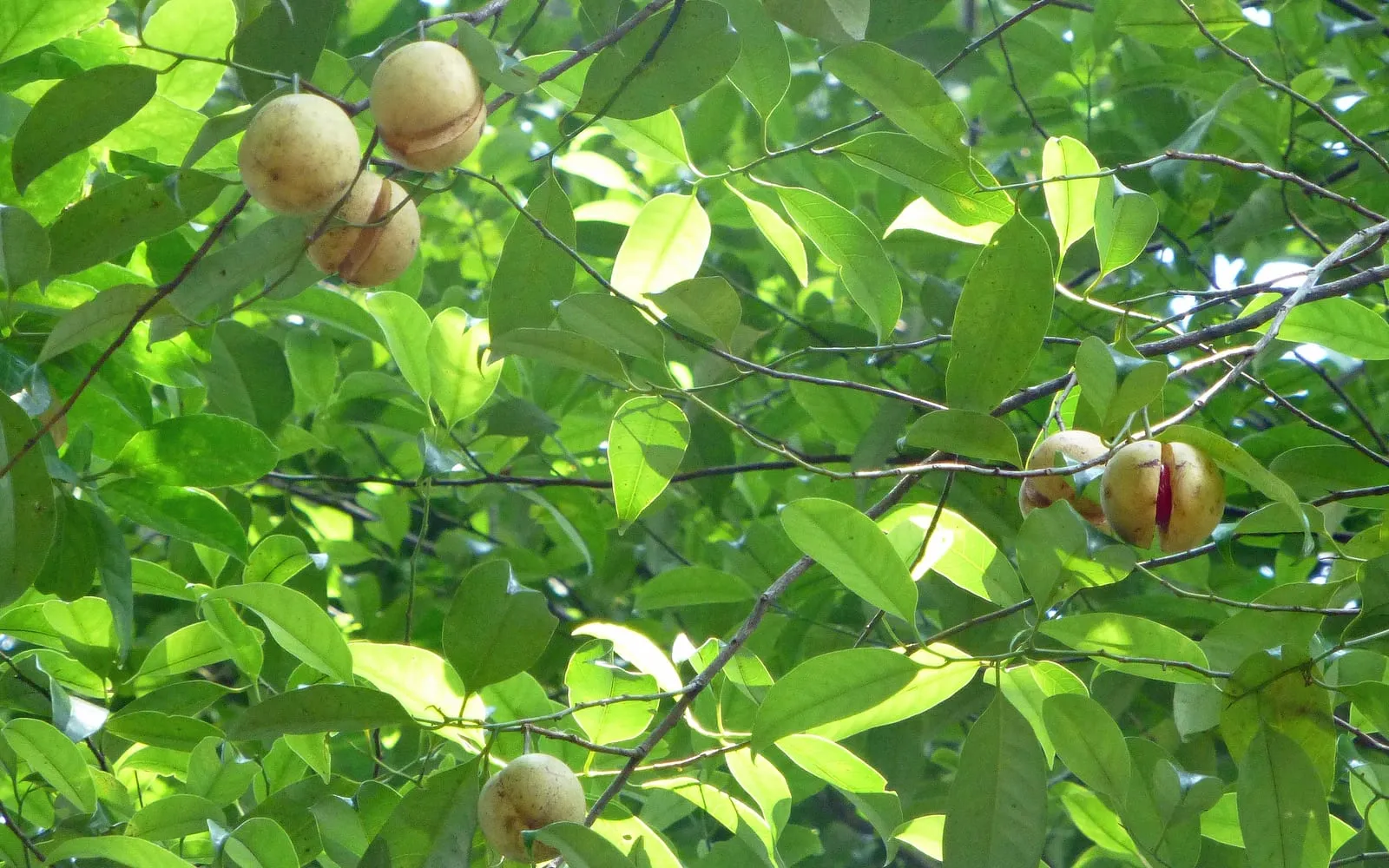
Nutmeg is two spices from one seed. The tree bears an apricot-like fruit that splits open when ripe to reveal a brown seed wrapped in a bright scarlet lacy covering. The seed, dried, is nutmeg. The covering, dried and flattened, is mace. Nothing else in the spice cupboard works that way.
The trade in it shaped an empire. Nutmeg grew only on the Banda Islands, the Dutch East India Company took them by force in 1621 and killed or enslaved most of the population, and in 1667 the English traded their claim to the tiny nutmeg island of Run in exchange for Manhattan.
The tree is dioecious, meaning male and female flowers are on separate plants, and only females fruit. Anyone growing one from seed is taking a gamble, because there is no way to tell which you have for six or seven years.
Appearance and character
A conical evergreen tree reaching 15 m in the tropics and 1 to 2 m in a pot.
Leaves are oval to lance-shaped, 5 to 15 cm, dark glossy green above and paler beneath, aromatic when crushed.
Flowers are small, pale yellow and bell-shaped, and separate trees carry male or female flowers.
Fruit is the size and shape of a small apricot, pale yellow, and it splits neatly in half when ripe.
Inside is the striking part. A single brown seed wrapped in a bright scarlet lacy aril, which is the mace, and the contrast of red on brown inside a yellow fruit is one of the more remarkable sights in the plant world.
Nutmeg is the kernel inside the seed’s hard shell, and it takes weeks of drying before the kernel rattles loose.
Where it is from
Nutmeg is native to the Banda Islands, a group of ten small volcanic islands in the Moluccas of Indonesia, and originally to nowhere else at all.
That monopoly made it one of the most valuable commodities in the world. In sixteenth century Europe nutmeg was worth many times its weight in gold, and control of Banda was worth a war.
The Dutch East India Company took the islands in 1621 under Jan Pieterszoon Coen, killing or deporting most of the fifteen thousand inhabitants and replacing them with enslaved workers on nutmeg plantations. That episode is the darkest of the spice trade histories.
England held the smallest island, Run, and gave up its claim in the Treaty of Breda in 1667 in exchange for New Amsterdam, which became New York.
The monopoly broke when the French and then the British moved seedlings to Mauritius, Grenada and Zanzibar. Indonesia and Grenada are the main producers now, and the nutmeg appears on the flag of Grenada.
How it grows
Grow from fresh seed. Nutmeg seed loses viability quickly and dried nutmegs from a shop will not germinate.
Sow fresh seed at 25 to 30 deg C in free-draining compost. Germination is slow, taking six weeks to several months.
Pot into rich humus-rich free-draining slightly acid compost.
Grow it under glass at a minimum of 15 deg C, with very high humidity.
Give bright light with shade from the hottest midday sun.
Water regularly and keep the compost evenly damp year round.
Feed with a balanced feed containing iron.
Accept that sex is a lottery. Seedlings are male or female in roughly equal numbers, only females fruit, and there is no way to tell until flowering at six or seven years. Commercial growers graft female material onto seedling rootstocks for exactly this reason.
Growth is slow and a temperate plant is a foliage subject.
Through the seasons
Winter is survival under glass above 15 deg C with high humidity, and it is the season most plants are lost in.
Spring brings new growth. Repot and start feeding.
Early summer is the main growing period.
Midsummer is peak growth.
Late summer is the point to stop feeding.
Autumn is when to reduce watering slightly without letting the plant dry out.
Care difficulty
Difficult, and comparable to clove in what it demands.
Minimum 15 deg C, and it suffers rather than merely pauses below that.
Very high humidity is a requirement rather than a preference.
Fresh seed is hard to obtain outside the tropics, and dried nutmegs are dead.
Germination is slow, taking six weeks to several months, which tests patience before the plant has even started.
Sex is unknowable for six or seven years and only females fruit, so growing one from seed for the spice is close to a lottery with a long wait.
Grown as a foliage plant in a humid greenhouse it is handsome and manageable, and that is the sensible ambition.
Watering
Keep the compost evenly damp throughout the year.
Water two or three times a week, letting the pot drain fully.
Never let it stand in water or dry out completely.
Use tepid water and rainwater in a hard water area.
Keep the humidity very high with misting, damp gravel trays and grouped planting.
Reduce watering slightly in winter without letting the compost dry.
Warning signs, diseases and pests
Leaf drop and steady decline mean cold or dry air.
Brown leaf edges mean dry air.
Yellowing between the veins is iron shortage in a pot.
Scale insects appear as brown limpets on the stems and leaf undersides.
Spider mite produces fine stippling and webbing in dry heated air.
Mealybug hides in the leaf axils as white waxy fluff.
Root rot from cold wet compost blackens the base.
A tree that flowers and never fruits is male. Nothing can be done about it except to grow another and hope.
Growing environment
A heated greenhouse or conservatory with high humidity. No outdoor option outside the tropics.
Minimum 15 deg C and 25 to 30 deg C for good growth.
Very high humidity.
Bright light with shade from the hottest sun.
Rich, humus-rich, free-draining slightly acid compost.
pH from 5.5 to 6.5.
Grouped with other tropical plants, which raises the humidity around it.
Feeding
Feed a balanced liquid feed fortnightly from May to August, containing iron.
Sequestered iron corrects yellowing between the veins.
Stop feeding from September and give nothing through winter.
Repot into fresh compost every second spring.
An ericaceous feed suits it.
Troubleshooting
What is mace? The scarlet lacy covering around the nutmeg seed, dried and flattened. Two spices come off one seed, and mace is milder and more delicate than nutmeg.
Can I grow it from a nutmeg in the cupboard? No. It has been dried and it is dead. Fresh seed is needed and it does not keep.
Is nutmeg dangerous? In culinary quantities, no. Around two whole nutmegs, or 5 to 10 g ground, produces a genuine and unpleasant poisoning with hallucinations and a racing heart that lasts a day or more. Hospital admissions happen every year. Half a teaspoon in a recipe is entirely safe.
Is it dangerous to dogs? Yes, at proportionally smaller amounts. Keep whole nutmegs out of reach.
Mine flowers and never fruits. It is male. Nutmeg is dioecious and only female trees fruit, and there is no way to tell which you have until it flowers at six or seven years.
Why did nutmeg matter so much historically? It grew only on the Banda Islands, it was worth many times its weight in gold in Europe, and control of that supply was worth wars. England traded its claim to the nutmeg island of Run for Manhattan in 1667.
It keeps dropping leaves. Cold or dry air. It needs 15 deg C minimum and very high humidity.