
Edible
Pineapple
Ananas comosus
Also known as Ananas, Pina
How to grow pineapple, Ananas comosus. Rooting a supermarket crown, the two years it takes, why it stings your mouth, and the fact that one plant gives one fruit.
At a glance
- Difficulty
- Moderate
- Water
- When the compost has dried most of the way through, roughly weekly
- Light
- As much direct sun as possible
- Temperature
- Minimum 10 deg C, and 20 to 30 deg C for growth
- Humidity
- Moderate. It is a drought-adapted bromeliad rather than a jungle plant
- Hardiness
- USDA 10-12, RHS H1b, hardy to 10 C
- Type
- Tender evergreen perennial, monocarpic on each rosette
- Height
- 1-1.5 m across and about 1 m tall in fruit
- Native to
- southern Brazil, Paraguay
- Best month
- June, July and August in the Northern Hemisphere, December, January and February in the Southern Hemisphere
Seasonally dry tropical South America. It uses crassulacean acid metabolism, taking in carbon dioxide at night, which is why it survives drought that would kill most fruit crops. Flowering can be forced with ethylene, and a ripe apple in a bag beside the plant does the same job.
Hardiness zones describe winter cold alone. Summer heat, humidity, rainfall and the length of the growing season decide as much, so treat the range as the outer limit rather than as a recommendation.
Every month named in this guide is for the temperate Northern Hemisphere. If you garden in the Southern Hemisphere, shift each one by six months, so June becomes December. Closer to the equator the wet and dry seasons matter more than the calendar, and the shift stops being a useful guide.
Skin irritant
- Safe to eat
- The ripe flesh
- Do not eat
- Unripe fruit, and the leaves, which are fibrous and irritant
- Harm from
- Eating it and handling it
- Affects
- People, cats and dogs
Ripe pineapple is food and the ASPCA lists it as non-toxic to cats and dogs. Two lesser effects matter. Pineapple contains bromelain, a protein-digesting enzyme, and eating a lot of fresh fruit leaves the mouth and tongue raw because the enzyme is digesting you back; it is harmless and passes in a few hours, and cooking or canning destroys the enzyme, which is why tinned pineapple never does it. Unripe pineapple is a strong irritant and a purgative, and eating much of it causes vomiting and diarrhoea. The leaves are tough, fibrous and spined along the margins in most cultivars, and both the spines and the sap can irritate skin, so gloves are sensible when handling a plant.
Sources: ASPCA toxic and non-toxic plants, RHS potentially harmful garden plants
About
Pineapple is a bromeliad, related to the tillandsias sold as air plants, and it grows on the ground rather than in a tree. The plant is a stiff rosette of spined leaves, the fruit sits on a short stalk in the middle, and each rosette fruits once and then dies, having first produced offsets around its base.
The fruit is not one fruit. A pineapple is up to two hundred separate flowers whose ovaries have fused into a single mass, and each of the diamond-shaped segments on the skin marks where one flower sat.
Growing one from a supermarket crown is among the most reliable plant tricks there is, provided you are patient. Rooting takes two months, fruiting takes about two years under glass outside the tropics, and the fruit at the end is smaller than the one you bought.
Appearance and character
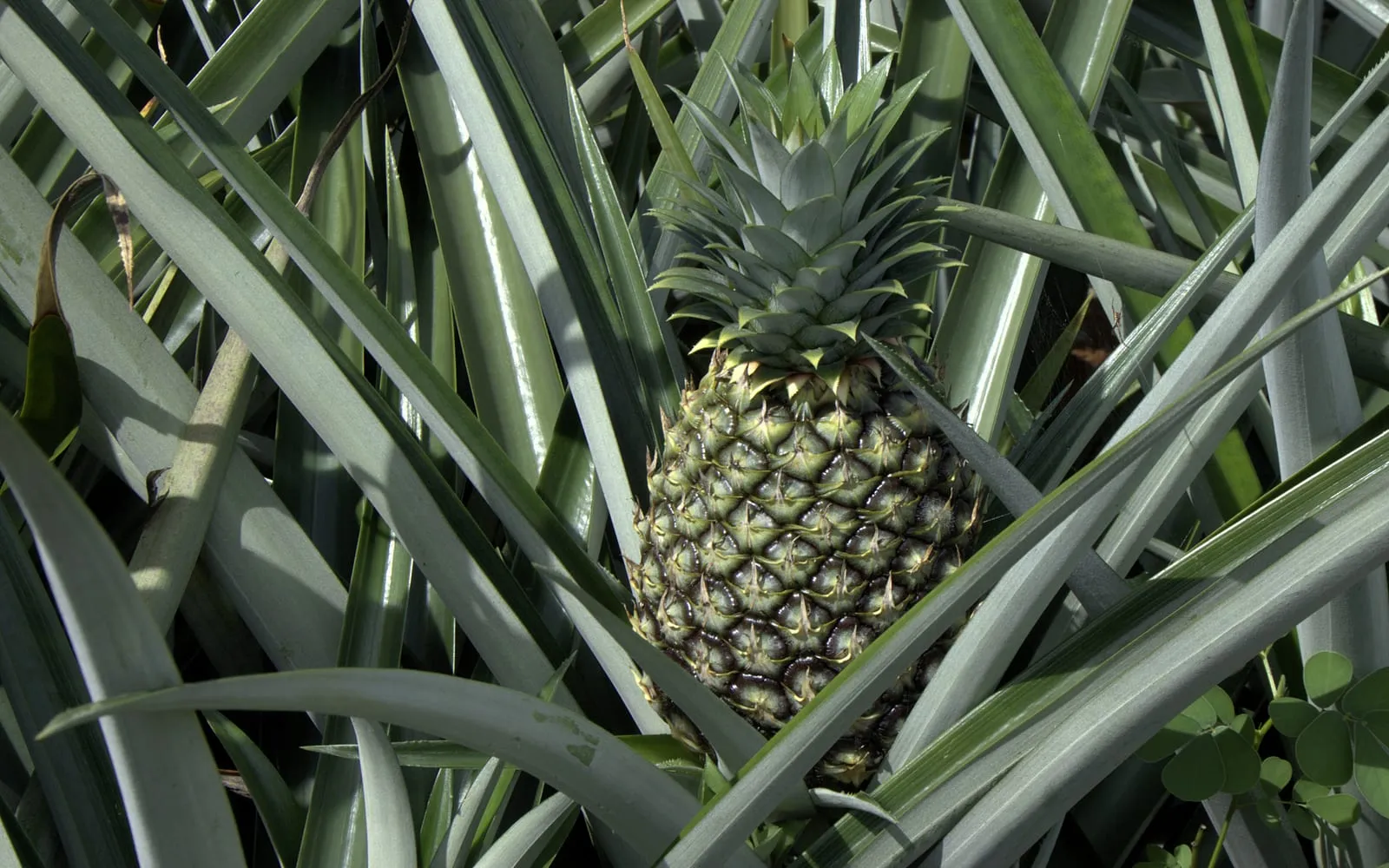
A rosette of 30 to 40 stiff, arching, sword-shaped leaves, 60 to 100 cm long, grey-green and usually toothed along the edges with backward-pointing spines.
Smooth-leaved cultivars exist and are the ones grown commercially, since harvesting a spined field is unpleasant work.
The rosette holds water in its centre, as most bromeliads do, though pineapple relies on its roots far more than a tank bromeliad does.
The flower head rises on a short thick stalk from the middle of the rosette, a cone of small purple-blue flowers each sitting behind a pink bract, opening a few at a time over a fortnight.
The fruit swells from that cone. Green at first, then yellow-orange, with the diamond pattern of fused segments across the skin and a tuft of leaves, the crown, at the top.
Offsets appear at the base and in the leaf axils as the fruit ripens. Those are the next generation, because the fruiting rosette itself dies.
Ripeness is told by smell at the base and by the fruit yielding slightly to a press. Pulling a leaf from the crown is folklore and works badly.
Where it is from
Pineapple comes from the region where southern Brazil meets Paraguay, in the Parana and Paraguay river basins, where wild Ananas still grow.
Indigenous peoples had carried it across South America, into Central America and through the Caribbean long before Europeans arrived. Columbus met it on Guadeloupe in 1493, and the Spanish named it pina for its resemblance to a pine cone.
In Britain it became the definitive luxury. The first pineapple fruited there in the late seventeenth century, and a Georgian gentleman could rent one for an evening to display at dinner and return it afterwards. Heated pineapple pits and pineries were built at great expense, and the fruit appears carved on gate piers across the country as a sign of hospitality and wealth.
Steamships and then canning ended all that. James Dole’s Hawaiian plantations made pineapple ordinary within a generation.
Costa Rica, the Philippines, Brazil and Thailand now supply most of the world crop, and almost every fruit on a supermarket shelf is a low-acid hybrid of the MD-2 type bred in Hawaii.
How it grows
Buy a pineapple with a healthy green crown and twist the crown off. Grip the fruit in one hand and the leaves in the other and turn, and it comes away with a small stub of core attached.
Strip the lowest 2 or 3 cm of small leaves to expose the stem, and you will often see the beginnings of roots as pale bumps.
Let it dry for two or three days so the cut callouses. Skipping this is what causes rot.
Root it in barely damp free-draining compost or in a glass of water. Compost is more reliable. Keep it at 22 to 28 deg C in bright light and resist watering much until roots form, which takes six to ten weeks.
Pot into a very free-draining mix once rooted, roughly half multipurpose compost and half grit or perlite.
Grow it warm and bright. It wants the sunniest spot in a greenhouse or conservatory and a minimum of 10 deg C.
Feed monthly through summer and water only when the compost has dried most of the way.
Wait. A crown-grown plant needs about 24 months and a rosette around 60 cm across before it will flower.
Force it if nothing happens. Ethylene triggers flowering in pineapple, and the domestic version is to seal the plant in a clear bag with a ripe apple for a week. Flowers follow in six to ten weeks.
Take the offsets when the fruit is ripening, since the parent rosette dies after fruiting.
Through the seasons
Winter is a holding period. Keep it above 10 deg C, water sparingly, and give it all the light there is.
Spring is the time to repot, remove any offsets and start feeding as growth resumes.
Early summer is when growth accelerates and the plant puts on most of its leaf.
Midsummer is the point at which a plant of flowering size that has not flowered is worth forcing with ethylene.
Late summer is fruit swell for a plant that flowered in spring, which takes five to six months from flower to ripe fruit.
Autumn is when to stop feeding and reduce watering as the light fails.
Care difficulty
Moderate, and the failures cluster in two places.
Rot is the first. Pineapple is drought adapted and a crown sat in wet compost turns to mush within a fortnight. Let the cut dry, root it barely damp, and water sparingly until the roots are established.
Patience is the second. Two years from crown to fruit is normal, and a plant that is not yet big enough will not flower whatever you do to it.
Heat is needed rather than humidity. It wants 20 to 30 deg C and full sun, and tolerates dry air far better than most tropical plants.
The spines on most cultivars are sharp and backward-facing, so handle a plant with gloves and long sleeves.
Once past rooting, it is a tough undemanding plant that will sit in a conservatory corner for years.
Watering
Water the compost when it has dried most of the way through, which in summer is about weekly and in winter far less.
Water at the compost rather than over the plant in winter, because water sitting in the central cup in the cold causes crown rot.
Put a little water in the central cup during warm weather, which the plant takes up through specialised scales at the leaf bases.
Drain fully. Never leave a pot standing in a saucer.
Use rainwater where the tap water is hard.
Cut watering right back below 15 deg C.
Err on the dry side throughout. A pineapple recovers from drought and rarely from waterlogging.
Warning signs, diseases and pests
A crown that goes soft and brown at the base within weeks of planting is rot, from planting a wet uncalloused cut into damp compost.
The central leaves pulling out with a tug, leaving a foul-smelling hollow, is crown rot from water sitting in the cup in cold weather.
Translucent water-soaked patches on the leaves are cold damage.
Red or purple leaf tinting is usually strong sun and is harmless, though it can also mean the plant is dry.
White cottony masses deep in the leaf axils are mealybug, which is awkward to reach and needs a cotton bud and patience.
Small brown limpets on the leaf undersides are scale.
A rosette that grows for years and never flowers is either too small or too shaded. Give it more sun, wait until it is 60 cm across, then force with ethylene.
The parent dying after fruiting is not a problem. That is the life cycle. Grow the offsets on.
Coconut rhinoceros beetle also attacks pineapple where it occurs. Native to Africa and tropical Asia, it has spread through much of the Pacific and continues gaining ground; clearing rotting plant debris nearby, where it breeds, is the main defence.
Growing environment
A greenhouse, conservatory or the sunniest windowsill in the house.
Minimum 10 deg C, with 20 to 30 deg C for real growth.
Full direct sun, as much as can be given.
Moderate humidity, which sets it apart from most tropical fruit. Pineapple tolerates dry air well.
A very free-draining mix, around half compost and half grit or perlite, or a cactus compost with some added organic matter.
pH from 4.5 to 6.5, so on the acid side.
A wide shallow pot suits it better than a deep one, because the root system is shallow and fibrous.
Space to work around it, given the spines.
Feeding
Feed monthly from May to September with a balanced liquid feed at half the recommended strength.
Foliar feeding works well, since the leaf bases absorb nutrients directly.
Stop feeding from October.
Give nothing in winter.
Repot into fresh mix each spring while the plant is growing on.
Avoid heavy feeding, which produces a lush rosette that is slow to flower.
A high-potash feed once the flower head appears helps the fruit swell.
Troubleshooting
How long from crown to fruit? About two years under glass outside the tropics, and the plant needs to reach roughly 60 cm across before it will flower at all.
My crown went mushy. It was planted wet. Twist the crown off, strip the lower leaves, and let the cut dry for two or three days before it goes anywhere near compost. Then keep the compost barely damp.
It is huge and it will not flower. Force it. Seal the plant in a clear plastic bag with a ripe apple for a week. The ethylene the apple gives off triggers flowering, and the flower head appears six to ten weeks later.
Why does pineapple make my mouth sore? Bromelain, a protein-digesting enzyme in the fresh fruit. It is harmless and wears off in a few hours. Tinned pineapple never does it, because heat destroys the enzyme.
The plant died after fruiting. That is normal. Each rosette flowers once. Look for offsets around the base and in the leaf axils, and grow those on.
Can I grow it from the seeds? Commercial pineapples are seedless. If you do find small black seeds, they will grow, and the plants take longer and differ from the parent.
Is pineapple safe for dogs? Yes, ripe fruit in small amounts. Avoid the tough core and the skin, and do not give unripe fruit, which is a purgative.
Pineapple problem guides
Not sure what is wrong? See the common vegetable pests guide.
- Root rot and crown rot from overwatering, which kills more pineapples than anything
- Mealybug deep in the leaf axils, where it is hard to reach
- Scale insects on the leaf undersides
- Failure to flower, which is a matter of plant size and can be forced
- Cold damage, showing as translucent patches on the leaves
- Coconut rhinoceros beetle, an established and still-spreading Pacific invader