
Edible
Chinese chestnut
Castanea mollissima
Also known as Chinese sweet chestnut, Ban li
How to grow Chinese chestnut, Castanea mollissima. A blight-resistant chestnut with sweet nuts, needing a partner tree and acid soil.
At a glance
- Difficulty
- Moderate
- Water
- First three summers, then in drought
- Light
- Full sun
- Temperature
- Fully hardy to -25 deg C
- Hardiness
- USDA 4-8, RHS H6, hardy to -30 C
- Type
- Deciduous tree, long-lived
- Height
- 10-15 m, less than a European sweet chestnut
- Native to
- China, Korea
- Best month
- September and October in the Northern Hemisphere, March and April in the Southern Hemisphere
Resistance to chestnut blight is the reason this species matters, since it evolved with the fungus and survives what killed the American tree outright. It needs hot summers to fill the nuts and is hardier than the European chestnut. Two trees are needed, as it will not pollinate itself.
Hardiness zones describe winter cold alone. Summer heat, humidity, rainfall and the length of the growing season decide as much, so treat the range as the outer limit rather than as a recommendation.
Every month named in this guide is for the temperate Northern Hemisphere. If you garden in the Southern Hemisphere, shift each one by six months, so September becomes March. Closer to the equator the wet and dry seasons matter more than the calendar, and the shift stops being a useful guide.
Not known to be toxic
- Safe to eat
- The kernels, cooked
The nuts are food and are eaten roasted and boiled across China, Korea and Japan. Neither the RHS nor the ASPCA lists Castanea as harmful, and no toxicity to cats or dogs is recorded. Sweet chestnuts are low in fat and high in starch and are eaten cooked rather than raw, since raw kernels contain tannins that upset the stomach in quantity. The spiny burrs are a physical hazard rather than a chemical one, sharp enough to go through a shoe, so gloves and stout footwear are needed at harvest. Do not confuse this with horse chestnut, Aesculus hippocastanum, which is a different family and whose conkers are toxic.
Sources: RHS potentially harmful garden plants, ASPCA toxic and non-toxic plants
About
Chestnut blight arrived in New York in 1904 on imported Asian nursery stock and killed something like four billion American chestnuts within forty years. Chinese chestnut is the species that survived it, having evolved alongside the fungus, and that resistance is why it is planted.
The nuts are sweeter and easier to peel than a European sweet chestnut, and the tree crops younger, often from the fourth or fifth year.
It makes a smaller and broader tree than Castanea sativa, spreading wider than it grows tall, which suits a garden better than a forest species.
Two trees are needed. Chestnuts are wind-pollinated and reject their own pollen, so a solitary specimen will flower heavily and set nothing.
Appearance and character
A broad spreading deciduous tree, often wider than tall, with a low branching habit in the open.
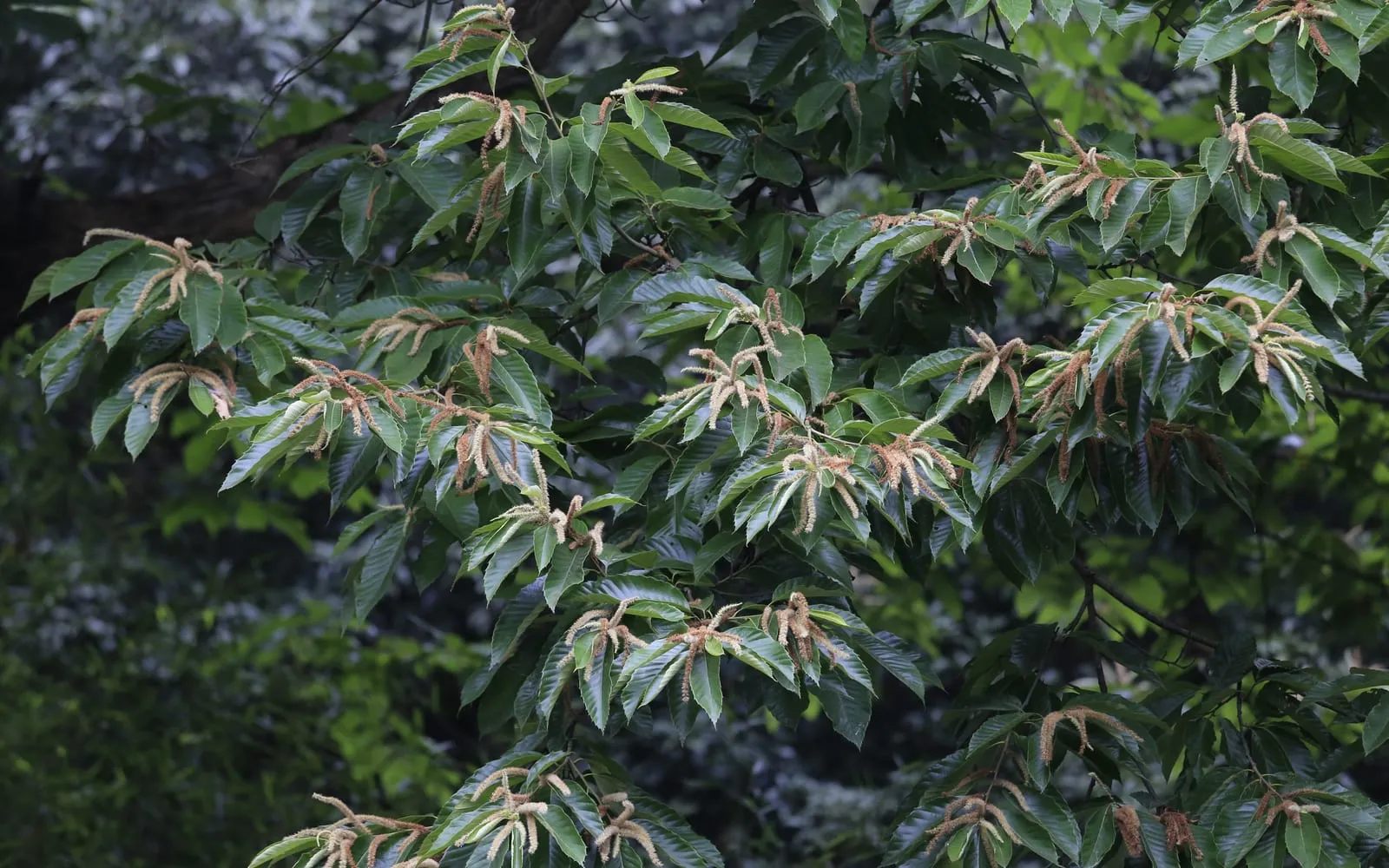
Leaves are oblong, 10 to 20 cm, with coarse bristle-tipped teeth along the margins, glossy dark green above and downy beneath, turning yellow and bronze in autumn.
Flowers open in late June and July, long creamy-yellow catkins carrying male flowers along most of their length with female flowers clustered at the base. The scent is strong and unusual, and not to everyone’s liking.
Fruit is a spiny green burr 5 to 8 cm across, densely covered in sharp branched spines, splitting into four segments when ripe.
Each burr contains two or three flattened brown nuts with a pointed tip and a pale scar at the base.
Where it is from
Castanea mollissima is native to China and Korea, growing in mixed forest on hills and mountains.
It has been cultivated in China for well over two thousand years, and China remains by far the largest producer of chestnuts worldwide.
Its accidental role in the American chestnut catastrophe is one of the more consequential plant introductions on record, since the fungus it carried harmlessly proved lethal to a species with no exposure to it.
American breeding programmes have since crossed it with the American chestnut to combine blight resistance with the taller timber form, work that continues.
It reached Europe in the early twentieth century and grows well there, though it is far less common than the European sweet chestnut.
How it grows
Buy two grafted trees of different named varieties. Seedlings are variable and take longer to crop.
Test the soil. This species needs acid to neutral ground at pH 5 to 6.5 and does badly on chalk, where the leaves yellow and growth stalls.
Plant bare-root in winter into well-drained soil, 8 to 10 m apart.
Site in full sun and shelter from cold wind, since flowering is late and warmth helps the set.
Stake for three years and guard against rabbits and deer.
Water through the first three summers, and prune only to remove dead or crossing wood in late winter.
Through the seasons
The tree leafs out in May, later than most, which protects it from spring frost.
Flowering is late, in late June and July, with long creamy catkins that scent the air strongly.
Nuts develop through late summer inside their spiny burrs.
September and October bring the harvest. Burrs split on the tree and the nuts fall, or the whole burr drops and splits on the ground.
Collect daily through the drop, using gloves and stout shoes, since the spines are sharp.
Cure the nuts for a week in a cool airy place, which converts starch to sugar and improves the flavour considerably, then store cool.
Care difficulty
Moderate. The tree is hardy and vigorous, and the requirements are specific rather than demanding.
Acid soil is the condition that decides success, and a chalky garden is unsuitable.
Two trees are needed for any crop at all, which doubles the space requirement.
Blight resistance removes the disease that defines the genus elsewhere, though Phytophthora ink disease on wet ground remains a risk.
Harvesting is uncomfortable work. The burrs are viciously spiny and squirrels compete for every nut.
Watering
Water weekly through the first three summers, 20 to 25 litres at a time.
An established tree needs water only in a prolonged drought.
Moisture through August helps the nuts fill, so a soaking in a dry late summer improves the crop.
Mulch in spring with compost or bark, kept clear of the trunk.
Drainage matters. Wet soil brings Phytophthora, which is the main disease threat to chestnuts in wet temperate regions.
Warning signs, diseases and pests
Nuts gone as soon as the burrs open. Squirrels. Collect daily through the drop rather than waiting for it to finish.
Sunken orange-brown cankers on stems, with the branch dying above. Chestnut blight. This species is resistant rather than immune. Cut out affected wood and burn it, and report it, since the disease is notifiable in most countries.
Tree declining with dark stained wood at the base and dying roots. Phytophthora ink disease on wet ground. Improve drainage, though a badly affected tree rarely recovers.
Leaves yellow with green veins. Chalky soil. This species needs acid ground and chelated iron is only a stopgap.
New growth blackened in late spring. Frost, despite the late leafing.
Whole branches dying with white sheets under the bark. Honey fungus.
Growing environment
Full sun, which the tree needs for both growth and nut fill.
Acid to neutral soil at pH 5 to 6.5, well-drained. Chalk is unsuitable and this is the main limitation on where the tree can be grown.
Shelter from cold wind helps, since flowering is late and pollination is by wind.
Hardiness to -25 deg C means winter is no obstacle across most of the temperate world.
Allow 8 to 10 m between trees and remember two are needed, so this is a plant for a large garden or a paddock.
Feeding
A balanced general fertiliser in spring is useful on poor soil and unnecessary on good ground.
Avoid lime and mushroom compost, which raise the pH on a tree that wants acid conditions.
Mulch with compost, composted bark or leaf mould each spring, which suits the tree’s preference for acid organic matter.
Avoid heavy nitrogen, which produces soft growth and delays nut production.
Leaf litter left beneath the crown maintains the acid conditions the tree prefers.
Troubleshooting
Heavy flowering, no nuts. Only one tree. Chestnuts reject their own pollen and need a second variety within pollinating distance.
Nuts small and poorly filled. Drought in August, or a cool summer during nut fill.
Leaves yellowing on chalk. The wrong soil for the species. Chelated iron helps temporarily but the tree will never thrive.
Burrs falling empty. Poor pollination, often from cold wet weather during flowering.
Nuts starchy rather than sweet. Not cured. Keep them a week in a cool airy place before eating, which converts starch to sugar.
Tree confused with horse chestnut. Different family entirely. Sweet chestnut leaves are single and toothed, horse chestnut leaves are palmate with five to seven leaflets from one point.
Chinese chestnut problem guides
Not sure what is wrong? See the common vegetable pests guide.