
Outdoor plant
American Chestnut
Castanea dentata
Practical guidance for growing American chestnut, Castanea dentata, including chestnut blight and its collapse from dominant forest tree to root sprouts, resistant hybrids, cross-pollination, and its sweet, edible nuts.
At a glance
- Difficulty
- Difficult
- Water
- Regularly for the first two to three seasons, then rarely once established
- Light
- Full sun
- Temperature
- Very hardy
- Hardiness
- USDA 4-8, RHS H7, hardy to -25 C
- Type
- Deciduous tree, historically massive and long-lived, now mostly root-sprouting shrub
- Height
- 30 m historically; wild survivors today rarely exceed 6 m before blight returns
- Native to
- eastern North America
Cool to cold temperate, and winter cold was never the constraint that shaped this tree's range or its history. It needs a long enough frost-free season to ripen a nut crop and a well-drained, acidic soil to grow well, but neither of those limits is what confined it to isolated survivors across most of its former range. That was an introduced fungus, and the zone number below says nothing about it.
Hardiness zones describe winter cold alone. Summer heat, humidity, rainfall and the length of the growing season decide as much, so treat the range as the outer limit rather than as a recommendation.
Not known to be toxic
- Safe to eat
- The roasted or cooked nuts
American chestnut is not toxic. The ASPCA does not list Castanea among plants harmful to cats, dogs or horses, and the RHS does not include it in its potentially harmful garden plants index; the nuts are a genuine food crop, traditionally roasted or cooked rather than eaten raw, since raw chestnuts are starchy and hard to digest in quantity rather than dangerous. The one real hazard is a name, not a chemical. Horse chestnut, Aesculus hippocastanum, shares a common name and a superficial resemblance in its nuts but belongs to an entirely different plant family, and its seeds are toxic if eaten in quantity, causing vomiting and other symptoms in people, dogs and horses. The two trees are unrelated and easy to tell apart once you know the tell: a true chestnut nut sits inside a bur bristling with fine, branching spines, while a horse chestnut sits inside a husk with a few short, blunt warts.
Sources: ASPCA toxic and non-toxic plants, RHS potentially harmful garden plants
About
American chestnut was once one of the most important trees in the eastern United States, standing among the largest and most numerous canopy trees from Maine to Mississippi and supplying a nut crop so reliable that it fed people, hogs and wildlife across the whole of that range every autumn. A fungal disease introduced from Asia around 1904 ended that within about forty years, and the tree a gardener plants today grows under conditions its ancestors never had to face.
What survives in most of the wild range is not the tree it once was. Root systems that predate the blight keep sending up shoots that grow for a decade or two before the same fungus finds them and kills the stem back again, a cycle that has repeated for generations without most of those roots ever producing a mature, seed-bearing tree.
Appearance and character
Where blight has not reached it, American chestnut is a large, handsome tree with a broad, rounded crown and deeply furrowed, dark grey bark on mature trunks.
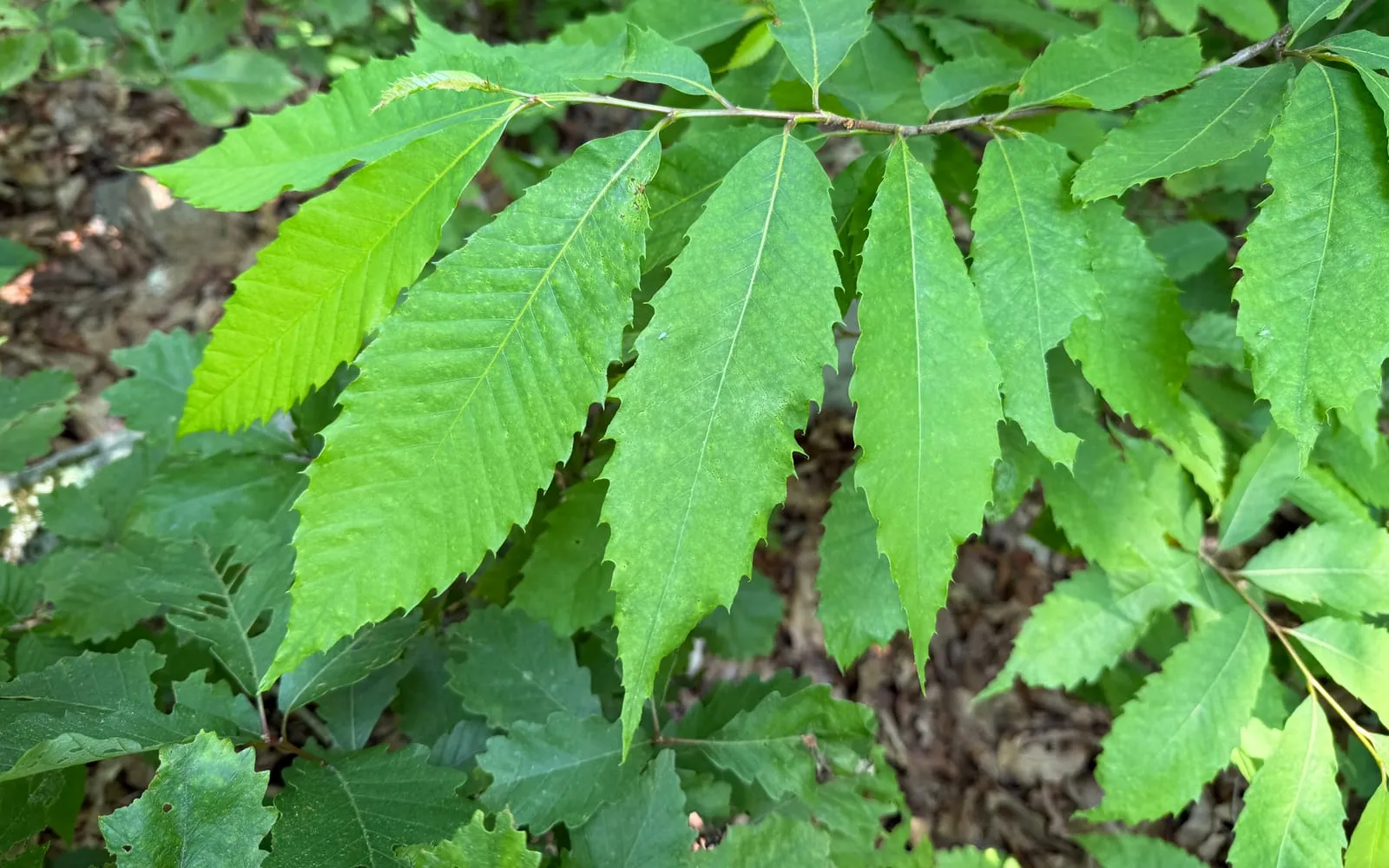
Leaves are long, narrow and sharply toothed, each tooth curving slightly inward toward the tip, glossy and hairless on the underside, a detail that separates it from the related Chinese chestnut, whose leaf underside is downy. Long, cream-coloured male catkins appear in early summer and carry a strong, distinctive scent that some find unpleasant at close range.
Nuts form two or three to a bur, encased in a dense, spiny husk that splits open in autumn. The kernels are smaller and noticeably sweeter than those of the European sweet chestnut sold in shops, and a tree needs a second, genetically different chestnut nearby to set a crop at all, since it cannot pollinate itself.
Where it is from
Castanea dentata is native to eastern North America, forming a broad band from southern Maine and Ontario down through the Appalachians to Mississippi and Alabama. Before the twentieth century it dominated that forest, making up as much as a quarter of the Appalachian canopy and supplying timber, tannin for leather and a nut crop of real commercial scale.
Chestnut blight, caused by the fungus Cryphonectria parasitica, arrived on imported Asian chestnut nursery stock and was first identified in New York in 1904. Asian chestnut species had evolved alongside the fungus and tolerated it; the American species had not, and the disease spread through the wild population at a pace with almost no precedent in forest history, killing an estimated three to four billion trees within about four decades. By 1950 a tree that had shaped entire ecosystems, fed communities and dominated the eastern hardwood canopy existed almost nowhere as a mature, fruiting adult.
The species did not disappear entirely, because the fungus kills the trunk above ground far more readily than it kills the roots, so sprouts keep appearing from stumps that in some cases predate the epidemic itself. The American Chestnut Foundation’s backcross breeding with blight-tolerant Chinese chestnut, and a separate genetically modified line developed at SUNY-ESF, both aim to return a resistant version of the species to its former range, though neither is yet a tree to plant with confidence it will outlive the disease.
How it grows
Plant in full sun on well-drained, acidic soil. Heavy clay and limy or alkaline ground both suit it poorly, and drainage matters more to this tree’s health than almost any other single factor.
Plant two genetically distinct trees for pollination, since a single specimen sets little or no fruit. Space large where planting for a nut crop and for the tree’s eventual mature size, since a specimen that escapes disease can still reach a considerable size given decades to do so.
Where chestnut blight is present, which today means most of the species’ former range, an isolated planting well away from other chestnuts and regularly inspected for cankers is the most realistic way to keep a tree alive to maturity, since the fungus needs a wound to enter and spreads between trees growing near each other. Planting a blight-resistant hybrid bred for the purpose, rather than a pure American chestnut, is the more reliable route to an actual nut harvest in most regions now.
Water new plantings well for the first two to three seasons while roots establish, then reduce watering as the tree matures.
Through the seasons
Spring brings new leaf growth, later than many trees, with flowering following in early summer rather than spring proper.
Summer carries the long male catkins and their strong scent, followed by developing burs through the second half of the season.
Autumn ripens and drops the spiny burs, splitting to release the nuts, which should be gathered promptly before wildlife takes the crop.
Winter is dormant, and the season to inspect the bark closely for any new canker, since blight can be active and spreading during the growing season that follows.
Care difficulty
Difficult, mainly because of chestnut blight. On suitable acidic, well-drained soil the tree grows readily from a nursery specimen. Chestnut blight is present across most of its former range and can infect and kill a healthy young tree regardless of care. Planting a pure American chestnut today is partly a conservation project. A resistant hybrid is the realistic choice for anyone wanting an actual nut harvest.
Watering
Water deeply and regularly through the first two to three growing seasons while the tree establishes a deep root system suited to its native well-drained soils.
Once established, an American chestnut needs supplemental water only in severe or prolonged drought. Waterlogged soil is a far greater risk to it than dry soil, particularly given its vulnerability to Phytophthora root rot.
Warning signs, diseases and pests
Chestnut blight is the disease that defines this species today. It enters through a wound in the bark and forms a sunken, orange-pustuled canker that girdles and kills the stem above the infection point. There is no cure once a canker has formed; the practical response is prompt removal of infected wood well below the canker, avoiding unnecessary wounds that give the fungus an entry point, and accepting that a severely infected trunk will most likely need to regrow from the roots.
Phytophthora root rot, known specifically on chestnut as ink disease for the dark, tar-like fluid it produces at the base of an infected trunk, attacks the roots directly, usually where drainage is poor, and can kill a tree from below even where the crown above ground looks unaffected.
Chestnut weevils bore into developing nuts and lay eggs inside them, the same family of pest that hazel and other nut trees deal with, leaving a small hole and a hollowed-out kernel. Collecting and destroying fallen nuts promptly reduces the population reaching the following season.
Squirrels and other wildlife are drawn to a nut crop as strongly as people once were, and a good yield can disappear within days of ripening if it is not collected promptly.
Growing environment
Full sun suits it best, matching the tree’s origin as a dominant canopy species that shaded out most competitors beneath it.
Well-drained, acidic soil is close to essential. Heavy clay, poorly drained ground and anything limy or alkaline all predispose the tree to root problems and poor growth.
Space generously if the tree is expected to reach any real size, and site an isolated planting away from other chestnuts where blight is a known local risk, since proximity between trees is part of how the disease spreads.
Feeding
Little is needed on suitable acidic soil, where the tree’s own leaf litter and natural soil fertility generally suffice.
A light spring feed with an acidic, woodland-tree fertiliser can help a young tree on poor ground establish, but avoid heavy nitrogen feeding, which produces soft growth more vulnerable to wounding and, by extension, to blight infection through that wound.
Troubleshooting
A sunken, orange-spotted patch has appeared on the bark. Most likely chestnut blight. There is no cure for an established canker; prune out the affected wood well below it and destroy the prunings, and expect the tree to resprout from the base even if the trunk above the canker is lost.
My tree keeps dying back and resprouting from the same spot. This is the pattern chestnut blight leaves across most of the wild population. The roots survive repeated infection even when the trunk above ground does not, and a wild-type tree where blight is present may never grow past this stage.
Is this the same tree as the chestnuts sold for roasting at Christmas? Usually not. Most commercial roasting chestnuts are the European sweet chestnut, Castanea sativa, or Chinese chestnut, both naturally more tolerant of blight and more widely planted commercially than the American species today.
Why has my tree never produced any nuts? It most likely needs a second, genetically distinct chestnut nearby for pollination, since a single tree sets very little fruit on its own.
Are horse chestnuts the same tree? No, and this matters. Horse chestnut, Aesculus hippocastanum, is unrelated and its seeds are toxic if eaten in quantity. A true chestnut nut sits inside a spiny, bristling bur; a horse chestnut sits inside a husk with a few blunt warts, and you need to know the difference before eating any nut found on the ground.
American Chestnut problem guides
- Chestnut blight, the fungal disease that reduced this species from a dominant forest tree to scattered root sprouts
- Phytophthora root rot, known on chestnut as ink disease, which kills from the roots up
- Chestnut weevils boring into the developing nuts, covered on the same page as hazel's nut weevil
- Squirrels and other wildlife stripping a nut crop before it can be collected