
Disease
Chestnut blight
Cryphonectria parasitica
Also called Chestnut canker
A sunken, orange-pustuled canker girdling the trunk or a branch, caused by a fungus that reduced the American chestnut from a dominant forest tree to scattered understorey sprouts within decades. Native to East Asia, where local chestnuts tolerate it, and now present across most of Europe and North America.
At a glance
- Type
- Disease
- Cause
- Fungus
- Severity
- Can kill the plant
- Affects
- Herbs and edibles, Garden plants
- Active
- All year
- Established in
- Asia, North America and Europe
What you are seeing
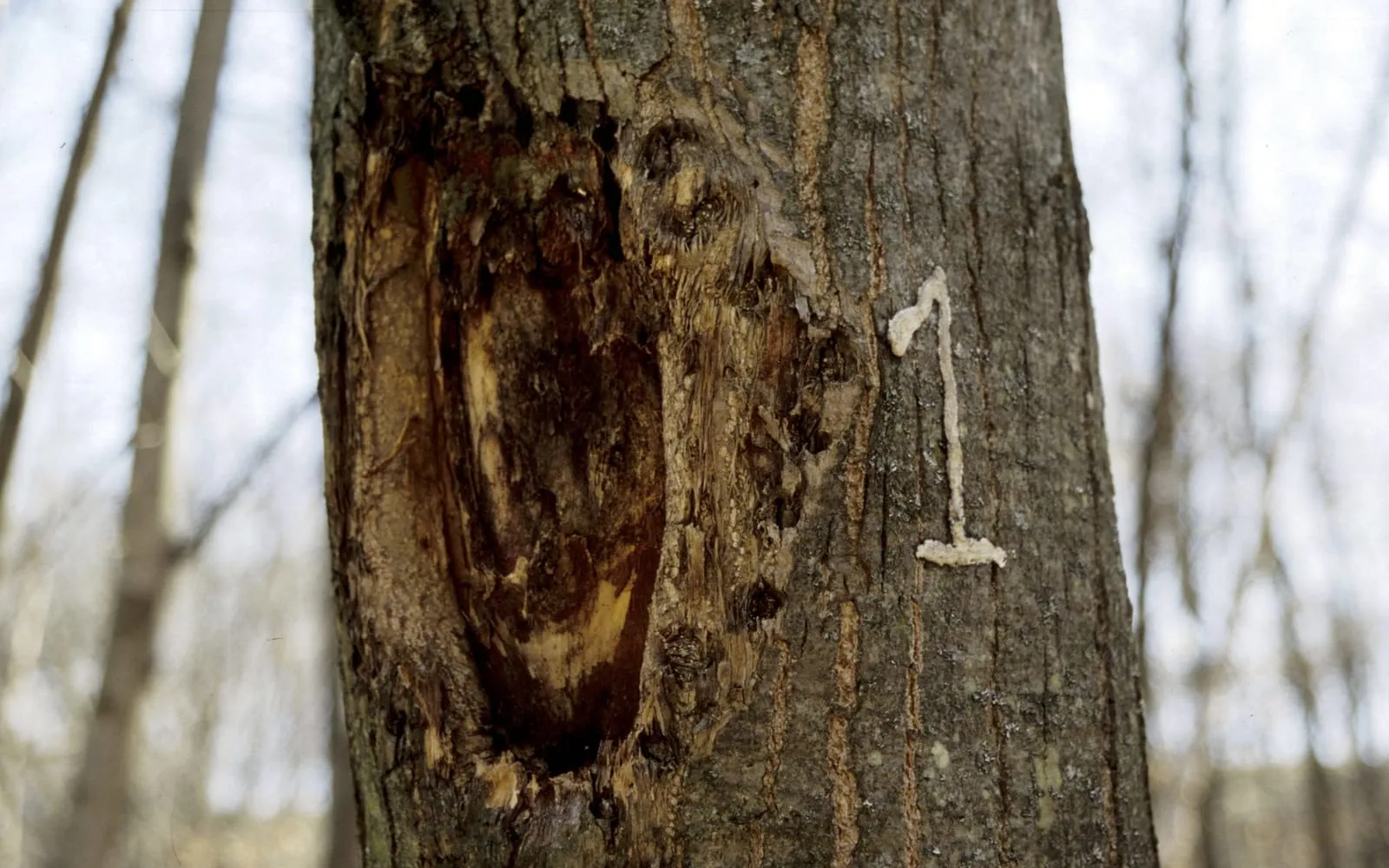
- A sunken, discoloured canker on the trunk or a branch, often with a cracked or fissured surface
- Small orange to yellow-orange pustules studding the canker surface, especially visible in damp weather
- Wilting and browning of leaves on a branch or the whole crown above a canker that has girdled the stem
- Bark splitting to reveal a fan-shaped mat of cream to yellowish fungal growth beneath, visible when affected bark is peeled back
- Suckers sprouting from the base of a tree killed above ground, a pattern that let the American chestnut persist as understorey growth for decades after mature trees were lost
- A canker girdling a stem completely kills everything above that point, while growth below can sometimes continue
Before you treat anything
None. This disease affects the tree rather than the edible nuts directly, though a badly affected tree will stop producing a useful crop.
What you are looking at
A sunken, discoloured, often cracked canker on the trunk or a branch, studded with small orange to yellow-orange pustules that show up clearly in damp weather. Peel back bark at the edge of an active canker and there is often a fan-shaped mat of cream to yellowish fungal growth spreading beneath it. Once a canker has grown all the way around a stem, everything above that point wilts, browns and dies, though the tree can sometimes keep growing below the girdled section, sending up suckers from the base even after the main trunk is lost.
The disease that removed a dominant tree from a continent’s forests
Few plant diseases have reshaped a landscape as completely as this one. Native to East Asia, where Chinese and Japanese chestnut species evolved alongside it and carry real tolerance, the fungus reached North America around 1904, almost certainly on imported nursery stock, and within a few decades reduced the American chestnut from one of the most abundant trees in the eastern hardwood forest, a source of timber, tannin and an enormous annual nut crop, to scattered, short-lived understorey sprouts that rarely reach maturity before blight finds them again. It reached Europe by the late 1930s and is now present across most of the continent’s sweet chestnut growing regions, including more recent outbreaks under active management in the United Kingdom.
It has not established in Australia or New Zealand, and a find in either is treated as reportable rather than routine, given the scale of what this disease has already done elsewhere.
What to do about it
Plant Chinese chestnut or a resistant hybrid rather than European or American chestnut in an area where the disease is present, since resistance in Asian species is real and well documented.
Prune out and destroy cankered branches promptly, cutting well below the visible canker, before it reaches the main trunk.
Avoid unnecessary wounding of chestnut trees, since the fungus enters through cuts, cracks and mechanical damage.
Where available, have an existing canker treated with a hypovirulent strain, which can let a tree wall off an infection it would otherwise lose to.
Report a suspected canker outside the established range immediately rather than treating it as ordinary dieback.
What it gets mistaken for
Coral spot produces small coral-pink pustules on already-dead wood across many unrelated tree species, without the sunken, fissured, stem-girdling canker specific to this fungus.
Bacterial cankers on other species typically ooze gum rather than showing orange pustules, and affect an entirely different range of hosts.
Not established in Australia and New Zealand
Do not prune, spray or otherwise treat a suspected case. Doing so risks spreading an organism the country has kept out, and it disturbs the evidence needed to identify it. Photograph what you can see, leave the plant alone, and contact your national or state plant health authority. The control advice further down this page is written for regions where this problem is already established.
Native to East Asia, where Chinese and Japanese chestnut species co-evolved with the fungus and carry meaningful natural tolerance. It reached North America around 1904, most likely on imported Asian nursery stock, and within a few decades reduced the American chestnut from one of the dominant trees of the eastern hardwood forest to scattered, short-lived understorey sprouts, one of the most complete ecological transformations any single tree disease has caused. It reached Europe by the late 1930s and is now present across most of the continent's sweet chestnut growing regions, including more recent, actively managed outbreaks in the United Kingdom. It has not established in Australia or New Zealand, and either treats a find as reportable.
What to do, in order
The steps below apply where this problem is already established.
Nothing available to a gardener will cure this once a plant has it. The steps below are about limiting the spread and deciding what to plant in its place.
Start here
Prevention, and the changes that stop the problem returning. Most of these pages should end at this tier.
- Plant resistant or tolerant cultivars where the disease is present
- Chinese chestnut and several hybrids bred from it carry meaningful resistance and are the standard planting choice in areas where the European or American species would be at serious risk. Breeding programmes working toward a blight-resistant American chestnut, by crossing it with resistant Asian species and backcrossing toward the American form, remain an active area of research rather than a finished product available to plant today.
- Prune out and destroy cankered branches promptly
- Removing an affected branch well below the visible canker, and burning or otherwise properly destroying the prunings rather than composting them, limits how much inoculum a single infected tree produces and can save a tree where the canker has not yet reached the main trunk.
- Avoid wounding chestnut trees unnecessarily
- The fungus infects through wounds, including pruning cuts, frost cracks, sunscald and mechanical damage. Working to avoid unnecessary injury to the bark, and treating any wound promptly, reduces the entry points available to it.
Then reach for a barrier
Netting, hand removal and water. Nothing here harms anything except the target.
- Report suspected symptoms outside the established range
- In Australia, New Zealand and any region not already affected, a sunken orange-pustuled canker on a chestnut is worth reporting to the plant health authority rather than treated as routine dieback, given how completely this disease reshaped chestnut forests elsewhere once established.
Then bring in the predators
Encourage what already lives in the garden, and buy predators in where the problem is under glass and nothing will arrive on its own.
- Apply hypovirulent strains to existing cankers where available
- A virus that infects the fungus itself, reducing its aggressiveness, occurs naturally in many European chestnut-growing regions and has also been introduced deliberately as a biological control. Inoculating an existing canker with a hypovirulent strain can allow a tree to wall off and survive an infection that would otherwise kill it, though this works better in Europe's chestnut blight population than it has so far in North America's more genetically diverse one.Used in coordinated disease-management programmes across parts of Europe; check local availability and regulatory status before attempting treatment.
Biological controls are live organisms and their sale and release are regulated country by country. An agent sold freely in one place may be unapproved in another, so buy from a licensed supplier where you live and never import or move one yourself.
Plants affected
Guides that name it among the problems to watch for. The list is the plants it is characteristic of rather than everything it will feed on.