
Edible
Walnut
Juglans regia
Also known as Common walnut, English walnut, Persian walnut
How to grow walnut, Juglans regia. Picking green for pickling in June, the juglone that kills what grows beneath it, and buying a grafted tree.
At a glance
- Difficulty
- Moderate
- Water
- In dry spells for the first few years
- Light
- Full sun, in a sheltered position away from frost pockets
- Temperature
- Fully hardy as a tree, and the young growth is damaged by late frost
- Hardiness
- USDA 5-9, RHS H6, hardy to -30 C
- Type
- Deciduous tree, very long lived and slow to come into bearing
- Height
- 15-25 m
- Native to
- The mountains of central Asia, from the Balkans to western China
- Best month
- October in the Northern Hemisphere, April in the Southern Hemisphere
The mature tree takes hard winters and the young growth does not, and a late frost in May takes the shoots, the flowers and that year's nuts together. Filling the kernels needs a long warm summer. Every part of the tree releases juglone, which kills tomatoes, apples and rhododendrons planted within the root spread.
Hardiness zones describe winter cold alone. Summer heat, humidity, rainfall and the length of the growing season decide as much, so treat the range as the outer limit rather than as a recommendation.
Every month named in this guide is for the temperate Northern Hemisphere. If you garden in the Southern Hemisphere, shift each one by six months, so October becomes April. Closer to the equator the wet and dry seasons matter more than the calendar, and the shift stops being a useful guide.
Toxic if eaten
- Safe to eat
- The kernel of the ripe nut, and the whole green nut when pickled
- Do not eat
- The green husk, the leaves and the roots
- Harm from
- Handling it and eating it
- Affects
- People and horses
The nuts are a food and are safe apart from allergy, and tree nut allergy is one of the more serious food allergies, so anyone with a known nut allergy should avoid handling the husks as well as eating the nuts. The green husk surrounding the developing nut contains juglone, which stains skin a deep brown that takes a fortnight to wear off and which irritates skin, so wear gloves when handling green walnuts. Juglone is also released from the roots and fallen leaves and suppresses the growth of many other plants beneath the tree, which is a real gardening consideration rather than a toxicity one. The horse risk is specific. Walnut shavings used as bedding cause severe laminitis in horses, and even a small proportion of walnut in a bedding mix is enough, so walnut wood and sawdust must be kept out of stables entirely. The ASPCA lists Juglans as toxic to horses and dogs, and the dog risk is largely from mouldy fallen walnuts, which can carry tremorgenic mycotoxins causing seizures. Clear fallen nuts where a dog has access.
Sources: RHS potentially harmful garden plants, ASPCA toxic and non-toxic plants
About
A walnut tree is a decision about the next century rather than the next few years.
It reaches 20 m and more, it casts dense shade, its roots and fallen leaves release juglone which suppresses a good many plants growing beneath it, and a seedling takes fifteen years or longer to produce a nut. It is emphatically not a tree for a small garden.
Given room it is one of the finest trees you can plant. The crown is broad and handsome, the bark is pale grey and fissured, the timber is the most valuable in Europe, and a mature tree in a paddock or a large lawn is a landmark.
Two things make it a realistic proposition rather than a gamble. Buy a grafted named cultivar rather than a seedling, which halves the wait to five or six years and gives predictable nuts. And choose a cultivar bred for a cool temperate climate, since late frost damaging the young growth and the flowers is the main limitation.
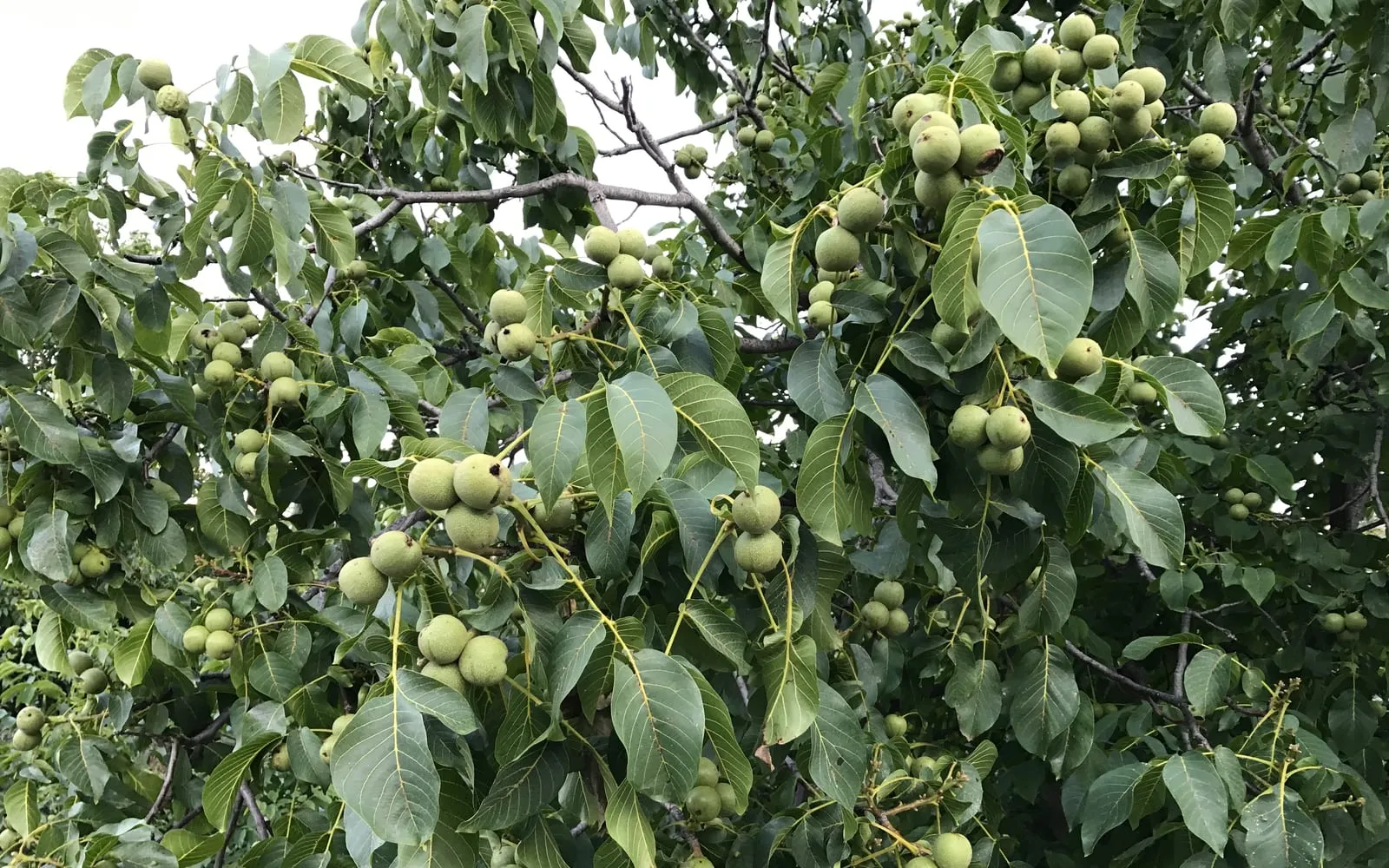
Green walnuts picked around the end of June, before the shell hardens inside, are pickled whole in vinegar and are a traditional English preserve. You can test them with a skewer, and if it passes through the whole nut without resistance they are ready.
Squirrels will take the ripe crop. It is the commonest reason a walnut owner never eats a walnut.
Appearance and character
A deciduous tree reaching 15 to 25 m, with a broad domed crown on a relatively short stout trunk.
Bark is smooth and pale silvery-grey on young trees, developing deep fissures with age.
Leaves are pinnate, 20 to 45 cm long, made of five to nine large oval leaflets with the terminal one largest, glossy and aromatic when crushed with a distinctive sharp smell.
New leaves emerge bronze-purple in late spring, and walnut comes into leaf very late, often not until May, which is an adaptation to frost.
Flowers appear in May. Male catkins are long, green and drooping, and female flowers are small and inconspicuous at the shoot tips.
Nuts ripen in September and October, each inside a smooth green fleshy husk 4 to 6 cm across that splits and blackens as the nut matures.
The shell inside is the familiar wrinkled pale brown case, and the kernel is the two-lobed seed.
Autumn colour is a modest yellow and the leaves fall early.
‘Broadview’ and ‘Buccaneer’ are the standard cultivars for cool climates, both grafted, both self-fertile and both cropping young.
Where it is from
The mountains of central Asia, from the Balkans and the Caucasus east through Iran and Afghanistan to western China, with the great relict walnut forests of Kyrgyzstan being the heart of its natural range.
It was spread west by the Greeks and Romans and reached Britain with the Romans, and the English walnut of the trade is the Persian walnut of botany.
The name comes from Old English wealhhnutu, meaning foreign nut, distinguishing it from the native hazel.
Walnut timber is the most valuable European hardwood, used for gun stocks, furniture and veneer, and the burrs at the base of an old tree are worth more than the rest of the tree.
Juglone, the compound in the roots, leaves and husks, is an allelopathic chemical that suppresses competing plants and has been recognised since Roman times, when Pliny noted that nothing grew well under a walnut.
Black walnut, Juglans nigra, is the American species with far higher juglone production and a much stronger suppressive effect, and it is grown in Europe mainly as a timber and ornamental tree.
Britain’s walnut planting declined sharply after the Napoleonic wars, when large numbers were felled for gun stocks, and the modern grafted cultivars have made it a garden proposition again.
How it grows
Buy a grafted named cultivar, not a seedling. A grafted ‘Broadview’ or ‘Buccaneer’ crops in five or six years, and a seedling may take fifteen and produces nuts of unpredictable quality.
Plant in autumn or early spring, in a sheltered position in full sun.
Avoid frost pockets. Walnut leafs out late as an adaptation to frost, and a late frost in a hollow still damages the young growth and destroys the flowers.
Choose deep, fertile, free-draining soil, neutral to slightly alkaline. It dislikes acid ground, waterlogging and thin dry sand.
Allow the space. A walnut reaches 15 to 25 m with a crown as wide, and it should be at least 15 m from a building.
Stake for two years and water through the first three summers.
Mulch generously while establishing, keeping the mulch clear of the trunk.
Prune only in midsummer or in late autumn, between about mid-July and mid-September or in November and December. Walnut bleeds sap heavily if cut in late winter or spring and the loss weakens the tree.
Prune as little as possible. Remove dead, damaged or crossing branches and lift the crown if needed, and leave the shape alone.
Pick green nuts around the end of June for pickling, testing with a skewer. If it passes straight through the whole nut the shell has not started to harden and they are ready. Wear gloves.
Harvest ripe nuts in late September and October as they fall, gathering them daily.
Remove the husks immediately after gathering, wearing gloves, since they stain hands severely.
Wash the nuts, then dry them thoroughly for two to three weeks somewhere warm and airy before storing, or they go mouldy.
Beat the squirrels by gathering daily from the moment the first nuts fall, and accept that in a garden with a grey squirrel population you may get very little.
Expect a tree to live for a couple of centuries.
Through the seasons
Winter the tree is bare, and late autumn into early winter is one of the two pruning windows. This is planting season.
Spring breaks bud very late, often in May, and the flowers appear then. Late frost is the risk.
Summer grows, and green nuts for pickling are picked at the end of June. Midsummer is the other pruning window.
Autumn ripens and drops the nuts through September and October, which is harvest and the race against squirrels.
Care difficulty
Moderate, and the difficulty is all in the decision rather than the maintenance.
An established walnut needs nothing. No feeding, no watering, almost no pruning, and it has few serious pests or diseases.
The difficulties are the size, the shade, the juglone effect on what grows beneath it, the wait before it crops, and the squirrels.
Buying a grafted cultivar addresses the wait. Nothing addresses the squirrels short of gathering the nuts daily as they fall.
Pruning at the wrong time of year is the one management error that does real harm, and it is easily avoided.
Watering
Water through the first three summers after planting.
An established walnut needs no watering in a temperate climate and is reasonably drought tolerant once its deep root system is down.
Mulch generously in the establishment years, which does more than watering.
It dislikes waterlogging, so improve drainage on heavy ground rather than adding water.
Warning signs, diseases and pests
The entire crop disappearing before it ripens is grey squirrels, which is the commonest complaint about garden walnuts. Gather the nuts daily from the moment they start to fall.
Black spots on the leaves and sunken black patches on the husks and young shoots is walnut blight, a bacterial disease that follows wet springs. Remove and destroy affected material, improve air movement, and choose a resistant cultivar.
Blistered, puckered patches on the leaves is walnut leaf blotch, a fungal disease, which is disfiguring rather than serious. Clear fallen leaves.
New growth blackened after a cold night in May is frost damage. The tree usually pushes a second flush and the crop is lost for that year. Avoid planting in a frost pocket.
Heavy sap bleeding from a pruning cut is pruning at the wrong time. Prune between mid-July and mid-September, or in November and December.
Nothing growing beneath the tree is juglone from the roots and fallen leaves, which suppresses many plants. It is not a disease and cannot be treated. Plant tolerant species or accept a bare or grassed area.
Nuts going mouldy in storage is inadequate drying. Dry them for two to three weeks somewhere warm and airy before storing.
Honey fungus attacks walnut and is fatal.
Spotted lanternfly is one of this pest’s preferred hosts and mobs the trunk in large numbers, weeping sap and coating the bark below in sticky honeydew. It has spread across nineteen US states since 2014 and has not established outside North America and its native Asia; destroy any mud-coloured egg mass found on the trunk.
Growing environment
Full sun in a sheltered position, away from frost pockets and hollows.
Deep, fertile, free-draining soil, neutral to slightly alkaline. Avoid acid ground, thin dry sand and waterlogged clay.
Fully hardy as a tree, and the late spring growth is vulnerable to frost.
Allow 15 m or more of space, and keep it at least 15 m from a building and away from drains.
It suits a paddock, a large lawn, a field corner, a parkland setting or a very large garden. It does not suit an ordinary suburban plot.
Plan for the juglone. Grass grows under a walnut, and many garden plants do not. Tolerant plants include hardy geranium, hellebore, bergenia, elder, hawthorn, daffodil, hosta and most grasses. Sensitive plants include tomato, potato, apple, rhododendron, azalea, lilac, peony and many others. Do not put a vegetable bed beneath one.
Choose ‘Broadview’ or ‘Buccaneer’, both grafted, self-fertile and cropping within five or six years.
Its wildlife value is fair. Squirrels and rooks take the nuts, and the tree supports fewer invertebrates than a native.
Feeding
None needed on reasonable soil.
Mulch generously for the first few springs with compost, keeping it clear of the trunk.
Avoid high-nitrogen feeds, which produce soft growth that walnut blight enters more easily and that suffers in frost.
Lime acid soil, since walnut prefers neutral to slightly alkaline ground.
A tree failing to thrive usually has a drainage or a pH problem rather than a nutrient one.
Troubleshooting
How long before it produces nuts? Five or six years for a grafted named cultivar, and fifteen years or more for a seedling. Buy a grafted tree.
Which cultivar should I grow? ‘Broadview’ or ‘Buccaneer’, both self-fertile, both grafted and both cropping young in a cool temperate climate.
Do I need two trees? No. Both of those cultivars are self-fertile, and cropping is often improved by a second tree nearby.
Why does nothing grow under it? Juglone, released from the roots and fallen leaves, which suppresses many plants. It cannot be treated. Grass grows fine, as do hardy geranium, hellebore, bergenia and most bulbs. Keep tomatoes, potatoes and rhododendrons well away.
Squirrels take everything. The standard experience. Gather the nuts daily from the moment they start to fall, and expect to lose a good deal regardless.
When should I prune it? Between mid-July and mid-September, or in November and December. Cutting in late winter or spring makes it bleed sap heavily.
How do I pickle green walnuts? Pick around the end of June and test with a skewer. If it passes straight through the whole nut, the shell has not started to harden and they are ready. Wear gloves, since the husks stain hands brown for a fortnight.
How do I store the nuts? Remove the husks immediately after gathering, wash the nuts, then dry them thoroughly for two to three weeks somewhere warm and airy before storing. Poorly dried nuts go mouldy.
Is it safe near horses? Keep walnut wood and shavings entirely out of stables. Walnut bedding causes severe laminitis in horses even at low proportions.
Walnut problem guides
Not sure what is wrong? See the common vegetable pests guide.