
Edible
Miracle Fruit
Synsepalum dulcificum
Also known as Miracle berry, Magic berry, Agbayun
How to grow miracle fruit, Synsepalum dulcificum. The West African berry that makes a lemon taste like lemonade for half an hour, how the effect works, and the acid compost it insists on.
At a glance
- Difficulty
- Moderate
- Water
- Twice a week, keeping the compost evenly damp
- Light
- Part shade to bright indirect light. Direct sun scorches it
- Temperature
- Minimum 10 deg C. Damaged below 8 deg C
- Humidity
- High
- Hardiness
- USDA 10-12, RHS H1b, hardy to 12 C
- Type
- Tender evergreen shrub
- Height
- 2-5 m in the open, 0.6-1 m in a pot
- Native to
- West Africa
- Best month
- June, July and September in the Northern Hemisphere, December, January and March in the Southern Hemisphere
West African understorey, growing in acid soil in shade. It needs a pH near 5 and rainwater, and it sulks in alkaline conditions in the way a blueberry does. Fruits several times a year in constant warmth.
Hardiness zones describe winter cold alone. Summer heat, humidity, rainfall and the length of the growing season decide as much, so treat the range as the outer limit rather than as a recommendation.
Every month named in this guide is for the temperate Northern Hemisphere. If you garden in the Southern Hemisphere, shift each one by six months, so June becomes December. Closer to the equator the wet and dry seasons matter more than the calendar, and the shift stops being a useful guide.
Not known to be toxic
- Safe to eat
- The pulp around the seed
- Do not eat
- The seed, which is not eaten
Miracle fruit is not toxic and it is one of the few plants in this collection where the interesting fact is the absence of any effect. The berry contains miraculin, a glycoprotein that binds to the sweet receptors on the tongue and switches them on in the presence of acid, so for thirty to sixty minutes afterwards sour food tastes sweet. It has no nutritional effect, no drug action and no toxicity, and West Africa has eaten it for centuries. The one real caution follows from the effect rather than from the plant. Anything acid tastes pleasant while it lasts, so it is possible to eat far more lemon, vinegar or rhubarb than is comfortable, and dental enamel and stomach lining do not care how it tastes. The seed is hard and is discarded.
Sources: ASPCA toxic and non-toxic plants, RHS potentially harmful garden plants
About
Miracle fruit does one thing and does it reliably. Chew the pulp of a ripe berry for a minute, and for the next half hour a lemon tastes like lemonade, vinegar tastes like sweet wine and rhubarb needs no sugar.
The mechanism is understood. A glycoprotein called miraculin binds to the sweet receptors on the tongue without activating them, and acid changes its shape so that it switches them on. The tongue then reads sourness as sweetness until the protein washes away.
Growing it is a matter of one non-negotiable requirement. Miracle fruit needs strongly acid compost and rainwater, and on ordinary compost or tap water it yellows and dies without much argument.
Appearance and character
A dense upright evergreen shrub, 2 to 5 m in the wild and rarely over a metre in a pot, branching from low down.
Growth is slow, adding a few centimetres a year in cultivation.
Leaves cluster at the shoot tips in loose rosettes, obovate, 5 to 10 cm, dark green, leathery, with a paler underside and slightly wavy edges.
Flowers are small, white to cream, and borne in the leaf axils, singly or in small clusters, and easy to miss.
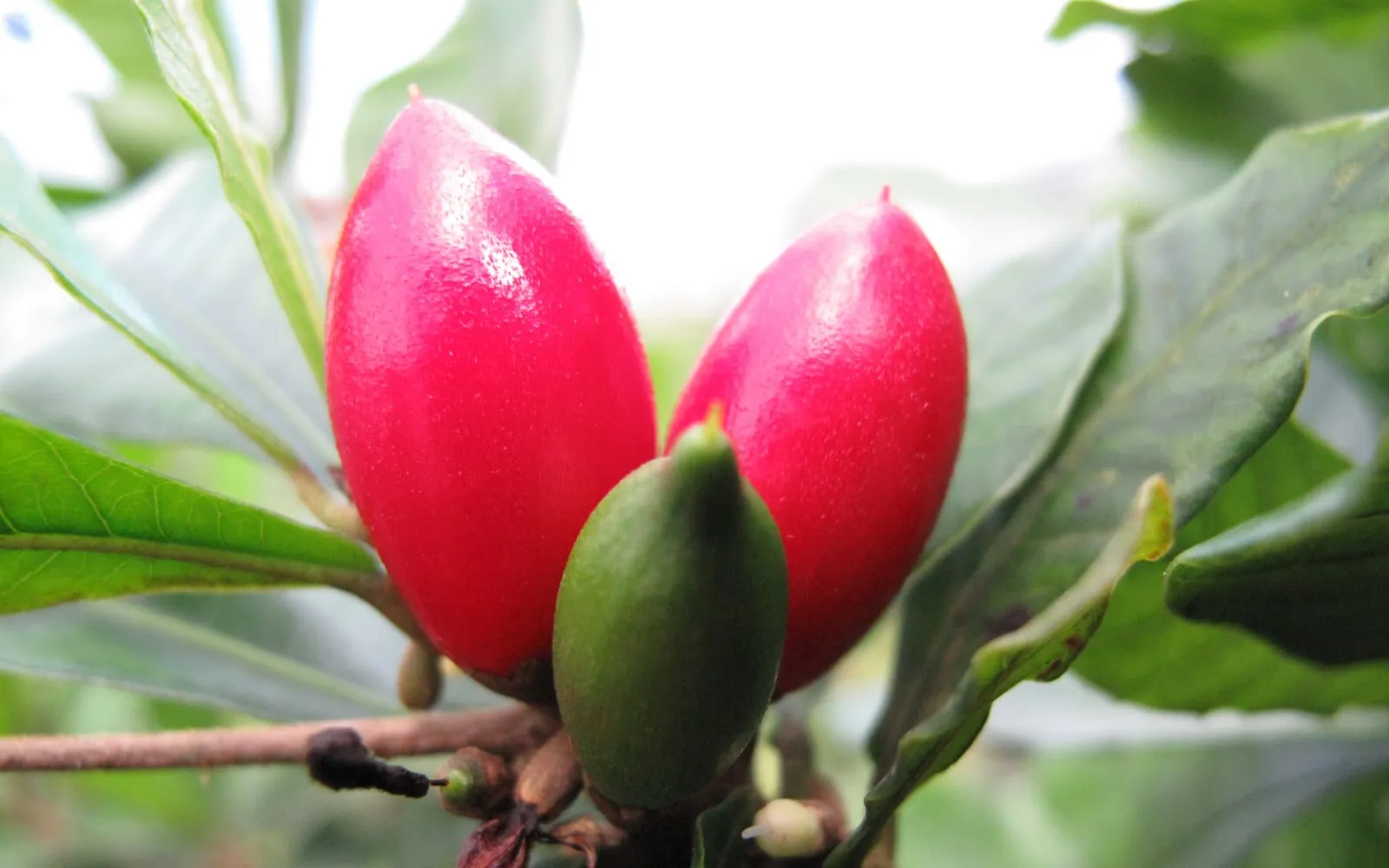
Fruit is a bright red berry, 2 to 3 cm, oblong, with a thin skin and a small amount of white pulp around a single large seed.
The pulp is what carries the effect, and there is very little of it, so a berry is chewed thoroughly and held in the mouth rather than swallowed quickly.
The fruit itself tastes of very little. Faintly sweet and slightly tart, with nothing to suggest what it is about to do.
A mature plant fruits two or three times a year.
Where it is from
Miracle fruit is native to the coastal forests of West Africa, from Ghana and Togo through Benin and Nigeria to Cameroon.
Local use is old. The berries were chewed before eating sour palm wine, maize porridge and other acid staples, and European travellers recorded the effect in the eighteenth century.
Western science took an interest in the twentieth. Miraculin was isolated in the 1960s and a company set out to develop it as a natural sweetener for people with diabetes.
The United States Food and Drug Administration blocked that in 1974, classifying miraculin as a food additive rather than as a food, which required a level of safety testing the venture could not fund. The product never reached the market and the company failed.
The berry survives as a novelty and a curiosity, sold fresh, frozen or as freeze-dried tablets, and flavour-tripping parties made it briefly fashionable in the 2000s.
Temperate markets see it as freeze-dried tablets and, from specialist nurseries, as plants.
How it grows
Sow seed from a fresh berry within a few days. Miracle fruit seed dies quickly and cannot be dried.
Sow at 24 to 30 deg C in a strongly acid peaty mix. Germination takes three to eight weeks.
Use ericaceous compost with added peat or coir and perlite. This is the single most important thing about growing it, and a plant on ordinary compost declines and dies.
Water with rainwater only. Tap water in a hard water area raises the pH and kills it.
Give part shade or bright indirect light. Direct sun scorches the leaves.
Keep the temperature above 10 deg C and the humidity high.
Water twice a week, keeping the compost evenly damp without waterlogging.
Feed monthly at half strength with an ericaceous feed.
Expect slow growth and fruit in three to five years from seed.
Through the seasons
Winter is a warm rest above 10 deg C with humidity kept up, watered steadily and unfed.
Spring brings a growth flush and the first flowering. Start feeding.
Early summer is fruit, which takes about two months from flower.
Midsummer is a second flowering.
Late summer to autumn is a second crop.
Autumn is when to stop feeding while keeping the compost damp and the air humid.
Care difficulty
Moderate, and the whole difficulty sits in one requirement.
Acid compost and rainwater are not negotiable. Miracle fruit needs a pH around 4.5 to 5.5, and on ordinary compost or hard tap water it yellows, stops growing and dies. Almost every failure traces back to this.
Part shade is needed, since direct sun scorches the leaves.
Minimum 10 deg C and high humidity are needed.
Growth is slow, adding a few centimetres a year.
Fruit comes in three to five years from seed, and a mature plant crops two or three times a year.
Given the right compost and rainwater it is an undemanding houseplant that lives for decades.
Watering
Water twice a week, keeping the compost evenly damp.
Use rainwater only. This is as important as the compost, and hard tap water will kill the plant over a season.
Never let it dry out and never let it stand in water.
Keep humidity high with a damp gravel tray, grouping or a humid room.
Reduce watering slightly in winter without letting the compost dry.
Use tepid water.
Mulch the pot surface with composted bark or leaf mould.
Warning signs, diseases and pests
Yellowing leaves with green veins, followed by leaf drop and stalled growth, is the classic miracle fruit failure and means the compost or the water is not acid enough. Repot into ericaceous compost and switch to rainwater.
Brown scorched patches on the leaves mean direct sun.
Brown leaf edges mean dry air.
Leaf drop after a cold spell is chill damage below 8 deg C.
Fine webbing on the leaves is spider mite.
Brown limpets on the stems are scale.
Wilting in wet compost is root rot.
Very slow growth is normal.
A berry that does not work was probably not fully ripe, or was swallowed rather than chewed.
Growing environment
A warm greenhouse, conservatory or a shaded windowsill in a humid room. A bathroom suits it well.
Minimum 10 deg C, with 22 to 30 deg C for growth.
Part shade or bright indirect light. No direct sun.
High humidity.
Strongly acid peaty compost with perlite for drainage.
pH from 4.5 to 5.5, which is lower than almost anything else here.
Rainwater only.
A pot of 20 to 30 cm, which a slow plant will occupy for years.
Feeding
Feed monthly from April to September with an ericaceous liquid feed at half strength.
Keep it light. This is a slow plant that cannot use much.
Add sequestered iron at the first yellowing between the veins.
Stop feeding at the end of September.
Give nothing through winter.
Top-dress with ericaceous compost each spring.
Repot every second or third year, taking care with the roots.
Troubleshooting
How do I use a berry? Chew the pulp thoroughly for a minute or so, moving it around the mouth so it coats the tongue, then spit out the seed. The effect starts at once and lasts thirty to sixty minutes.
How does it work? A glycoprotein called miraculin binds to the sweet receptors on your tongue without switching them on. Acid changes its shape so that it does switch them on, so sour food reads as sweet until the protein washes away.
Is it safe? Yes. It has no nutritional effect, no drug action and no toxicity, and West Africa has eaten it for centuries. The sensible caution is that acid food tastes pleasant while the effect lasts, so it is easy to eat far more lemon or vinegar than your teeth and stomach would like.
My plant went yellow and stopped growing. The compost or the water is not acid enough. This is the commonest failure by a wide margin. Repot into ericaceous compost and use rainwater only.
Can I use tap water? Not in a hard water area. It will kill the plant over a season.
The leaves scorched. Direct sun. Miracle fruit is a forest understorey shrub and wants part shade or bright indirect light.
How soon will it fruit? Three to five years from seed, and a mature plant crops two or three times a year.
Why was it never sold as a sweetener? The US Food and Drug Administration classified miraculin as a food additive rather than a food in 1974, which required safety testing the company developing it could not fund. The product never reached the market.
Miracle Fruit problem guides
Not sure what is wrong? See the common vegetable pests guide.