
Edible
Celeriac
Apium graveolens var. rapaceum
Also known as Celery root, Knob celery, Turnip-rooted celery
How to grow celeriac, Apium graveolens var. rapaceum. The six-month season it needs, removing side shoots and lower leaves, and lifting through the frost.
At a glance
- Difficulty
- Difficult
- Water
- Weekly at minimum, and never allow a dry fortnight
- Light
- Full sun to light shade
- Temperature
- 15-21 deg C to grow, and it stands frost to about -10 deg C
- Hardiness
- USDA 4-9, RHS H5, hardy to -10 C
- Type
- Biennial grown as an annual
- Height
- 30-60 cm
- Native to
- Europe and the Mediterranean, on damp salty coastal ground
- Best month
- February in the Northern Hemisphere, August in the Southern Hemisphere
It wants 30 weeks of steady growth with the soil never drying out, which is a longer and more demanding run than any other root in the garden. A check from cold or drought stops the root swelling and cannot be made up later. A fortnight below 10 deg C on a young plant makes it bolt.
Hardiness zones describe winter cold alone. Summer heat, humidity, rainfall and the length of the growing season decide as much, so treat the range as the outer limit rather than as a recommendation.
Every month named in this guide is for the temperate Northern Hemisphere. If you garden in the Southern Hemisphere, shift each one by six months, so February becomes August. Closer to the equator the wet and dry seasons matter more than the calendar, and the shift stops being a useful guide.
Skin irritant
- Safe to eat
- The swollen crown, peeled, and the leaves as a herb
- Harm from
- Handling it
- Affects
- People
Celeriac is a food crop and the crown and leaves are both eaten. The caution concerns handling. Like celery, it belongs to the Apiaceae and its foliage and sap contain furanocoumarins, which react with sunlight on skin to cause phytophotodermatitis, a burn appearing a day or two after exposure that can blister and leave brown marks for months. The risk to a gardener stripping leaves off a crown on a bright day is real, so wear long sleeves and wash your forearms afterwards. Celery and celeriac are named allergens under UK food labelling law and are among the more common causes of food-related anaphylaxis in northern Europe, and the allergen survives cooking. The ASPCA does not list Apium graveolens as toxic to cats and dogs. The RHS records the phototoxic sap among its harmful garden plants. Brown discolouration inside a crown is boron deficiency rather than a toxin, and the affected tissue is unpalatable rather than harmful.
Sources: RHS potentially harmful garden plants, ASPCA toxic and non-toxic plants
About
Celeriac is celery selected for its base instead of its stalks, and it is the easier of the two to grow because nothing has to be blanched. What it asks for instead is time. Six months from a February sowing to an October lift, and the plant uses every week of it.
The commonest disappointment is a crown the size of a golf ball in October, and it has one cause almost every time. Sown too late, planted out too small, or allowed to dry out in July, the plant never builds the leaf area it needs to fill a crown.
The reward is the best-keeping root vegetable a temperate garden produces. Crowns stand in the ground through frost, improve for it, and lift through to March.
Appearance and character
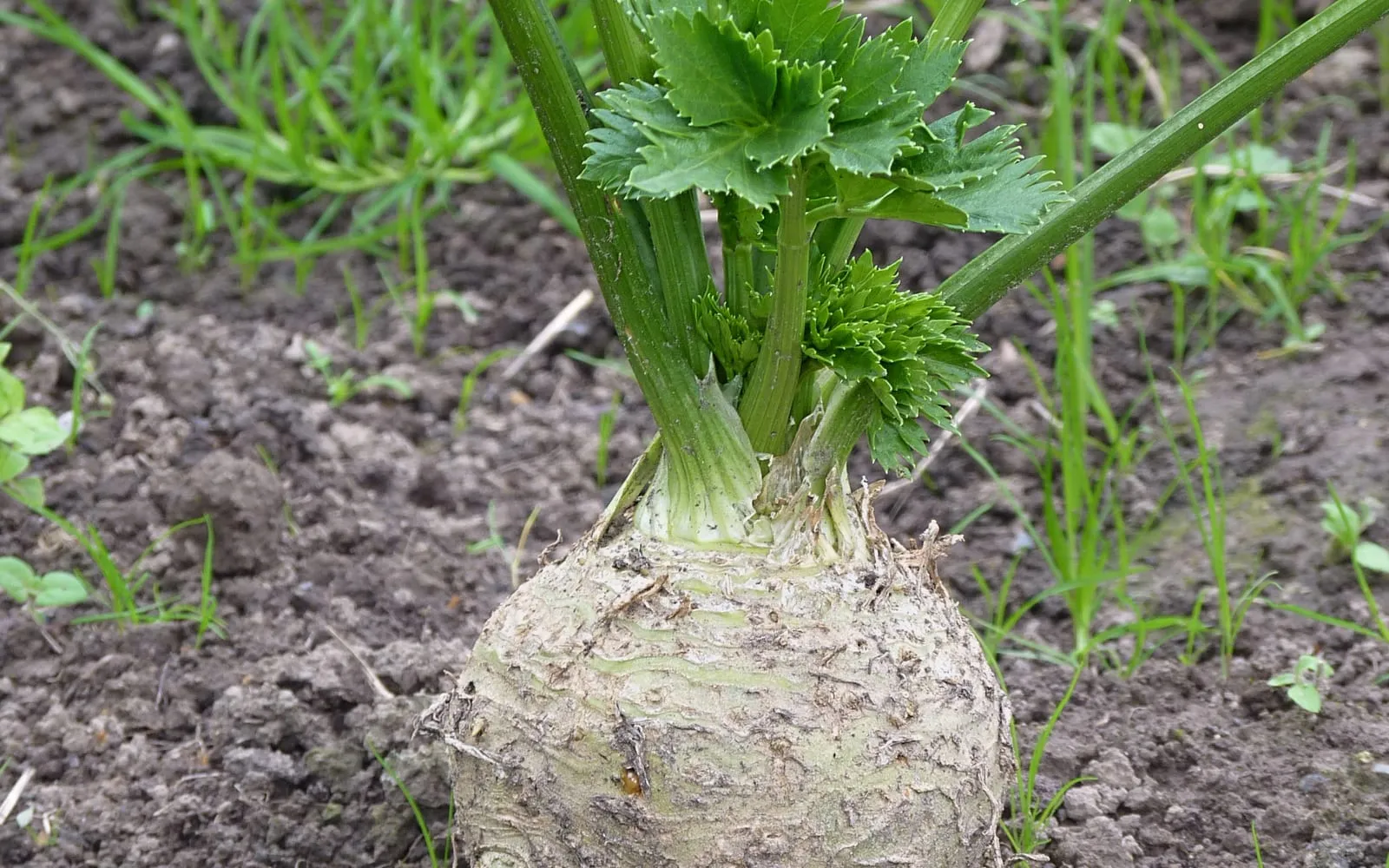
A rough, knobbly, roughly spherical crown sitting at soil level, 8 to 12 cm across in a good year, with a mass of fibrous roots underneath and leaf scars across the top.
Skin is brown-grey and irregular, and peeling it wastes a third of the crown, which is normal rather than a fault.
Flesh is creamy white, dense and firm, discolouring quickly when cut. It tastes of celery with a nuttiness celery does not have, and it is better cooked than raw, though remoulade is the classic raw use.
Leaves are the same divided, toothed, glossy foliage as celery, on hollow grooved stalks, and are used as a herb.
A bolting plant sends up a branched flower stem to a metre with flat umbels of greenish-white flowers. The crown stays small and woody.
Where it is from
Celeriac is the same species as celery, Apium graveolens, and shares the wild ancestor that grows on damp brackish coastal ground across Europe, Britain included.
Selection for a swollen hypocotyl rather than thick stalks happened in the Mediterranean, and the root form is recorded in northern Europe from the seventeenth century.
Germany, the Netherlands and eastern Europe took to it far more thoroughly than Britain, and it is still described in British seed catalogues in terms that assume the reader has not met it.
The crown is not a root. It is a swollen stem base, a hypocotyl, which is why it sits on the surface rather than under it and why the true roots hang beneath it in a beard.
How it grows
Sow indoors in February at 15 to 20 deg C. The seed is tiny and needs light, so sow on the surface of moist compost and do not cover it. Germination takes two to three weeks.
Prick out into modules at the first true leaf and grow on above 10 deg C. A cold check here produces a plant that bolts in July.
Harden off over a fortnight and plant out in late May, once the nights have warmed. Plant with the crown at soil level rather than buried.
Space at 30 cm each way.
Through the summer, strip the lower leaves and any side shoots off the crown as it swells, which exposes it to light and air and gives a rounder, cleaner crown.
Lift from October. Crowns stand frost in the ground under a straw mulch and are lifted as needed until March.
Through the seasons
Late winter is for sowing, in February indoors on the surface of moist compost. Sowing later than early March costs the crop its size.
Spring grows the plants on above 10 deg C. Pot on rather than let them become potbound. Harden off through late May.
Early summer is for planting out at 30 cm each way, into ground dug with manure. Water in generously and mulch thickly.
Summer is watering and feeding, without a break. Start stripping lower leaves and side shoots in July as the crown begins to swell.
Autumn and winter are the harvest. Lift from October, and mulch the rest with straw to lift through the winter. Clear the bed by March.
Care difficulty
Difficult, and for the same two reasons as celery.
The season is the first. Six months means a February sowing under cover and a late May planting, and there is no way to shorten it. A plant sown in April makes a small crown whatever else is done for it.
Water is the second. The crop needs consistently moist soil for its whole season, and a dry fortnight in July costs size that is never recovered.
Bolting follows a cold check on a young plant, exactly as in celery.
Leaf spot is seed-borne, so buy treated seed.
Stripping the lower leaves is the one technique unique to this crop, and skipping it gives a crown buried in roots and leaf bases that is unpleasant to prepare.
Watering
Water weekly at absolute minimum, and more in heat. Around 20 litres per square metre a week, applied as a soak.
Mulch thickly at planting with 8 cm of compost or well-rotted manure, kept just clear of the crown. Celeriac has a shallow root system and the mulch does more than the watering can.
Water at the base rather than over the plant.
Never let the plants wilt. A check in growth shows up as a small crown in October and cannot be corrected later.
The critical months are July to September, which is when the crown fills.
Warning signs, diseases and pests
Celery leaf spot brings small brown spots spreading across the leaves in a wet summer, weakening the plant and reducing the crown. The fungus is carried on the seed, so use treated seed, space for airflow, and remove affected leaves.
Celery leaf miner tunnels white blotches through the foliage. Crush the larvae by squeezing the tunnel, and cover with fine mesh from May.
Slugs graze the crown and get under the leaf bases. Keep the ground clear and patrol on damp evenings.
Carrot fly larvae tunnel into the crown leaving brown channels. Fine mesh over the bed from planting, or a 60 cm vertical barrier.
Bolting sends up a flower stem and stops the crown developing.
Brown discolouration inside a sound-looking crown is boron deficiency, common on light, dry or over-limed soil. Apply borax at 3 g per square metre dissolved in water.
A small crown in October is a season or a watering fault rather than a disease.
Growing environment
Full sun to light shade.
Rich, deep, moisture-retentive soil is the requirement. Dig in a bucket of well-rotted manure per square metre the autumn before planting.
Ground that stays damp naturally suits celeriac better than free-draining soil.
Lime to pH 6.5 or 7 if the soil is acid, and test rather than guess, since over-liming causes the boron lock-up behind brown discolouration.
Space at 30 cm each way. Crowding gives small crowns.
Shelter from wind, which dries the plants and tears the leaves.
Rotate with the other umbellifers, counting carrot, parsnip, celery, parsley and fennel as one crop.
Feeding
Celeriac is a heavy feeder over a long season.
Dig in well-rotted manure or compost generously before planting.
Feed fortnightly with a balanced liquid feed from planting out until September. Liquid seaweed suits it well.
Use a nitrogen-rich feed in early summer to build the leaf area that fills the crown, then switch to a balanced feed from August.
Stop feeding at the end of September. Late soft growth is damaged by frost.
Add boron only where brown discolouration has appeared before, at 3 g of borax per square metre. Overdosing damages the crop.
Troubleshooting
A crown the size of a golf ball in October. Sown too late, planted out too small, or allowed to dry out in summer. Sow in February, plant out in late May, and water weekly without fail.
The plants flowered in their first summer. Bolting, from a cold check as young plants. Keep seedlings above 10 deg C and plant out in late May rather than early May.
Brown spots spreading across the leaves. Celery leaf spot. Use treated seed, space for airflow, and remove affected leaves.
White tunnels in the leaves. Celery leaf miner. Crush the larvae in the tunnel and cover with fine mesh from May.
Brown, bitter flesh inside a sound crown. Boron deficiency. Apply borax at 3 g per square metre and check the soil is not over-limed.
A mass of roots and leaf bases all over the crown. The lower leaves and side shoots were not stripped off through the summer. Do it from July.
The cut surface goes brown immediately. Normal oxidation. Drop peeled pieces into water with lemon juice.
Can I leave them in the ground over winter? Yes, under a straw mulch, and they improve for the frost. Lift as needed until March, then clear the bed.
Celeriac problem guides
Not sure what is wrong? See the common vegetable pests guide.