
Edible
Bitter Gourd
Momordica charantia
Also known as Bitter melon, Karela, Ampalaya, Goya, Balsam pear
How to grow bitter gourd, Momordica charantia. The two shapes it comes in, how to take the edge off the bitterness, and why anyone on diabetes medication should read the safety section first.
At a glance
- Difficulty
- Moderate
- Water
- Two or three times a week, more in fruit
- Light
- Full sun
- Temperature
- 24-30 deg C for growth, nothing below 15
- Humidity
- Moderate to high, which suits a polytunnel
- Hardiness
- USDA 10-12, RHS H1b, hardy to 8 C
- Type
- Tender annual climber
- Height
- 3-5 m in a season
- Native to
- India, southern China
- Best month
- April and May in the Northern Hemisphere, October and November in the Southern Hemisphere
Hot humid conditions suit it and it crops through a monsoon that would rot a cucumber. Nothing below 15 deg C. Hand pollination raises the set sharply, since the female flowers open for a single morning and the male flowers outnumber them heavily.
Hardiness zones describe winter cold alone. Summer heat, humidity, rainfall and the length of the growing season decide as much, so treat the range as the outer limit rather than as a recommendation.
Every month named in this guide is for the temperate Northern Hemisphere. If you garden in the Southern Hemisphere, shift each one by six months, so April becomes October. Closer to the equator the wet and dry seasons matter more than the calendar, and the shift stops being a useful guide.
Toxic if eaten
- Safe to eat
- The unripe green fruit, and the young leaves and shoots after cooking
- Do not eat
- The seeds, and the red pulp around them in a ripe fruit
- Harm from
- Eating it
- Affects
- People, dogs and cats
The green fruit is a staple vegetable across Asia and Africa and is eaten by hundreds of millions of people. Two parts of the plant are a different matter. The seeds contain vicine, and the bright red aril that forms around them as the fruit ripens is attractive to children and should be kept away from them. Cases of haemolytic anaemia in children who ate the seeds are reported from South Asia, and people with G6PD deficiency are the group at risk. Scoop the seeds out and discard them. The second concern is the opposite of a poisoning. Bitter gourd lowers blood glucose, which is why it is taken as a folk treatment for diabetes, and anyone already on insulin or an oral hypoglycaemic can be pushed too low by eating it in quantity or by drinking the juice. Speak to your diabetes team before making it a regular part of your diet rather than stopping any medicine yourself. It is also avoided in pregnancy in most of the countries that grow it. The ASPCA lists Momordica charantia as toxic to cats, dogs and horses, with vomiting and diarrhoea after ingestion, so keep fallen fruit away from a dog.
Sources: ASPCA toxic and non-toxic plants, RHS potentially harmful garden plants, NHS on type 2 diabetes
About
Bitter gourd is the warty green vegetable sold in every South Asian and Chinese grocer in the world, usually under the name karela. It tastes of quinine and nothing else does.
Two shapes turn up on the same shelf. The Indian type is slender, pointed at both ends, dark green and covered in sharp longitudinal ridges broken into teeth. The Chinese type is fatter, blunter, paler and covered in smooth rounded warts, and it is the milder of the two.
Bitterness is the point rather than a fault. The compounds behind it are momordicin and a group of cucurbitacin relatives, and cooks manage them rather than remove them. Salting sliced fruit for half an hour and squeezing it out takes off the harshest edge, and so does parboiling, and both cost some of the flavour people grow it for.
Appearance and character
A slender annual climber, far lighter in build than most cucurbits, reaching 3 to 5 m on strings or netting.
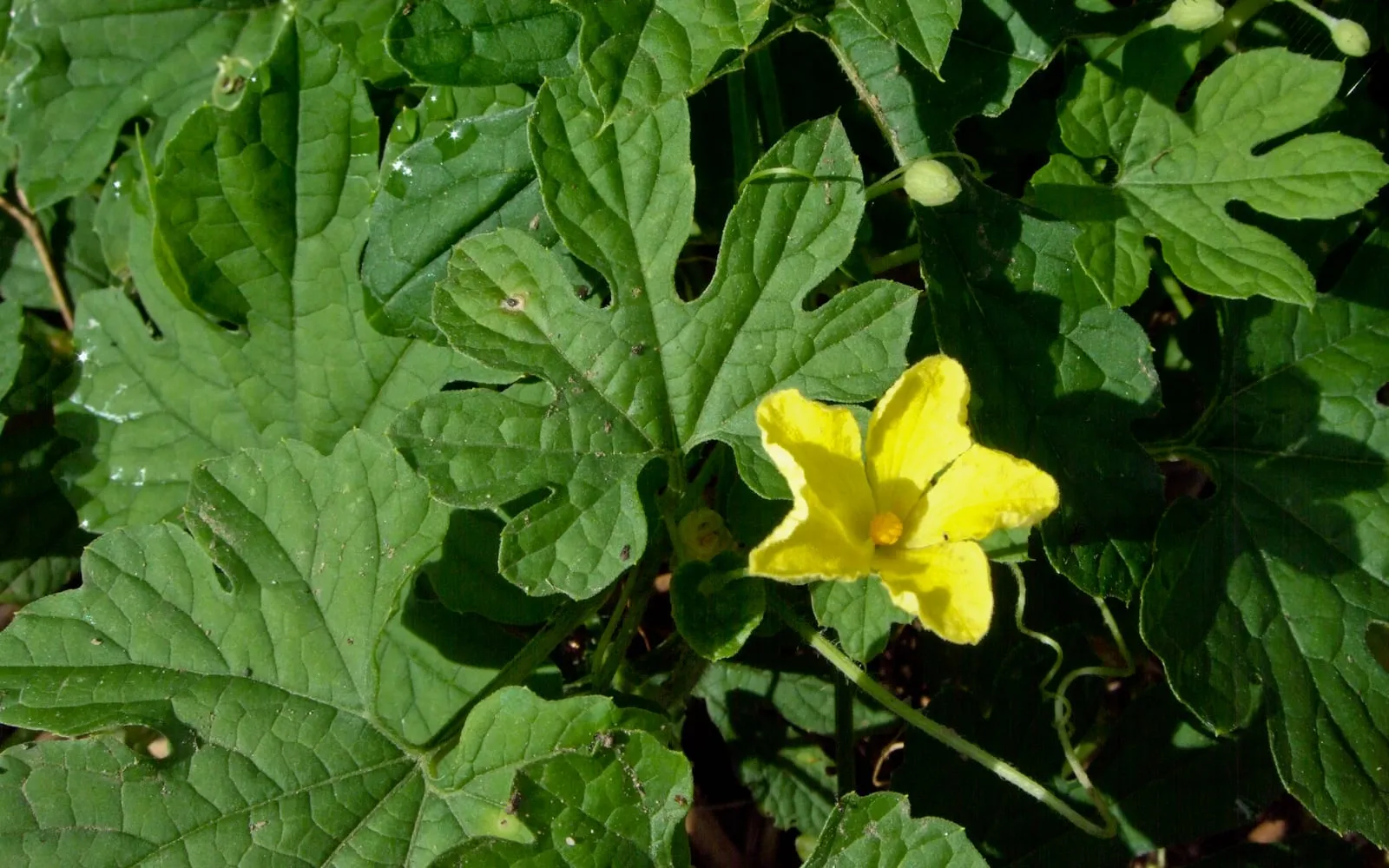
The leaves are the easiest identification. Each one is 4 to 12 cm across and cut almost to the base into five to seven narrow lobes, giving a lacy outline that no other common gourd has. Crushed, they smell sharp and green.
Tendrils are simple and unbranched, coming singly from the leaf axils.
The flowers are yellow, 2 to 3 cm across, with five separate petals, and male and female sit on the same plant. Each rises on a long thin stalk with a small green bract partway up, which is another useful field character.
Fruit starts green and warty. Left on the vine it turns orange, then splits from the base into three curling segments and hangs open, showing scarlet seed coats inside. The display is a bird lure and it is the point at which the fruit stops being food.
The whole plant has a rank green smell when handled, quite unlike cucumber.
Where it is from
Bitter gourd was domesticated in the eastern Himalayan foothills and eastern India, with a second centre in southern China. Wild and weedy forms with small bitter fruit grow across tropical Asia and Africa.
Chinese medical texts describe it from the fourteenth century, and Indian material is older still. The plant travelled with people rather than with trade in bulk, and it now grows wild in the Caribbean, Florida, West Africa and northern Australia, usually as a garden escape.
Cultivation today is concentrated in China, India, Bangladesh, the Philippines and Vietnam. In Okinawa it is goya, eaten in the stir-fry goya champuru, and it is credited locally with a share of the island’s reputation for long life.
How it grows
Sow seed in April or May at 22 to 25 deg C. The seed coat is hard, so soak it for 24 hours and nick the edge with a knife before sowing.
Sow two seeds to a 9 cm pot, 2 cm deep, and thin to the strongest.
Germination takes a week to a fortnight at the right temperature and is patchy below 20 deg C.
Plant out into a greenhouse or polytunnel border in late May or June. Outdoors in a cool summer it will grow in a good year and fruit in a very good one.
Train up strings or netting. The vine is light enough that a single vertical string per plant is enough.
Pinch out the growing point at about 2 m to encourage side shoots, since the female flowers come mostly on those rather than on the main stem.
Hand-pollinate under glass. Pick a male flower, strip the petals and brush the anther into the centre of a female, which is the one with the tiny fruit behind the flower.
Harvest young, at 10 to 15 cm for the Indian type and 15 to 25 cm for the Chinese, while the fruit is firm and dark. Once it pales towards yellow it has gone.
Pick every few days. A fruit left to ripen on the vine tells the plant its work is finished and slows everything else down.
Through the seasons
April and May are for sowing in warmth, after soaking and nicking the seed.
June is planting out under glass and getting the strings up.
July brings rapid growth and the first male flowers, which always open a week or so before the females.
August is the main cropping month, and the point at which mildew usually arrives.
September brings a second flush if the plant has been picked hard and fed.
October ends it. The first cold night finishes the vine.
Winter does not apply. Bitter gourd is grown fresh from seed each year.
Care difficulty
Moderate under glass, and unreliable outdoors where summers are cool.
Germination is the first hurdle and needs both warmth and a nicked seed coat.
The plant itself is fast, light and easy to train.
Hand pollination is needed in a closed greenhouse, and it takes seconds.
Powdery mildew arrives by August and shortens the season more than anything else.
Picking often is the difference between one flush and three.
Watering
Water two or three times a week from planting out.
Increase once fruit is setting, since a check to growth makes the fruit bitter even by the standards of a bitter gourd.
Water at the root in the morning and keep the leaves dry.
Mulch to hold moisture.
Never let the compost dry out completely, and never leave it standing wet.
Ease off in late September as the plant slows.
Warning signs, diseases and pests
White powdery patches spreading over the upper leaves from August are powdery mildew.
Angular yellow patches between the veins with grey fuzz beneath are downy mildew, which follows wet weather outdoors.
Fine pale speckling and webbing is red spider mite in dry greenhouse air.
Sticky leaves with black mould on them mean aphids or whitefly above.
Flowers opening and dropping with no fruit behind them are male flowers doing their job, and are normal.
Small fruit that yellows and drops at 2 cm was not pollinated.
Fruit turning orange on the vine has been left too long and is past eating.
Bitterness sharper than usual across a whole picking usually means the plant went short of water.
Growing environment
A greenhouse, polytunnel or a very warm sheltered wall.
Full sun.
Minimum 15 deg C at night, with 24 to 30 deg C by day for real growth.
Moderate to high humidity, though with enough ventilation to slow mildew.
Rich moisture-retentive soil with compost dug in.
Vertical support of 2 to 3 m.
Good airflow around the plants, which means spacing them at 50 cm rather than crowding.
Feeding
Dig in garden compost or rotted manure before planting.
Feed a balanced liquid feed weekly from planting out.
Switch to a high-potash tomato feed once the first female flowers open.
Keep feeding through the cropping period, since the plant is carrying fruit and making new growth at the same time.
Stop in late September.
Avoid heavy nitrogen, which gives a beautiful lacy vine and very little fruit.
Troubleshooting
How do I make it less bitter? Slice it, salt it for 30 minutes, squeeze out the liquid and rinse. Parboiling for two minutes does much the same. Choose the pale fat Chinese type over the dark spiny Indian one, and pick young.
Should I take the seeds out? Yes, always. Scoop out the spongy core and the seeds and discard them, particularly if the fruit has started to colour.
My fruit has gone orange and split open. It is over-ripe. The red pulp inside is sweet and is eaten in some places, but keep it away from children and compost the rest.
Is it true that it helps with diabetes? It lowers blood glucose, which is well documented, and that is the reason for caution rather than the reason to take it. Anyone on insulin or tablets should speak to their diabetes team before eating it regularly, and nobody should stop a prescribed medicine for it.
Can I grow it outdoors in a cool climate? In a hot summer, against a sheltered sunny wall, you may get a few fruit. Under glass it is far more reliable.
Why are there flowers but no fruit? Either they are all male, which is normal early on, or the females are not being pollinated. Under glass, do it by hand.
The seeds never came up. They need 22 deg C and a nicked coat. Soak overnight, chip the edge away from the pointed end, and keep the pot on a propagator.
Is karela the same as bitter melon? Yes. Karela, ampalaya, goya, bitter gourd and balsam pear are all Momordica charantia.
Can my dog eat the fruit? No. The ASPCA lists it as toxic to dogs and cats, and it causes vomiting and diarrhoea. Pick up any fruit that falls.
Bitter Gourd problem guides
Not sure what is wrong? See the common vegetable pests guide.