
Edible
Greater Yam
Dioscorea alata
Also known as Water yam, Purple yam, Ube, Winged yam, Ratalu
How to grow greater yam, Dioscorea alata. The winged stem that twines one way and only one way, the purple flesh sold as ube, and why nobody eats it raw.
At a glance
- Difficulty
- Moderate
- Water
- Twice a week through active growth, tailing off as the vine yellows
- Light
- Full sun, with light shade tolerated when young
- Temperature
- 25-30 deg C for growth, nothing below 15
- Humidity
- High
- Hardiness
- USDA 10-12, RHS H1b, hardy to 8 C
- Type
- Tender perennial climber grown from a tuber
- Height
- 10-20 m in the tropics, 3-4 m under glass in a short season
- Native to
- South East Asia
- Best month
- April in the Northern Hemisphere, October in the Southern Hemisphere
Tubers bulk only once the days shorten, so the crop follows the season rather than the planting date, and it wants 8 to 10 months of warmth before that. Nothing below 15 deg C. A tuber reaching 20 kg needs deep loose soil and a 3 m support, which is why the crop is staked in every region that grows it.
Hardiness zones describe winter cold alone. Summer heat, humidity, rainfall and the length of the growing season decide as much, so treat the range as the outer limit rather than as a recommendation.
Every month named in this guide is for the temperate Northern Hemisphere. If you garden in the Southern Hemisphere, shift each one by six months, so April becomes October. Closer to the equator the wet and dry seasons matter more than the calendar, and the shift stops being a useful guide.
Skin irritant
- Safe to eat
- The cooked tuber and the cooked aerial bulbils
- Do not eat
- Raw tuber, which is indigestible and irritant, and the sap, which itches
- Harm from
- Eating it and handling it
- Affects
- People
Cultivated greater yam is a staple food across the tropics and is safe once cooked. Raw it is another matter. The flesh contains calcium oxalate needles and saponins that irritate the mouth and throat and can cause itching on the hands of anyone peeling a large quantity, which is why growers peel under water or wear gloves. Cooking destroys the problem, and yam is never eaten raw anywhere it is grown. Some wild Dioscorea species contain the alkaloid dioscorine and are poisonous, requiring days of soaking and leaching before they can be eaten, so a yam of unknown species is not a yam to try. Neither the RHS nor the ASPCA lists Dioscorea alata, and cooked yam in small amounts does no harm to cats or dogs.
Sources: RHS potentially harmful garden plants, ASPCA toxic and non-toxic plants
About
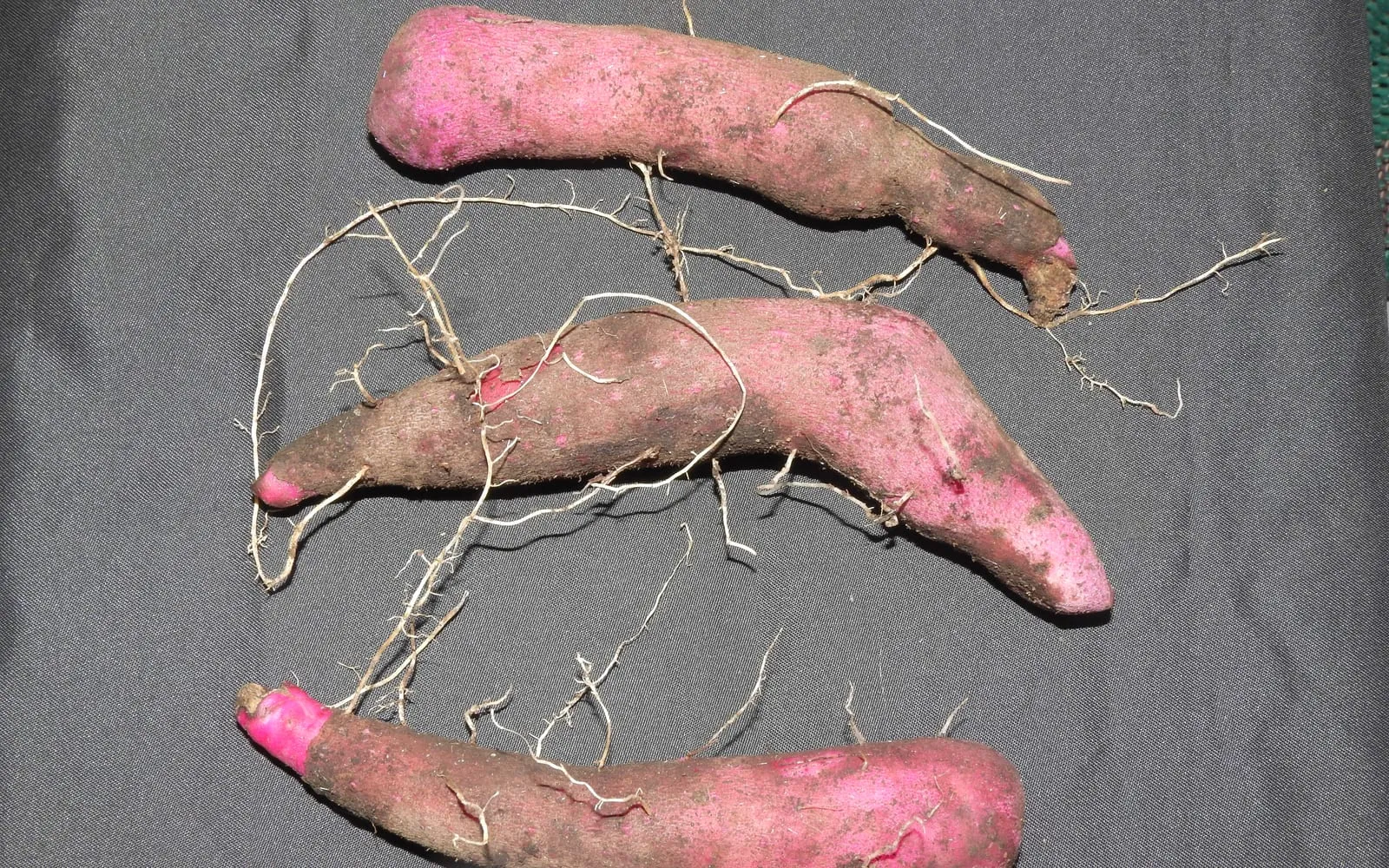
Greater yam is the yam most likely to turn up in a temperate shop, a heavy brown-skinned tuber with rough bark-like skin, sold in South Asian, African and Caribbean grocers. The flesh may be white, cream or a startling violet purple.
Purple ones are ube, and Filipino cooking has made them famous. Ube halaya, ube ice cream and the purple cakes that follow from them all come from this species rather than from the Okinawan sweet potato they are often confused with.
Yam and sweet potato are not related. Sweet potato is a bindweed relative with an orange root; yam is a monocot climber in its own family, with a starchy tuber that can weigh 50 kg. American shops calling a sweet potato a yam have muddled the two for a century.
The plant is a twining vine, and the direction of the twine tells you which species you have. Greater yam twines to the right, clockwise seen from above. White yam and most other cultivated yams twine to the left.
Appearance and character
A vigorous twining perennial climber, 10 to 20 m in the tropics and 3 or 4 m in one greenhouse season.
The stem is the identification. It is square in cross-section with four papery wings running along the angles, often flushed purple, and no other cultivated yam has it.
Leaves are broadly heart-shaped, 10 to 25 cm long, opposite on the stem rather than alternate, glossy, with prominent veins running from base to tip in the way monocot leaves do.
Aerial bulbils form in the leaf axils on many cultivars, small brown knobbly tubers hanging on the vine. They are edible after cooking and are the easiest way to propagate the plant.
Flowers are small, greenish and rarely produced in cultivation, and most cultivars are propagated only from tubers.
The tuber varies more than any other part. Cylindrical, lobed, palmate or irregular, from 2 kg to 50 kg, with rough brown skin and flesh in white, cream, yellow or deep purple.
Cut flesh is slippery and mucilaginous, which is where the name water yam comes from.
Where it is from
Dioscorea alata was domesticated in South East Asia, most likely in the region between Assam, Myanmar and Indonesia, and no wild population of the cultivated form survives.
Austronesian voyagers carried it across the Pacific along with taro, breadfruit and banana, and it reached Melanesia, Polynesia and Madagascar in their canoes. The Pacific yam festivals of Vanuatu and Papua New Guinea are built around it.
It travelled west into India and Africa in early trade, and Portuguese and Spanish ships took it to the Caribbean and Brazil in the sixteenth century.
Today it is grown across the humid tropics, with West Africa, the Caribbean, India and the Pacific all producing large quantities. Nigeria is the largest yam producer in the world, though most of that crop is white yam rather than this species.
How it grows
Start from a tuber, since seed is rarely available and rarely comes true. Use a whole small tuber, a cut piece with at least one bud, or an aerial bulbil.
Cut pieces should be dusted with wood ash or left to dry for a day so the wound seals before planting.
Plant in March or April in a large deep container or a greenhouse border, 10 cm deep, at 25 deg C.
Give it depth. The tuber grows downwards, and a shallow pot gives a small distorted crop. A 50 litre container or a bed with 60 cm of loose soil is the minimum.
Provide a tall support and let the vine twine. It will not cling like a cucurbit and needs something narrow to wrap around.
Keep it warm and humid. Growth stops below 20 deg C and the plant will sit and do nothing.
Water steadily through summer and feed monthly.
Stop watering when the vine yellows and dies back in autumn, which is the plant telling you the tuber is finished.
Harvest by digging carefully, since a broken tuber will not store. Cure for a week somewhere warm and airy, then keep it in the dark at 15 deg C.
Save a piece with a bud for next year.
Through the seasons
March and April are for planting a tuber piece in a deep container under heat.
May brings the first shoot, which can take four to eight weeks to appear and tests the patience.
June and July are rapid vine growth, and the point to get the support in.
August is when the tuber begins to bulk, well after the vine looks finished growing.
September is peak tuber growth, and the month to keep watering and warmth going.
October brings yellowing leaves, which is the signal to stop watering.
November is harvest, after the vine has died back completely.
Winter is storage in the dark at around 15 deg C, with a piece kept back for planting.
Care difficulty
Moderate under glass, and impossible outdoors in a cool climate.
Heat is the whole requirement, with 25 to 30 deg C wanted through a season that runs from March to November.
Sprouting is slow and unnerving, often taking six weeks with nothing visible.
The plant needs depth for the tuber and height for the vine at the same time.
Nothing about it is fussy once it is growing.
The realistic outcome in a cool climate is a modest tuber of a kilogram or two, which is still a good result.
Watering
Water twice a week once the shoot is up and growing.
Increase through August and September while the tuber is bulking.
Keep humidity high, which suits a closed greenhouse.
Water at the root and avoid wetting the crown.
Reduce and then stop as the leaves yellow in October, since a wet tuber at lifting will rot in store.
Never let a dormant tuber sit in damp compost over winter.
Warning signs, diseases and pests
Dark sunken spots on the leaves spreading to the stems are anthracnose, the main disease of yam worldwide.
A shoot that never appears after eight weeks usually means the piece rotted, and cold wet compost is the reason.
Yellowing leaves in August rather than October mean the plant has been too cold or too dry.
Fine speckling with webbing is red spider mite in dry glasshouse air.
A tuber that is small and forked has hit a stone or the bottom of the pot.
Soft brown patches on a stored tuber started as a bruise at lifting.
Aerial bulbils forming heavily can mean the plant is stressed, though many cultivars produce them freely regardless.
Growing environment
A heated greenhouse, conservatory or a very warm polytunnel.
Full sun, with light shade tolerated early on.
Minimum 15 deg C, with 25 to 30 deg C for real growth.
High humidity.
Deep loose stone-free soil or compost, at least 60 cm.
A tall narrow support for the vine to twine around.
A dark frost-free store at about 15 deg C for the harvested tuber.
Feeding
Work compost or rotted manure deeply into the bed before planting.
Feed a balanced liquid feed monthly once the vine is growing.
Switch to a high-potash feed from August, when the tuber starts to bulk.
Avoid heavy nitrogen, which gives 5 m of vine and a disappointing tuber.
Mulch to hold moisture and keep the root zone warm.
Stop feeding once the leaves begin to yellow.
Troubleshooting
Is a yam the same as a sweet potato? No. Sweet potato is Ipomoea batatas, a bindweed relative, while yam is Dioscorea, a monocot climber in its own family. The American habit of calling orange sweet potatoes yams is a marketing muddle a century old.
What is ube? The purple-fleshed cultivars of this species, made famous by Filipino desserts. The colour is natural and cooks to a deep violet.
Can I eat it raw? No. Raw yam contains oxalate needles and saponins that irritate the mouth and gut. It is always cooked.
My hands itched after peeling one. The sap. Peel under running water or wear gloves, and the itch passes.
Nothing came up for six weeks. That is normal. Yam tubers sprout slowly and need 25 deg C. If nothing appears after eight weeks, dig the piece up and check whether it has rotted in cold compost.
How do I tell greater yam from white yam? The stem. Greater yam has a square winged stem and twines clockwise. White yam has a round stem, often spiny at the base, and twines anticlockwise.
What are the little brown knobs on the vine? Aerial bulbils. They are edible cooked and they are the easiest planting material you will get.
Can I grow it outdoors in a cool climate? No. It needs months at 25 deg C and will sit motionless in a cool summer.
How do I store the tuber? Cure it for a week somewhere warm and airy after lifting, then keep it dry and dark at around 15 deg C. Do not refrigerate it, which causes chilling injury.
Greater Yam problem guides
Not sure what is wrong? See the common vegetable pests guide.