
Edible
Black walnut
Juglans nigra
Also known as American walnut, Eastern black walnut
How to grow black walnut, Juglans nigra. Superb timber, a rich strong-flavoured nut, and a root system that poisons the ground around it.
At a glance
- Difficulty
- Moderate
- Water
- First three summers, then none
- Light
- Full sun
- Temperature
- Fully hardy to -30 deg C
- Hardiness
- USDA 4-9, RHS H6, hardy to -35 C
- Type
- Deciduous tree, living two centuries or more
- Height
- 20-30 m
- Native to
- Eastern North America
- Best month
- October and November in the Northern Hemisphere, April and May in the Southern Hemisphere
Hardier than the English walnut and much slower, with a taproot that makes it hard to move once planted. It produces more juglone than any other tree in cultivation, and a mature specimen sterilises a circle of ground for vegetables and fruit well beyond the reach of its branches.
Hardiness zones describe winter cold alone. Summer heat, humidity, rainfall and the length of the growing season decide as much, so treat the range as the outer limit rather than as a recommendation.
Every month named in this guide is for the temperate Northern Hemisphere. If you garden in the Southern Hemisphere, shift each one by six months, so October becomes April. Closer to the equator the wet and dry seasons matter more than the calendar, and the shift stops being a useful guide.
Toxic if eaten
- Safe to eat
- The kernels
- Do not eat
- Husks, roots, bark and fallen mouldy nuts
- Harm from
- Eating it and handling it
- Affects
- People, horses and dogs
The kernels are food. Everything else about this tree needs respect. Juglone, concentrated in the roots, husks and bark, is toxic to many other plants and gives the tree its reputation, and the effect on people is limited to skin irritation and a persistent brown stain from handling green husks, so wear gloves. Horses are the animals most at risk. Shavings containing black walnut used as bedding cause laminitis within hours of contact, and this is a well-documented veterinary emergency, so never use walnut sawdust or shavings near horses. Dogs are at risk from mouldy fallen nuts rather than from the tree, since moulds growing on them produce tremorgenic toxins that cause tremors and seizures. Clear windfalls promptly. Tree nut allergy applies here as to any nut.
Sources: RHS potentially harmful garden plants, ASPCA toxic and non-toxic plants
About
Black walnut poisons the ground it grows in. Juglone, produced in the roots and leached from the husks and leaves, kills or stunts a long list of plants, and tomatoes, potatoes, apples, rhododendrons, azaleas and pines are among the most sensitive. The affected zone extends well beyond the canopy, following the roots.
Site the tree with that in mind, or decide against planting one. A black walnut in the middle of a productive garden will slowly kill a good deal of what surrounds it.
Given space it is a magnificent tree. Tall, straight, with a high domed crown and handsome pinnate leaves that come very late and fall very early.
The nuts are richer and stronger in flavour than an English walnut and much harder to extract, sitting in a thick shell inside a green husk that stains everything it touches.
Appearance and character
A tall deciduous tree with a straight trunk and a high domed crown, casting light dappled shade despite its size.
Bark is dark grey-brown, deeply furrowed into a diamond pattern on a mature trunk, which is one of the easier ways to identify it.
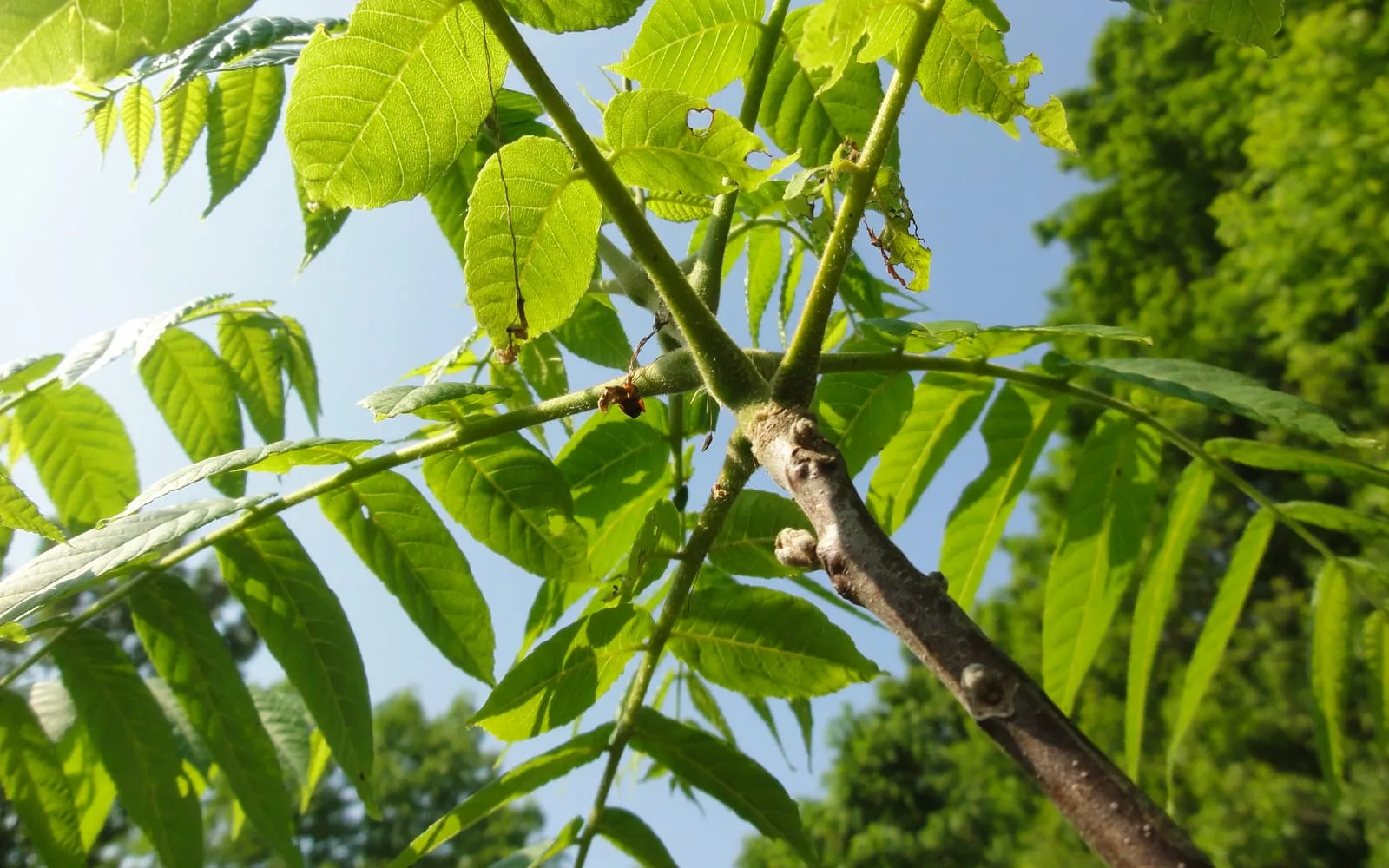
Leaves are pinnate, 30 to 60 cm long, with fifteen to twenty-three narrow pointed leaflets, aromatic when crushed. They emerge very late, often not until late May, and fall early, sometimes in September.
Flowers appear in May, with drooping green male catkins and inconspicuous female flowers in small clusters at the shoot tips.
Fruit is a round green husk 4 to 6 cm across, containing a deeply corrugated hard shell around the kernel. The husk does not split and must be removed by hand.
Where it is from
Juglans nigra is native to the eastern and central United States, from New England to Georgia and west to the Great Plains.
It grows in rich bottomland forest and on deep fertile slopes, favouring moist well-drained soil.
The timber is among the most valuable hardwoods in North America, dark chocolate-brown, stable and strong, used for gunstocks, furniture and veneer. Mature trees are occasionally stolen for it.
It reached Europe in the seventeenth century and grows well there as a specimen tree, though it fruits less reliably than in its native climate.
Juglone was identified in the nineteenth century, and the effect had been noted by Pliny long before that, who recorded that the shade of a walnut was harmful to other plants.
How it grows
Choose the position with the juglone in mind. Well away from a vegetable garden, a fruit plot or any bed containing rhododendrons, azaleas or apples.
Plant a young tree, since black walnut makes a long taproot and transplants badly once established. A one or two-year-old whip establishes better than a larger tree.
Plant bare-root in winter into deep fertile moist well-drained soil at pH 6 to 7.
Stake for three years and guard against rabbits and deer.
Water through the first three summers, since the taproot takes time to reach moisture.
Prune only in late summer if at all. Walnuts bleed heavily from winter and spring cuts.
Through the seasons
The tree leafs out very late, often not until the end of May, which is normal and protects it from spring frost.
Flowering follows quickly, wind-pollinated and inconspicuous.
Through summer the crown casts a light shade and the nuts develop inside their green husks.
Leaves fall early, sometimes from September, so the tree is bare for a long stretch of the year.
Nuts drop in October and November. Collect them promptly, both to beat the squirrels and to prevent mould forming where dogs might find them.
Remove the husks while still green, wearing gloves, then dry the nuts in a single layer for several weeks before cracking.
Care difficulty
Moderate, and the difficulty is siting and processing rather than growing.
The tree itself is hardy, vigorous and largely trouble-free once established.
Juglone makes the planting decision consequential in a way few trees do, and it cannot be undone later without felling.
Transplanting is awkward because of the taproot, so a small tree planted young is much more likely to succeed.
Getting at the kernels is hard work. Husking stains hands and clothes permanently, and the shells need a vice or a hammer rather than a nutcracker.
Watering
Water weekly through the first three summers, 25 litres at a time.
The taproot takes several years to reach reliable moisture, which is why the establishment period is longer than for most trees.
An established tree needs no watering in a temperate climate.
Mulch generously in spring during the early years, kept clear of the trunk.
The tree prefers moist ground and grows fastest on deep fertile soil that does not dry out.
Warning signs, diseases and pests
Nearby plants yellowing, wilting and dying within the root zone. Juglone toxicity. Move the affected plants, since the tree cannot be made harmless.
Nuts gone within days of falling. Squirrels. Collect daily through October.
Dark blotches on leaflets followed by early leaf fall. Walnut leaf blotch, common in wet summers and rarely serious. Rake up fallen leaves.
New shoots blackened in late spring. Frost, despite the late leafing. Little can be done on a large tree.
Coral-pink pustules on dead twigs. Coral spot, entering dead or damaged wood. Cut back to healthy growth.
Branches dying back with white sheets under the bark. Honey fungus, which is fatal.
Trunk mobbed by grey, red-flashing insects, with sooty mould on the bark below. Spotted lanternfly, one of this tree’s preferred hosts and spreading fast across the eastern and midwestern US. Not established outside North America and its native Asia. Destroy any mud-coloured egg mass found.
Growing environment
Full sun. This is a canopy tree and it needs the light.
Deep, fertile, moist and well-drained soil at pH 6 to 7. It grows poorly on thin chalk or dry sand.
Space is essential in two senses: the crown reaches 20 m or more, and the juglone zone extends beyond it.
Cold is no obstacle, with hardiness to -30 deg C, and the late leafing avoids spring frost damage in most years.
Suitable for a paddock, a large garden boundary or a woodland planting, and unsuited to anywhere near a vegetable plot or an orchard.
Feeding
No fertiliser is needed in open ground.
Mulch with compost through the first three or four years to support establishment.
Avoid nitrogen, which produces soft growth without improving the crop.
Leaf litter beneath the tree returns nutrients, though the leaves themselves carry juglone and should not be composted for use around sensitive plants.
Keep walnut leaves and husks out of general garden compost for the same reason.
Troubleshooting
Vegetables failing near the tree. Juglone. Move the vegetables, or grow them in raised beds well outside the root zone with a barrier beneath.
Tree dying after transplanting. Taproot damage. Plant young whips rather than large trees.
No nuts after ten years. Seedlings take ten to fifteen years to fruit, and grafted trees rather less.
Hands stained brown for weeks. Husk juice. Wear gloves, since the stain is persistent and does not wash off.
Nuts mouldy on the ground. Clear them promptly, particularly where a dog has access, since mouldy walnuts cause seizures in dogs.
Tree bleeding sap from pruning cuts. Pruned at the wrong time. Cut in late summer rather than winter or spring.