
Edible
Cloudberry
Rubus chamaemorus
Also known as Bakeapple, Knotberry, Averin, Nordic berry, Molte
How to grow cloudberry, Rubus chamaemorus. An arctic bog plant with amber fruit, separate male and female plants, and a real reluctance to crop outside the far north.
At a glance
- Difficulty
- Difficult
- Water
- Constantly moist, so most days in summer
- Light
- Full sun
- Temperature
- Fully hardy to -40 deg C, and it needs a cold winter
- Hardiness
- USDA 2-5, RHS H7, hardy to -45 C
- Type
- Herbaceous perennial spreading by rhizome
- Height
- 10-25 cm
- Native to
- Britain, Scandinavia, Northern Russia, Northern North America
- Best month
- July and August in the Northern Hemisphere, January and February in the Southern Hemisphere
A long hard winter is a requirement rather than a hazard, and the plant fails in mild ones. Plants are male or female, so a crop needs both, and even in the Nordic countries the yield swings wildly with frost at flowering. Nobody has made a commercial planting work, so the crop is still gathered from wild bog.
Hardiness zones describe winter cold alone. Summer heat, humidity, rainfall and the length of the growing season decide as much, so treat the range as the outer limit rather than as a recommendation.
Every month named in this guide is for the temperate Northern Hemisphere. If you garden in the Southern Hemisphere, shift each one by six months, so July becomes January. Closer to the equator the wet and dry seasons matter more than the calendar, and the shift stops being a useful guide.
Not known to be toxic
- Safe to eat
- The ripe fruit
The fruit is food and the plant carries no toxicity concern. Neither the RHS nor the ASPCA lists Rubus as harmful, and the ASPCA does not record the genus as toxic to cats or dogs. Leaves have a long history as a herbal tea and present no hazard. The practical risks are physical rather than chemical. Prickles and bristles scratch, and a scratch from a cane that has been lying in soil is worth washing properly. Fruit picked at knee height beside a path or a field edge may carry contamination from animals, which is a foraging caution rather than a garden one.
Sources: RHS potentially harmful garden plants, ASPCA toxic and non-toxic plants
About
Cloudberry is the most prized wild fruit in Scandinavia and one of the hardest things on this list to grow. In Norway and Finland the picking grounds are guarded knowledge, and the fruit sells for more per kilo than any other berry in Europe.
The taste is worth the reputation. Ripe cloudberry is soft, amber-orange and tastes of baked apple and honey with a resinous edge that has no real parallel.
Two things make it difficult. The plant is dioecious, so male and female plants are separate and only the females fruit. And it needs a hard continental winter followed by a cool summer, which most temperate gardens do not provide.
It is native to Britain, on blanket bog in the Pennines and the Scottish Highlands, where it flowers freely and fruits sparsely. That behaviour follows it into gardens.
Appearance and character
A low herbaceous perennial with no canes at all, which sets it apart from every other Rubus. Shoots rise singly from a creeping underground rhizome.
Each shoot carries two or three leaves and, on a flowering shoot, a single flower.
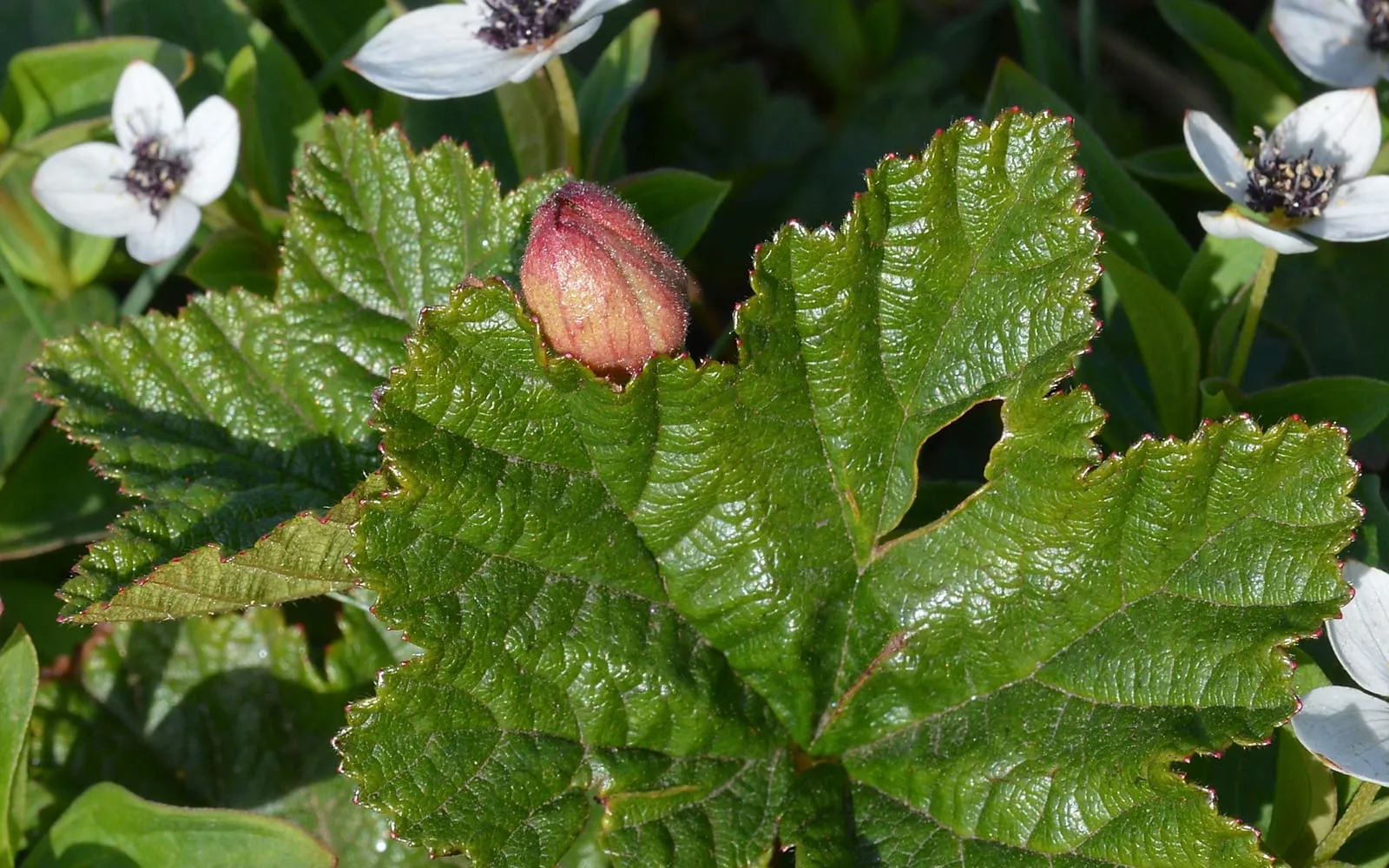
Leaves are rounded with five to seven shallow lobes and crinkled toothed edges, 3 to 8 cm across, mid-green and slightly wrinkled.
Flowers open in June, white with five petals, 2 to 3 cm across, held singly on an upright stalk above the leaves. Male flowers are larger than female ones.
Fruit ripens from red to a translucent amber-orange, 1.5 to 2 cm, softening markedly as it ripens. Unlike other Rubus, it grows paler as it ripens rather than darker.
Where it is from
Rubus chamaemorus circles the northern hemisphere on peat bog and tundra, from Britain and Scandinavia across northern Russia to Alaska, Canada and Greenland.
In Britain it grows on blanket bog above about 300 m, in the Pennines, the Cheviots and across the Scottish Highlands, and it is common in the right habitat.
British plants flower well and fruit poorly, which is thought to reflect a shortage of male plants in many colonies together with a climate at the edge of what the species needs.
Norway, Sweden and Finland harvest large quantities from the wild each year, and Finland grants public right of access to pick it.
Newfoundland and Labrador call it bakeapple and treat it the same way, and the annual picking is a fixture of the calendar there.
How it grows
Buy plants from a specialist bog or native-plant nursery, and buy both sexes. Finnish breeding produced named clones such as ‘Nyby’ and ‘Apolto’ for females and ‘Apollen’ as a pollinator, though availability outside the Nordic countries is patchy.
Never dig it from the wild. Colonies are slow to recover and in many places protected.
Build the habitat first. A lined bog bed or a large container without drainage, filled with acid peat substitute and sphagnum, kept permanently saturated with rainwater.
Plant in full sun. Despite the cold climate it grows in the open rather than in shade.
Space at 30 cm and let the rhizomes spread. Expect the colony to take several years to establish before it flowers.
Grow it in the coldest part of the garden. A mild sheltered spot works against it.
Through the seasons
Shoots emerge in late April and May from the rhizome mat.
Flowering is in June, one flower per shoot, and this is the point at which a late frost can cost the entire crop.
Fruit sets on female plants only, swelling through late June and July.
Ripening runs through late July and August. The fruit goes from hard and red to soft, translucent and amber, and is ready at the point where it looks almost overripe.
Pick gently, since the ripe fruit collapses easily.
The plant dies back to the rhizome in autumn and disappears entirely over winter, which is normal rather than a sign of failure.
Care difficulty
Difficult, and honestly so. Few fruiting plants are harder to crop in a temperate garden.
It needs acid saturated peat, rainwater, full sun, a cold winter and a cool summer. Southern England fails on the last two.
Separate male and female plants mean a single specimen will never fruit, and sexing before flowering is impossible.
Even given everything it wants, the plant often flowers for several years before setting fruit.
Gardeners in cold upland and far northern regions have the best chance. Anyone in a mild lowland climate should treat it as a curiosity rather than a crop.
Watering
Keep the peat saturated at all times, using rainwater only.
Tap water raises the pH and the plant declines within a season or two.
Stand a container permanently in a reservoir of rainwater, topped up so the medium never dries at the surface.
A hot dry week in July will kill an unwatched container plant, and the fine rhizomes have little reserve.
Overhead misting with rainwater in warm weather suits it, since it grows naturally in humid bog air.
Warning signs, diseases and pests
Leaves scorching and shoots collapsing in a hot spell. Heat and drought together, which is the commonest cause of failure in a mild lowland garden.
Growth stalling with pale yellow leaves. Lime from tap water. Flush with rainwater and change the water source permanently.
Flowers browning in June. Frost on open blossom, which costs that year’s fruit entirely.
Grey mould on ripening berries. Wet still weather. Improve airflow, though this is hard in a low bog planting.
Plenty of flowers, never any fruit. All plants are male, or no male is present. Both are common outcomes when buying unsexed stock.
Colony thinning over several years. Usually the medium drying out periodically or drifting upwards in pH.
Growing environment
Full sun, in the open, as on a bog surface.
Acid peat at pH 3.5 to 5, permanently saturated and very low in nutrients.
A cold winter is a requirement rather than a tolerance. The plant needs deep dormancy and does badly where winters are mild.
Cool summers suit it. Heat above the mid-twenties checks growth and scorches foliage.
Northern and upland gardens have a genuine chance. In the south, a large sphagnum container in a cool north-facing but open position is the best available compromise, and fruit remains unlikely.
Feeding
Do not feed it. The plant grows on some of the poorest ground in the northern hemisphere and fertiliser will scorch it.
Sphagnum moss and rainwater supply everything it needs.
Never use lime, wood ash, mushroom compost or general fertiliser anywhere near it.
If growth is poor, the cause is water, pH or temperature rather than nutrition.
A top-dressing of fresh sphagnum every few years is the only input worth making.
Troubleshooting
Flowers every year, no fruit ever. No male plant, or all plants female with no pollinator. Buy sexed stock from a specialist.
Plant vanishing in autumn. Normal. It is herbaceous and dies back to the rhizome.
Foliage scorching in July. Too warm and too dry. Move to a cooler position and increase the reservoir.
Slow spread after three years. Normal. Cloudberry establishes slowly and may take five years before flowering freely.
Yellow leaves and stalled growth. Tap water. Switch to rainwater and repot into fresh acid medium.
No success at all in a mild lowland garden. The climate rather than the gardener. This species is at the edge of what it tolerates.
Cloudberry problem guides
Not sure what is wrong? See the common vegetable pests guide.