
Edible
Chinese wolfberry
Lycium chinense
Also known as Chinese boxthorn, Gou qi, Gau gei choi, Chinese matrimony vine
How to grow Chinese wolfberry, Lycium chinense. The leafier of the two goji species, grown across southern China as a vegetable as much as for its fruit.
At a glance
- Difficulty
- Easy
- Water
- First summer weekly, then in drought only
- Light
- Full sun to light shade
- Temperature
- Fully hardy to -20 deg C
- Hardiness
- USDA 6-9, RHS H5, hardy to -20 C
- Type
- Deciduous shrub, long-lived, suckering
- Height
- 1-2 m tall, spreading to 3 m
- Native to
- China, Korea, Japan
- Best month
- August, September and October in the Northern Hemisphere, February, March and April in the Southern Hemisphere
Slightly less hardy than its relative and rather more tolerant of humidity, cropping in warm damp summers where the other sulks. It suckers freely on light soil. The same boxthorn weed restrictions apply in Australia and New Zealand.
Hardiness zones describe winter cold alone. Summer heat, humidity, rainfall and the length of the growing season decide as much, so treat the range as the outer limit rather than as a recommendation.
Every month named in this guide is for the temperate Northern Hemisphere. If you garden in the Southern Hemisphere, shift each one by six months, so August becomes February. Closer to the equator the wet and dry seasons matter more than the calendar, and the shift stops being a useful guide.
Edible, with limits
- Safe to eat
- The ripe fruit, and the young leaves and shoots cooked
- Harm from
- Eating it
- Affects
- People
The ripe fruit is food, sold dried in every health-food shop, and the young leaves are cooked as a vegetable across southern China. The caution is a drug interaction rather than a poisoning. Case reports link goji fruit and juice to a raised INR in people taking warfarin, so anyone on that medication should ask a pharmacist before eating it regularly. Lycium belongs to the nightshade family alongside tomato and potato, and as in those crops the fruit is the part that is eaten while the root bark and the unripe fruit are not. Neither the RHS nor the ASPCA lists the genus among plants harmful to people or pets, and no poisoning of cats or dogs is recorded from the berries.
Sources: RHS potentially harmful garden plants, ASPCA toxic and non-toxic plants
About
Two species are sold as goji, and this is the other one. Lycium chinense is lower and broader than L. barbarum, with wider leaves and fruit that is a little smaller and a little less sweet.
Across southern China it is grown as a leaf vegetable more than as a fruit crop. The young shoots are sold in bundles as gau gei choi and cooked in soup with pork and egg, and the flavour is faintly bitter in the way that suits a broth.
Growing it for leaves changes the job. Instead of training long stems and waiting for berries, you cut the soft tips repeatedly through the season and the plant responds by branching.
It is as hardy and as tolerant as its better-known relative, and the same warnings apply about sprawl and suckering.
Appearance and character
A spreading deciduous shrub with arching stems, typically wider than it is tall, and lower-growing than Lycium barbarum.
Stems are slender and grey-green, and older wood often carries short spines.
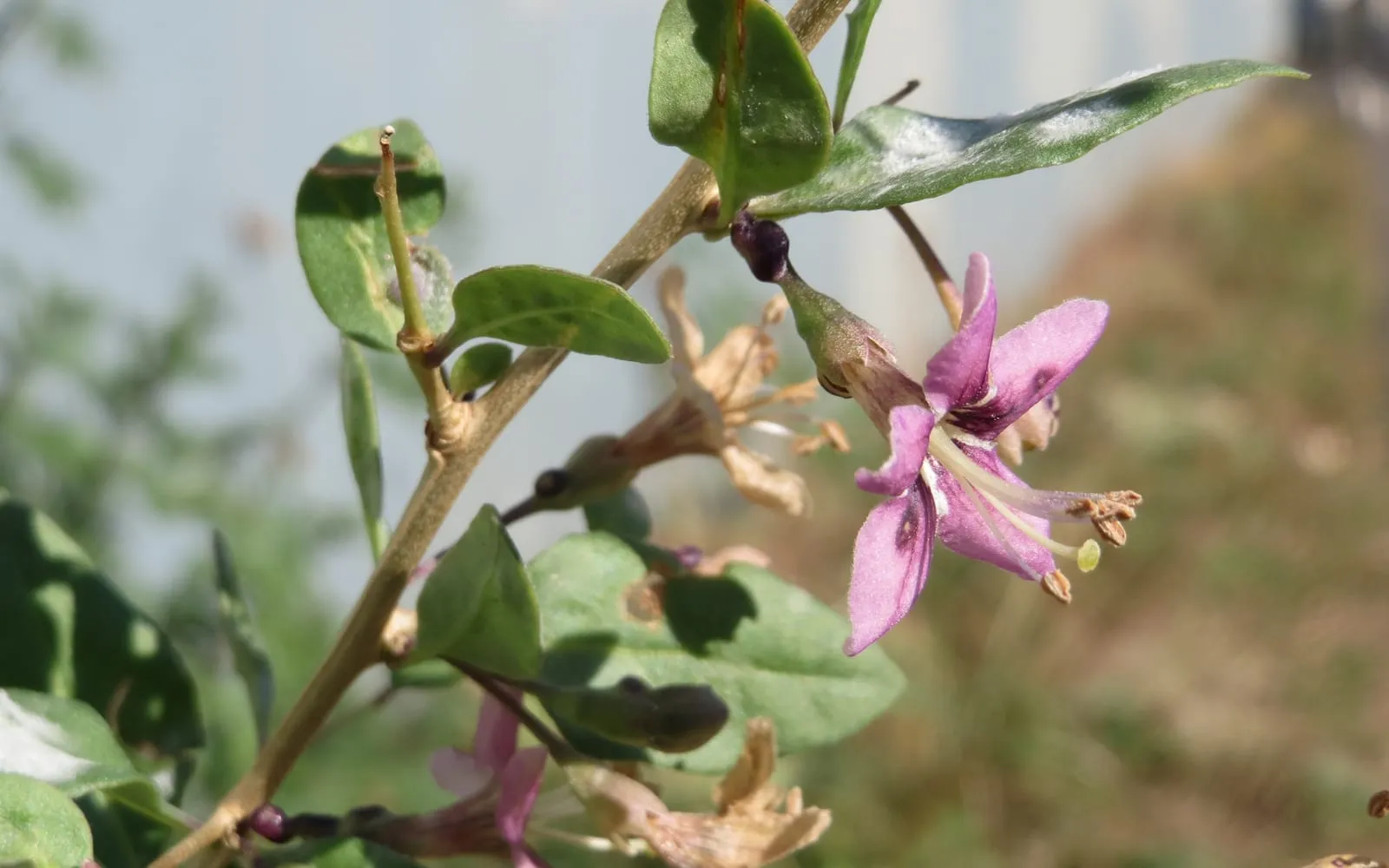
Leaves are broader and more diamond-shaped than in L. barbarum, 3 to 7 cm, soft mid-green rather than grey-green, which is the easiest way to tell the two species apart.
Flowers are purple and star-shaped, 1 to 1.5 cm, opening from June into September, with the five-lobed corolla and protruding stamens typical of the nightshade family.
Fruit is an oval orange-red berry 1 to 2 cm long, ripening from August. It is slightly smaller than the L. barbarum berry and rather less sweet.
Where it is from
Lycium chinense is native to China, Korea and Japan, growing on riverbanks, waste ground and scrub across a wide climatic range.
It is the southern species of the two, favouring the warmer and wetter parts of China, where L. barbarum belongs to the drier north.
The leaf crop is grown in gardens and market plots across Guangdong and Hong Kong, where bundles of soft shoots are sold through spring and summer.
Chinese medicine uses the root bark, sold as di gu pi, which is a separate item from the fruit and is not something to experiment with at home.
The plant reached Europe in the eighteenth century and, like its relative, naturalised on coastal banks and hedges in southern England.
How it grows
Buy a container-grown plant. Nurseries sometimes label the two Lycium species interchangeably, so check the leaf shape if you want this one.
Plant in autumn or spring in sun or light shade, in well-drained soil. It accepts poorer and more alkaline ground than most soft fruit.
Cut back to 45 cm after planting to force low branching, which matters more here than for L. barbarum because the useful growth is the soft tips.
For leaves, pinch the shoot tips regularly from May onwards, taking the top 10 to 15 cm, and the plant responds with more.
For fruit, train stems to wires and shorten side shoots in winter, exactly as for the other species.
Doing both from the same plant works, since picking early tips still leaves plenty of later growth to flower.
Through the seasons
Growth starts in April, later than most shrubs, and the first soft tips are ready to pick in May.
Leaf picking runs from May to August. Take the tips regularly and the plant stays compact and productive.
Flowering starts in June and continues into September, overlapping with fruiting from August.
Berries ripen from August into October. Pick as they colour fully, going over the plant every few days.
Autumn brings little colour, and the plant drops its leaves unremarkably.
Winter is the pruning season. Shorten side shoots, remove old congested stems at the base, and dig out unwanted suckers.
Care difficulty
Easy. Hardy, drought-tolerant, tolerant of poor soil and largely free of pests.
Grown for leaves it is easier still, since a crop of shoots needs no pollination, no training and no waiting for the plant to mature.
The sprawl and the suckering are the two habits to manage, and this species suckers more freely than L. barbarum.
Mildew and aphids turn up on soft growth and neither is serious.
It is a good plant for a difficult dry corner where you want something productive without much attention.
Watering
Water weekly through the first summer.
An established plant needs water only in drought, though a plant cropped for leaves benefits from more than one grown for fruit, since soft growth needs moisture.
Water during dry spells in July and August if you are picking shoots regularly.
Avoid waterlogging, which rots the roots. Free drainage matters more than fertility for this plant.
A container plant needs watering all season, in a pot of at least 40 cm with grit worked into the compost.
Warning signs, diseases and pests
White powdery coating on leaves. Powdery mildew, encouraged by still air. Thin the stems and mulch to keep the roots moist.
Clusters of aphids on soft shoot tips. More of a nuisance here than on the other species, since the tips are the crop. Rinse them off with water before picking.
Speckled bronzed leaves with fine webbing. Spider mite in hot dry conditions. Improve airflow and moisture.
Plant yellowing and collapsing on heavy soil. Root rot from waterlogging. Improve drainage or move it.
Holes in low soft shoots. Slugs and snails, which find the new growth as appealing as you do. Pick them off in the evening.
New shoots coming up across the bed. Suckering. Slice through them with a spade in spring, and expect to repeat annually.
Growing environment
Full sun gives the best fruit. Light shade is acceptable and suits a plant grown mainly for leaves, where softer growth is an advantage.
Free-draining soil is the main requirement. Sand, chalk and stony ground all work.
pH from 6 to 8 suits it, and it grows on alkaline soil where most soft fruit struggles.
Shelter from strong wind helps, since the long stems whip and break.
Allow 2 to 3 m of width, or grow it in a large container to contain the suckers.
Feeding
A balanced general fertiliser in spring is enough for a plant grown for fruit.
A plant cropped for leaves needs more, since you are removing growth repeatedly. Feed again in midsummer with a balanced liquid feed.
Avoid pushing nitrogen hard even so, since it produces soft growth that mildews and attracts aphids.
Mulch with compost in spring, kept away from the stems.
A container plant needs a balanced liquid feed fortnightly from May to August.
Troubleshooting
Leaves bitter. Normal for this species and part of the flavour in Chinese cooking. Picking younger tips reduces it.
Very few berries. Plants grown hard for leaves flower less, which is the trade-off. Leave some stems unpicked from June if you want fruit.
Sprawling growth flopping over neighbours. Put in support, or cut the plant back harder each winter.
Suckers everywhere. More vigorous in this species than in L. barbarum. Contain it in a pot or slice the suckers annually.
Shoots tough and stringy. Picked too late. Take only the top 10 to 15 cm while it snaps cleanly.
Plant slow to start in spring. Normal. Lycium leafs out well after most shrubs.
Chinese wolfberry problem guides
Not sure what is wrong? See the common vegetable pests guide.