
Edible
Elder
Sambucus nigra
Also known as Elderberry, Common elder, Black elder
How to grow elder, Sambucus nigra. Picking elderflowers at the right moment, why the berries must be cooked, hard pruning for coloured foliage, and keeping it in bounds.
At a glance
- Difficulty
- Easy
- Water
- Rarely once established
- Light
- Full sun for the heaviest crop, tolerating partial shade
- Temperature
- Very hardy, to -25 deg C
- Hardiness
- USDA 4-8, RHS H6, hardy to -30 C
- Type
- Deciduous shrub or small tree, fast-growing and short-lived
- Height
- 4-6 m, or 1.5-2 m when hard pruned each year
- Native to
- Europe, western Asia and North Africa, including native Britain
- Best month
- June in the Northern Hemisphere, December in the Southern Hemisphere
It grows almost anywhere with a temperate winter and enough summer moisture, and it fruits best where the soil is rich in nitrogen. Chill is modest. In frost-free climates it behaves as a semi-evergreen shrub and flowers unevenly, which spoils the point of it.
Hardiness zones describe winter cold alone. Summer heat, humidity, rainfall and the length of the growing season decide as much, so treat the range as the outer limit rather than as a recommendation.
Every month named in this guide is for the temperate Northern Hemisphere. If you garden in the Southern Hemisphere, shift each one by six months, so June becomes December. Closer to the equator the wet and dry seasons matter more than the calendar, and the shift stops being a useful guide.
Toxic if eaten
- Safe to eat
- The flowers, and the berries once cooked
- Do not eat
- Leaves, bark, roots, seeds, and the berries while raw
- Harm from
- Eating it
- Affects
- People, cats, dogs and horses
Elder is a food plant with a rule attached, and the rule is that the berries must be cooked. Leaves, bark, roots, unripe fruit and the seeds inside ripe berries all contain cyanogenic glycosides, chiefly sambunigrin, which release hydrogen cyanide when the tissue is damaged. Eating raw berries in quantity causes nausea, vomiting, abdominal cramps and diarrhoea, and an outbreak in California in 1983 hospitalised a group of people who had drunk juice pressed from raw berries along with leaves and stems. Cooking destroys the glycosides, so cordials, jellies, wines and syrups made in the ordinary way are safe. Strip the berries from the green stalks before cooking, since the stalks carry more of the compound than the fruit does, and discard any unripe green berries. Elderflowers are safe raw and cooked, and are the part most people use. The ASPCA lists elderberry as toxic to cats, dogs and horses through the same compounds, with the leaves and stems the greater risk to a browsing animal. Red-berried elder, Sambucus racemosa, and dwarf elder, Sambucus ebulus, are both considerably more toxic than Sambucus nigra and neither should be used in the kitchen.
Sources: ASPCA (Elderberry, Sambucus canadensis), RHS potentially harmful garden plants
About
Elder grows itself. Birds plant it along every fence line and hedge bottom, it reaches four metres in a few years, and it produces two harvests a year without anyone doing anything for it.
June brings the flowers, flat creamy heads with a heavy muscat scent that make the cordial. September brings the berries, which need cooking before they are safe and which turn into some of the best hedgerow preserves there are.
The modern reason for planting one deliberately is foliage. Cut hard back every spring, the purple-black cut-leaved varieties make dramatic 1.5 m shrubs with pink flowers, and hard pruning suits the plant’s habits exactly.
Appearance and character
A fast-growing deciduous shrub or small tree, 4 to 6 m, open and arching, with a short life by tree standards.
Stems are brittle and filled with soft white pith, which is why branches snap in wind and why children once hollowed them into whistles and popguns.
Bark is grey-brown, deeply furrowed and corky on old stems, and smooth with raised lenticels on young ones.
Leaves are pinnate, divided into five or seven toothed leaflets, mid-green, and they smell distinctly unpleasant when crushed.
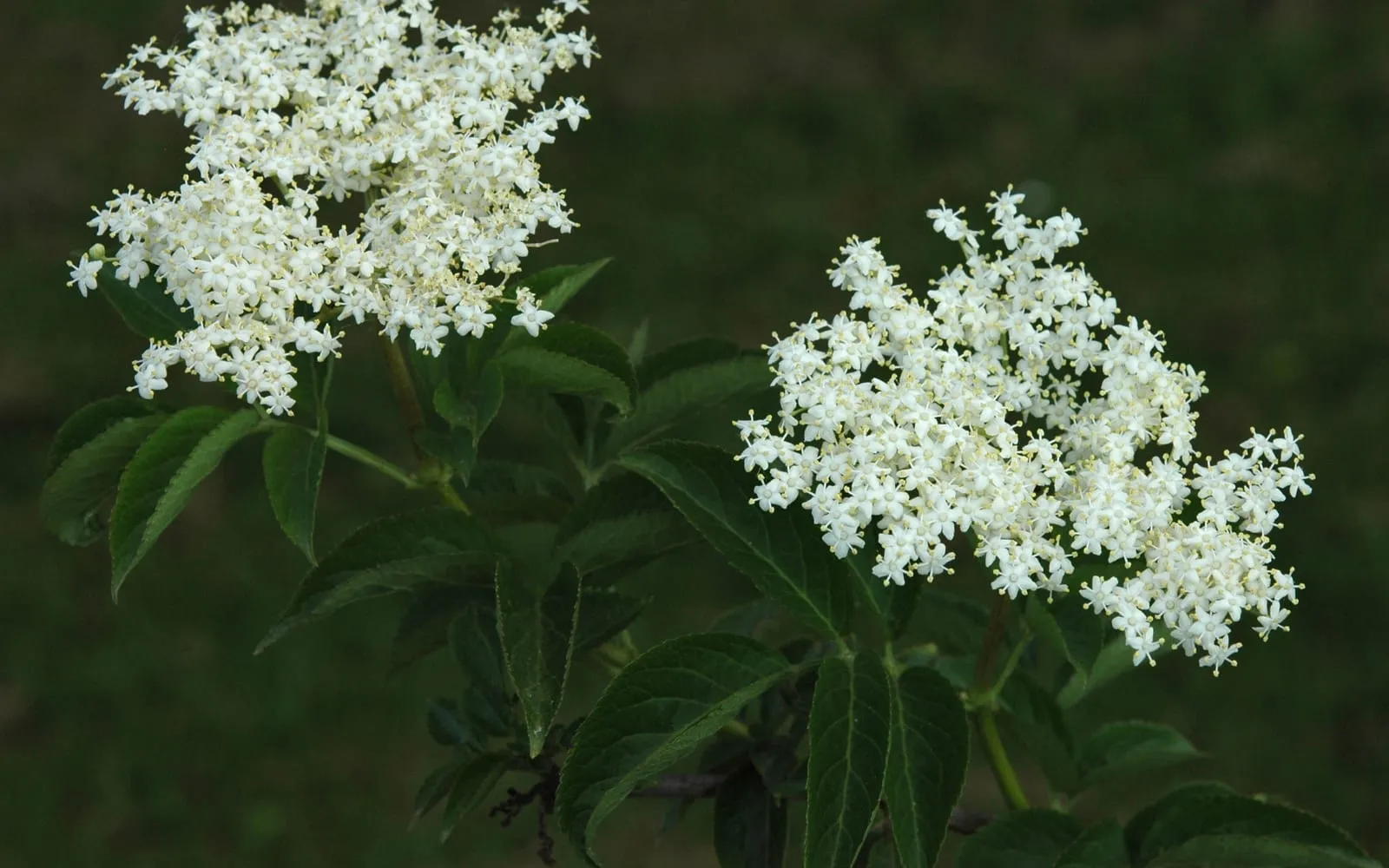
Flowers open in June in flat heads 10 to 25 cm across, made of hundreds of small creamy-white blooms with a strong sweet muscat scent.
Berries follow from late August, small and glossy purple-black in drooping clusters on stalks that turn red as the fruit ripens.
Ornamental varieties are grown for leaves rather than crop. ‘Black Lace’ has finely cut near-black foliage and pink flowers, and ‘Aurea’ is golden.
Where it is from
Europe, western Asia and North Africa, including Britain, where it is native and grows in hedgerows, woodland edges, waste ground and anywhere a bird has perched.
It favours nitrogen-rich soil, which is why it appears around farmyards, rabbit warrens, badger setts and old buildings. A stand of elder is a reasonable indication of disturbed, enriched ground.
Its folklore is deeper than almost any other European plant. The Elder Mother was said to live in the tree, and country practice held that you asked permission before cutting one and never brought the wood indoors or burned it.
Elder has been used medicinally across Europe for centuries, and elderflower and elderberry preparations remain in use for colds, with the evidence for them modest.
The plant is short-lived, fast-growing and quick to colonise, which is a successional strategy rather than a garden virtue.
How it grows
Plant in autumn or winter into almost any soil. Elder is untroubled by clay, chalk, damp or poor ground, and it grows fastest on rich damp soil.
Give a full-size plant 3 m of space, or grow a hard-pruned ornamental variety in half that.
Prune in winter while dormant. For a crop, thin out old and crowded stems and cut a share of the oldest wood to the base each year. For foliage varieties, cut every stem back to 30 cm from the ground, which produces large, strongly coloured leaves on vigorous new shoots.
Hard pruning for foliage costs most of the flowers, since elder flowers best on two-year-old wood. Choose the display you want.
Pick elderflower heads on a dry sunny morning when most of the florets on a head have just opened and the pollen is visible. Heads picked wet or over-mature make poor cordial.
Shake the heads rather than washing them, which removes insects while keeping the pollen that carries the flavour.
Pick berries in September when the whole cluster has turned deep purple-black and the stalks have gone red. Strip the fruit off the stalks with a fork before cooking.
Take hardwood cuttings in winter. They root with almost no effort.
Through the seasons
Winter is the pruning season. Cut ornamental varieties hard back to 30 cm, thin older stems on a fruiting plant, and take hardwood cuttings.
Spring brings fast growth and blackfly on every shoot tip. Neither needs much action.
Early summer is the elderflower harvest, usually the first three weeks of June depending on the season and the region.
Late summer and autumn bring the berries from late August into September. Leave some for the birds, and remember to cook whatever you pick.
Care difficulty
Easy to the point of being difficult to stop. Elder grows in any soil, in sun or partial shade, in damp or dry ground, and recovers from any amount of cutting.
Restraint is the actual task. Seedlings appear all over a garden where birds perch, and a plant left unpruned reaches six metres and shades everything near it.
Brittle stems break in wind, which is normal and looks worse than it is.
Blackfly cover the new shoots every spring and the plant grows past them.
The only genuine caution is the toxicity of the raw fruit, which is a kitchen matter rather than a growing one.
Watering
Established plants need no watering. Elder is drought-tolerant once its roots are down, though it prefers damp ground.
Water new plants through their first summer.
A hard-pruned foliage variety benefits from watering in a dry June, since it is making a great deal of growth in a short time.
Mulch in spring on dry soil to hold moisture and boost the growth.
Waterlogging is tolerated better by elder than by most shrubs, and it grows happily in damp corners.
Warning signs, diseases and pests
Blackfly colonise the shoot tips and flower buds every spring in dense colonies. They distort the young growth and rarely do lasting damage. Ladybirds and hoverflies usually deal with them, and hard-pruned plants grow through the infestation.
Self-seeding is the commonest long-term problem. Birds spread the seed everywhere, and a seedling reaches two metres in a couple of seasons. Pull them out while young, since an established elder has a tough root system.
Snapped branches after wind are the result of brittle pithy stems. Cut back cleanly to a joint and the plant regrows.
Elder whitefly gathers under the leaves and produces honeydew and sooty mould.
Honey fungus kills elder, showing as sudden dieback with white fungal sheets under the bark at the base.
Few or no flowers on a plant cut hard back each winter is a consequence of the pruning rather than a fault. Elder flowers on two-year-old wood.
Leaves scorching at the margins in high summer usually mean drought on thin soil.
Growing environment
Full sun for the heaviest crop of flowers and berries. Partial shade is tolerated with a lighter crop, and coloured-leaved varieties keep their colour better in sun.
Almost any soil, and it does best on damp, rich, nitrogen-heavy ground. Clay, chalk and sand are all acceptable.
Shelter from strong wind, which snaps the brittle stems, though elder tolerates exposure well enough in a hedge.
Space to reach its size, or a commitment to cutting it back to 30 cm every winter.
A hedgerow or a boundary is the natural place for a fruiting elder. A border suits a hard-pruned ornamental variety.
Elder makes a useful wildlife plant. The flowers feed insects, the berries feed birds through autumn, and the dense growth shelters nesting birds.
Keep it away from drains and foundations, since it roots vigorously and appears in walls.
Feeding
Elder needs no feeding on ordinary soil and grows too vigorously on rich ground as it is.
A mulch of garden compost in spring is enough for a hard-pruned foliage variety making a lot of growth.
Avoid nitrogen fertiliser, which produces sappy growth that blackfly find irresistible.
A weak plant is more often shaded, waterlogged or affected by honey fungus than hungry.
Troubleshooting
Can I eat the berries raw? No. Raw berries, along with the leaves, stalks and seeds, contain cyanogenic glycosides and cause vomiting and diarrhoea. Cook them and the compounds break down.
When should I pick the flowers? On a dry sunny morning in June, when most of the florets on a head have just opened and the pollen shows. Shake the heads rather than washing them.
My hard-pruned elder never flowers. Elder flowers on two-year-old wood, and cutting everything to the ground each winter removes it. Prune half the plant each year if you want both foliage and flowers.
Seedlings are coming up everywhere. Birds spread the seed. Pull them out while they are small, since an established plant is hard to remove.
The shoot tips are black with aphids. Blackfly, every spring. Predators usually clear them and the plant grows past the damage.
Branches keep snapping. The stems are brittle and full of pith. Cut back cleanly to a joint, and prune to keep the shrub compact in a windy spot.
How do I get the strongest leaf colour? Cut a purple variety such as ‘Black Lace’ back to 30 cm every winter and grow it in full sun.
Are the stalks a problem in cordial? For berries, yes. Strip the fruit off the green stalks with a fork before cooking, since the stalks carry more of the toxic compound than the fruit.