
Edible
Wax Gourd
Benincasa hispida
Also known as Winter melon, Ash gourd, Petha, Dong gua, Fuzzy melon
How to grow wax gourd, Benincasa hispida. The white bloom that lets it keep for a year, why it has almost no flavour of its own, and the fuzzy melon sold as the same plant.
At a glance
- Difficulty
- Moderate
- Water
- Two or three times a week, heavily while fruit is swelling
- Light
- Full sun
- Temperature
- 23-28 deg C, with nothing below 15
- Humidity
- Moderate, with good ventilation
- Hardiness
- USDA 10-12, RHS H1b, hardy to 8 C
- Type
- Tender annual, trailing or climbing
- Height
- 4-6 m of trailing growth
- Native to
- South and South East Asia
- Best month
- May in the Northern Hemisphere, November in the Southern Hemisphere
A long hot humid season of 120 days or more is the requirement, and the waxy bloom that forms on the ripe fruit is what lets it keep for a year without refrigeration. Nothing below 15 deg C. That keeping quality is why it matters across monsoon Asia, where the harvest has to last the dry season.
Hardiness zones describe winter cold alone. Summer heat, humidity, rainfall and the length of the growing season decide as much, so treat the range as the outer limit rather than as a recommendation.
Every month named in this guide is for the temperate Northern Hemisphere. If you garden in the Southern Hemisphere, shift each one by six months, so May becomes November. Closer to the equator the wet and dry seasons matter more than the calendar, and the shift stops being a useful guide.
Not known to be toxic
- Safe to eat
- The fruit, the young shoots and the seeds
Wax gourd is food and nothing about it is harmful. Neither the RHS nor the ASPCA lists Benincasa hispida. The flesh is eaten cooked, the young shoots and leaves are eaten as a green in South East Asia, and the seeds are roasted. The waxy bloom on the skin of a mature fruit is a natural plant wax, and it is scrubbed off before cooking rather than being a treatment applied to the fruit. Cooked flesh in small amounts is harmless to cats and dogs.
Sources: RHS potentially harmful garden plants, ASPCA toxic and non-toxic plants
About
Wax gourd is the enormous pale green fruit sold in Chinese supermarkets, often in cut sections wrapped in film because a whole one weighs as much as a small child. The name comes from the coat of white wax it grows in its last weeks on the vine.
That wax is why it exists. A mature fruit with its bloom intact keeps for six months to a year in a cool dry room, unrefrigerated, which made it the vegetable that carried households through the season when nothing else was in the ground. The English name winter melon records that rather than any winter hardiness in the plant, which dies at the first touch of frost.
Its other quality is having almost no flavour. The flesh is white, translucent when cooked, and tastes of the broth it is simmered in. Chinese cooking uses it in soups, Indian cooking candies it into the sweet petha, and Vietnamese and Thai kitchens use it in braises.
Appearance and character
A coarse trailing annual with thick, brittle, strongly hairy stems reaching 4 to 6 m, usually left to run along the ground rather than trained up.
The leaves are large, 10 to 25 cm across, rounded to kidney-shaped with five to seven shallow lobes and a bristly upper surface that catches on skin.
Tendrils are branched, splitting into two or three arms.
Flowers are large, bright yellow and up to 8 cm across, the biggest of the gourds in this group, with males and females on the same plant.
The young fruit is covered in stiff white hairs and is sold in that state in South East Asia as fuzzy melon or mao gua, cut at 15 to 20 cm and cooked like a courgette.
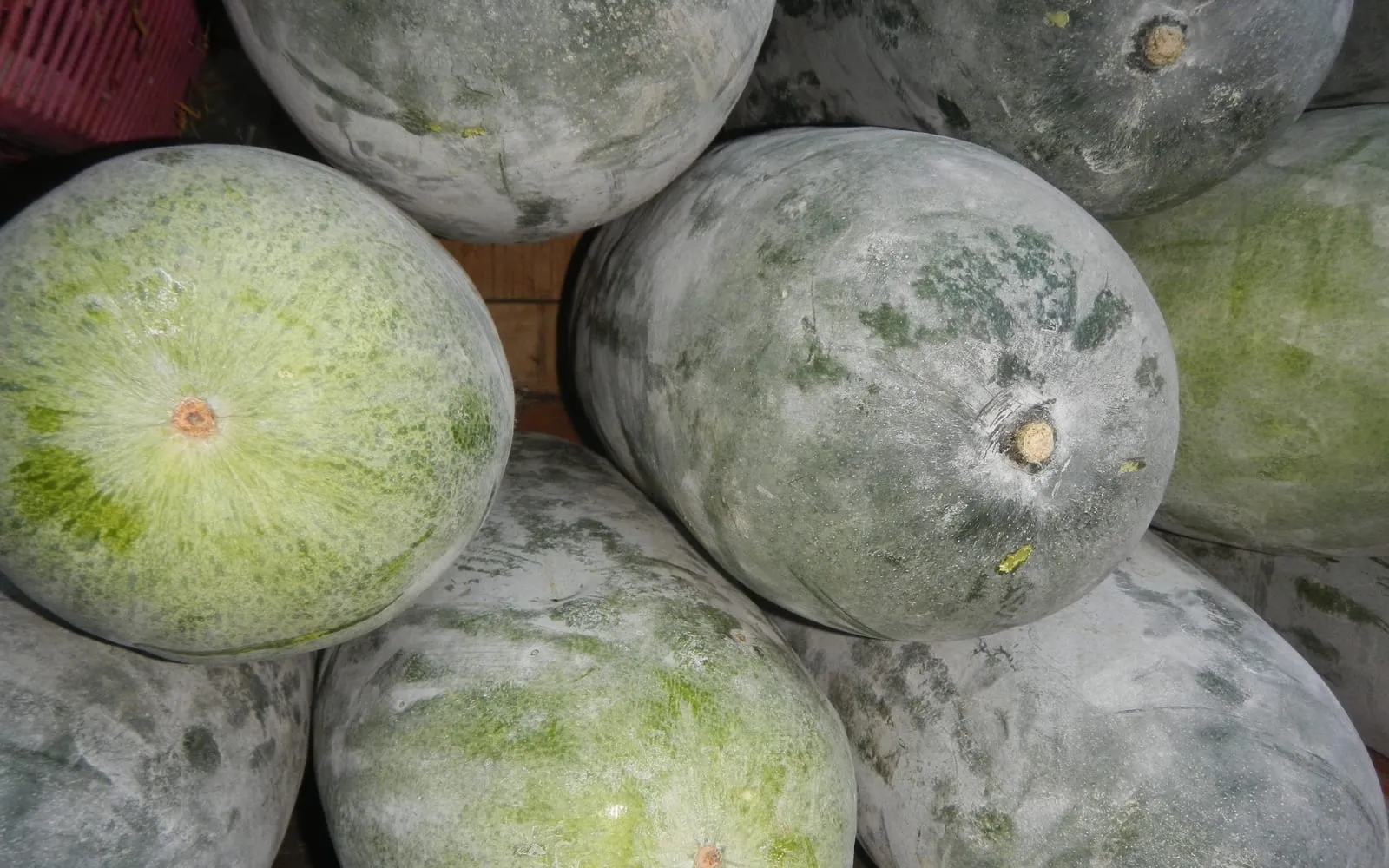
A fruit left to mature loses the hairs and grows the wax instead. Mature fruit runs from 30 cm and 3 kg up to a metre and 30 kg, cylindrical or barrel-shaped, matt pale green under a chalky white coating.
The flesh is white, firm and crisp raw, with a large seed cavity holding flat pale seeds.
Where it is from
Wax gourd is native to tropical South and South East Asia, though the wild ancestor is not settled and the plant has been carried by people for so long that its original range is blurred.
Archaeological seeds from Japan, Spirit Cave in Thailand and sites in India put it in cultivation for several thousand years. It reached China early and became part of the standard vegetable repertoire there.
Indian cooking treats it as ash gourd and gives it a medicinal reputation in Ayurveda, where the juice is drunk and the flesh is made into the sweet petha associated with Agra.
It now grows across Asia, in parts of Africa and the Caribbean, and in Australia. Commercial production is dominated by China and India.
How it grows
Sow in late April or May at 22 to 25 deg C, two seeds to a 9 cm pot, 2 cm deep, thinning to one.
Harden off carefully and plant out after the last frost, spacing at 1.5 m each way because the plant covers a great deal of ground.
Choose the warmest site available. A polytunnel or the sunny end of a greenhouse suits it, and a sheltered south-facing bed will do in a hot summer.
Let it trail rather than climb. A mature fruit is far too heavy for a support that would carry a cucumber, and growers who train it vertically have to sling each fruit in a net.
Slide a tile, a slate or a piece of board under each developing fruit to keep it off wet soil.
Hand-pollinate under glass, since the flowers are large and the job is easy.
Limit each plant to two or three fruit if you want large ones, or leave it alone and take more, smaller ones.
Harvest young at 15 to 20 cm for fuzzy melon, or leave a fruit until the hairs have gone and the white bloom has formed for storage.
Cut with a length of stalk attached and handle the mature fruit gently, since rubbing the wax off shortens its keeping life to weeks.
Through the seasons
Late April and May are for sowing under cover in warmth.
Early June is planting out, once the soil has warmed and the frosts have finished.
Late June and July are for rapid running growth, hand pollination and getting boards under the fruit.
August is fruit swell, and the month to pick young fuzzy melons if that is what you want.
September is when the hairs drop and the wax bloom forms on any fruit left to mature.
October is harvest for storage, before the first frost.
Winter is storage rather than growing. A waxed fruit sits in a cool dry room and keeps for months.
Care difficulty
Moderate. The plant is undemanding and the climate is the limitation.
It needs a long warm season, about four months from planting out to a mature waxed fruit.
Space is the practical problem, since one plant takes several square metres.
Ripening a fruit to full wax outdoors in a cool summer is uncertain, and picking young as fuzzy melon is the reliable alternative.
Fruit rot from contact with wet soil is the commonest loss and is easy to prevent.
Nothing about the plant is fragile once it is growing.
Watering
Water two or three times a week from planting out.
Increase heavily once fruit begins to swell, since a 10 kg fruit is mostly water.
Soak the root zone rather than sprinkling.
Water in the morning and keep the foliage dry.
Mulch to hold moisture and to keep the fruit off bare soil at the same time.
Reduce watering in the last fortnight before harvest, which helps the skin harden and the wax form.
Warning signs, diseases and pests
White powdery coating on the leaves from July is powdery mildew.
Yellow angular blotches with grey growth beneath in wet weather are downy mildew.
A soft brown patch on the underside of a fruit lying on soil is contact rot, and a board under the fruit prevents it.
Grey fuzzy mould on a damaged fruit or a dead flower is botrytis.
Curled shoot tips with sticky residue are aphids.
Small fruit shrivelling and dropping is a failure of pollination.
A fruit that stops swelling and yellows is usually one the plant has abandoned because it is carrying too many.
Wax that rubs off in handling means the fruit will not keep, so use that one first.
Growing environment
Full sun and shelter, in a polytunnel or on the warmest bed in the garden.
Minimum 15 deg C, with 23 to 28 deg C for real growth.
Deep rich soil with plenty of organic matter.
Free drainage, since the plant hates standing water at the root.
At least 2 square metres per plant.
A dry surface under each fruit.
A cool dry frost-free room for storing the mature fruit afterwards.
Feeding
Dig in a barrow of rotted manure per planting station before setting the plants out.
Feed a balanced liquid feed fortnightly from planting until the first fruit sets.
Switch to a high-potash tomato feed once fruit is swelling.
Keep feeding through August and September, since a large fruit is a large demand.
Stop feeding a fortnight before harvest.
Avoid high nitrogen after midsummer, which delays maturity and softens the skin.
Troubleshooting
What is the white powder on a shop-bought one? Natural plant wax, made by the fruit itself. Scrub it off before cooking. It is what lets the fruit keep for months without refrigeration.
Is fuzzy melon a different plant? No, the same species picked young, while the fruit still carries its coat of white hairs. Cook it like a courgette.
What does it taste of? Very little. That is what it is for. It takes up the flavour of a stock or a syrup and holds its texture through long cooking.
How big should I let it get? For storage, leave it until the hairs have gone and the wax has formed, which usually means 5 kg or more. For eating fresh, cut it at any size.
Mine rotted where it sat on the ground. Put a slate, tile or piece of wood under every fruit as soon as it starts to swell.
Can I grow it outdoors in a cool climate? In a hot summer, yes, though you may only get fuzzy melons rather than a mature waxed fruit. A polytunnel makes it far more likely.
How long does a whole one keep? Six months to a year in a cool dry room, provided the wax is undamaged and the stalk is intact. Once cut, wrap it and refrigerate it, and use it within a week.
Is it related to the honeydew melon? No. Honeydew is Cucumis melo. Wax gourd is Benincasa hispida, its own genus, and the resemblance stops at the shape.
Wax Gourd problem guides
Not sure what is wrong? See the common vegetable pests guide.