
Edible
Cornelian cherry
Cornus mas
Also known as Cornel, European cornel, Dogwood cherry, Kizil, Drenjina
How to grow cornelian cherry, Cornus mas. Yellow flowers in February, sour red fruit in late summer, and waiting for it to drop before you pick.
At a glance
- Difficulty
- Easy
- Water
- First two summers, then none
- Light
- Full sun to part shade
- Temperature
- Fully hardy to -25 deg C
- Hardiness
- USDA 4-8, RHS H7, hardy to -30 C
- Type
- Deciduous shrub or small tree, living well over a century
- Height
- 4-6 m, occasionally 8 m
- Native to
- Southern Europe, Western Asia
- Best month
- August and September in the Northern Hemisphere, February and March in the Southern Hemisphere
Flowers open on bare wood in late winter and shrug off frost that would blacken an apricot, which is unusual for anything blooming that early. Ripening needs summer heat, and in a cool season the fruit stays sour and scarlet instead of turning dark and sweet. Two clones fruit far better than one.
Hardiness zones describe winter cold alone. Summer heat, humidity, rainfall and the length of the growing season decide as much, so treat the range as the outer limit rather than as a recommendation.
Every month named in this guide is for the temperate Northern Hemisphere. If you garden in the Southern Hemisphere, shift each one by six months, so August becomes February. Closer to the equator the wet and dry seasons matter more than the calendar, and the shift stops being a useful guide.
Not known to be toxic
- Safe to eat
- The ripe fruit
The fruit is food and has been eaten around the Black Sea and the eastern Mediterranean for thousands of years. Neither the RHS nor the ASPCA lists Cornus mas as harmful, and the ASPCA does not record it as toxic to cats or dogs. The stone is large and hard and should be discarded rather than chewed, which is a practical point rather than a toxicity one. Unripe fruit is mouth-puckeringly astringent and will upset a stomach in quantity, which is a property of the tannins and passes as the fruit softens. No part of the plant carries a recorded poisoning risk.
Sources: RHS potentially harmful garden plants, ASPCA toxic and non-toxic plants
About
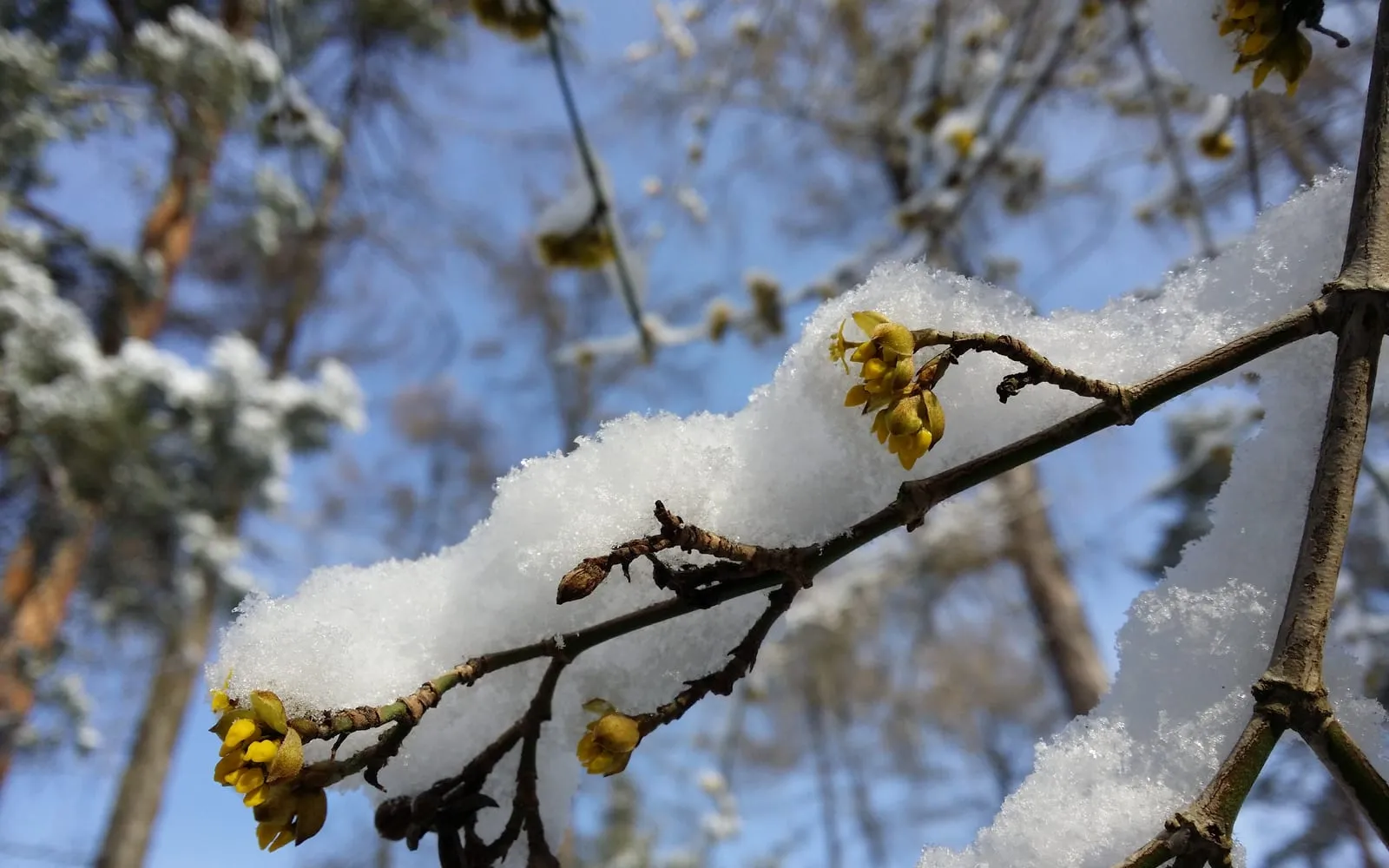
Cornus mas flowers in February, when almost nothing else does, covering bare grey twigs in small acid-yellow clusters. From a distance it reads as a haze rather than as individual flowers, and it holds for three or four weeks in cold weather.
The fruit that follows is a long red drupe the shape of a small olive, ripening in August. Picked while firm it is so sour it is barely food. Left until it falls it turns sweet, soft and slightly like a sharp cherry crossed with a cranberry.
That waiting is the one skill this plant demands. Spread a sheet under the tree and shake, and take only what comes away.
It is a dogwood rather than a cherry, and it makes a dense long-lived shrub that tolerates chalk, drought, shade and cold without complaint.
Appearance and character
A dense rounded shrub, low-branched from the base, which can be trained to a single stem as a small tree.
Bark on older wood is grey-brown and flakes away in small plates, leaving a mottled surface that is one of the plant’s winter features.
Flowers open in February and March on bare twigs, in tight rounded clusters 2 cm across, each made of many small four-petalled yellow flowers.
Leaves are oval with pointed tips, 4 to 10 cm, deeply marked with curving parallel veins that run towards the tip. That venation identifies a dogwood at a glance.
Fruit hangs on short stalks, 1.5 to 2 cm long, oblong, glossy and bright red, with a single large stone. Autumn foliage turns purple-red.
Where it is from
Cornus mas grows wild from central and southern Europe eastwards into the Caucasus and northern Iran, in open woodland, scrub and hedgerow, often on limestone.
It has been used as food far longer than it has been grown as an ornamental. Stone remains turn up on Neolithic sites across the Balkans and Greece.
Homer mentions cornel wood for spear shafts, and the timber is the densest in Europe, heavy enough to sink in water and once used for tool handles and ladder rungs.
The fruit remains a staple across Turkey, the Caucasus and the Balkans, where it is made into sherbet, preserves and a sour syrup, and dried for winter.
Ukraine, Turkey and Serbia grow named large-fruited selections commercially, and those are the varieties worth seeking out for a garden grown for fruit.
How it grows
Buy a container-grown plant, and choose a named fruiting variety such as ‘Jolico’ or ‘Kasanlaker’ if you want fruit rather than flowers alone. The species fruits, but the selected forms carry berries two or three times the size.
Plant in autumn or spring into any well-drained soil. Chalk suits it, which makes it valuable where fruit choices are limited.
Site in sun for the heaviest crop, though it flowers and fruits acceptably in part shade.
Plant two if you can. Cornelian cherry is partly self-fertile and crops far better with a second plant of a different variety nearby.
Prune very little. Remove dead or crossing wood after flowering, and leave the shape alone otherwise.
Fruiting begins slowly, often in the fifth or sixth year, and builds steadily from there.
Through the seasons
February and March bring the flowers, on bare wood, at a point in the year when they carry the whole garden.
Early bees work them on any mild day, which makes the plant useful well beyond its own fruiting.
Leaves follow in April and the plant becomes anonymous green through the summer while the fruit develops.
August is the harvest, and the timing is the trick. Red but firm means it is not ready. Leave it until the fruit darkens and softens, and take it when it starts to drop of its own accord.
Shake the branches over a sheet every few days through late August and September and take what falls.
Autumn colour is purple-red, and after leaf fall the flaking bark and the fine twiggy structure carry the plant through winter.
Care difficulty
Easy, and unusually so. This is a plant that survives hard winters, dry summers, alkaline soil and shade.
It has almost no pest or disease problems anywhere it is grown. Leaf spot and mildew turn up in the wrong summer and do nothing lasting.
The only demands are patience and picking technique. It takes several years to fruit and the fruit must be allowed to fall.
No spraying, no feeding, no thinning and barely any pruning.
Its slow start is the main reason it is not planted more often, since a gardener wanting fruit in three years will be disappointed.
Watering
Water weekly through the first two summers, 15 to 20 litres at a time.
An established plant is markedly drought-tolerant and needs nothing in a cool summer.
Fruit size improves with moisture in July and August, so a soaking in a dry summer is worthwhile once the plant is cropping.
Mulch in spring with compost or leaf mould, kept clear of the stems.
Avoid waterlogged ground. This is a plant of dry limestone hillsides and it will not tolerate roots standing wet through winter.
Warning signs, diseases and pests
Brown scorched leaf margins in high summer. Leaf scorch from drought or wind on a young plant. Water and mulch, and the plant recovers.
Purple-bordered spots on leaves in a wet year. Leaf spot. Rake up fallen leaves. No treatment needed.
White powdery coating on leaves in a dry spell. Powdery mildew. It rarely troubles a plant with a mulched root run.
Brown scale-like bumps along old stems. Scale insects. Scrub them off with a stiff brush where they are reachable.
Fruit vanishing as it ripens. Blackbirds. They arrive as it softens, which is the same moment you want it, so net a small plant if the crop matters.
Whole branches dying, white sheets under the bark at the base. Honey fungus. Uncommon on this species and fatal where it takes hold.
Growing environment
Full sun gives the best crop, and the plant flowers acceptably in part shade, so it can work on a shady boundary.
It grows on chalk, clay, sand and loam, at any pH from 6 to 8, and alkaline ground suits it better than most fruit.
Drainage matters more than fertility. Dry stony ground is close to its native habitat.
Cold and wind are tolerated fully. It is hardy to -25 deg C and unbothered by exposure.
Allow 4 m of width for a mature plant, or train it early to a single stem and keep a clear trunk beneath a raised crown.
Feeding
Almost nothing is required. The plant grows on poor limestone soil in the wild and does not want rich feeding.
A compost mulch every second spring is enough on ordinary garden soil.
On very poor sand, a handful of general fertiliser in March through the first few years supports establishment.
Avoid nitrogen-rich feed, which produces soft growth and delays the onset of fruiting further.
A container plant needs a balanced liquid feed monthly through summer, though the species eventually outgrows any practical pot.
Troubleshooting
No fruit after five years. Often the wait rather than a fault. Plant a second variety to improve pollination and give it two more seasons.
Fruit unbearably sour. Picked too early. Wait until it darkens and drops, which in a cool climate can be late September.
Flowers browning in February. Frost on open blossom. The plant is hardy but the flowers are not, and a hard frost during flowering costs that year’s fruit.
Few flowers on a mature plant. Too much shade or too much nitrogen. Thin overhanging branches and stop feeding.
Growth very slow. Normal. Cornus mas is slow for its first decade and speeds up afterwards.
Leaves dropping in August. Drought stress on a young plant. Water deeply and mulch.