
Edible
Java Apple
Syzygium samarangense
Also known as Wax apple, Wax jambu, Rose apple, Chomphu
How to grow Java apple, Syzygium samarangense. Warmth, watering, the bell-shaped fruit, flowering control and why the fruit bruises easily.
At a glance
- Difficulty
- Moderate
- Water
- Twice a week in growth, and it wants more water than most
- Light
- Full sun
- Temperature
- Minimum 10 deg C. Damaged by frost
- Humidity
- High
- Hardiness
- USDA 10-12, RHS H1b, hardy to 12 C
- Type
- Tender evergreen tree
- Height
- 5-15 m in the open, 1.5-2 m in a pot
- Native to
- the Malay peninsula, the Andaman Islands
- Best month
- June and July in the Northern Hemisphere, December and January in the Southern Hemisphere
Warm lowland tropics with rain spread through the year. The tree flowers whenever conditions suit rather than on a calendar, so a climate with a cold season gives one crop under glass instead of two or three outdoors.
Hardiness zones describe winter cold alone. Summer heat, humidity, rainfall and the length of the growing season decide as much, so treat the range as the outer limit rather than as a recommendation.
Every month named in this guide is for the temperate Northern Hemisphere. If you garden in the Southern Hemisphere, shift each one by six months, so June becomes December. Closer to the equator the wet and dry seasons matter more than the calendar, and the shift stops being a useful guide.
Not known to be toxic
- Safe to eat
- The whole fruit, skin included
Java apple is not toxic and nothing in the plant is listed as harmful to people or to cats and dogs. The whole fruit is eaten with the skin on, and it is bland enough to be handed to small children across South East Asia without a second thought. Around nine-tenths of the fruit is water, so it carries very little sugar and very little of anything else, which makes it unusual among tropical fruits for being nutritionally close to nothing. Where seeds are present they are small, soft and harmless. The genus also contains the clove, whose eugenol oil is a real irritant in quantity, and none of that chemistry shows up in the fruit.
Sources: ASPCA toxic and non-toxic plants, RHS potentially harmful garden plants
About
A Java apple is a glass of water with a crunch. Bite one and it snaps like celery, floods the mouth, and leaves behind a faint sweetness and a smell of roses. Around nine-tenths of the weight is water, and a ripe fruit holds roughly the calories of a stick of it.
Mildness is the reason it is eaten rather than an apology for it. Thai and Indonesian eaters take it in the heat of the afternoon with salt or a chilli and sugar dip, in the way a European would reach for a cold drink.
The Latin name records Semarang on the north coast of Java, where Europeans first described the cultivated tree, though it came originally from further north around the Malay peninsula and the Andamans.
Appearance and character
A spreading evergreen with branches starting low on the trunk and a crown wide enough to shade a yard, 5 to 15 m where it has room.
Bark is pinkish grey and lifts in thin papery scales that come off in the hand.
Leaves are opposite, elliptic to oblong and 10 to 25 cm, thick and leathery, dark and glossy above, and strongly aromatic when crushed. Each new flush comes out pink or bronze and hardens to green over a fortnight.
Flowers are the showiest part of the tree. Each is a boss of creamy white stamens 2 to 4 cm across with the petals almost lost among them, carried in clusters on old wood and at the branch tips, and a flowering tree hums with bees.
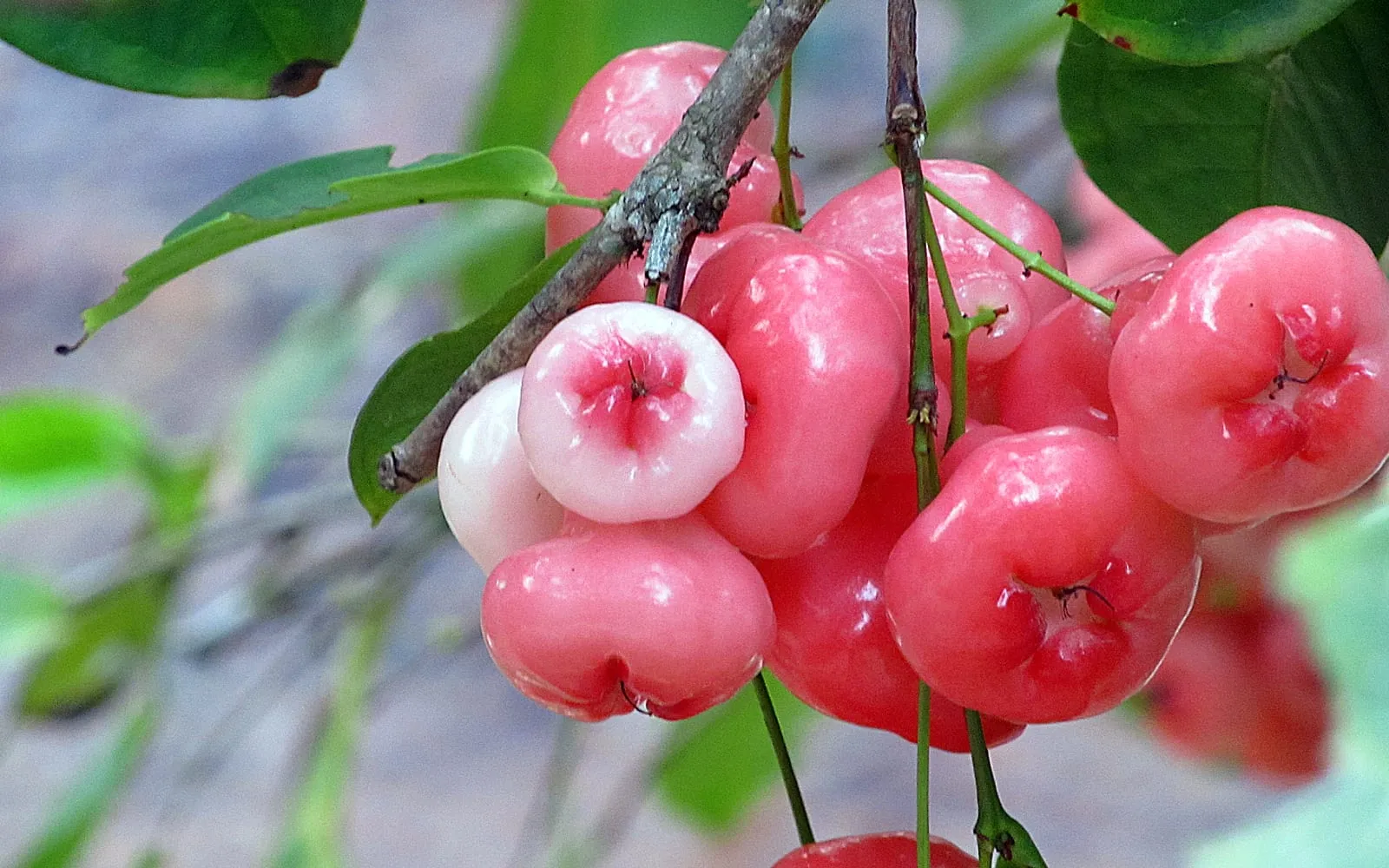
Fruit is bell-shaped, waxy and glossy, 4 to 6 cm, and comes in deep red, pink, pale green or white depending on the cultivar. The shape is the flower’s hypanthium swollen up around the ovary rather than an ordinary berry.
The broad end stays open, ringed by four dried calyx lobes that make a shallow cup, and the flesh inside a good cultivar is hollow at the centre.
Flesh is white, crisp and spongy at once, and it gives up its juice the moment it is broken.
Seeds are absent altogether in the best selections and reduced to one or two soft ones elsewhere.
Where it is from
The wild tree belongs to the Malay peninsula and the Andaman and Nicobar Islands, and cultivation spread it across South East Asia long before any European wrote it down.
Taiwan made it a serious crop. Growers in Pingtung in the south bred the dark cultivars sold as lien-wu, among them Black Pearl and Black Diamond, selecting for deep colour, thick crisp flesh and no seed at all.
They also moved the season. Java apple flowers on warmth and water rather than on day length, so a Taiwanese orchard is flooded, then drained and stressed, and sometimes shaded or root-pruned, to force flowering out of its natural rhythm and land the crop on the Lunar New Year market when prices are at their peak. That is why Taiwanese fruit appears in January.
Thailand, Indonesia, Malaysia, the Philippines and Vietnam all grow it as a garden tree, and it reached the Caribbean and tropical America through colonial botanic gardens.
The skin is thin enough to mark under a thumbnail and the fruit is finished within days of picking, so it goes to market packed individually in foam sleeves and it goes nowhere further than that.
How it grows
Buy a grafted or air-layered plant if you want a named cultivar, since the good seedless selections cannot be reproduced from seed and a seedling will not match its parent.
Where seed is present, sow it straight out of the fruit. It comes up at 22 to 28 deg C within a fortnight and is dead within a few weeks of drying.
Use a rich compost that holds water and still drains, at a slightly acid pH, in the largest pot you are willing to move.
Full sun, and a floor of 10 deg C with no frost at any point.
Water heavily. This tree drinks more than almost anything else grown under glass, and the fruit reports every lapse.
Keep humidity up, since dry air brings mite and leaf drop before it does anything else.
Feed monthly from April to September, moving to a high-potash feed once fruit has set.
Prune straight after a crop. The tree branches low and spreads, and it takes hard cutting without sulking.
Fruit follows in three or four years from a grafted plant, and each fruit takes only about a month from open flower to ripe.
Through the seasons
Winter is a warm rest rather than a dormancy. Hold above 10 deg C, water enough to keep the compost from drying, and give no feed.
Spring brings a flush of bronze leaves and the first flowering. Repot now if the plant needs it, and start feeding as the flowers open.
Early summer sets fruit, and clusters thin themselves heavily before the survivors begin to swell.
Midsummer is the harvest, four to five weeks after flowering, taken over a few days because the whole cluster ripens together.
Late summer often brings a second flowering under warm glass, and a second crop with it.
Autumn ends the feeding, and watering eases back as the light goes.
Care difficulty
Moderate, and among the fastest fruits here to reach a crop.
Water is the whole of the difficulty. A fruit that is nine-tenths water cannot be built by a plant that is short of it, and a tree kept dry gives small, dry, split fruit that is scarcely worth picking.
Consistency matters more than quantity. The commonest fault is a dry fortnight followed by a generous soak, which forces the flesh outwards faster than the thin skin can stretch, and every fruit in the cluster splits at once.
Humidity has to stay high, or leaf drop and spider mite arrive together.
A floor of 10 deg C, with frost fatal rather than merely damaging.
Thin the clusters. A tree left to itself carries far more fruit than it can fill, and the result is a large crop of small watery bells rather than a small crop of good ones.
Watering
Twice a week through growth, keeping the compost damp all the way through rather than damp on top.
More than instinct suggests. The tree transpires hard and the fruit is mostly what it drinks.
Never dry and then flood. That pattern is what splits the skin, and it is avoidable in a way that almost nothing else about this plant is.
Ease back over winter without letting the rootball dry out.
Hold humidity with damped gravel and grouped plants rather than by misting alone.
Rainwater where the tap supply is hard.
Free drainage regardless, because cold wet compost rots the roots whatever the species wants above ground.
Warning signs, diseases and pests
Small dry fruit means the plant was short of water during swell.
Split fruit means erratic watering, usually a heavy soak after a dry spell.
Brown leaf edges mean dry air.
Leaf drop after a cold night is chill damage.
Brown limpets on the stems are scale.
White fluff in the leaf axils is mealybug.
Fine webbing on the leaves is spider mite.
Wilting in damp compost is root rot.
Fruit with small holes and brown patches is fruit fly, which is a field problem in the tropics and almost unknown under glass.
Growing environment
A heated greenhouse or conservatory, since no temperate garden will hold it through a winter.
A floor of 10 deg C, with 25 to 32 deg C wanted for growth and fruit.
Full sun. Shade costs colour in the fruit before it costs anything else.
High humidity year round.
Rich, moisture-retentive, free-draining compost at pH 5.5 to 6.5.
A pot of 40 cm or more before it will carry a crop.
Room to spread, or a commitment to prune it every year after fruiting.
Feeding
A balanced liquid feed monthly from April to September.
High potash from fruit set onwards, which improves both the colour and the crispness.
Nothing from the end of September, and nothing at all through the winter rest.
A top-dressing or a repot each spring, since this is a hungry tree in a pot.
Magnesium where the older leaves yellow between the veins, which happens readily on a plant fed hard and watered harder.
Steady feeding across a two-crop season rather than a heavy spring dose, since the tree may be flowering and ripening at the same time.
Troubleshooting
What does it taste like? Very mild. Crisp, watery and faintly sweet, with a rose scent in some cultivars. It is eaten as something cooling, often with salt or a chilli dip.
Why can I never buy one? The skin marks under a fingernail and the fruit is past its best within days, so it is packed in foam sleeves for a domestic market and never enters international trade.
What are the other Syzygium fruits? Malay apple, water apple and jamun, all in this collection, and the clove, which is the dried unopened flower bud of Syzygium aromaticum.
Do I peel it? No. Eat it whole, skin and all, and cut out the small brown cup at the flared end if it bothers you.
My fruit split on the tree. Erratic watering. A heavy soak after a dry spell pushes the flesh out faster than the skin can give. Keep the compost evenly damp and the problem disappears.
The fruit is small and dry. The plant ran short of water while the fruit was swelling, or it was carrying more fruit than it could fill. Thin the clusters and water harder.
Is it the same as a rose apple? The name rose apple attaches to several Syzygium species and most often to Syzygium jambos, which is a different plant with a rounder, hollower, far more perfumed fruit. Java apple, wax apple and wax jambu all mean this one.
How soon will it fruit? Three or four years from a grafted plant. Each fruit then takes about a month from flower to ripe, so a warm house can give two crops in a year.
Java Apple problem guides
Not sure what is wrong? See the common vegetable pests guide.