
Edible
Java Plum
Syzygium cumini
Also known as Jamun, Jambolan, Black plum, Duhat
How to grow jamun, Syzygium cumini. The purple-black fruit that dyes your tongue, its place in Indian summer, the diabetes claim attached to the seed, and why Florida wishes it had never been planted.
At a glance
- Difficulty
- Moderate
- Water
- Weekly in growth, and it tolerates wet feet better than most
- Light
- Full sun
- Temperature
- Minimum 5 deg C. A mature tree takes a light frost
- Humidity
- Moderate to high
- Hardiness
- USDA 10-11, RHS H1b, hardy to 2 C
- Type
- Tender to half-hardy evergreen tree
- Height
- 10-30 m in the open, 2 m in a pot
- Native to
- the Indian subcontinent, South East Asia
- Best month
- June and July in the Northern Hemisphere, December and January in the Southern Hemisphere
Monsoon India and south-east Asia, tolerant of flooding and drought alike. It has naturalised widely and is an invasive weed in Florida, Hawaii and parts of east Africa.
Hardiness zones describe winter cold alone. Summer heat, humidity, rainfall and the length of the growing season decide as much, so treat the range as the outer limit rather than as a recommendation.
Every month named in this guide is for the temperate Northern Hemisphere. If you garden in the Southern Hemisphere, shift each one by six months, so June becomes December. Closer to the equator the wet and dry seasons matter more than the calendar, and the shift stops being a useful guide.
Not known to be toxic
- Safe to eat
- The ripe fruit
- Do not eat
- Unripe fruit, which is strongly astringent
Jamun is not toxic and nothing in the plant is listed as harmful to people or to cats and dogs. Unripe fruit is heavily astringent and unpleasant rather than dangerous. The claim worth addressing is medical rather than toxicological. Powdered jamun seed is sold widely as a treatment for diabetes, the tradition behind it is long, and controlled clinical evidence that it lowers blood glucose in people is weak. Anyone with diabetes should treat it as a food rather than as a substitute for prescribed medication. The fruit stains skin, cloth and teeth a deep purple that takes days to fade, which is the practical hazard most people meet.
Sources: ASPCA toxic and non-toxic plants, RHS potentially harmful garden plants
About
Jamun arrives with the Indian monsoon, and the tongue gives it away. The fruit is deep purple-black, astringent and sweet at once, and eating a handful dyes the mouth violet for the rest of the day.
Street vendors sell it tossed with salt, which takes the edge off the astringency and is the standard way to eat it across northern India.
The tree is the toughest here. It tolerates drought, waterlogging, poor soil, clay and a light frost, and that same durability has made it a serious invasive weed in Florida, Hawaii and parts of Australia, where birds spread the seed and dense stands replace native vegetation.
Appearance and character
A dense spreading evergreen tree with a heavy crown, 10 to 30 m in the open, and often with a short trunk dividing low.
Bark is grey-brown, rough and flaking at the base and smoother above.
Leaves are opposite, elliptic to oblong, 6 to 15 cm, thick, leathery and glossy dark green, with a distinctive vein running parallel to the leaf margin a little inside it. Crushed, they smell of turpentine.
New growth flushes pink to bronze.
Flowers are small, cream to greenish white, fragrant, and borne in branched clusters mainly on the older wood.
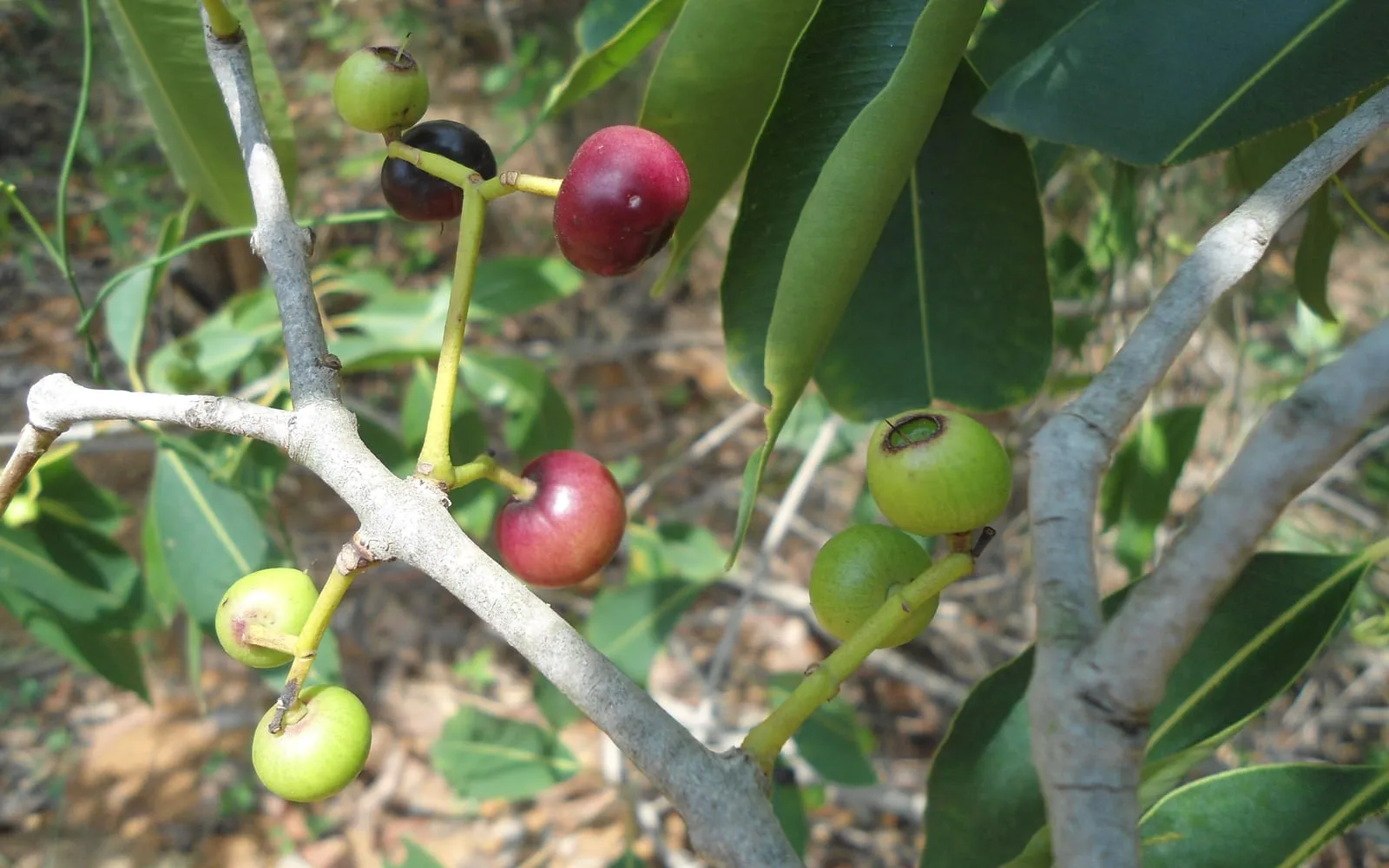
Fruit is oval to oblong, 1.5 to 3.5 cm, ripening green to pink to deep purple-black with a glossy skin.
Flesh is purple or white depending on cultivar, juicy, sweet and strongly astringent, staining everything it touches.
A single oblong seed sits at the centre.
Where it is from
Jamun is native to the Indian subcontinent and South East Asia, and it has been cultivated in India for millennia.
It appears in Hindu and Buddhist texts, and one traditional name for the Indian subcontinent, Jambudvipa, means the island of the jambu tree.
The fruit is bound up with the Indian summer. It arrives in June and July with the monsoon, is sold from handcarts with salt, and is made into juice, vinegar and a sharp purple sorbet.
It spread through South East Asia early and reached East Africa with Indian traders.
Colonial botanic gardens took it to the Americas and the Pacific, and there it became a problem. Florida lists it as an invasive species, Hawaii has large naturalised stands, and parts of Australia treat it as a weed.
Temperate markets see frozen jamun and jamun juice in South Asian groceries in summer.
How it grows
Sow seed from a ripe fruit. Jamun seed germinates readily and often produces several seedlings from one seed, most of them clones of the parent.
Sow at 20 to 28 deg C. Germination takes two to five weeks.
Grow in almost any compost. This species tolerates clay, poor ground, drought and waterlogging, which almost nothing else here does.
Give full sun and a minimum of 5 deg C. A mature tree takes a light frost.
Water weekly in growth. It minds a wet pot less than any other tree in this wave.
Feed monthly from April to September.
Prune to control size, since the natural habit is large and heavy.
Expect fruit on a grafted plant in four to six years and on a seedling in six to eight.
Do not plant it out anywhere warm. It is an established invasive weed in several countries.
Through the seasons
Winter is a cool rest above 5 deg C, watered lightly and unfed.
Spring brings a growth flush and flowering, which is fragrant and heavy.
Early summer is fruit set, and fruit develops fast.
Midsummer is harvest, matching the Indian season.
Late summer is a growth flush after fruiting.
Autumn is when to stop feeding and reduce watering.
Care difficulty
Moderate, and the most tolerant tree in this collection by a wide margin.
Cold hardiness is the best here after the Cattley guava. A minimum of 5 deg C is ample and a mature tree takes a light frost.
Soil tolerance is exceptional. Clay, sand, poor ground, drought and waterlogging are all handled.
Fruiting comes in four to six years on a grafted plant.
Size is the main obstacle. The tree is naturally large and heavy-crowned, so a pot plant needs regular pruning.
Astringency in the fruit surprises people, and salt is the traditional answer.
The invasiveness abroad is a reason to keep it in a pot rather than a growing difficulty.
Watering
Water weekly in growth, giving a thorough soak.
Reduce in winter.
This species tolerates a wet pot better than anything else here, and it still prefers to drain.
Water steadily during fruit swell.
Tap water is fine, including hard water.
Keep humidity moderate to high.
An established plant tolerates a dry spell without complaint.
Warning signs, diseases and pests
Astringent fruit means it was picked before full colour. Wait for deep purple-black.
Purple stains on everything are the fruit rather than a problem, and they take days to fade.
Brown limpets on the stems are scale.
White fluff in the leaf axils is mealybug.
Dark spots on the leaves in humid still air are leaf spot. Improve airflow.
Fine webbing on the leaves is spider mite in dry air.
Leaf drop after a hard frost is cold damage, and the tree usually recovers.
Seedlings appearing in nearby pots means fruit fell. Remove them.
Growing environment
A frost-free greenhouse or conservatory, standing outdoors in a warm summer.
Minimum 5 deg C, with 25 to 32 deg C for growth and fruit.
Full sun.
Moderate to high humidity.
Almost any compost, including heavy ones.
pH from 5.5 to 8.0, which is the widest tolerance in this collection.
A large pot and regular pruning, since the tree is naturally big.
No planting out in any frost-free climate.
Feeding
Feed monthly from April to September with a balanced liquid feed.
Switch to high potash as fruit swells.
Stop feeding at the end of September.
Give nothing through winter.
Top-dress or repot each spring.
Add magnesium if older leaves yellow between the veins.
Keep feeding moderate, since this is a vigorous tree that needs little encouragement.
Troubleshooting
Why is my tongue purple? Anthocyanins in the skin and flesh. The stain lasts a day on a tongue and days on cloth, and it is the fruit rather than a fault.
Why is it so astringent? Jamun carries tannins alongside the sugar. Salt is the traditional answer, and a handful tossed with salt is how it is sold across northern India.
Does jamun seed cure diabetes? No. Powdered seed is widely sold on that claim and the tradition is old, but controlled clinical evidence in people is weak. Treat it as a food and never as a substitute for prescribed medication.
How hardy is it? The toughest tree in this collection after the Cattley guava. It takes a light frost when mature and tolerates clay, drought and waterlogging.
Should I plant one out somewhere warm? No. Florida lists it as invasive, Hawaii has large naturalised stands, and parts of Australia treat it as a weed.
Several seedlings came from one seed. Normal. Jamun seed is often polyembryonic and most of the seedlings are clones of the parent.
What is the connection with the other Syzygium fruits? Same genus. Java apple, Malay apple and water apple are all Syzygium, as is the clove, which is the dried flower bud of Syzygium aromaticum.
When is it ripe? When it turns deep purple-black and softens slightly. Picked earlier it is sharply astringent.
Java Plum problem guides
Not sure what is wrong? See the common vegetable pests guide.