
Edible
Water Apple
Syzygium aqueum
Also known as Watery rose apple, Jambu air, Bell fruit
How to grow water apple, Syzygium aqueum. The smallest and palest of the Syzygium fruits, the one that is almost entirely water, and how to tell it from its two larger relatives.
At a glance
- Difficulty
- Moderate
- Water
- Twice a week in growth, and it wants plenty
- Light
- Full sun to light shade
- Temperature
- Minimum 10 deg C. Damaged by frost
- Humidity
- High
- Hardiness
- USDA 10-12, RHS H1b, hardy to 12 C
- Type
- Tender evergreen tree
- Height
- 3-10 m in the open, 1.5 m in a pot
- Native to
- the Malay peninsula, the Andaman Islands
- Best month
- June and July in the Northern Hemisphere, December and January in the Southern Hemisphere
Wet lowland south-east Asia, often beside water. The fruit is watery and mild rather than sweet, and it bruises within a day, which is why it rarely travels.
Hardiness zones describe winter cold alone. Summer heat, humidity, rainfall and the length of the growing season decide as much, so treat the range as the outer limit rather than as a recommendation.
Every month named in this guide is for the temperate Northern Hemisphere. If you garden in the Southern Hemisphere, shift each one by six months, so June becomes December. Closer to the equator the wet and dry seasons matter more than the calendar, and the shift stops being a useful guide.
Not known to be toxic
- Safe to eat
- The whole fruit, skin included
Water apple is not toxic and nothing in the plant is listed as harmful to people or to cats and dogs. The whole fruit is eaten skin and all, and it is among the mildest fruits in this collection. It is largely water with very little sugar, so it contributes almost nothing nutritionally beyond hydration, which is exactly how it is used across South East Asia in hot weather. This is one of four Syzygium fruits here, a genus that also contains the clove, and none of the four raises a toxicological concern.
Sources: ASPCA toxic and non-toxic plants, RHS potentially harmful garden plants
About
Water apple is the mildest of the three jambu fruits and the one most people would struggle to describe. Small, bell-shaped, pale pink or white, crisp, watery, and sweet enough to notice and no more.
Sorting the three out is worth doing. Water apple is the smallest at 2 to 4 cm and the palest. Java apple is 4 to 6 cm and usually deep pink or red. Malay apple is 5 to 10 cm, pear-shaped, deep crimson, and has a single large seed.
It is a garden tree throughout South East Asia rather than a commercial crop, grown for shade and for something to pick at in the heat, and it never travels far enough to be sold.
Appearance and character
A low-branching spreading evergreen tree, often shrubby, 3 to 10 m in the open and the smallest of the three jambu species.
Bark is pinkish brown, smooth, and flakes in thin papery scales.
Leaves are opposite, elliptic to oblong, 5 to 25 cm, thick and leathery, dull to glossy green, and heart-shaped or rounded at the base where they clasp the stem on very short stalks.
Flowers are creamy white to pale yellow, 1.5 to 3 cm, consisting mostly of long stamens, borne in loose clusters at the branch tips and in the leaf axils.
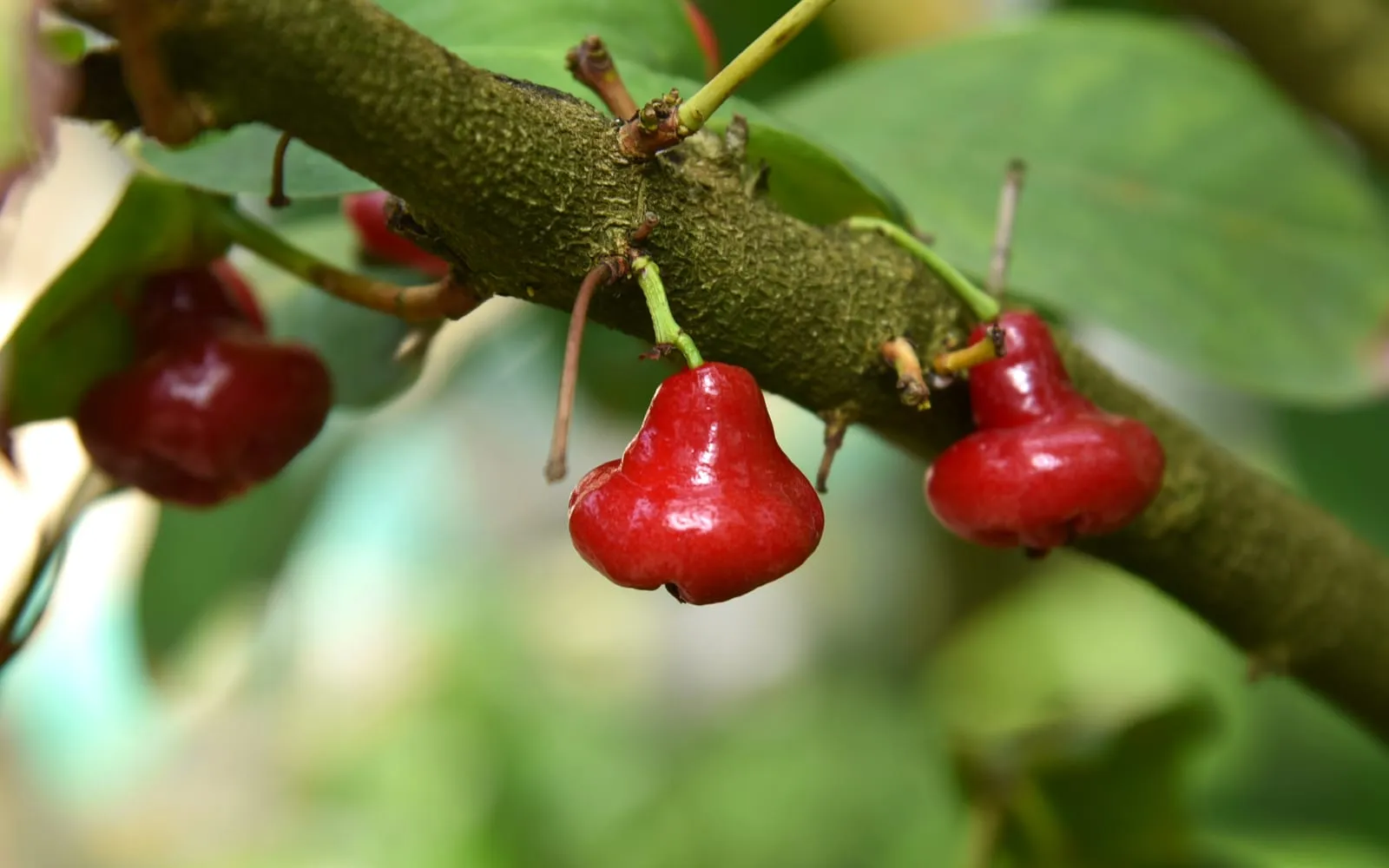
Fruit is small and bell-shaped with a broad flared open end, 2 to 4 cm, waxy and glossy, in white, pale pink or pale red.
The flared end carries the dried calyx as a shallow four-lobed cup.
Flesh is white, crisp, spongy and very watery, with a faint sweetness and sometimes a rose note.
Seeds are one or two small ones, or absent.
Where it is from
Water apple is native to the Malay peninsula and the Andaman and Nicobar Islands, in the same region as the Java apple.
It has been grown throughout South East Asia for centuries as a dooryard tree, and Indonesia, Malaysia, Thailand, the Philippines and Vietnam all have it in gardens and small orchards.
Indonesia and Malaysia distinguish the jambu fruits by name. Jambu air is the water apple, jambu semarang or jambu madu is the Java apple, and jambu bol is the Malay apple.
It reached India and Sri Lanka early and is grown in a small way in the Caribbean and tropical America.
The fruit is too watery, too perishable and too mild to have any export trade at all, so it is almost unknown outside its range.
How it grows
Sow seed from a ripe fruit where one is present. It germinates at 22 to 28 deg C in two to four weeks and loses viability fast.
Take cuttings or air-layer for a named selection, since seedlings vary.
Grow in rich moisture-retentive compost that still drains.
Give full sun or light shade and a minimum of 10 deg C.
Keep humidity high.
Water twice a week and generously, because the fruit is largely water.
Feed monthly from April to September.
Prune after fruiting. The tree is naturally low-branching and takes cutting well, which makes it the most pot-friendly of the three.
Expect fruit in three or four years from a grafted or layered plant under warm glass.
Through the seasons
Winter is a warm rest above 10 deg C, watered moderately and unfed.
Spring brings a growth flush and flowering.
Early summer is fruit set, and fruit develops in about a month.
Midsummer is harvest.
Late summer brings a second flowering in a warm house.
Autumn is when to stop feeding and reduce watering.
Care difficulty
Moderate, and the easiest of the three jambu fruits to keep in a pot.
Size is the reason. Water apple is naturally the smallest and most shrubby of the three, and it takes pruning well.
Water is the main demand, as with its relatives, and short watering gives small dry fruit.
High humidity is needed and dry heated air causes leaf drop.
Minimum 10 deg C is the floor.
Fruit develops in about a month from flower and a warm greenhouse gives two crops.
The fruit is so mild that it is worth growing for interest rather than for a crop worth eating in quantity.
Watering
Water twice a week in growth, keeping the compost consistently damp.
Give plenty. The fruit is largely water and quality depends on it.
Avoid drying out and then soaking, which splits the fruit.
Reduce in winter without letting the compost dry.
Keep humidity high with misting and grouping.
Use rainwater where the supply is hard.
Drain fully, since cold wet compost still rots roots.
Warning signs, diseases and pests
Fruit that comes small and dry is a tree that went short of water while it was filling. On a fruit made mostly of water there is no hiding it.
Skin split down the side means the watering went dry and then heavy, and the flesh swelled faster than the skin could give.
Crisping along the leaf edges is dry air.
Leaves shed a day or two after a cold night are chill damaged.
Brown limpets along the stems are scale.
White fluff in the leaf axils is mealybug.
Fine webbing over the foliage is spider mite.
A plant wilting while the compost is wet is rotting at the root.
Pinprick holes with a soft brown patch spreading under them is fruit fly, which is a field problem in the tropics and almost unknown under glass.
Growing environment
A heated greenhouse or conservatory. There is no outdoor option outside the tropics.
Minimum 10 deg C, with 25 to 32 deg C for growth and fruit.
Full sun to light shade.
High humidity.
Rich moisture-retentive free-draining compost, slightly acid.
pH from 5.5 to 6.5.
A pot of 35 cm or more, which is smaller than its two relatives need.
Regular pruning, which this species takes well.
Feeding
A balanced liquid feed once a month through the growing half of the year.
High potash from fruit set, which is what puts the faint sweetness into flesh that is otherwise close to water.
Nothing after September, and nothing over the winter rest.
A top-dress or a repot each spring.
Magnesium if the oldest leaves start yellowing between green veins.
Spread it evenly rather than front-loading the spring. A warm house gives this species two crops in a year, and a tree still ripening one lot of fruit while flowering for the next cannot live on a single feed in April.
Troubleshooting
How do I tell the three jambu fruits apart? By size and colour. Water apple is the smallest and palest, at 2 to 4 cm, and Java apple runs 4 to 6 cm and is usually deep pink. Malay apple is the outlier. It reaches 5 to 10 cm, it is pear-shaped and deep crimson, and it carries one large seed where the other two carry almost none.
What does it taste like? Very little. Crisp, spongy and watery, with a faint sweetness and sometimes a rose note. It is eaten for coolness rather than flavour.
Do I peel it? No. The whole fruit is eaten, skin and all.
My fruit split. Erratic watering. A heavy soak after a dry spell splits the thin skin.
The fruit was small and dry. The plant was short of water while the fruit swelled. This species drinks heavily.
Why is it never sold in Europe? It is watery, mild and perishable, so there is no export trade for it at all.
Which of the three is best in a pot? This one. It is the smallest and most shrubby of the three and takes pruning well.
How soon will it fruit? Three or four years from a grafted or layered plant, and fruit develops in about a month from flower.
Water Apple problem guides
Not sure what is wrong? See the common vegetable pests guide.