
Edible
Malay Apple
Syzygium malaccense
Also known as Mountain apple, Ohia ai, Pomerac, Jambu merah
How to grow Malay apple, Syzygium malaccense. The deep crimson fruit Polynesian voyagers carried across the Pacific, how it differs from the Java apple, and the flowers that carpet the ground.
At a glance
- Difficulty
- Moderate
- Water
- Twice a week in growth, and it dislikes drying out
- Light
- Full sun to light shade
- Temperature
- Minimum 10 deg C. Damaged by frost
- Humidity
- High
- Hardiness
- USDA 10-12, RHS H1b, hardy to 12 C
- Type
- Tender evergreen tree
- Height
- 12-20 m in the open, 2 m in a pot
- Native to
- the Malay peninsula, Java
- Best month
- June and July in the Northern Hemisphere, December and January in the Southern Hemisphere
Wet tropical Malaysia and the Pacific. It wants year-round moisture and shelter, and the crop follows flowering closely, so a dry spell at bloom costs the year.
Hardiness zones describe winter cold alone. Summer heat, humidity, rainfall and the length of the growing season decide as much, so treat the range as the outer limit rather than as a recommendation.
Every month named in this guide is for the temperate Northern Hemisphere. If you garden in the Southern Hemisphere, shift each one by six months, so June becomes December. Closer to the equator the wet and dry seasons matter more than the calendar, and the shift stops being a useful guide.
Not known to be toxic
- Safe to eat
- The whole fruit, skin included
Malay apple is not toxic and nothing in the plant is listed as harmful to people or to cats and dogs. The whole fruit is eaten skin and all, and it is a common children's fruit across the Pacific. The single large seed is inedible and is discarded rather than being a hazard in the way an avocado stone is, since it is loose in a cavity and obvious. This is one of four Syzygium fruits in this collection, sharing a genus with the clove, and the group carries no toxicological concern.
Sources: ASPCA toxic and non-toxic plants, RHS potentially harmful garden plants
About
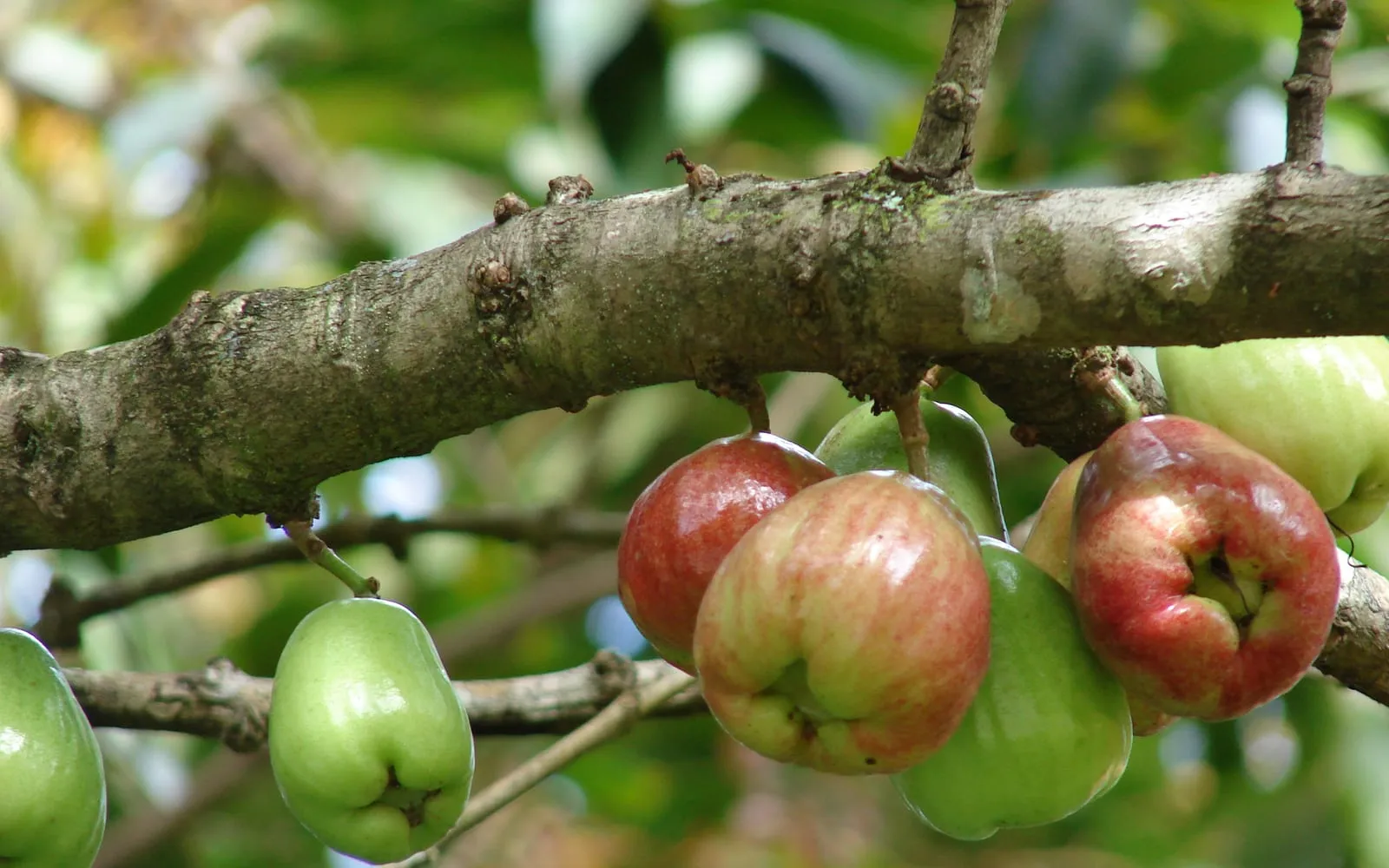
Malay apple is the handsome one of the group. The fruit is pear-shaped, 5 to 10 cm, and a deep glossy crimson that looks almost artificial, and the flesh inside is white, crisp and juicy with a faint rose scent.
It carries more flavour than the Java apple and rather less crunch, and it has a single large seed in a hollow centre where the Java apple has none.
The tree is worth growing for the flowering alone. Bright crimson-pink flowers, all stamens and no visible petals, are borne along the older branches and on the trunk, and when they drop they carpet the ground beneath the tree in red.
Appearance and character
An upright evergreen tree with a dense conical or columnar crown, 12 to 20 m in the open, and a straight trunk.
Leaves are opposite, oblong to elliptic, 15 to 40 cm, large, thick and glossy dark green, with a prominent pale midrib. New growth flushes deep red.
Flowers are the spectacle. Deep crimson to magenta, 5 to 7 cm across, consisting almost entirely of long stamens, borne in clusters directly on the trunk and older branches.
Fallen flowers form a red carpet under the tree, which is how many people first notice one.
Fruit is pear-shaped to oblong, 5 to 10 cm, with a smooth glossy skin in deep crimson, sometimes streaked white or entirely white in some cultivars.
Flesh is white, crisp, juicy and mildly sweet, with a faint rose fragrance and more flavour than the Java apple.
A single large brown seed sits loose in a hollow at the centre.
Where it is from
Malay apple is native to the Malay peninsula and Java, and it was carried east across the Pacific by Austronesian voyagers.
It is one of the canoe plants, the set of species Polynesian settlers took with them deliberately, and it reached Hawaii with the first settlers, where it is ohia ai and is embedded in Hawaiian tradition and place names.
The tree spread west as well, to India and Sri Lanka, and the Portuguese and Spanish moved it to the Caribbean and tropical America, where Trinidad calls it pomerac.
It is grown across the humid tropics as a garden and dooryard tree rather than as a plantation crop, because the fruit bruises and keeps for days.
Temperate markets see it almost never. The fruit does not travel and there is no export trade to speak of.
How it grows
Sow seed from a ripe fruit the same week. Malay apple seed is large and loses viability fast.
Germinate at 24 to 30 deg C in rich free-draining compost. Germination takes three to six weeks and multiple shoots from one seed are common.
Buy a grafted or air-layered plant for named cultivars.
Grow in rich deep moisture-retentive compost that still drains.
Give full sun when mature and light shade when young, since the large leaves scorch under glass.
Keep the temperature above 10 deg C and the humidity high.
Water twice a week and never let it dry out.
Feed monthly from April to September.
Prune after fruiting to keep the plant within bounds.
Expect fruit on a grafted plant in four to six years under warm glass, and on a seedling in six to eight.
Through the seasons
Winter is a warm rest rather than a dormancy. Hold above 10 deg C, water moderately and give no feed.
Spring pushes a flush of bronze leaves, and on a mature tree the flowers break straight out of the trunk and the older limbs. They are crimson pompoms of stamens with almost no petal to speak of, and they drop to leave a coloured carpet under the tree that is half the reason the species is planted.
Early summer sets fruit, which then takes about two months to fill.
Midsummer is picking, and the fruit bruises if it falls, so take it off by hand.
Late summer often brings a second flowering under warm glass.
Autumn ends the feeding, and the watering eases back with the light.
Care difficulty
Moderate, with the same demands as the Java apple and rather more size.
Water and humidity are the main requirements, and neither can be allowed to lapse.
Minimum 10 deg C is the floor.
Leaf scorch on young plants under direct glass sun is common, so shade them at first.
Size is the practical obstacle. The leaves are up to 40 cm long and the tree is naturally columnar and tall, so a pot plant needs pruning and head room.
Fruit comes in four to six years on a grafted plant.
The flowering alone justifies the plant, and it comes earlier than the fruit.
Watering
Water twice a week in growth, keeping the compost consistently damp.
Never let it dry out. The large leaves wilt fast and the fruit drops.
Reduce in winter without letting the compost dry.
Drain fully.
Keep humidity high with misting, damp gravel and grouping.
Use rainwater where the supply is hard.
Water heavily through fruit swell.
Warning signs, diseases and pests
Brown scorched patches on young leaves mean direct glass sun on a plant that wants shade.
Brown leaf edges mean dry air.
Wilting with dry compost is drought, and the plant recovers if caught early.
Leaf drop after a cold night is chill damage.
Brown limpets on the stems are scale.
White fluff in the leaf axils is mealybug.
Fine webbing on the leaves is spider mite.
Wilting in damp compost is root rot.
Fruit dropping small usually means the plant went short of water.
Growing environment
A heated greenhouse or large conservatory. There is no outdoor option outside the tropics.
Minimum 10 deg C, with 25 to 32 deg C for growth and fruit.
Full sun when mature, light shade when young.
High humidity.
Rich deep moisture-retentive free-draining compost, slightly acid.
pH from 5.5 to 6.5.
A large pot and head room, since the tree is columnar and the leaves are large.
Shelter from draughts.
Feeding
A balanced liquid feed every month while the tree is in growth, from April through September.
High potash once the fruit is swelling.
Nothing from October, and nothing across the winter rest.
A top-dress or a repot each spring, before the new flush opens.
Magnesium where the older leaves go yellow between green veins, which is the shortage a hard-fed plant in a pot shows first.
Feed this one well. The leaves run to 30 cm and a tree carrying a full canopy of them, plus a crop borne on its own trunk, is asking a great deal of a container.
Troubleshooting
How is it different from the Java apple? Larger and darker, deep crimson and pear-shaped rather than bell-shaped, with more flavour, less crunch and a single large seed in a hollow centre where the Java apple has none.
Why are the flowers growing on the trunk? Cauliflory, which several tropical trees show. The crimson flowers are borne on the trunk and older branches and carpet the ground when they fall.
What is a canoe plant? One of the species Polynesian voyagers carried deliberately across the Pacific. Malay apple was one of them and reached Hawaii with the first settlers as ohia ai.
The young leaves scorched. Direct sun through glass. Young plants want light shade, and the large soft leaves burn readily.
Do I peel it? No. The whole fruit is eaten, skin included, and the single seed is discarded.
Why can I never buy one? It bruises and keeps for days, so there is no export trade to speak of.
My fruit dropped small. The plant went short of water. This species does not tolerate drying out at any stage.
How soon will it fruit? Four to six years from a grafted plant, six to eight from seed, and the flowering starts earlier than that.
Malay Apple problem guides
Not sure what is wrong? See the common vegetable pests guide.