
Edible
Tatsoi
Brassica rapa var. narinosa
Also known as Rosette bok choy, Tah tsai, Spoon mustard
How to grow tatsoi, Brassica rapa var. narinosa. The flat winter rosette that stands hard frost, sowing for a February harvest, and keeping the leaves off wet soil.
At a glance
- Difficulty
- Easy
- Water
- Every few days in dry weather, less in winter
- Light
- Full sun through autumn and winter
- Temperature
- 5-20 deg C, and hardy to about -10 deg C
- Hardiness
- USDA 4-10, RHS H5, hardy to -10 C
- Type
- Annual, or a biennial run as an annual
- Height
- 10-20 cm
- Native to
- Eastern Asia
- Best month
- September in the Northern Hemisphere, March in the Southern Hemisphere
It holds through frost better than any of the other oriental greens, flattening into a dark rosette against the ground and staying edible under snow. Warm weather makes it bolt and loosens the rosette. Autumn is the sowing that works.
Hardiness zones describe winter cold alone. Summer heat, humidity, rainfall and the length of the growing season decide as much, so treat the range as the outer limit rather than as a recommendation.
Every month named in this guide is for the temperate Northern Hemisphere. If you garden in the Southern Hemisphere, shift each one by six months, so September becomes March. Closer to the equator the wet and dry seasons matter more than the calendar, and the shift stops being a useful guide.
Not known to be toxic
- Safe to eat
- The leaves and stalks, raw or cooked
Tatsoi is a food crop and carries no toxicity concern for people. The RHS does not list it as a potentially harmful garden plant and the ASPCA does not list Brassica rapa as toxic to cats and dogs, though a dog eating a quantity of raw brassica leaf is likely to get wind and a loose stomach from the glucosinolates. Tatsoi is among the mildest of the mustard-family greens and its glucosinolate content sits well below rocket or mustard greens. It carries the vitamin K load common to leafy brassicas, worth knowing for anybody taking warfarin, where a consistent intake is the practical advice. The flowers that follow bolting are edible and taste of sprouting broccoli.
Sources: RHS potentially harmful garden plants, ASPCA toxic and non-toxic plants
About
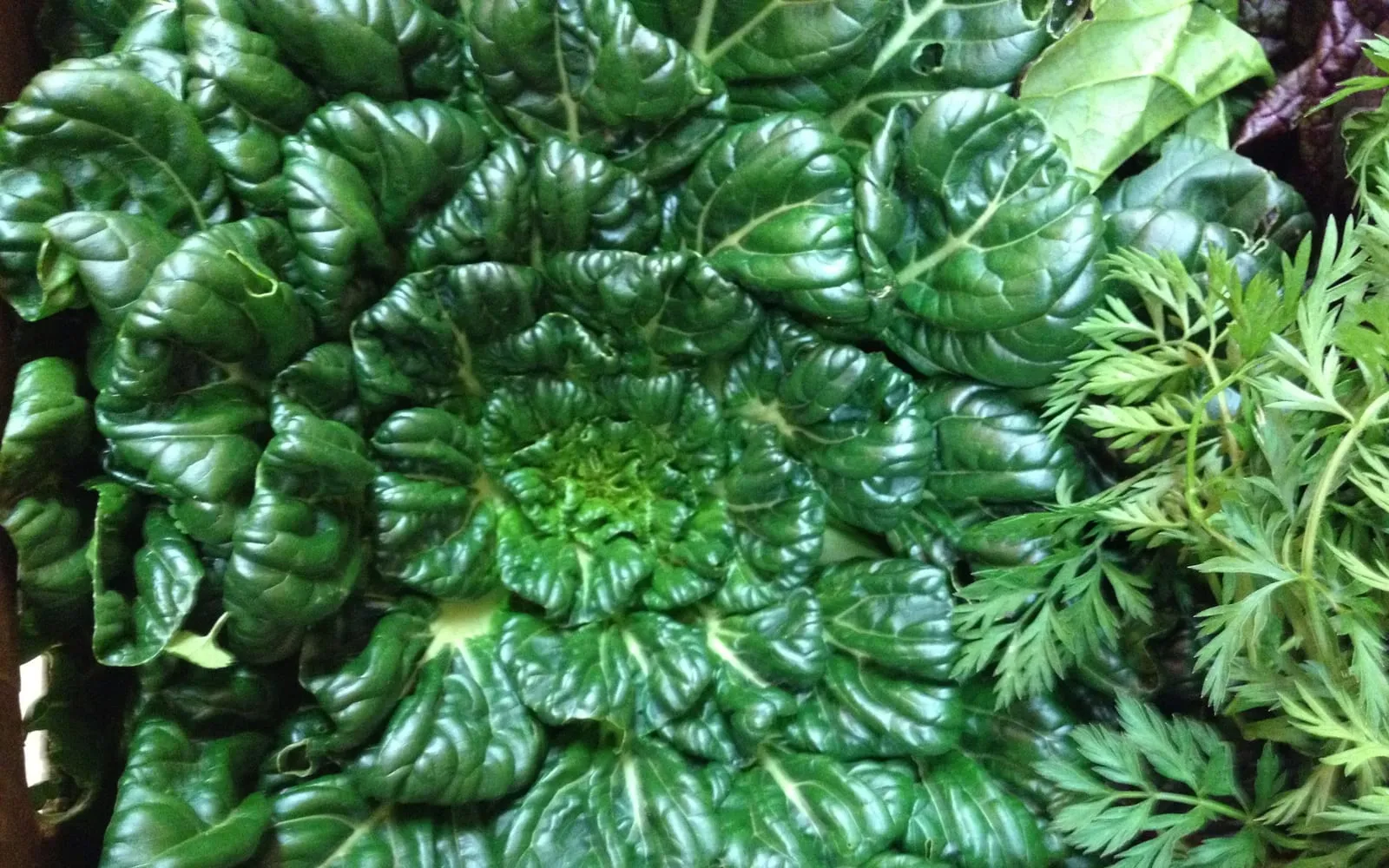
Tatsoi grows flat against the ground in a dark green rosette, and that habit is the whole reason to grow it. Pressed against the soil, the plant sits in the warmest and most sheltered air available on a frosty night, which is how a leaf this soft survives temperatures that flatten lettuce.
A row sown in early September gives pickings from late October through to March, and the leaves sweeten after each frost.
The same habit creates the one problem. Leaves lying on wet winter soil rot, and slugs live underneath them in comfort. Growing tatsoi well in a wet winter is mostly a matter of getting the rosette off the mud.
Appearance and character
A flat, almost circular rosette pressed to the ground, 15 to 25 cm across and seldom more than 15 cm tall.
Leaves are small, rounded and spoon-shaped, glossy and very dark green, held on short pale stalks that thicken and whiten at the base.
The texture is soft and succulent in the blade and crisp in the stalk, and both are eaten. Flavour is mild, sweet and faintly mustardy, sweeter after cold.
Colour deepens through winter. A plant that grew pale green in September turns almost black-green by December, which is a normal cold response.
A bolting plant loses the flat habit first, lifting the rosette into a loose upright cluster before pushing up a branched flower stem with small yellow flowers.
Where it is from
Tatsoi is Brassica rapa, the same species as turnip, pak choi, mizuna and Chinese cabbage, selected in China for a flat cold-hardy rosette.
Chinese growers have used it as a winter vegetable for centuries, and the flat form is sometimes described as having been selected so that snow would cover and insulate the plant.
The name reaches English through Cantonese and Japanese, and it is sold as tah tsai, tatsoi, rosette bok choy and spoon mustard depending on the catalogue.
It came into British seed lists with the other oriental greens from the 1970s onwards, and it has stayed a specialist crop here despite being the hardiest of the group.
How it grows
Sow direct. Tatsoi has a taproot and a checked plant bolts.
For full rosettes, sow at 1 cm deep in rows 30 cm apart and thin to 25 cm. The plants need that space to lie flat.
For baby leaves, broadcast thinly or sow in drills 15 cm apart and cut at 8 cm tall with scissors, 2 cm above the crown. Expect three cuts.
Germination takes four to seven days and works down to about 7 deg C soil temperature, which is what makes a September sowing viable.
Full rosettes take eight to ten weeks. Pick individual leaves from the outside rather than cutting the whole plant, and a single rosette crops for months.
Sow every three weeks from late July to mid-September. A March sowing under fleece gives an early crop that bolts in June.
Through the seasons
Spring takes a sowing under fleece in March, cut small. It bolts by June, so treat it as a short crop rather than a lasting one.
Summer is the wrong season. Heat and long days put the plant into flower before it makes a rosette.
Late summer is the sowing window, from late July to mid-September. The September sowing is the one that carries the winter, and it is the sowing most worth making.
Autumn and winter are the harvest. Growth slows from November and stops in the darkest weeks, then restarts in late January. Frost improves the flavour. Slip a sheet of slate, a tile or a mulch of dry straw under the rosette to keep the leaves off wet soil.
Care difficulty
Easy, provided the rosette stays dry underneath.
Wet soil under the leaves is the whole difficulty. On heavy ground the outer leaves rot from October onwards and slugs work along the row from underneath. A raised bed, a gritty surface mulch or a tile under each plant fixes it.
Slugs are the pest that follows from that habit. They shelter under the leaves in daylight, which makes them easy to find and easy to miss.
Bolting is a spring and summer problem, avoided by sowing in the right season.
Flea beetle hits spring and early summer sowings and largely misses the autumn ones.
Watering is undemanding once the weather cools, and the crop asks very little between November and February.
Watering
Water every few days through September and October while the plants are building their rosettes.
Cut back sharply from November. A winter plant in wet soil needs no help, and overwatering is a greater risk than drought at that end of the year.
Water at the base and in the morning, never over the rosette. Water sitting in the crown overnight in autumn is what starts grey mould.
Keep a gritty or strawy surface under the leaves so that what does fall drains away rather than sitting.
Container growing works well and solves the wet-soil problem outright. Use a wide shallow pot of 20 cm or more, and stand it where rain does not pool.
Warning signs, diseases and pests
Slugs and snails are the main pest, sheltering under the flat rosette by day and grazing at night. Lift a leaf edge to find them. Keep the ground around the plants clear, water in the morning, use a gritty mulch, and patrol on damp evenings.
Grey mould rots the outer leaves where they lie on wet soil, spreading inwards in a still, damp autumn. Raise the rosette off the ground, pick off affected leaves promptly, and space the plants at 25 cm so air moves between them.
Flea beetle shot-holes spring and early summer sowings. Fine mesh from the day of sowing, and an August or September sowing avoids most of it.
Cabbage white caterpillars are active into September. Net with 7 mm mesh.
Downy mildew shows as yellow patches with grey growth beneath in a wet autumn. Space, ventilate and remove affected leaves.
Bolting lifts the rosette upright before flowering, and is a sowing-date fault.
Growing environment
Full sun through autumn and winter. Every hour of low winter light counts, so give it the most open position available.
Fertile soil that holds moisture in autumn and drains in winter is the ideal, which in practice means a raised bed or ground with plenty of compost worked in.
Lime to pH 6.5 or 7.
A gritty surface mulch, a slate or a tile under each rosette keeps the leaves clear of wet soil and keeps the crop cleaner.
Cloches and low tunnels extend the season and keep the leaves clean, and they need ventilating on dry days to stop mould.
Shelter from wind, which tears the leaves and rocks the shallow root.
Feeding
Work garden compost into the bed before sowing.
Feed with a balanced liquid feed after each cut on a baby-leaf patch, and monthly through September and October on full rosettes.
Stop feeding in November. Winter growth is limited by light rather than nutrients, and soft late growth rots.
Avoid fresh manure and avoid heavy nitrogen, both of which give soft leaves that mould in a damp winter.
Troubleshooting
Outer leaves rotting brown where they touch the soil. Wet ground under the rosette. Slip a tile or a gritty mulch underneath and pick off the affected leaves.
Slugs living under the plant. The flat habit gives them shelter. Lift the leaf edges to find them, clear the surrounding ground, and patrol on damp evenings.
The rosette has lifted upright. The first stage of bolting, usually from a spring or summer sowing. Sow from late July.
Small round holes across the leaves. Flea beetle. Fine mesh from sowing, or sow later in the summer.
Growth stopped in December. Normal. Low light rather than cold. It restarts in late January.
Pale, soft, floppy leaves. Too much nitrogen or too little light. Stop feeding and move the next sowing to a more open position.
How hardy is it really? To about -10 deg C unprotected, which is hardier than pak choi, mizuna or any lettuce. Under a cloche it takes a hard winter without losing the crop.
Tatsoi problem guides
Not sure what is wrong? See the common vegetable pests guide.